
 You are here
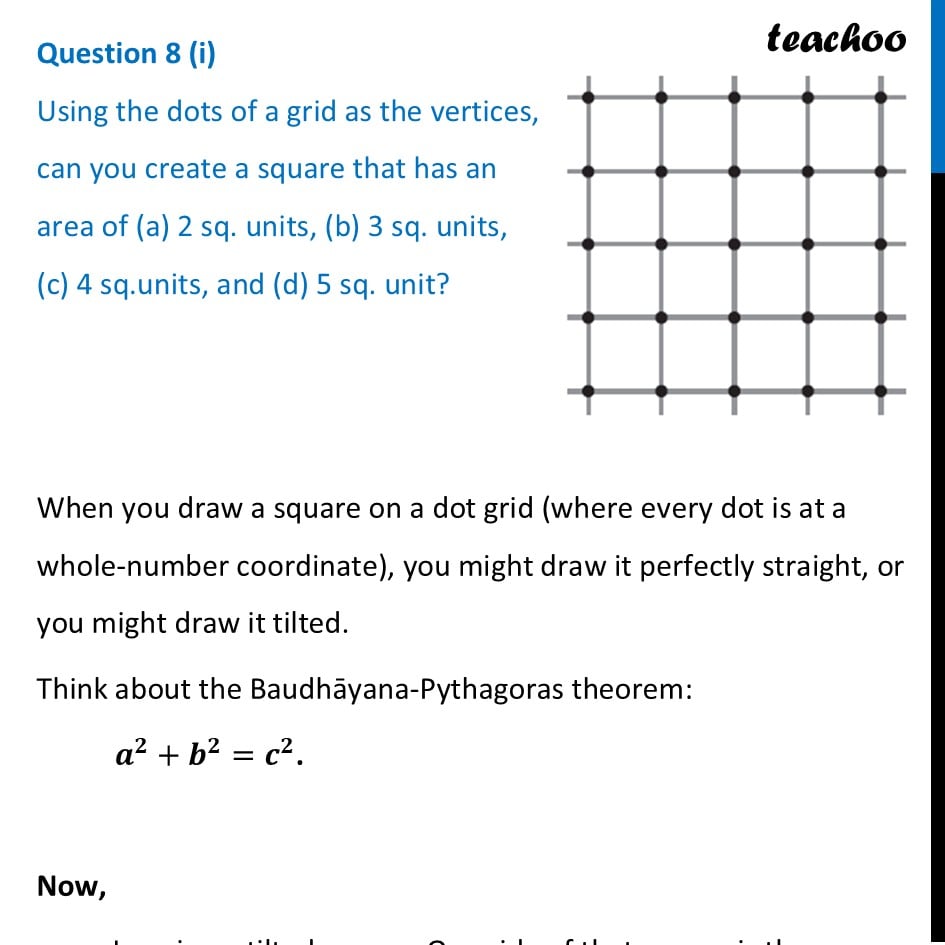
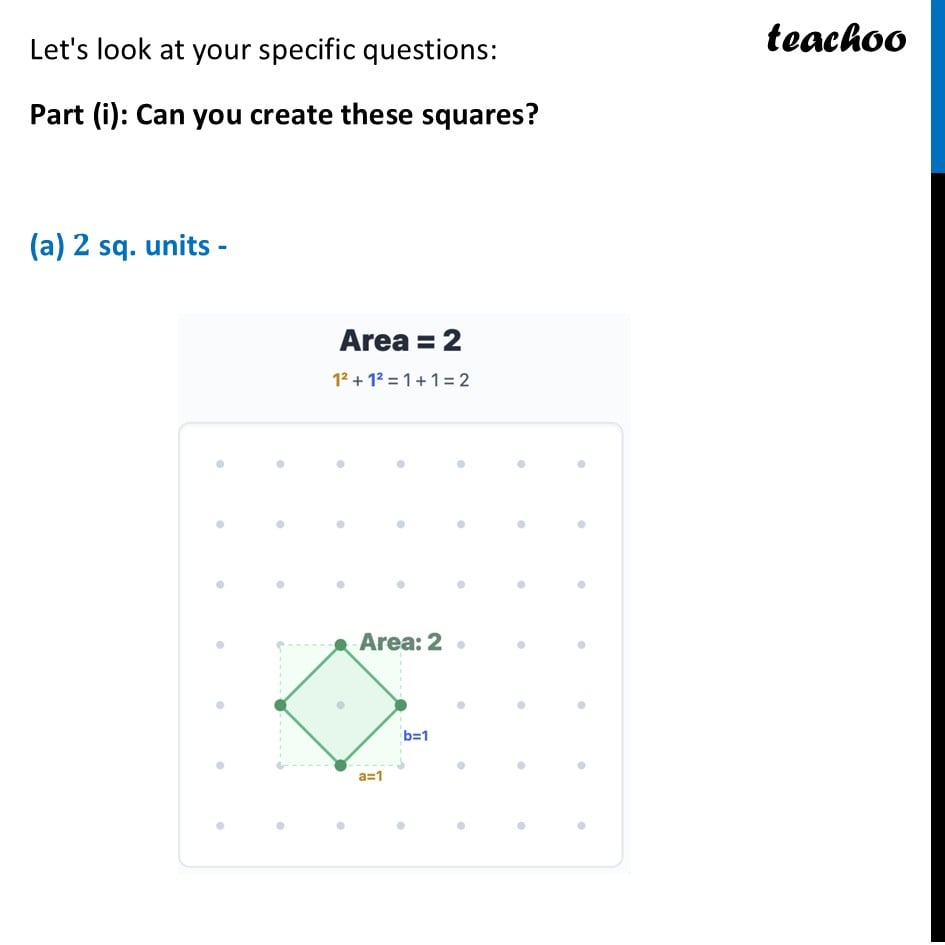
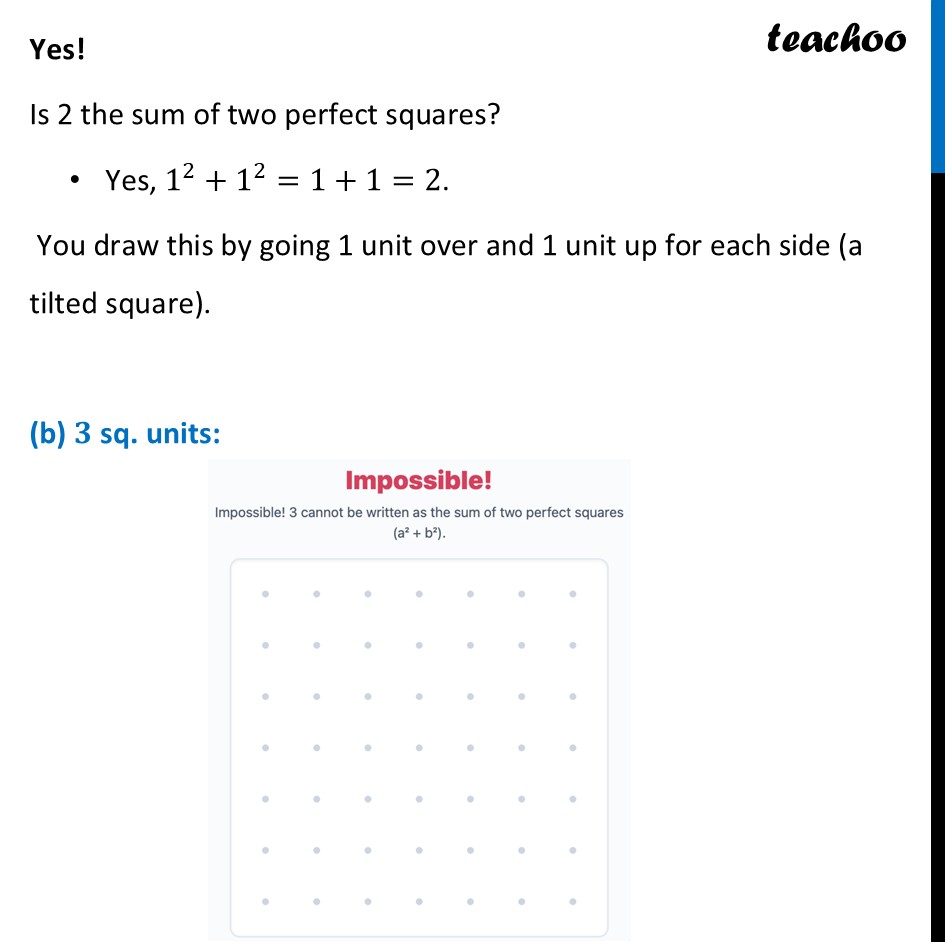
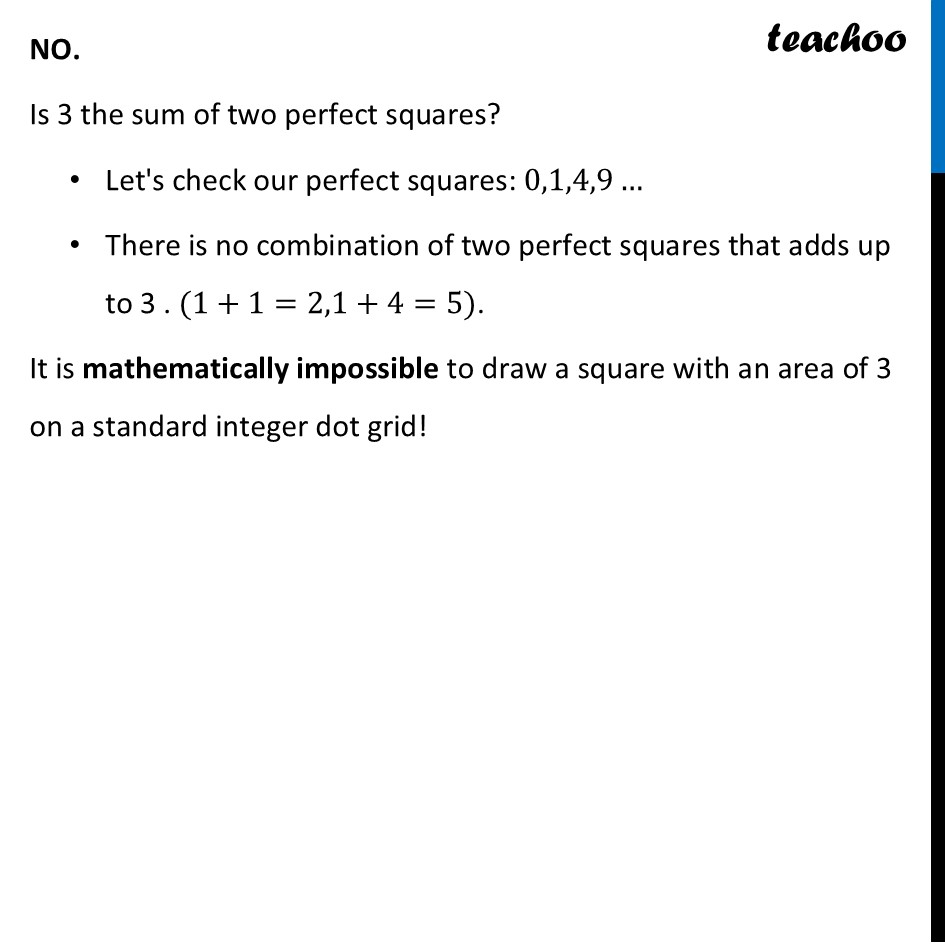
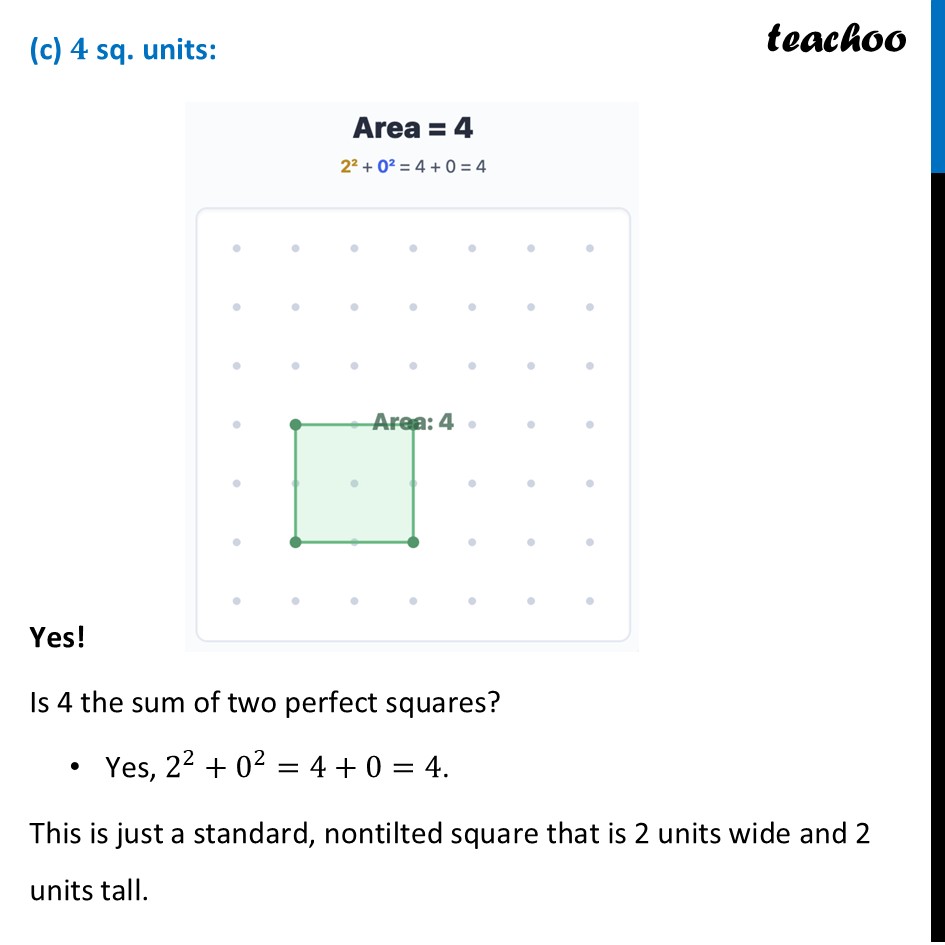
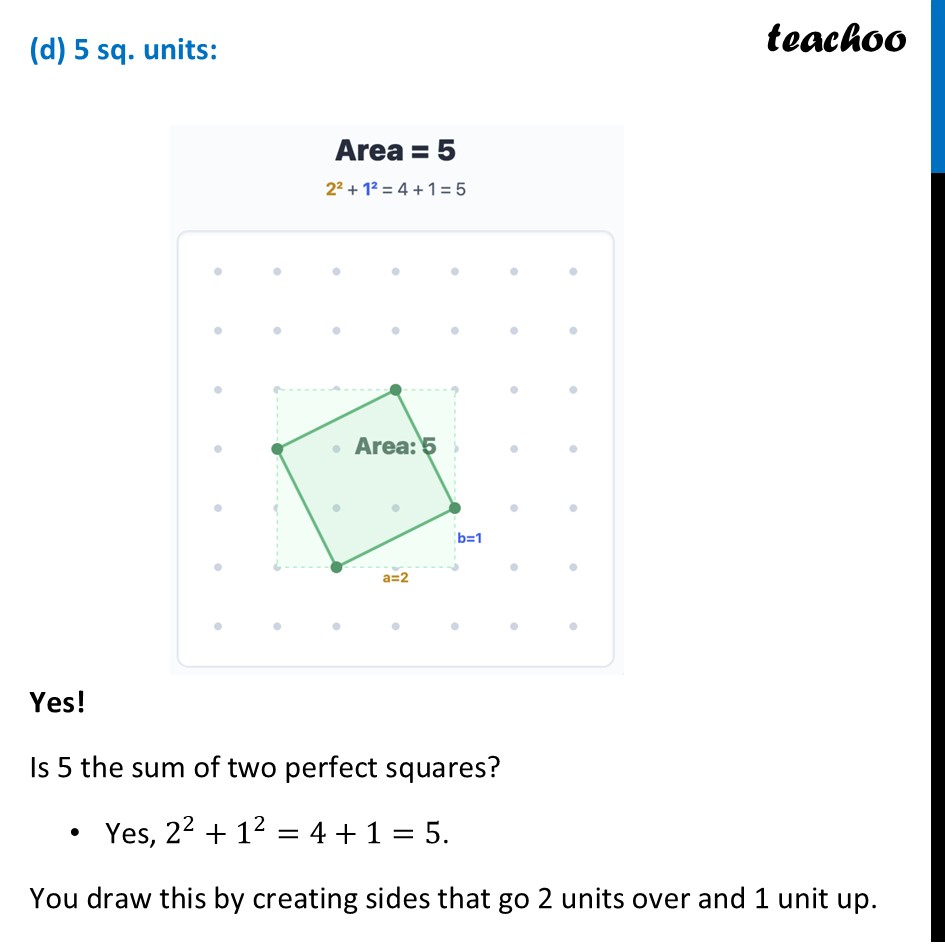
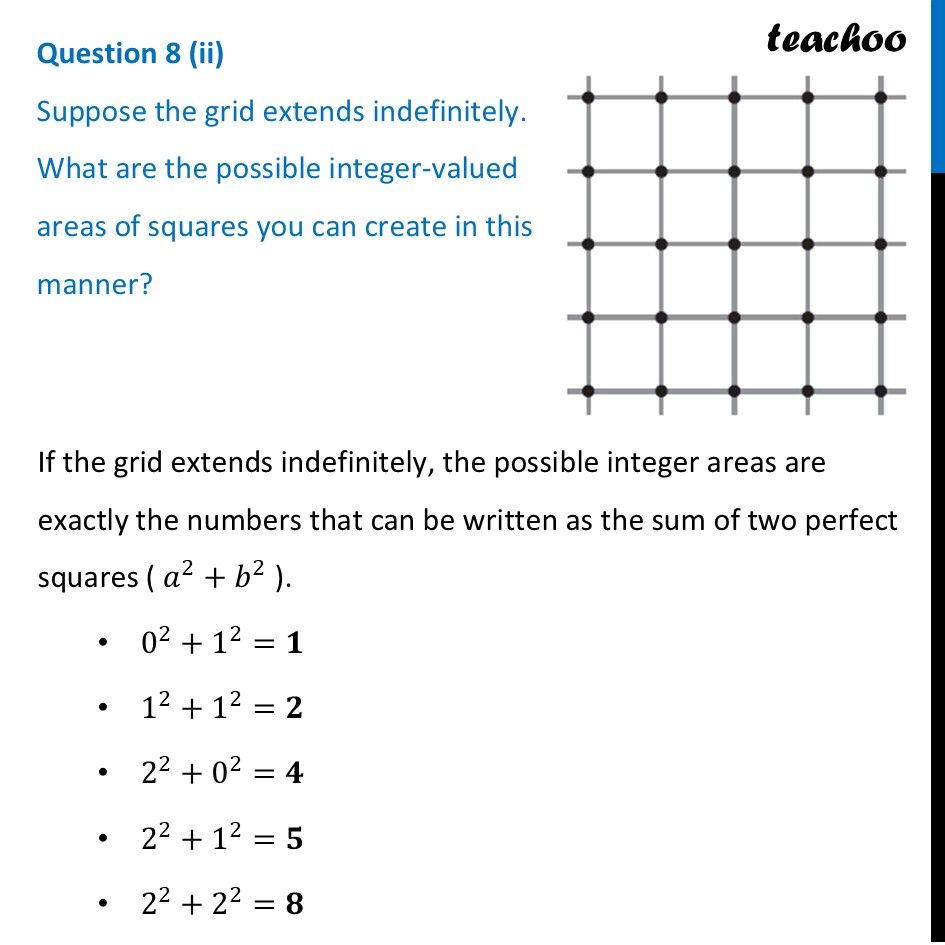
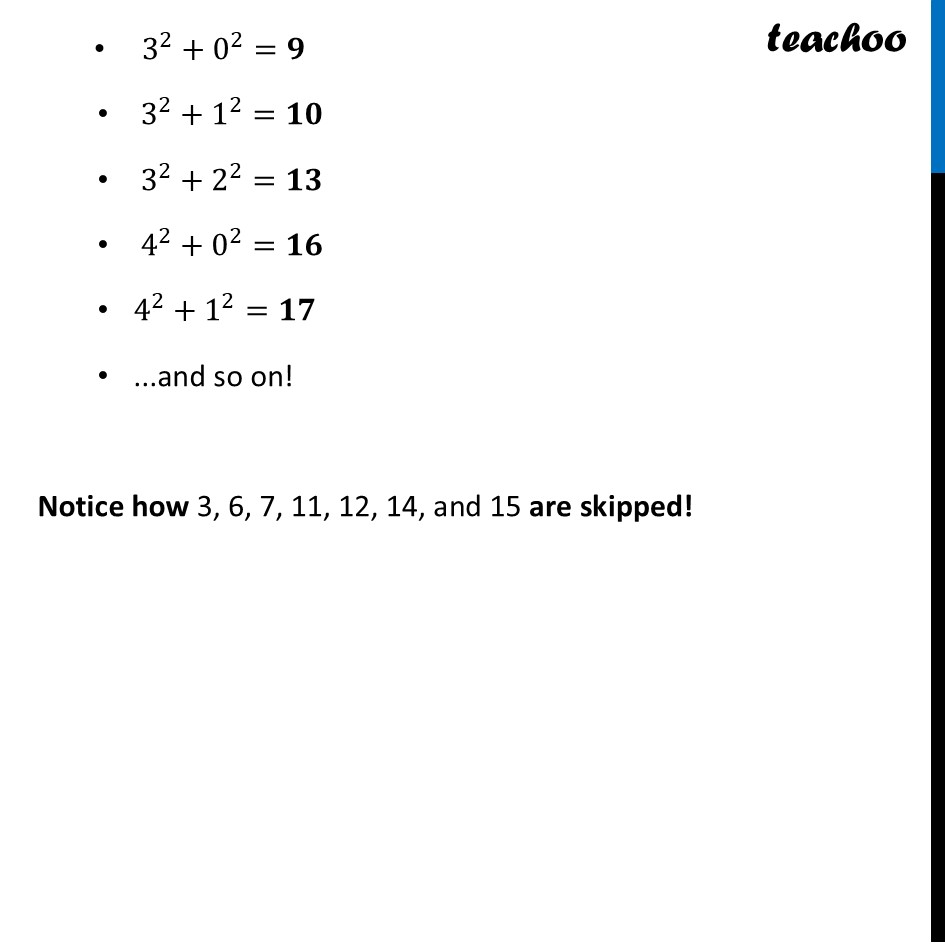
Figure it out - Page 52, 53, 54
Last updated at February 23, 2026 by Teachoo
Transcript
Question 8 (i) Using the dots of a grid as the vertices, can you create a square that has an area of (a) 2 sq. units, (b) 3 sq. units, (c) 4 sq.units, and (d) 5 sq. unit?When you draw a square on a dot grid (where every dot is at a whole-number coordinate), you might draw it perfectly straight, or you might draw it tilted. Think about the Baudhāyana-Pythagoras theorem: 𝒂^𝟐+𝒃^𝟐=𝒄^𝟐. Now, Imagine a tilted square. One side of that square is the hypotenuse (c) of an invisible right triangle formed by the grid lines. The legs of this invisible triangle are the horizontal distance (a) and the vertical distance (b) between the dots. We know the Area of a square is just its side length squared (𝑐^2 ). Therefore, because 𝑐^2=𝑎^2+𝑏^2, the Area of any square on a grid MUST equal 𝒂^𝟐+𝒃^𝟐. Because the dots are on a grid, 𝒂 and 𝒃 must be whole numbers ( 0,1,2,3... ). This means the area of a square on a dot grid must always be the sum of two perfect squares! Let's look at your specific questions: Part (i): Can you create these squares? (a) 𝟐 sq. units - Yes! Is 2 the sum of two perfect squares? Yes, 1^2+1^2=1+1=2. You draw this by going 1 unit over and 1 unit up for each side (a tilted square). (b) 𝟑 sq. units: NO. Is 3 the sum of two perfect squares? Let's check our perfect squares: 0,1,4,9… There is no combination of two perfect squares that adds up to 3 . (1+1=2,1+4=5). It is mathematically impossible to draw a square with an area of 3 on a standard integer dot grid! (c) 𝟒 sq. units: Yes! Is 4 the sum of two perfect squares? Yes, 2^2+0^2=4+0=4. This is just a standard, nontilted square that is 2 units wide and 2 units tall. (d) 5 sq. units: Yes! Is 5 the sum of two perfect squares? Yes, 2^2+1^2=4+1=5. You draw this by creating sides that go 2 units over and 1 unit up. Question 8 (ii) Suppose the grid extends indefinitely. What are the possible integer-valued areas of squares you can create in this manner?If the grid extends indefinitely, the possible integer areas are exactly the numbers that can be written as the sum of two perfect squares ( 𝑎^2+𝑏^2 ). 0^2+1^2=𝟏 1^2+1^2=𝟐 2^2+0^2=𝟒 2^2+1^2=𝟓 2^2+2^2=𝟖 3^2+0^2=𝟗 3^2+1^2=𝟏𝟎 3^2+2^2=𝟏𝟑 4^2+0^2=𝟏𝟔 4^2+1^2=𝟏𝟕 ...and so on! Notice how 3, 6, 7, 11, 12, 14, and 15 are skipped!
