
 You are here
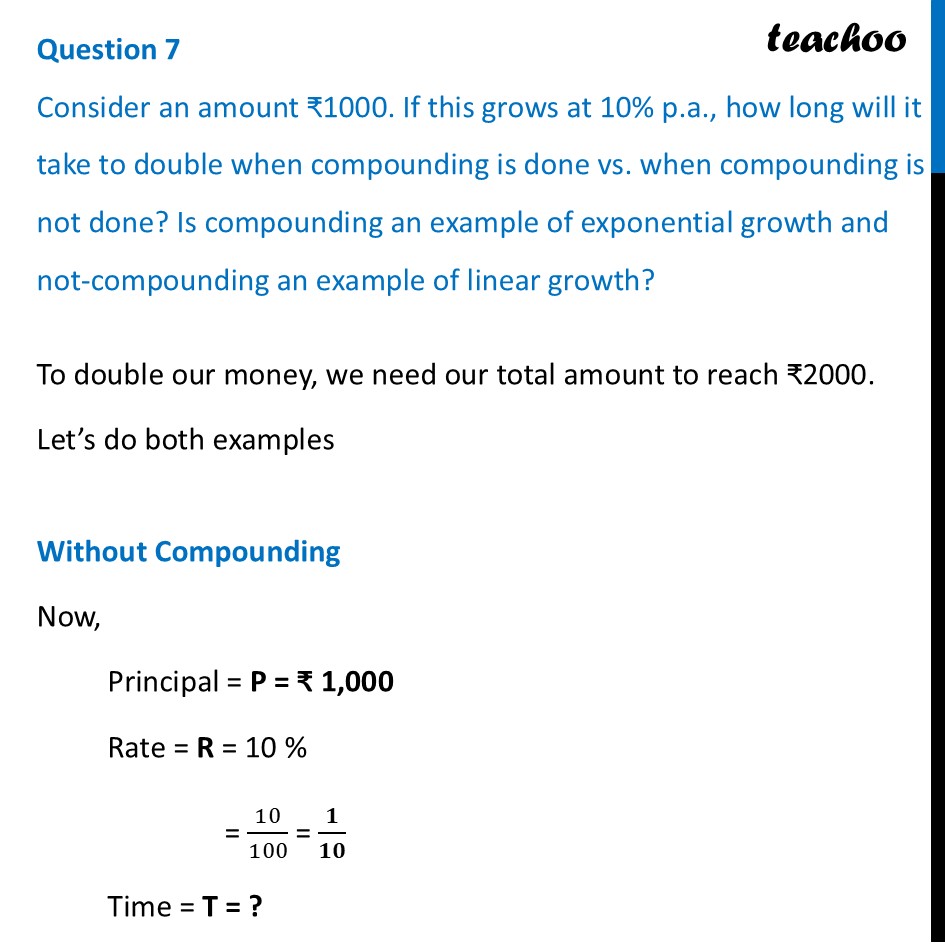
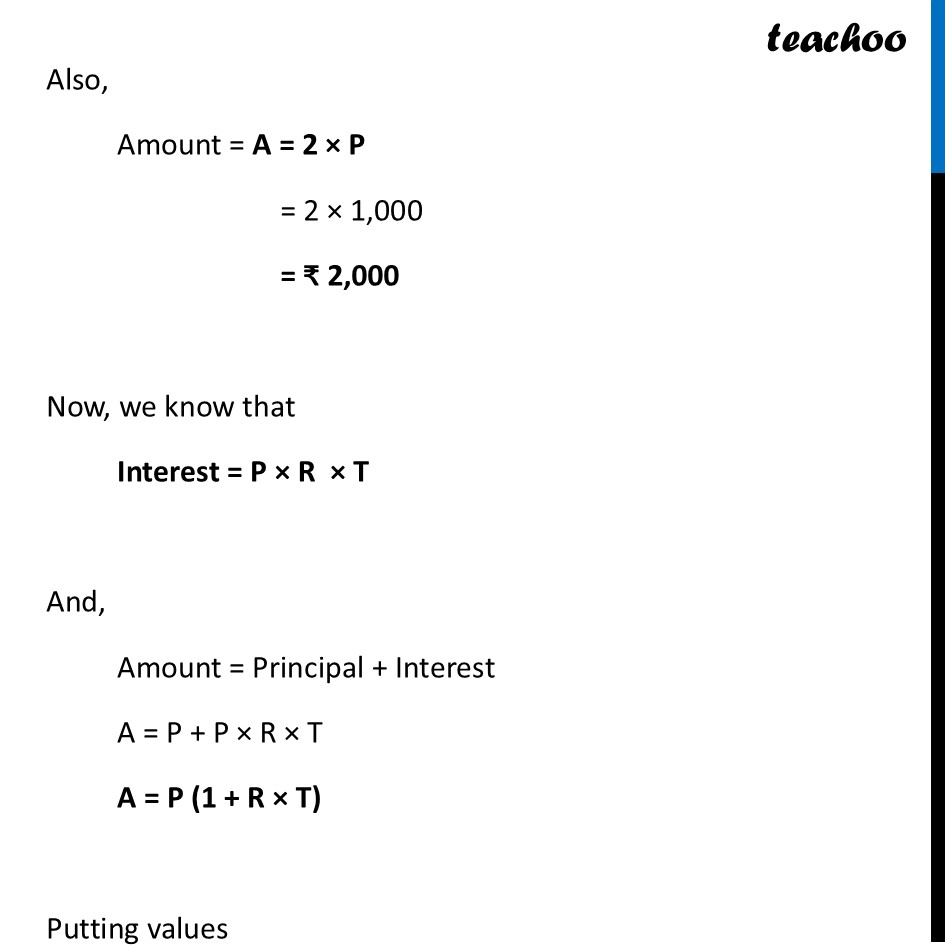
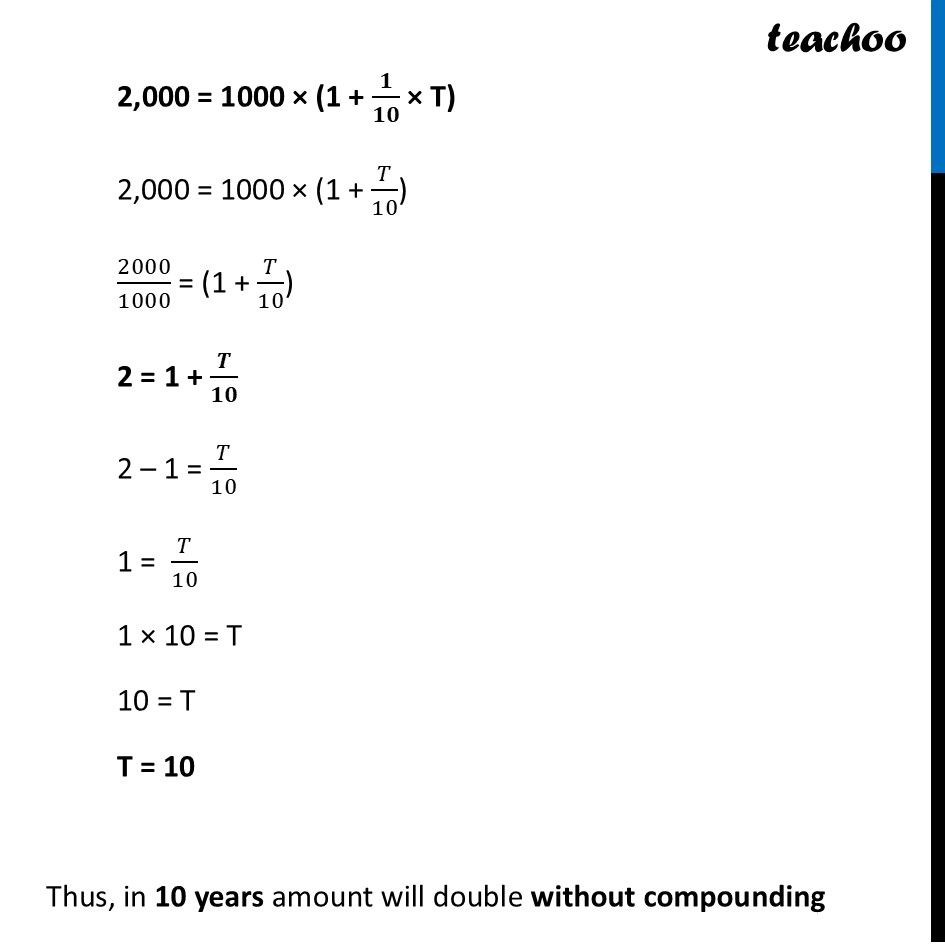
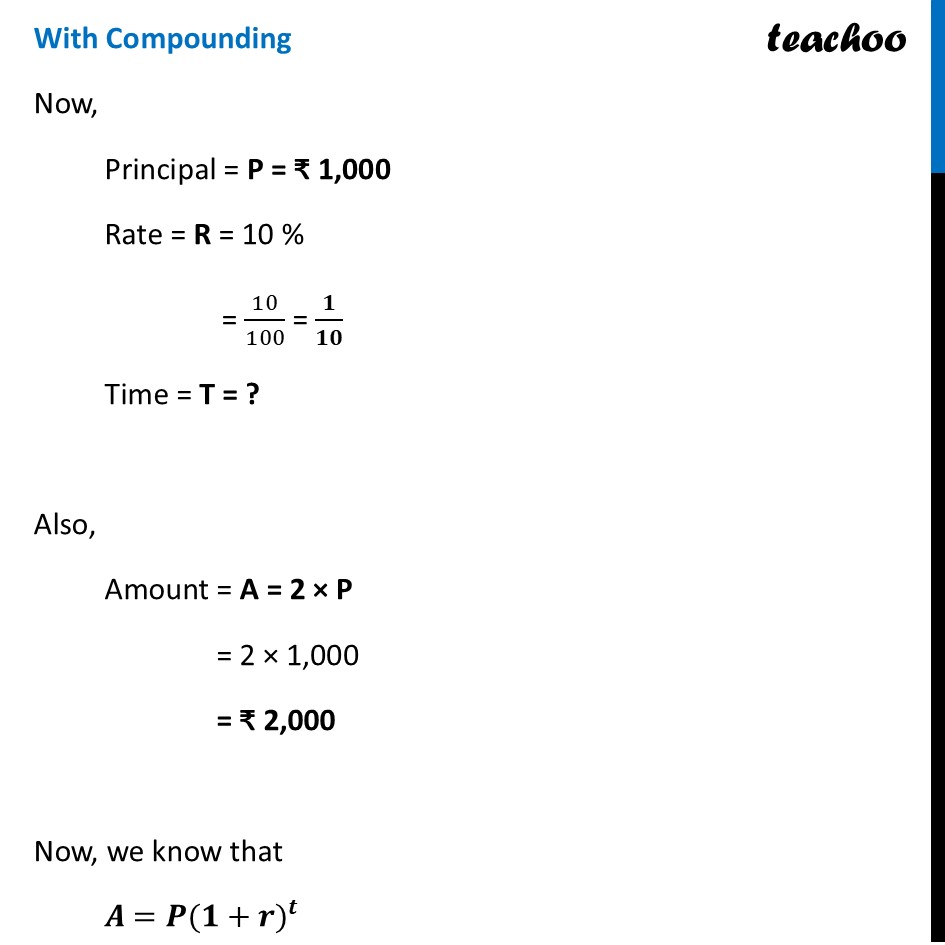
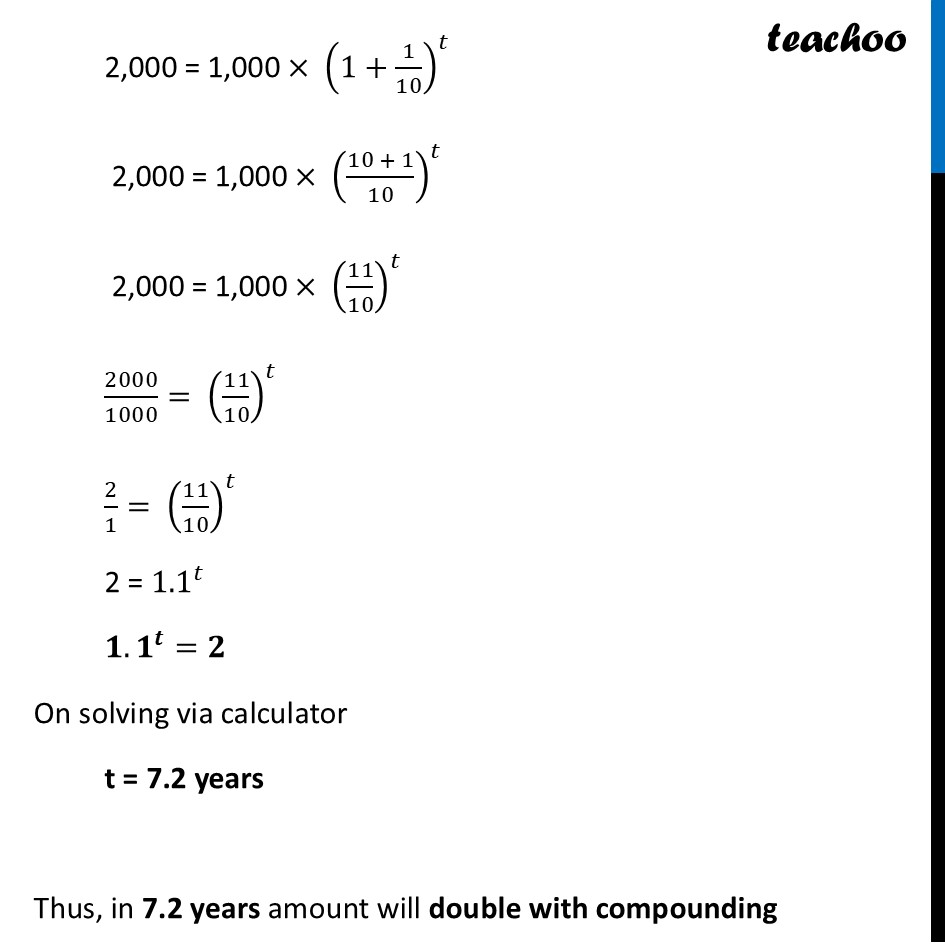
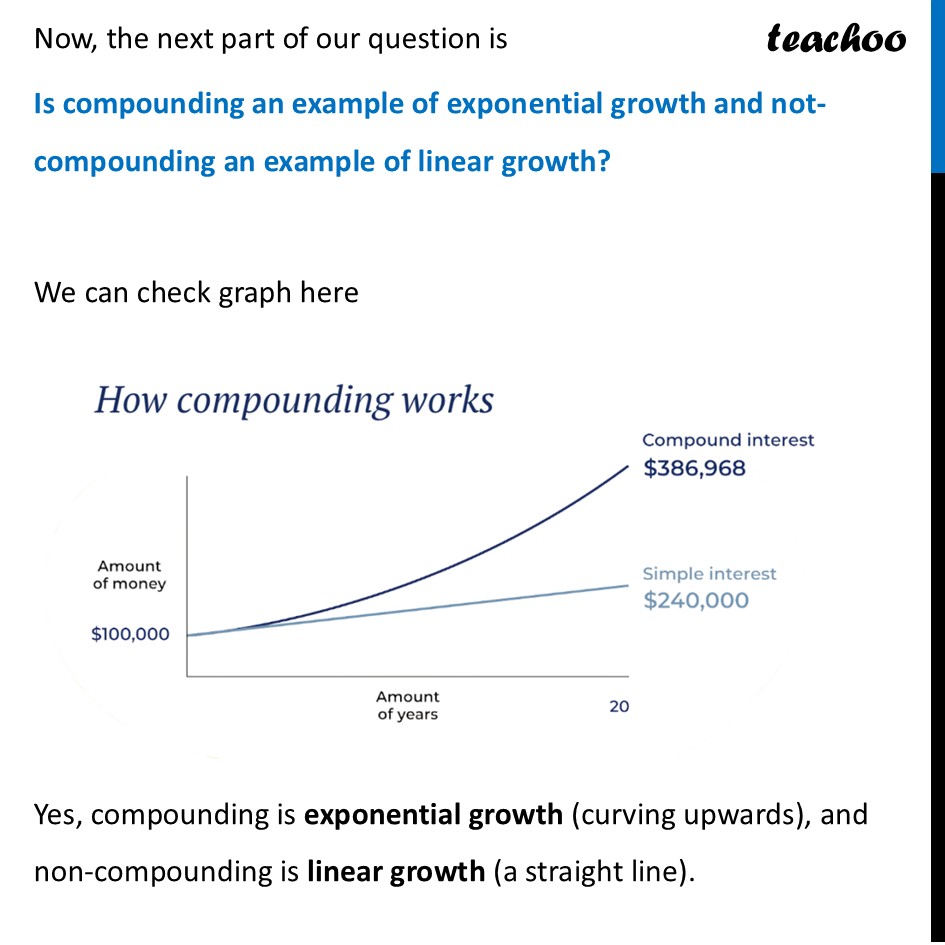
Figure it out - Page 22, 23, 24
Last updated at February 17, 2026 by Teachoo
Transcript
Question 7 Consider an amount ₹1000. If this grows at 10% p.a., how long will it take to double when compounding is done vs. when compounding is not done? Is compounding an example of exponential growth and not-compounding an example of linear growth?To double our money, we need our total amount to reach ₹2000. Let’s do both examples Without Compounding Now, Principal = P = ₹ 1,000 Rate = R = 10 % = 10/100 = 𝟏/𝟏𝟎 Time = T = ? Also, Amount = A = 2 × P = 2 × 1,000 = ₹ 2,000 Now, we know that Interest = P × R × T And, Amount = Principal + Interest A = P + P × R × T A = P (1 + R × T) Putting values 2,000 = 1000 × (1 + 𝟏/𝟏𝟎 × T) 2,000 = 1000 × (1 + 𝑇/10) 2000/1000 = (1 + 𝑇/10) 2 = 1 + 𝑻/𝟏𝟎 2 – 1 = 𝑇/10 1 = 𝑇/10 1 × 10 = T 10 = T T = 10 Thus, in 10 years amount will double without compounding With Compounding Now, Principal = P = ₹ 1,000 Rate = R = 10 % = 10/100 = 𝟏/𝟏𝟎 Time = T = ? Also, Amount = A = 2 × P = 2 × 1,000 = ₹ 2,000 Now, we know that 𝑨 =𝑷(𝟏+𝒓)^𝒕 2,000 = 1,000 × (1+1/10)^𝑡 2,000 = 1,000 × ((10 + 1)/10)^𝑡 2,000 = 1,000 × (11/10)^𝑡 2000/1000= (11/10)^𝑡 2/1= (11/10)^𝑡 2 = 〖1.1〗^𝑡 〖𝟏.𝟏〗^𝒕=𝟐 On solving via calculator t = 7.2 years Thus, in 7.2 years amount will double with compounding Now, the next part of our question is Is compounding an example of exponential growth and not-compounding an example of linear growth? We can check graph here Yes, compounding is exponential growth (curving upwards), and non-compounding is linear growth (a straight line).
