You are here
Last updated at October 12, 2026 by Teachoo
Transcript
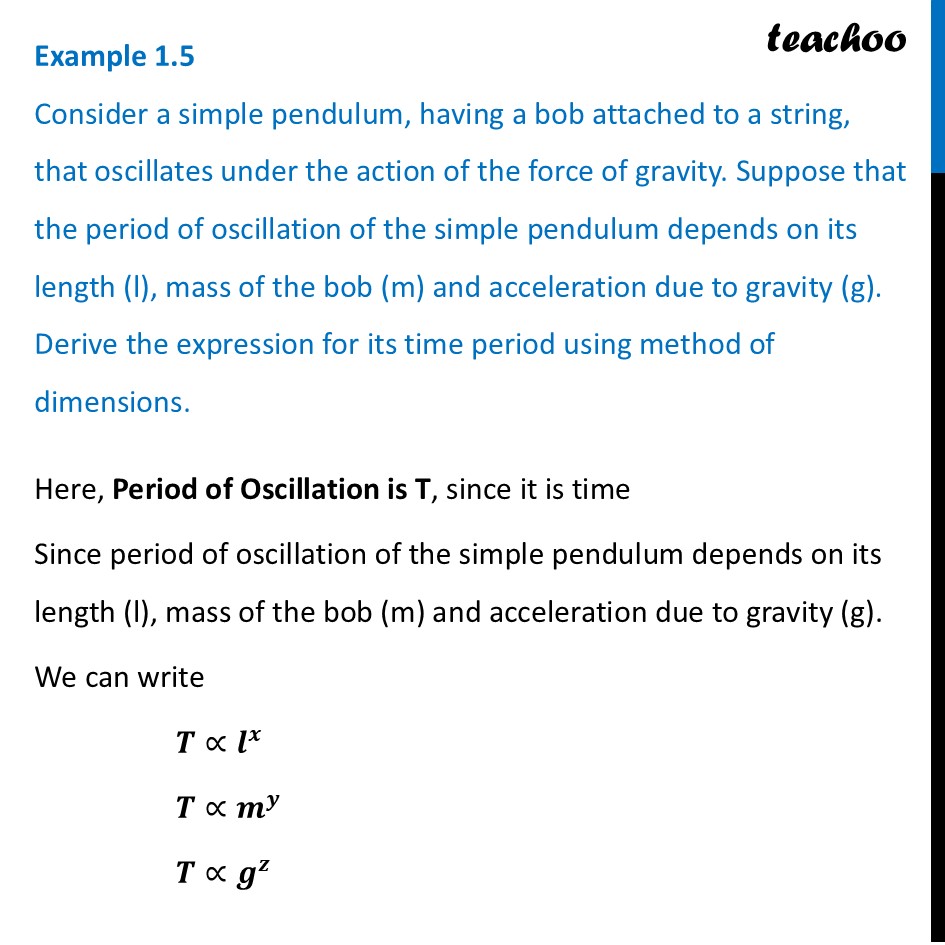
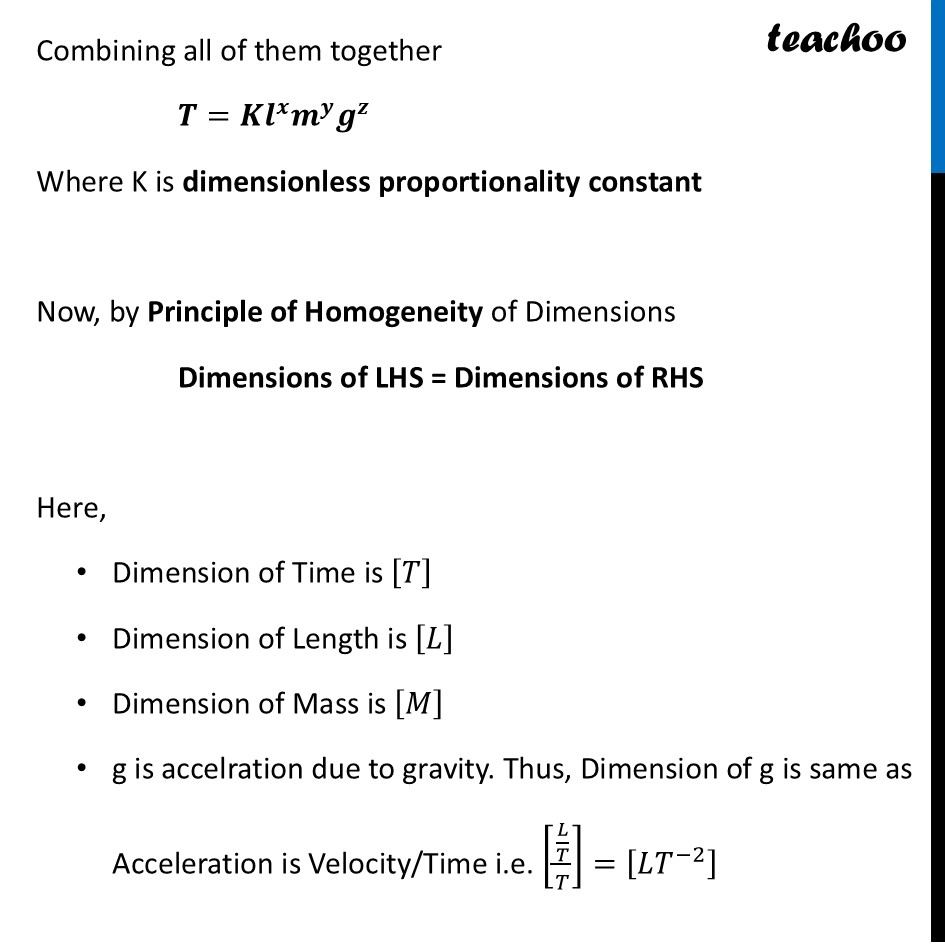
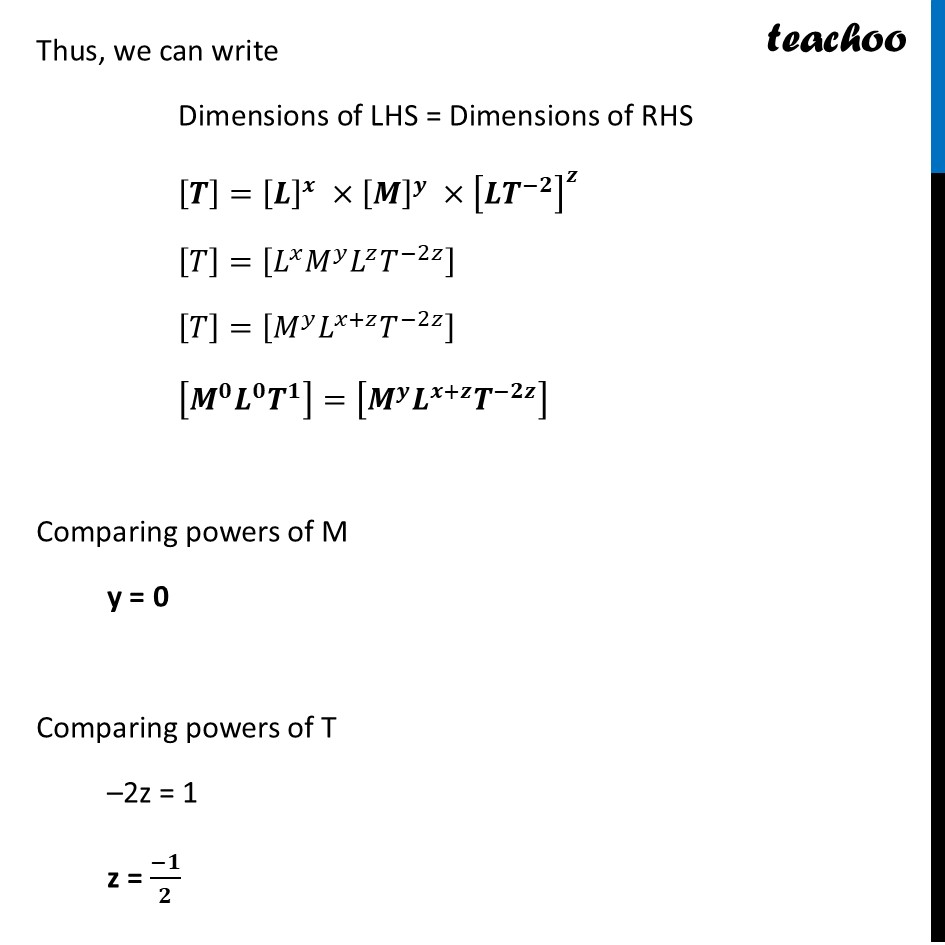
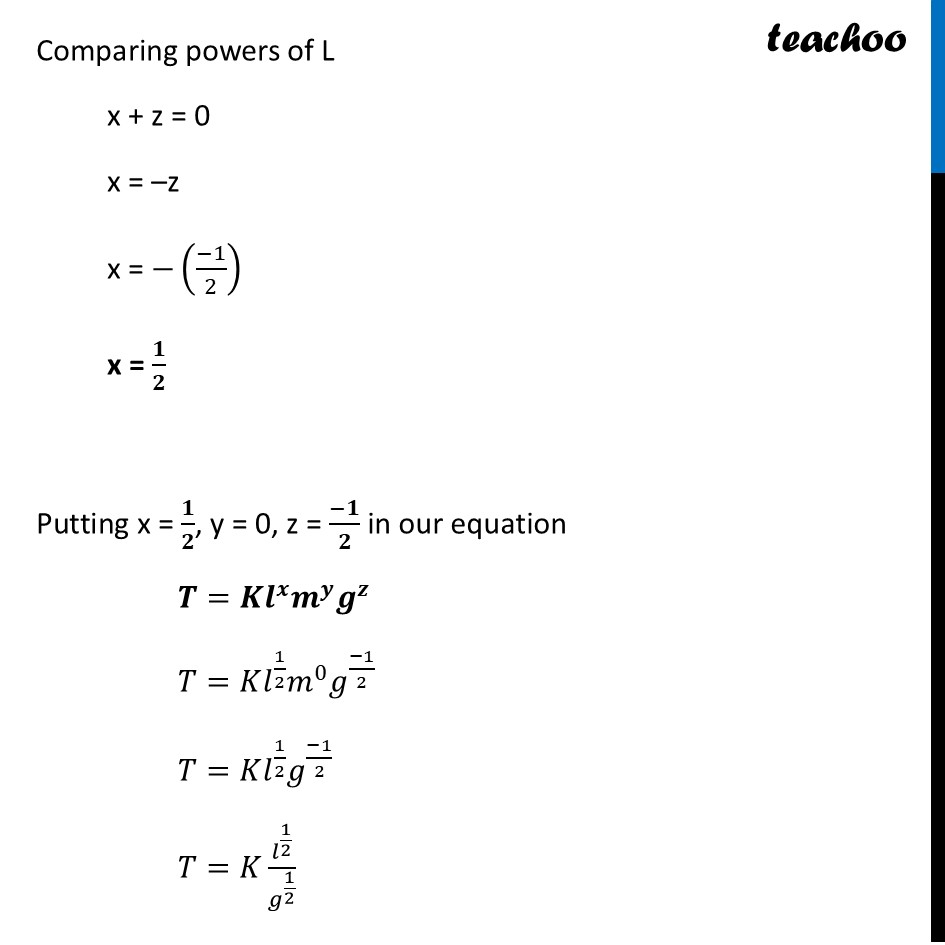
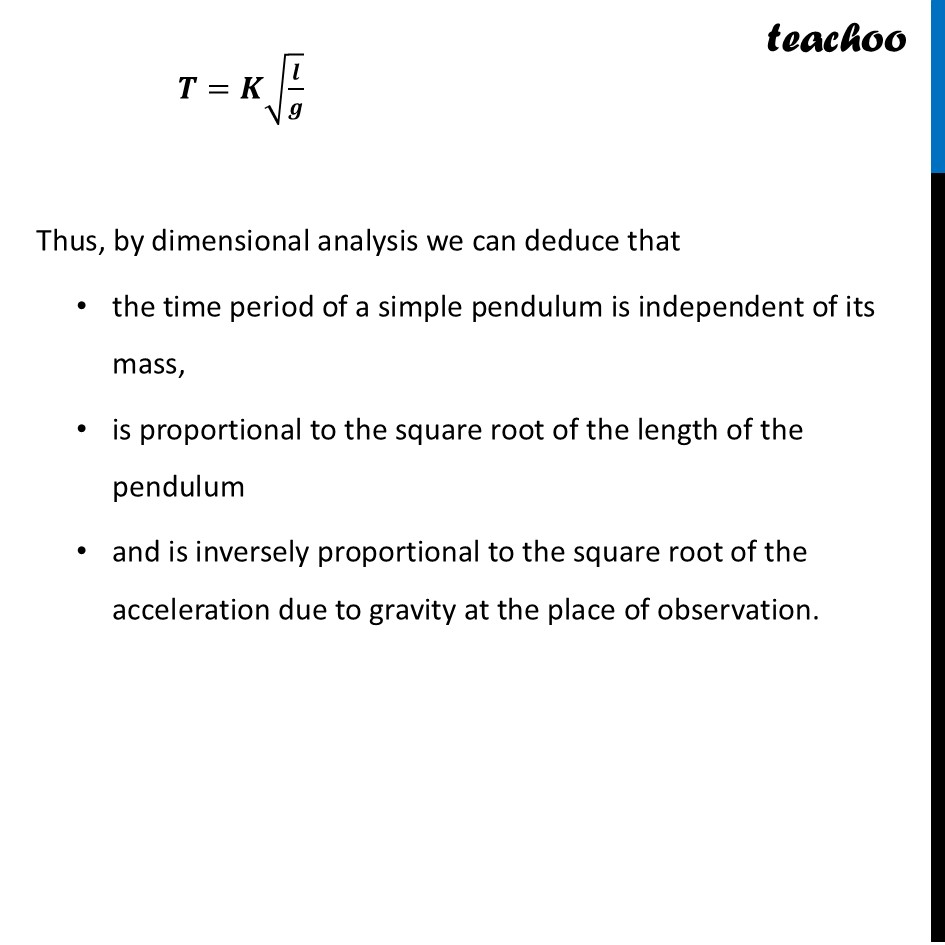
Example 1.5 Consider a simple pendulum, having a bob attached to a string, that oscillates under the action of the force of gravity. Suppose that the period of oscillation of the simple pendulum depends on its length (l), mass of the bob (m) and acceleration due to gravity (g). Derive the expression for its time period using method of dimensions. Here, Period of Oscillation is T, since it is time Since period of oscillation of the simple pendulum depends on its length (l), mass of the bob (m) and acceleration due to gravity (g). We can write 𝑻∝𝒍^(𝒙) 𝑻∝𝒎^(𝒚) 𝑻∝𝒈^(𝒛) Combining all of them together 𝑻=𝑲𝒍^(𝒙)𝒎^(𝒚)𝒈^(𝒛) Where K is dimensionless proportionality constant Now, by Principle of Homogeneity of Dimensions Dimensions of LHS = Dimensions of RHS Here, Dimension of Time is [𝑇] Dimension of Length is [𝐿] Dimension of Mass is [𝑀] g is accelration due to gravity. Thus, Dimension of g is same as Acceleration is Velocity/Time i.e. [((𝐿)/(𝑇))/(𝑇)]=[𝐿𝑇^(−2)] Thus, we can write Dimensions of LHS = Dimensions of RHS [𝑻]=[𝑳]^(𝒙) ×[𝑴]^(𝒚) ×[𝑳𝑻^(−𝟐)]^(𝒛) [𝑇]=[𝐿^(𝑥)𝑀^(𝑦)𝐿^(𝑧)𝑇^(−2𝑧)] [𝑇]=[𝑀^(𝑦)𝐿^(𝑥+𝑧)𝑇^(−2𝑧)] [𝑴^(𝟎)𝑳^(𝟎)𝑻^(𝟏)]=[𝑴^(𝒚)𝑳^(𝒙+𝒛)𝑻^(−𝟐𝒛)] Comparing powers of M y = 0 Comparing powers of T –2z = 1 z = (−𝟏)/(𝟐) Comparing powers of L x + z = 0 x = –z x = -(−𝟏)/(𝟐) Putting x = 1, y = 1 in our equation 𝐹=𝐾𝑚^(𝑥)𝑎^(𝑦) 𝐹=𝐾𝑚^(1)𝑎^(1) 𝑭=𝑲𝒎𝒂 Thus, we can find relation using Dimensional Analysis But: We cannot find Dimensionless constant K Comparing powers of L x + z = 0 x = –z x = −((−1)/(2)) x = (𝟏)/(𝟐) Putting x = (𝟏)/(𝟐), y = 0, z = (−𝟏)/(𝟐) in our equation 𝑻=𝑲𝒍^(𝒙)𝒎^(𝒚)𝒈^(𝒛) 𝑇=𝐾𝑙^((1)/(2))𝑚^(0)𝑔^((−1)/(2) ) 𝑇=𝐾𝑙^((1)/(2))𝑔^((−1)/(2) ) 𝑇=𝐾(𝑙^((1)/(2)))/(𝑔^((1)/(2))) 𝑇=𝐾(𝑙^((1)/(2)))/(𝑔^((1)/(2))) 𝐹=𝐾𝑚^(𝑥)𝑎^(𝑦) 𝐹=𝐾𝑚^(1)𝑎^(1) 𝑭=𝑲𝒎𝒂 Thus, we can find relation using Dimensional Analysis But: We cannot find Dimensionless constant K 𝑻=𝑲sqrt((𝒍)/(𝒈)) Thus, by dimensional analysis we can deduce that the time period of a simple pendulum is independent of its mass, is proportional to the square root of the length of the pendulum and is inversely proportional to the square root of the acceleration due to gravity at the place of observation.