You are here

Last updated at October 12, 2026 by Teachoo
Transcript
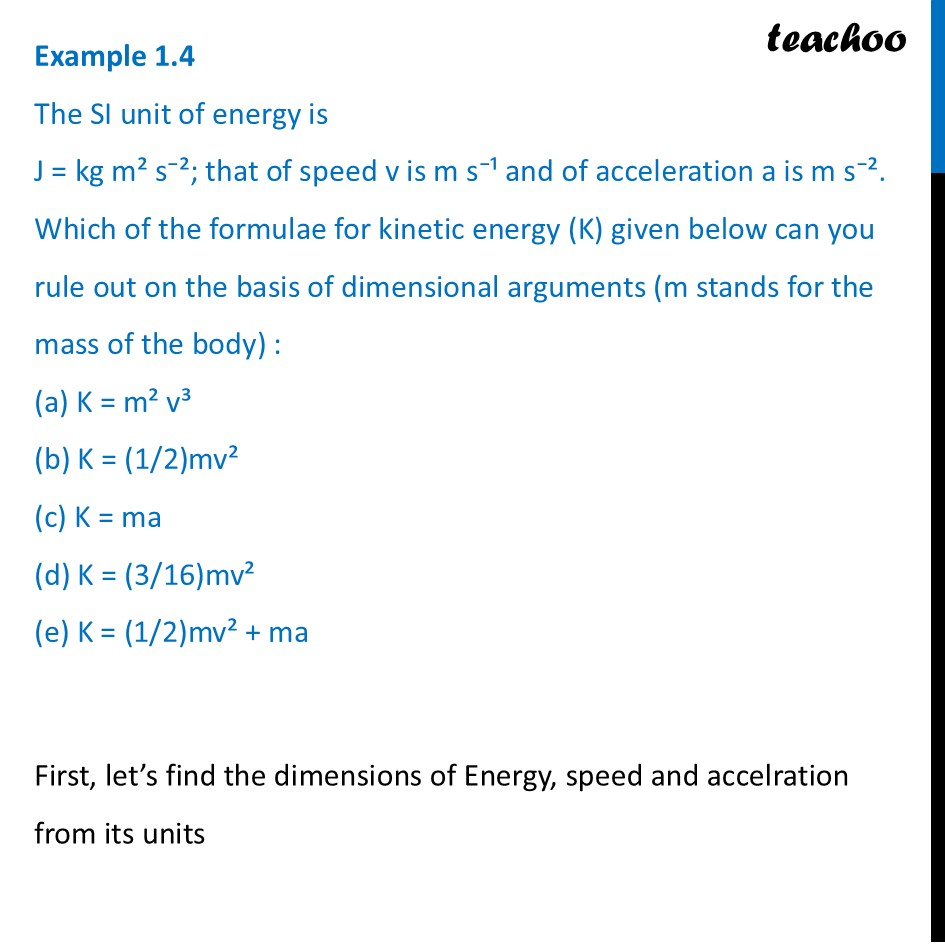
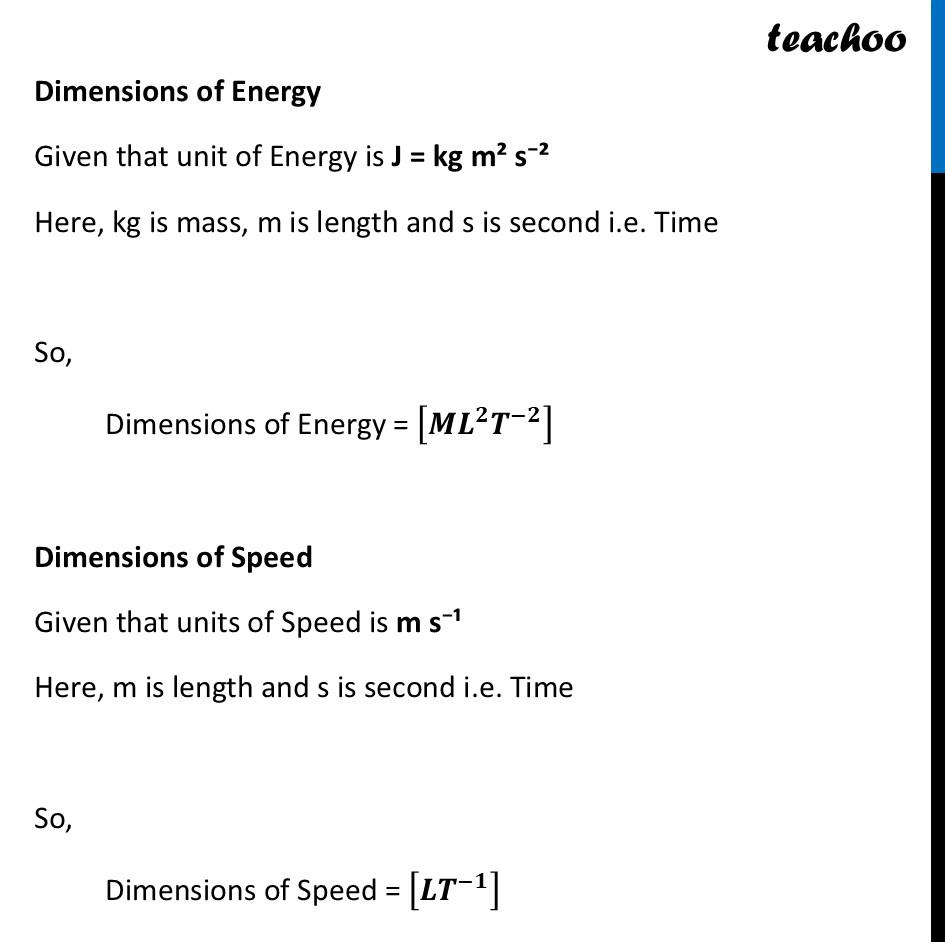
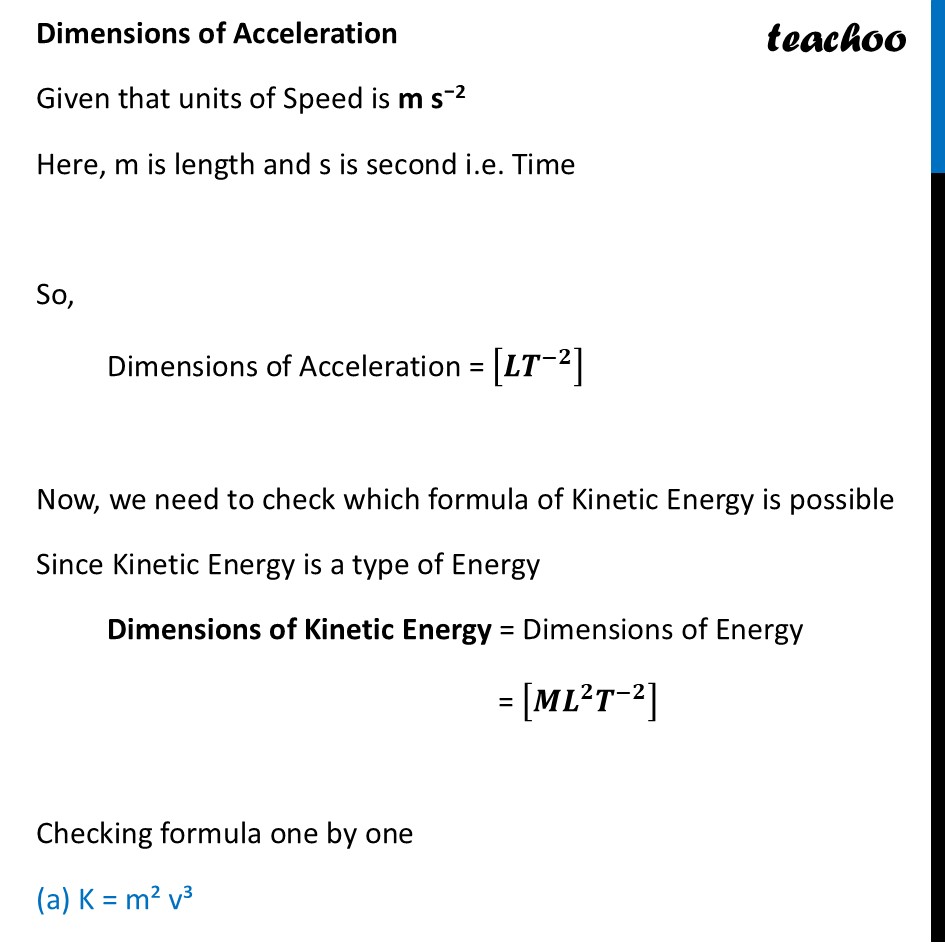
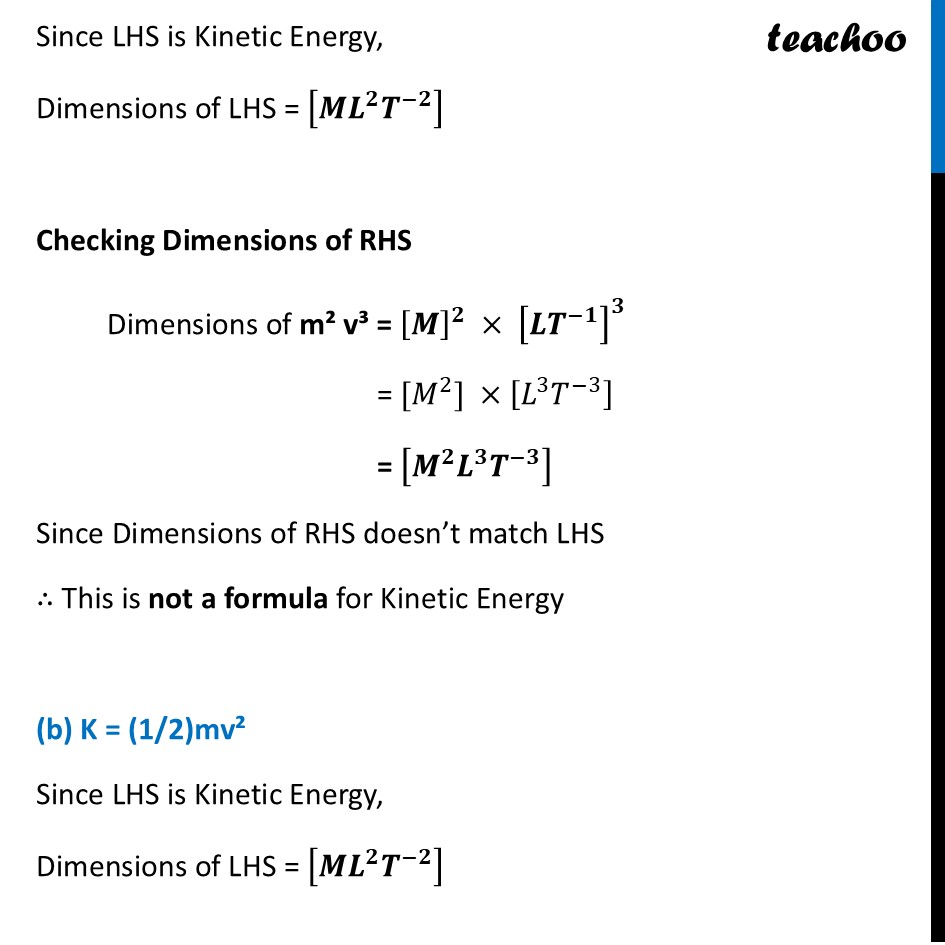
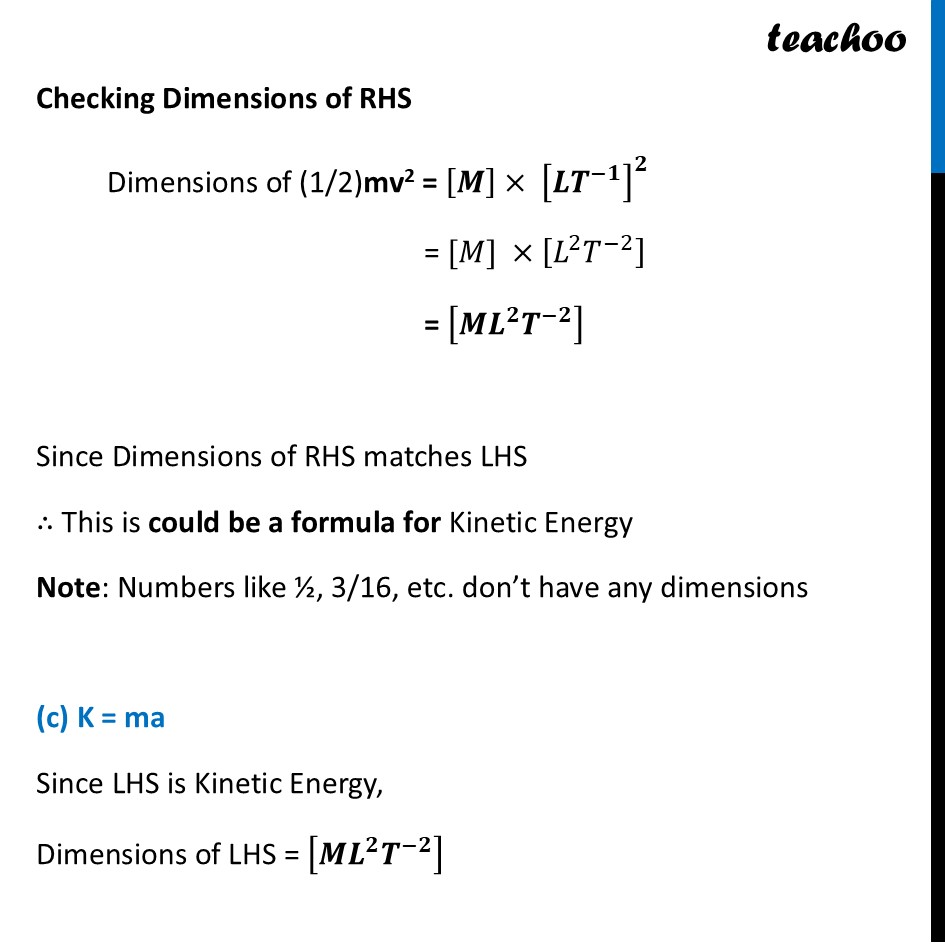
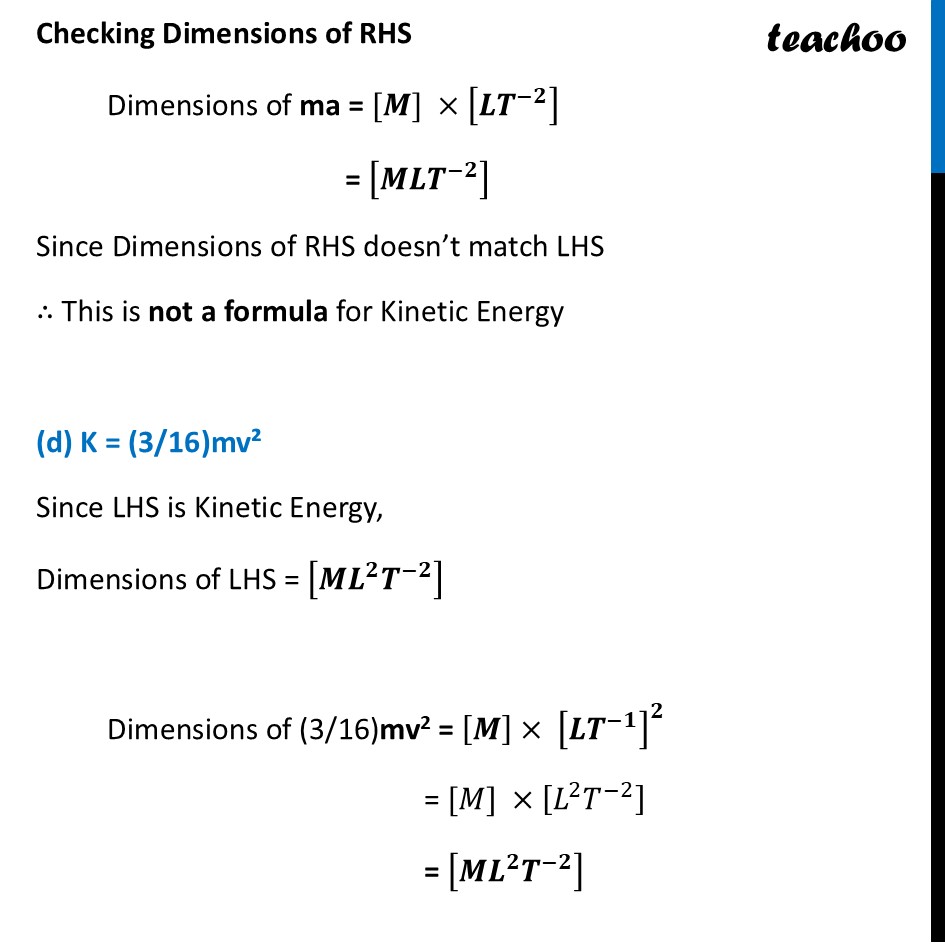
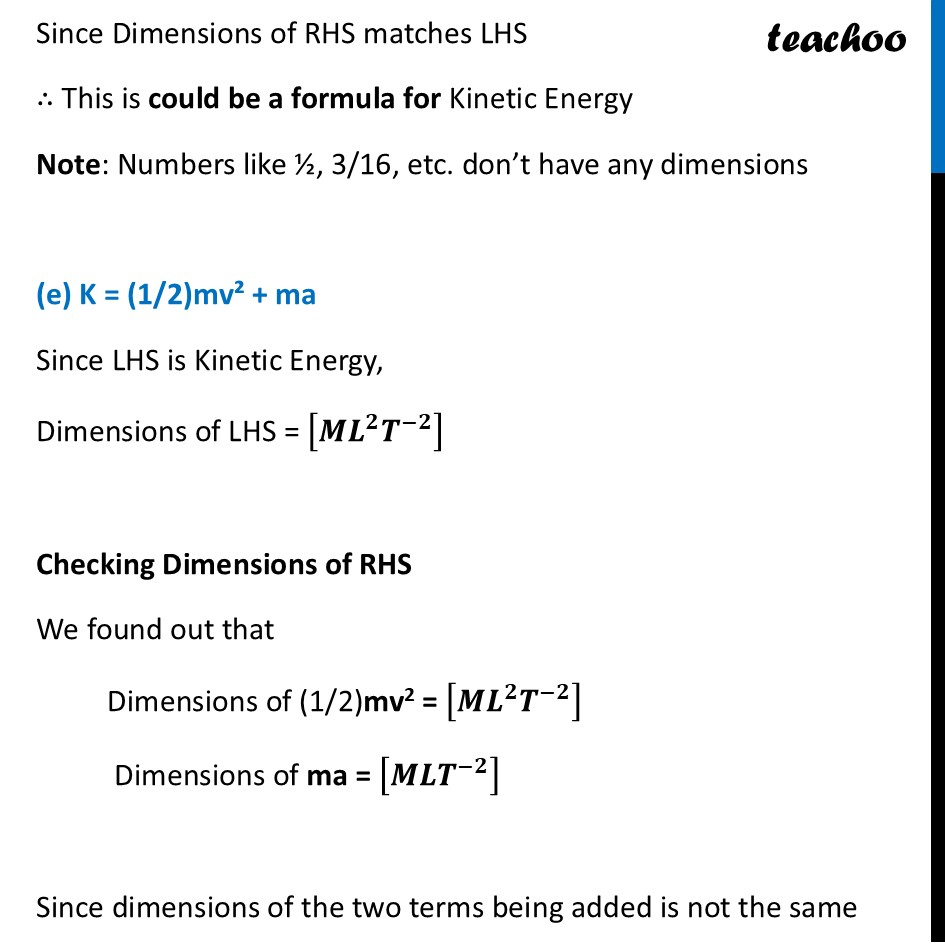
Example 1.4 The SI unit of energy is J = kg m² s⁻²; that of speed v is m s⁻¹ and of acceleration a is m s⁻². Which of the formulae for kinetic energy (K) given below can you rule out on the basis of dimensional arguments (m stands for the mass of the body) : (a) K = m² v³ (b) K = (1/2)mv² (c) K = ma (d) K = (3/16)mv² (e) K = (1/2)mv² + ma First, let’s find the dimensions of Energy, speed and accelration from its units Dimensions of Energy Given that unit of Energy is J = kg m² s⁻² Here, kg is mass, m is length and s is second i.e. Time So, Dimensions of Energy = [𝑴𝑳^(𝟐)𝑻^(−𝟐)] Dimensions of Speed Given that units of Speed is m s⁻¹ Here, m is length and s is second i.e. Time So, Dimensions of Speed = [𝑳𝑻^(−𝟏)] Dimensions of Acceleration Given that units of Speed is m s⁻2 Here, m is length and s is second i.e. Time So, Dimensions of Acceleration = [𝑳𝑻^(−𝟐)] Now, we need to check which formula of Kinetic Energy is possible Since Kinetic Energy is a type of Energy Dimensions of Kinetic Energy = Dimensions of Energy = [𝑴^(𝟏)𝑳^(𝟐)𝑻^(−𝟐)] Dimensions of Acceleration Given that units of Speed is m s⁻^(2) Here, m is length and s is second i.e. Time So, Dimensions of Acceleration = [𝑳𝑻^(−𝟐)] Now, we need to check which formula of Kinetic Energy is possible Since Kinetic Energy is a type of Energy Dimensions of Kinetic Energy = Dimensions of Energy = [𝑴𝑳^(𝟐)𝑻^(−𝟐)] Checking formula one by one (a) K = m² v³ Since LHS is Kinetic Energy, Dimensions of LHS = [𝑴𝑳^(𝟐)𝑻^(−𝟐)] Checking Dimensions of RHS Dimensions of m² v³ = [𝑴]^(𝟐) × [𝑳𝑻^(−𝟏)]^(𝟑) = [𝑀^(2)] ×[𝐿^(3)𝑇^(−3)] = [𝑴^(𝟐)𝑳^(𝟑)𝑻^(−𝟑)] Since Dimensions of RHS doesn’t match LHS ∴ This is not a formula for Kinetic Energy (b) K = (1/2)mv² Since LHS is Kinetic Energy, Dimensions of LHS = [𝑴𝑳^(𝟐)𝑻^(−𝟐)] Checking Dimensions of RHS Dimensions of (1/2)mv^(2) = [𝑴]^(𝟐) × [𝑳𝑻^(−𝟏)]^(𝟑) = [𝑀^(2)] ×[𝐿^(3)𝑇^(−3)] = [𝑴^(𝟐)𝑳^(𝟑)𝑻^(−𝟑)] Since Dimensions of RHS doesn’t match LHS ∴ This is not a formula for Kinetic Energy (c) K = ma Since LHS is Kinetic Energy, Dimensions of LHS = [𝑴𝑳^(𝟐)𝑻^(−𝟐)] Checking Dimensions of RHS Dimensions of m² v³ = [𝑴]^(𝟐) × [𝑳𝑻^(−𝟏)]^(𝟑) = [𝑀^(2)] ×[𝐿^(3)𝑇^(−3)] = [𝑴^(𝟐)𝑳^(𝟑)𝑻^(−𝟑)] Since Dimensions of RHS doesn’t match LHS ∴ This is not a formula for Kinetic Energy (d) K = (3/16)mv² Since LHS is Kinetic Energy, Dimensions of LHS = [𝑴𝑳^(𝟐)𝑻^(−𝟐)] Checking Dimensions of RHS Dimensions of m² v³ = [𝑴]^(𝟐) × [𝑳𝑻^(−𝟏)]^(𝟑) = [𝑀^(2)] ×[𝐿^(3)𝑇^(−3)] = [𝑴^(𝟐)𝑳^(𝟑)𝑻^(−𝟑)] Since Dimensions of RHS doesn’t match LHS ∴ This is not a formula for Kinetic Energy (e) K = (1/2)mv² + ma Since LHS is Kinetic Energy, Dimensions of LHS = [𝑴𝑳^(𝟐)𝑻^(−𝟐)] Checking Dimensions of RHS Dimensions of m² v³ = [𝑴]^(𝟐) × [𝑳𝑻^(−𝟏)]^(𝟑) = [𝑀^(2)] ×[𝐿^(3)𝑇^(−3)] = [𝑴^(𝟐)𝑳^(𝟑)𝑻^(−𝟑)] Since Dimensions of RHS doesn’t match LHS ∴ This is not a formula for Kinetic Energy Checking Dimensions of RHS Dimensions of (1/2)mv^(2) = [𝑴]× [𝑳𝑻^(−𝟏)]^(𝟐) = [𝑀] ×[𝐿^(2)𝑇^(−2)] = [𝑴𝑳^(𝟐)𝑻^(−𝟐)] Since Dimensions of RHS matches LHS ∴ This is could be a formula for Kinetic Energy Note: Numbers like ½, 3/16, etc. don’t have any dimensions (c) K = ma Since LHS is Kinetic Energy, Dimensions of LHS = [𝑴𝑳^(𝟐)𝑻^(−𝟐)] Checking Dimensions of RHS Dimensions of ma = [𝑴] ×[𝑳𝑻^(−𝟐)] = [𝑴^(𝟐)𝑳^(𝟑)𝑻^(−𝟑)] Since Dimensions of RHS doesn’t match LHS ∴ This is not a formula for Kinetic Energy (d) K = (3/16)mv² Since LHS is Kinetic Energy, Dimensions of LHS = [𝑴𝑳^(𝟐)𝑻^(−𝟐)] Checking Dimensions of RHS Dimensions of m² v³ = [𝑴]^(𝟐) × [𝑳𝑻^(−𝟏)]^(𝟑) = [𝑀^(2)] ×[𝐿^(3)𝑇^(−3)] = [𝑴^(𝟐)𝑳^(𝟑)𝑻^(−𝟑)] Since Dimensions of RHS doesn’t match LHS ∴ This is not a formula for Kinetic Energy (e) K = (1/2)mv² + ma Since LHS is Kinetic Energy, Dimensions of LHS = [𝑴𝑳^(𝟐)𝑻^(−𝟐)] Checking Dimensions of RHS Dimensions of m² v³ = [𝑴]^(𝟐) × [𝑳𝑻^(−𝟏)]^(𝟑) = [𝑀^(2)] ×[𝐿^(3)𝑇^(−3)] = [𝑴^(𝟐)𝑳^(𝟑)𝑻^(−𝟑)] Since Dimensions of RHS doesn’t match LHS ∴ This is not a formula for Kinetic Energy Checking Dimensions of RHS Dimensions of ma = [𝑴] ×[𝑳𝑻^(−𝟐)] = [𝑴𝑳𝑻^(−𝟐)] Since Dimensions of RHS doesn’t match LHS ∴ This is not a formula for Kinetic Energy (d) K = (3/16)mv² Since LHS is Kinetic Energy, Dimensions of LHS = [𝑴𝑳^(𝟐)𝑻^(−𝟐)] Dimensions of (3/16)mv^(2) = [𝑴]× [𝑳𝑻^(−𝟏)]^(𝟐) = [𝑀] ×[𝐿^(2)𝑇^(−2)] = [𝑴𝑳^(𝟐)𝑻^(−𝟐)] Since Dimensions of RHS matches LHS ∴ This is could be a formula for Kinetic Energy Note: Numbers like ½, 3/16, etc. don’t have any dimensions (e) K = (1/2)mv² + ma Since LHS is Kinetic Energy, Dimensions of LHS = [𝑴𝑳^(𝟐)𝑻^(−𝟐)] Checking Dimensions of RHS Dimensions of m² v³ = [𝑴]^(𝟐) × [𝑳𝑻^(−𝟏)]^(𝟑) = [𝑀^(2)] ×[𝐿^(3)𝑇^(−3)] = [𝑴^(𝟐)𝑳^(𝟑)𝑻^(−𝟑)] Since Dimensions of RHS doesn’t match LHS ∴ This is not a formula for Kinetic Energy Since Dimensions of RHS matches LHS ∴ This is could be a formula for Kinetic Energy Note: Numbers like ½, 3/16, etc. don’t have any dimensions (e) K = (1/2)mv² + ma Since LHS is Kinetic Energy, Dimensions of LHS = [𝑴𝑳^(𝟐)𝑻^(−𝟐)] Checking Dimensions of RHS We found out that Dimensions of (1/2)mv^(2) = [𝑴𝑳^(𝟐)𝑻^(−𝟐)] Dimensions of ma = [𝑴𝑳𝑻^(−𝟐)] Since dimensions of the two terms being added is not the same It doesn’t satisfy principle of homegenity ∴ This is not a formula for Kinetic Energy It doesn’t satisfy principle of homogeneity ∴ This is not a formula for Kinetic Energy