You are here
Chapter mind map
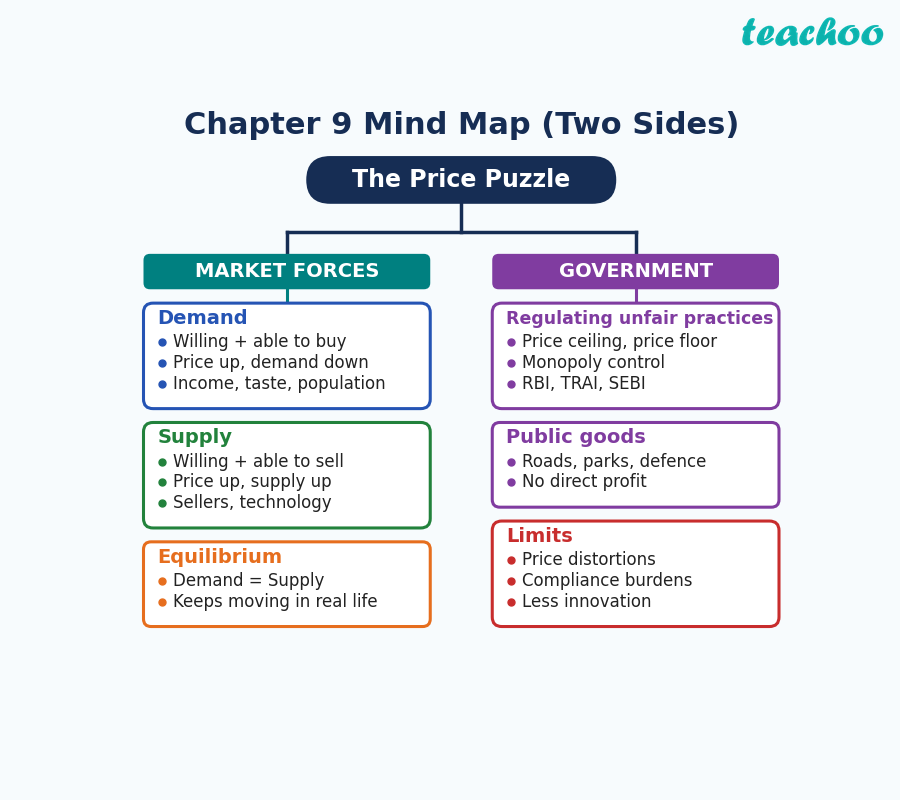
Mind map of the whole chapter: market forces and government
What should we carry away from this chapter?
-
Demand
- The quantity buyers are willing and able to buy at different prices.
- By the Law of Demand, as price falls, quantity demanded rises (an inverse relationship).
- Demand also depends on income, related goods, taste and preference, population, seasons and future expectations.
-
Supply
- The quantity sellers are willing and able to offer at different prices.
- By the Law of Supply, as price rises, quantity supplied rises (a direct relationship).
- Supply also depends on related goods, the number of sellers, technology, input costs and weather.
- Market equilibrium - where quantity demanded equals quantity supplied. In real markets, it keeps moving as weather, trends, technology and income change.
- Government intervention - the government steps in when markets give unfair results (unaffordable essentials), fail to provide public goods, or allow monopolies. But too much regulation can also cause harm.
Answers to the Big Questions
Big Question
Answer
What are the factors that influence the demand for and supply of goods and services?
Demand depends on price, income, taste, population, seasonality, future expectations and related goods. Supply depends on price, number of sellers, technology, future expectations, related goods, input costs and weather.
How are prices determined through demand and supply interactions?
Buyers want low prices, sellers want high prices. A shortage raises the price, a surplus lowers it, and the price settles where demand equals supply.
What is market equilibrium, and does it exist in the real world?
It is the point where quantity demanded equals quantity supplied, with no shortage or surplus. In the real world it exists only briefly, because demand and supply keep changing.
How and why does the government intervene in the market?
Through price ceilings, price floors, controlling monopolies, regulators and public goods, to keep markets fair - but without over-regulating.
Section-wise recap
| Section | Summary |
|---|---|
| Introduction |
|
| Demand and the Law of Demand |
|
| Other Determinants of Demand |
|
| Supply and the Law of Supply |
|
| Other Determinants of Supply |
|
| Market Equilibrium |
|
| Does Market Equilibrium Exist in the Real World? |
|
| Role of Government: Regulating Unfair Practices |
|
| Provision of Public Goods |
|
| Limitations of Government Intervention |
|
Key terms
| Term | Meaning |
|---|---|
| Demand | Quantity buyers are willing and able to buy at a price |
| Supply | Quantity sellers are willing and able to offer at a price |
| Law of Demand | Price and quantity demanded move in opposite directions |
| Law of Supply | Price and quantity supplied move in the same direction |
| Market equilibrium | Point where quantity demanded equals quantity supplied |
| Excess demand (shortage) | Demand is more than supply |
| Excess supply (surplus) | Supply is more than demand |
| Price ceiling | Maximum price set by the government |
| Price floor | Minimum price set by the government |
| Monopoly | A market with a single seller and no close substitutes |
| Public goods | Goods and services the government provides for all citizens |
1. What is the difference between demand and supply?
Show answer
Demand is what buyers are willing and able to buy at a price. Supply is what sellers are willing and able to offer at a price.
2. Fill in the blank: The Law of Demand shows an ______ relationship, and the Law of Supply shows a ______ relationship.
Show answer
Inverse; direct.
3. What happens to price when there is a shortage?
Show answer
The price rises until demand equals supply.
4. List any three ways the government intervenes in markets.
Show answer
Any three of: price ceilings, price floors, controlling monopolies, regulators, providing public goods.
5. True or false: In the real world, the equilibrium price stays fixed forever. Give a reason.
Show answer
False. Demand and supply keep changing, so the equilibrium keeps moving.
Worth remembering:
Every price you see is a live negotiation between demand and supply - and the next time it changes, you now know what questions to ask.