
 You are here
Example
- Suppose we carry our bag up a flight of stairs to our classroom.
- Case 1 — We run up the stairs in 1 minute.
- Case 2 — We walk up slowly in 5 minutes.
- In both cases, the same work is done (same bag, same height).
- But running up feels very different from walking up slowly.
- This difference is described by a physical quantity called power .
What is Power?
- Power is the rate at which work is done.
- In easy language — how fast work is done.
What is the formula of Power?
- Average power P is the work done W, divided by the time taken t
- P = W / t
How does power depend on work and time?
| Case | Power |
|---|---|
| More work in the same time | More power |
| Same work in a shorter time | More power |
Example 1 — More work, same time
-
Machine A does 100 J of work in 10 s.
- Power = 100 / 10 = 10 W
-
Machine B does 200 J of work in the same 10 s.
- Power = 200 / 10 = 20 W
- Machine B does more work in the same time — so it has more power .
Example 2 — Same work, less time
-
Student A climbs the stairs doing 400 J of work in 20 s.
- Power = 400 / 20 = 20 W
-
Student B does the same 400 J of work, but in 10 s.
- Power = 400 / 10 = 40 W
- Student B did the same work in a shorter time — so student B has more power .
What is the unit of Power?
- The SI unit of power is the watt (W) .
- 1 W = 1 J s⁻¹
- How derived?
-
We know that
- Power = Work / Time
-
Writing their units
- 1 Watt = Joule / Seconds
- 1 Watt = 1 J / 1 s
- 1 Watt = 1 J s⁻¹
- So 1 watt of power means 1 joule of work is done in 1 second.
📘 Example 7.10 (NCERT)
A weightlifter lifts a 75 kg mass by 2 m in 5 seconds. How much power would she require for this task?
- Work done = mgh
- Work done = 75 × 10 × 2
- Work done = 1500 J
- Power = Work / time
- Power = 1500 / 5
- Power = 300 W
📘 Example 7.11 (NCERT)
A car of mass 1000 kg starts from rest and reaches a speed of 72 km h⁻¹ in 10 seconds. Calculate the power of the engine required to achieve this start.
- Final velocity v = 72 km h⁻¹ = 72000 m / 3600 s = 20 m s⁻¹
- Initial velocity u = 0
-
Work done by the engine in 10 s = final kinetic energy − initial kinetic energy
- = ½mv² − ½mu²
- = ½ × 1000 × (20)² − 0
- = 200000 J
- Power = Work / time
- Power = 200000 / 10
- Power = 20000 W
-
📋 Revise, Reflect, Refine, Q6 (Page 137)
A crane lifts a mass m to the 10th floor of a building in a certain time. It then raises the same mass to the 20th floor of the same building in double the time. How much more energy and power are required? Assume that the height of all floors is equal.GIF Watch: why does the pendulum eventually stop in real life
View answer
Answer-
Energy
- Energy = mgh. Height of 20th floor = 2 × height of 10th floor.
- So energy required is 2 times .
-
Power
- Power = Work / time
- Work became 2 times, and time also became 2 times.
- Power = 2W / 2t = W / t — same as before!
- So the power required is the same (no more power needed).
-
Energy
📝 Important points — 7.5 Power
| Point | Detail |
|---|---|
| Power | Rate of doing work |
| Formula | P = W / t |
| SI unit | watt (W), 1 W = 1 J s⁻¹ |
| More work, same time | More power |
| Same work, less time | More power |
🧵 Threads of Curiosity
- You may have heard about another unit called horsepower (hp) used to measure power, especially for car engines, or pumps used to lift water. One horsepower is equal to 746 W. In the early days, when engines were newly discovered, the powers of engines were compared to the power of actual horses which were used to drive carriages.
👩🔬 Meet a Scientist
IMAGE
Portrait: James Watt — the watt is named after him
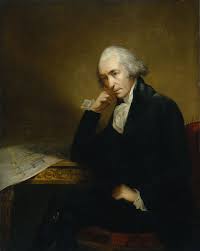
- The unit of power, watt is named in the honour of James Watt .
- He invented an efficient steam engine that could generate rotational motion and move wheels.
💡 Worth remembering
- Same work, different time = different power. Power is about speed of doing work, not amount.
- Watt for machines, horsepower for engines — 1 hp = 746 W.
- Doubling both work and time keeps power unchanged.
✅ Quick self-check
-
A machine does 500 J of work in 10 seconds. Find its power.
View Answer
- P = W / t
- P = 500 / 10
- P = 50 W
-
Two students of the same mass climb the same stairs. One takes 20 s, the other takes 40 s. Who uses more power?
View Answer
- Both do the same work (same mass, same height).
- The one who takes less time (20 s) uses more power.
-
A pump is rated 1 hp. How many watts is that?
View Answer
- 1 hp = 746 W
-
GIF Watch: example — Pulling a bucket of water from a well
-
GIF Watch: example — Pulling a bucket of water from a well
- Power of the pump = 746 W
Key terms and units
| Term | Meaning | Unit |
|---|---|---|
| Power (P) | Rate of doing work, P = W/t | watt (W) |
| Watt | 1 joule of work per second | 1 W = 1 J s⁻¹ |
| Horsepower | Old unit for engine power | 1 hp = 746 W |
