
 You are here
What is Mechanical Energy?
- The sum of the kinetic energy and the potential energy of an object is called its mechanical energy .
- Mechanical energy = Kinetic energy + Potential energy
Example
-
A bird is flying at a height.
- It is moving — so it has kinetic energy.
- It is at a height — so it has potential energy.
- Suppose its kinetic energy is 10 J and potential energy is 40 J.
| Energy | Value |
|---|---|
| Kinetic energy (moving) | 10 J |
| Potential energy (at a height) | 40 J |
| Total mechanical energy | 50 J |
What is Conservation of Mechanical Energy?
- As an object moves due to the gravitational force, its mechanical energy remains the same — if no other external forces act on it.
- Kinetic energy and potential energy keep changing into each other, but their sum stays constant .
- This is called the conservation of mechanical energy .
Example
- We drop a ball from a height. Suppose its mechanical energy at the top is 50 J.
-
GIF Watch: how do we show this with formulas? (Falling object)

| Position | Potential energy | Kinetic energy | Total mechanical energy |
|---|---|---|---|
| At the top | 50 J | 0 J | 50 J |
| Midway | 25 J | 25 J | 50 J |
| Just before the ground | 0 J | 50 J | 50 J |
- PE kept decreasing, KE kept increasing — but the total stayed 50 J at every point.
- This is conservation of mechanical energy.
How do we show this with formulas? (Falling object)
- Suppose an object of mass m is lifted to point A at height h and dropped.
-
GIF Watch: how do we show this with formulas? (Falling object)

- Its initial velocity u = 0.

- After falling for time t, it reaches point B.
Step 1 — At point A (top, just dropped)
- The object is at height h, not moving yet.
GIF
Watch: how do we show this with formulas? (Falling object)

| Position | Potential energy | Kinetic energy | Total mechanical energy |
|---|---|---|---|
| A (top) | mgh | 0 (velocity = 0) | mgh |
Step 2 — At point B (after falling for time t)
-
First, lets find the velocity at B.
- From Chapter 4, first equation of motion — v = u + at
- Here u = 0, and acceleration = g (gravity)
- v = 0 + gt
- v = gt
-
Now, kinetic energy at B
- KE = ½mv²
- KE = ½m(gt)²
- KE = ½mg²t²
-
Next, lets find the height at B.
- From Chapter 4, second equation of motion — s = ut + ½at²
- Distance fallen s = 0 + ½gt² = ½gt²
- Height at B = original height − distance fallen
- h′ = h − ½gt²
-
Now, potential energy at B
- PE = mgh′
- PE = mg(h − ½gt²)
- PE = mgh − ½mg²t²
-
GIF Watch: how do we show this with formulas? (Falling object)
| Position | Potential energy | Kinetic energy | Total mechanical energy |
|---|---|---|---|
| B (after time t) | mgh − ½mg²t² | ½mg²t² | mgh − ½mg²t² + ½mg²t² = mgh |
-
Notice —
- Kinetic energy increased by ½mg²t² (it was 0 at A)
- Potential energy decreased by ½mg²t² (it was mgh at A)
- The increase in KE is exactly equal to the decrease in PE!

Step 3 — Just before the ground
- All the height is lost — h′ = 0, so PE = 0.
- All the potential energy has become kinetic energy.
-
GIF Watch: how do we show this with formulas? (Falling object)
| Position | Potential energy | Kinetic energy | Total mechanical energy |
|---|---|---|---|
| Just before ground | 0 | mgh | mgh |

Conclusion
GIF
Watch: how do we show this with formulas? (Falling object)
| Position | Potential energy | Kinetic energy | Total mechanical energy |
|---|---|---|---|
| A (top) | mgh | 0 | mgh |
| B (after time t) | mgh − ½mg²t² | ½mg²t² | mgh |
| Just before ground | 0 | mgh | mgh |
- The lost potential energy is converted into kinetic energy during motion.
- The mechanical energy remains constant and equal to mgh at every point.
-
GIF Watch: activity 7.2 — Let us experiment (Pendulum)

- Step 1 — Set up a simple pendulum (as learnt in Grade 7).
- Step 2 — Paste a white sheet of paper on a wall behind the pendulum. Draw a horizontal line above the position of the bob when it is not oscillating.
- Step 3 — Take the bob to one side to a point P at the level of the horizontal line and let it go. Observe it at the extreme points of the first couple of oscillations.
What do we observe?
- The bob almost reaches the level of the horizontal line on the other side (point R).
Why does this happen?
| Position | Potential energy | Kinetic energy | Total mechanical energy |
|---|---|---|---|
| P (extreme, one side) | mgh (maximum) | 0 | mgh |
| Q (bottom-most point) | 0 | Maximum (mgh) | mgh |
| R (extreme, other side) | mgh (regained) | 0 | mgh |
- At P — all energy is potential.
- At Q — all potential energy has become kinetic energy.
- At R — all kinetic energy has become potential energy again.
- The bob reaches almost the same height it started with.
- This demonstrates that the mechanical energy of the bob remains constant .
Why does the pendulum eventually stop in real life?
- In real life, the pendulum slows down and eventually stops.
- This is because of energy loss due to friction at the support and air resistance .
- The mechanical energy slowly converts into heat and sound.
📘 Example 7.8 (NCERT)
What will be the magnitude of velocity of the child on reaching the bottom of the slide of height h?
| Position | Potential energy | Kinetic energy | Total mechanical energy |
|---|---|---|---|
| Top of slide | mgh | 0 | mgh |
| Bottom of slide | 0 | ½mv² | ½mv² |
GIF
Watch: why does the pendulum eventually stop in real life

- The potential energy at the top gets converted entirely to kinetic energy at the bottom (neglecting friction).
-
Mechanical energy is conserved — so the two totals are equal
- ½mv² = mgh
- v² = 2gh
- v = √(2gh)
- Note — this velocity depends only on the height h. The shape of the slide or the mass of the child does not matter.
🧠 Think It Over
(Page 116 — chapter opener, answered now)
At the start of the chapter, we saw children on slides and were asked 3 questions. Now we can answer them.
-
Question 1 — What will be the magnitude of velocity of the child at the bottom of the blue slide?
- From Example 7.8 — v = √(2gh), where h is the height of the slide.
-
Question 2 — Will two children of different masses reach the bottom of the same slide with the same velocity?
- Yes. v = √(2gh) has no mass in it.
- Mass does not matter — both reach with the same velocity.
-
Question 3 — Which of the slides will result in the largest magnitude of velocity for the child at its bottom?
- v = √(2gh) — velocity depends only on height.
- The tallest slide gives the largest velocity at the bottom.
- The shape of the slide (straight, curvy, spiral) does not matter.
📘 Example 7.9 (NCERT)
Escape ramps are inclined planes filled with sand or gravel that help stop trucks when their brakes fail on a highway. A truck of mass 10000 kg is moving at 72 km h⁻¹ when its brakes fail. The driver steers it onto an escape ramp inclined at 30°, where the truck comes to rest. If the sand exerts a force of 50000 N opposite to truck's motion, what is the minimum length of the ramp to be able to stop such a truck? Take g = 10 m s⁻² (Hint: For a 30° incline, the truck rises 1 m vertically for every 2 m it travels along the ramp).
GIF
Watch: why does the pendulum eventually stop in real life

- Velocity of the truck = 72 km h⁻¹ = 20 m s⁻¹
- Let the truck travel a distance d along the ramp. Height gained = d/2 (from the hint).
| Position | Potential energy | Kinetic energy | Total energy |
|---|---|---|---|
| Bottom of ramp (moving) | 0 J | ½ × 10000 × (20)² = 2000000 J | 2000000 J |
| Stopped on ramp (height d/2) | 10000 × 10 × d/2 = 50000 × d | 0 J | 50000 × d |
-
Work done by sand
- Sand force is opposite to motion — negative work.
- Work done by sand = −50000 × d
-
Apply the work-energy theorem
- Work done by sand = Final energy − Initial energy
- −50000 × d = 50000 × d − 2000000
- 2000000 = 50000 × d + 50000 × d
- 2000000 = 100000 × d
- d = 20 m
- The minimum length of the ramp is 20 m.
-
🤔 Pause and Ponder 7 (from the book)
For the situation of the falling object (Fig 7.19), calculate the mechanical energy of the ball just before it hits the ground and show that even at this position, it is mgh.View answer
Answer- Just before hitting the ground, height = 0, so potential energy = 0.
- The ball fell from height h. Using v² = u² + 2gh (u = 0) — v² = 2gh
- Kinetic energy = ½mv² = ½m × 2gh = mgh
GIF Watch: why does the pendulum eventually stop in real life
Position Potential energy Kinetic energy Total mechanical energy Top (height h) mgh 0 mgh Just before ground 0 mgh mgh - Mechanical energy just before hitting the ground = 0 + mgh = mgh. Conserved!
-
🤔 Pause and Ponder 8 (from the book)
You may have seen an exhibit like that in Fig. 7.22 in a science park, where a ball is released from the highest point. Describe how the kinetic energy and potential energy change at points A, B and C. Why do subsequent points, such as C, D and E, usually have lower heights compared to the previous ones? Could it have anything to do with the energy lost due to friction?GIF Watch: why does the pendulum eventually stop in real life
View answer
AnswerPosition Potential energy Kinetic energy Released at the highest point Maximum 0 Going down to a low point (B) Decreases Increases Climbing a peak (A, C) Increases Decreases GIF Watch: why does the pendulum eventually stop in real life
-
Why are later peaks (C, D, E) lower?
- Yes — it is because of friction .
- At every point, some mechanical energy is lost as heat due to friction (and air resistance).
- So the ball has less mechanical energy left at each subsequent peak.
- Less energy = less height it can climb — that is why each peak is lower than the previous one.
-
Why are later peaks (C, D, E) lower?
-
📋 Revise, Reflect, Refine, Q3 (Page 137)
When a ball thrown upwards reaches its highest point, tick which of the following statement(s) are correct?View answer
AnswerStatement Correct? Reason (i) The force acting on the ball is zero ✗ Gravity (mg) still acts on it (ii) The acceleration of the ball is zero ✗ Acceleration due to gravity g still acts (downward) (iii) Its kinetic energy is zero ✓ At the highest point, velocity = 0, so KE = 0 (iv) Its potential energy is maximum ✓ Height is maximum, so PE = mgh is maximum
-
📋 Revise, Reflect, Refine, Q10 (Page 138)
A ball of mass 2 kg is thrown up with a velocity of 20 m s⁻¹.View answer
Answer- (i) Sign of work done by gravity —
Motion Direction of gravity Direction of displacement Work done by gravity Upward Downward Upward Negative Downward Downward Downward Positive - (ii) If the ball reaches a height of 19.4 m, how much work was done by air resistance? (g = 10 m s⁻²)
Position Potential energy Kinetic energy Total mechanical energy Ground (thrown up at 20 m s⁻¹) 0 J ½ × 2 × (20)² = 400 J 400 J Highest point (19.4 m) 2 × 10 × 19.4 = 388 J 0 J 388 J - Work done by air resistance = Final energy − Initial energy
- = 388 − 400
- = −12 J
- Negative — air resistance opposes motion and takes away energy. (Mechanical energy was NOT conserved here because air resistance acted.)
-
📋 Revise, Reflect, Refine, Q12 (Page 138)
The gravitational attraction on the surface of the Moon is about 1/6th of that on the surface of the Earth. An astronaut can throw a ball up to a height of 8 m from the surface of the Earth. How far up will the ball thrown with the same upward velocity travel from the surface of the Moon?View answer
Answer- Same throw = same initial kinetic energy = ½mv²
- All kinetic energy converts to potential energy at the top — ½mv² = mgh
- So h = v² / 2g
- On the Moon, g is 1/6th — so h becomes 6 times .
- Height on the Moon = 6 × 8 m = 48 m
-
📋 Revise, Reflect, Refine, Q14 (Page 138)
The potential energy-displacement graph of a 0.5 kg ball moving along a frictionless track is shown. At O, the velocity of the ball is 0 m s⁻¹ and potential energy is 30 J. Calculate the velocity of the ball at P, Q and R. (From the graph — PE at P = 20 J, at Q = 30 J, at R = 40 J.)GIF Watch: why does the pendulum eventually stop in real life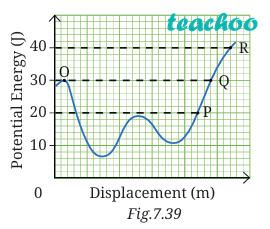
View answer
Answer- At O — velocity = 0, so kinetic energy = 0.
- Total mechanical energy = PE + KE = 30 + 0 = 30 J
- The track is frictionless — mechanical energy stays 30 J everywhere.
Position Potential energy Kinetic energy = 30 − PE Velocity (from ½ × 0.5 × v² = KE) P 20 J 10 J √40 ≈ 6.3 m s⁻¹ Q 30 J 0 J 0 m s⁻¹ R 40 J −10 J — impossible! Ball can never reach R - Kinetic energy can never be negative — so the ball does not have enough mechanical energy to reach R.
-
📋 Revise, Reflect, Refine, Q15 (Page 138)
A coconut of mass 1.5 kg falls from the top of a coconut tree onto the wet sand on a beach. The height of the tree is 10 m. On impact, the coconut comes to rest by making a depression in the sand. (i) Calculate the velocity of the coconut just before it hits the sand. (ii) Assume that the average resistive force of sand is 3000 N and all of the coconut's energy is used to create the depression in the sand. Calculate the depth of the depression the coconut makes in the sand. Assume g = 10 m s⁻².View answer
Answer- (i) Velocity of the coconut just before it hits the sand
Position Potential energy Kinetic energy Total mechanical energy Top of tree (10 m) 1.5 × 10 × 10 = 150 J 0 J 150 J Just before sand 0 J 150 J 150 J - ½mv² = 150
- v = √(2gh) = √(2 × 10 × 10) = √200
- v ≈ 14.1 m s⁻¹
-
(ii) Depth of the depression
- Energy of the coconut = 150 J
- This energy = work done against the sand's resistive force
- 150 = 3000 × d
- d = 150 / 3000
- d = 0.05 m = 5 cm
📝 Important points — 7.4.3 Conservation of Mechanical Energy
| Point | Detail |
|---|---|
| Mechanical energy | KE + PE |
| Conservation | Mechanical energy stays constant if no external forces act |
| Falling object | PE decreases, KE increases, sum stays mgh |
| Pendulum | PE ⇌ KE at every swing, total constant |
| v at bottom of fall/slide | v = √(2gh) — no mass, no shape |
| Real life | Friction and air resistance slowly drain mechanical energy as heat |
🧵 Threads of Curiosity
- Solving problems directly through Newton's laws can become cumbersome in many cases. Conservation of mechanical energy may offer a simpler route. By keeping track of the total mechanical energy, we can often find the final speed or the position of an object without working through all the detailed steps of the intermediate motion.
🚀 Ready to Go Beyond
- Mechanical energy is just one part of a bigger picture. In nature, energy can appear in many different forms. Scientists have discovered that the total energy of an object or system of objects which is not acted upon by any external forces, stays constant.
💡 Worth remembering
- Falling — PE becomes KE. Rising — KE becomes PE. The total never changes (without friction).
- v = √(2gh) is a shortcut worth memorising — works for any fall or slide, any mass, any shape.
- An object can never reach a point where the required PE is more than its total mechanical energy.
✅ Quick self-check
-
A stone of mass 1 kg is dropped from a height of 5 m. What is its mechanical energy (a) at the top, (b) just before hitting the ground? (g = 10 m s⁻²)
View Answer
Position Potential energy Kinetic energy Total mechanical energy Top (5 m) 1 × 10 × 5 = 50 J 0 J 50 J Just before ground 0 J 50 J 50 J - Mechanical energy = 50 J at both points — conserved.
-
A pendulum bob at its bottom-most point has 2 J of kinetic energy. Neglecting friction, how much potential energy will it have at its extreme point?
View Answer
Position Potential energy Kinetic energy Total mechanical energy Bottom-most point 0 J 2 J 2 J Extreme point 2 J 0 J 2 J - Potential energy at the extreme point = 2 J
-
Two slides have the same height but different shapes — one straight, one spiral. On which slide does a child reach the bottom with greater speed? (Neglect friction)
View Answer
- v = √(2gh) — depends only on height.
- Same height = same speed.
- The speed is the same on both slides.
Key terms and units
| Term | Meaning | Unit |
|---|---|---|
| Mechanical energy | KE + PE | joule (J) |
| Conservation of mechanical energy | ME stays constant if no external forces act | — |
