
 You are here
pages 138 to 140
In short:
Democratic ideas in India are ancient, were disrupted, and were revived by the freedom struggle.
Timeline of Democracy in India
Democratic ideas in India over time
Vedic and Buddhist
ideas present
Medieval and British
disrupted, limited
1947 to 1950
revived, written down
↓
The Constitution gave those ideas their written form
- Democratic ideas were present early , disrupted in between , and revived by the freedom struggle.
- The Constitution gave those ideas their written form .
- The chapter does not name any medieval ruler or dynasty.
- It says only that invasions by foreign invaders disrupted the political and social fabric of some parts of the country.
What is the evidence of democracy in the Vedic period?
Evidence from the Vedic period
two kinds of evidence
The assemblies
Sabha, Samiti and Vidhata
Collective decision-making
Example:
the king consulted, he did not rule alone
The ancient text
Aikyamatya Suktam of the Rig Veda
Rigveda 10.191.3
Example:
collective thinking and unity of purpose
- Two kinds of evidence - assemblies and an ancient text .
1. The assemblies
![Tracing Democratic Traditions from Early Times - Democracy - [Teachoo] - Concepts](https://cdn.teachoo.com/aadebd64-c44f-4e85-bdcf-535b5b1f3c97/an-early-assembly.jpg)
An early assembly
Assemblies of the Vedic period
collective decision-making
Sabha
A smaller assembly of elders and select members
Also took part in judicial matters
Example:
the king consulted, he did not rule alone
Samiti
A larger general assembly of the people
Discussed important matters including the king
Example:
early republican states were ganas or samghas
Vidhata
The earliest assembly
Used for distribution, religious and military matters
Example:
both men and women took part
Assembly
What it was
Sabha
A smaller assembly of elders and select members; also took part in judicial matters
Samiti
A larger general assembly of the people, which discussed important matters including the king
Vidhata
The earliest assembly, used for distribution, religious and military matters; both men and women took part
- The meanings above come from Chapter 5.
- This chapter only names the three assemblies.
- All three involved collective decision-making .
- Early republican states were called ganas or samghas .
- The king was not an independent ruler .
- He worked in consultation with assemblies, ministers and officers.
2. The ancient text
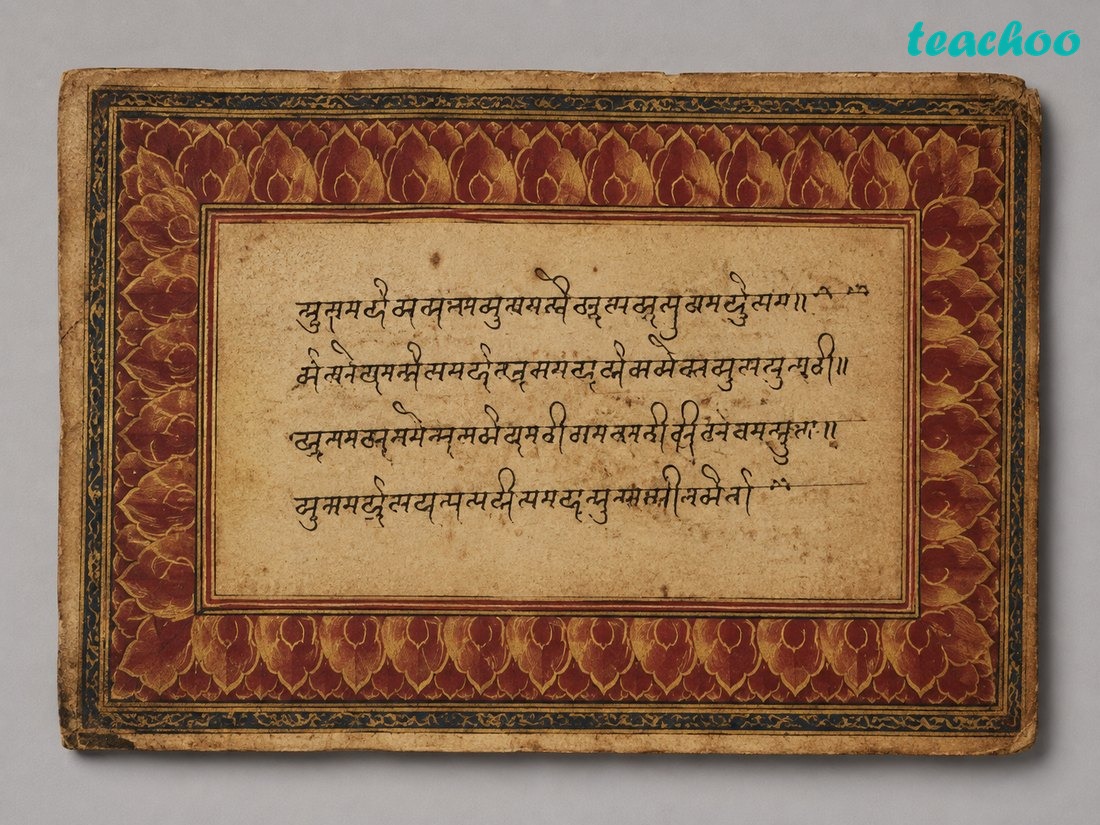
A verse from the Rig Veda
- A verse from the Aikyamatya Suktam of the Rig Veda , reference Rigveda 10.191.3 .
- Aikyamatya means agreement of minds.
- Samano mantrah samitih samani samanam manah saha chittam eshham | Samanam mantram abhimantraye vah samanena vo havisha juhomi ||
- The book's translation:
- "Their counsel is one and the same; their assembly is one.
- Their mind is one, and their intention together is one.
- I invoke for you this same guiding resolve; with a common offering, on your behalf, I make the oblation."
What does this verse tell us?
- It stresses collective thinking , shared discussion and unity of purpose .
- Democratic values such as consultation, consensus and shared responsibility have deep roots in India's intellectual and cultural traditions.
What it does not tell us
- It is a hymn about an ideal, not a record of procedure.
- It does not say who could attend an assembly, how decisions were counted, or what happened when agreement failed.
How do the Bauddha Samghas show India's democratic traditions?
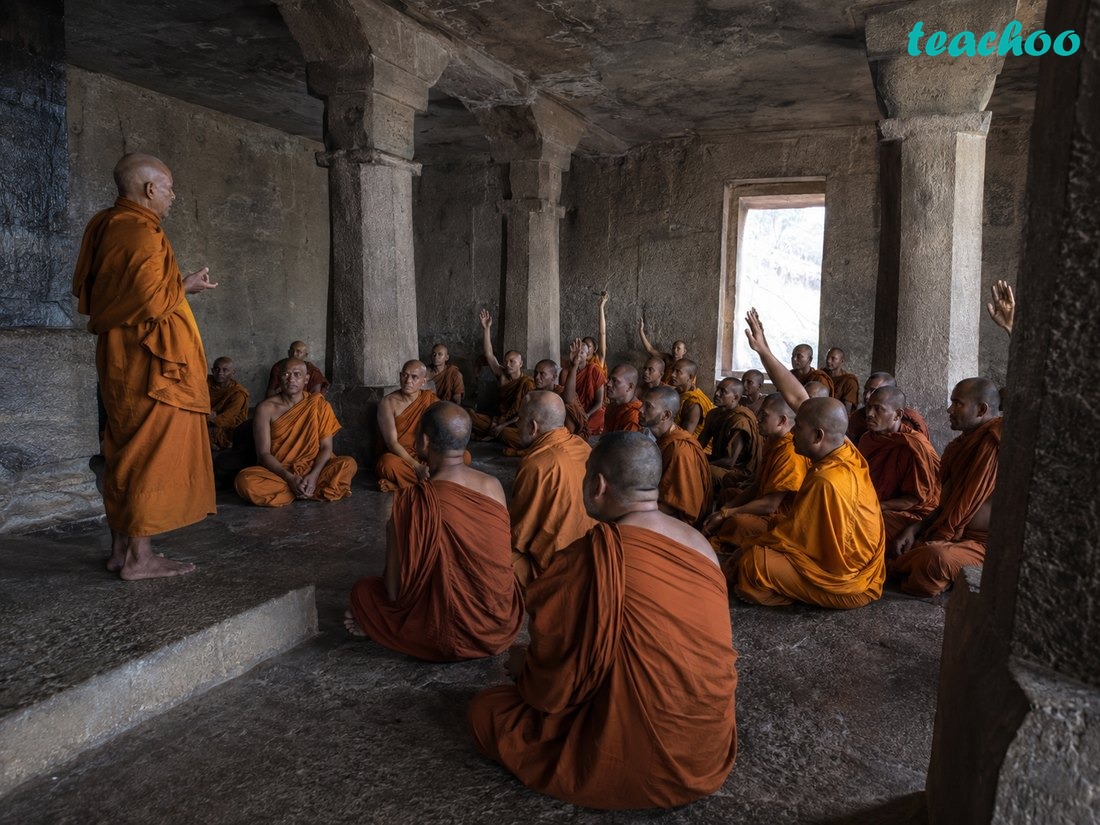
A Buddhist Sangha assembly
How the Bauddha Samghas worked
Debate and discussion
encouraged
Chose their leader
members decided
Decisions by voting
↓
Collective decision-making in practice
- The Bauddha Samghas were a monastic community established by Gautama Buddha .
- The Samgha encouraged debate and discussion .
- Members could choose their leader .
- Members could make decisions through voting .
- This shows collective decision-making in practice.
Was there democracy during Mughal and British rule?
Democracy in between
what the chapter says
Medieval period
Invasions by foreign invaders
Fabric of some parts disrupted
Example:
the chapter names no ruler or dynasty
British rule
Colonised most of the subcontinent
Participation limited
Example:
India was NOT a democracy
Medieval period
- The chapter does not discuss the Mughal period, or name any dynasty.
- All it says is that over the long passage of time, invasions by foreign invaders disrupted the political and social fabric of some parts of the country.
British rule
- By the 19th century the British had colonised most parts of the Indian subcontinent.
- Foreign rule altered political structures .
- It limited people's participation in their governance.
- So under colonial rule India was not a democracy.
But this is not the whole story
- The long struggle for independence revived and strengthened democratic ideas among the people.
- Colonial rule reduced participation; the fight against it increased democratic thinking.
Period
Effect on democratic ideas
Under British rule
Weakened
- participation limited
During the freedom struggle
Strengthened
- democratic ideas revived
What was the Constituent Assembly?
Making the Constitution
1946
Constituent Assembly formed
2 years, 11 months, 18 days
to draft
26 Nov 1949
adopted
26 Jan 1950
came into force
↓
The world's longest written Constitution
| Point | Detail |
|---|---|
| What it was | The body formed to draft a constitution for India |
| Formed in | 1946 , before Independence in 1947 |
| Chairman, Drafting Committee | Dr. B.R. Ambedkar |
| Time taken | 2 years, 11 months and 18 days |
| Result | The world's longest written Constitution |
| What influenced its Debates (CAD) | India's indigenous democratic traditions and the global spread of democratic values |
| Kind of document wanted | A dynamic document , not a rigid legal code |
| Values upheld | Liberty, equality, justice and fraternity |
| Provision for change | Amendments under Article 368 |
| Constitution described as | Robust, flexible, transformative and responsive |
| Adopted | 26 November 1949 |
| Came into force | 26 January 1950 |
Should the Constitution be rigid or dynamic?
What kind of document?
the Constituent Assembly decided
A rigid legal code
Fixed forever
Cannot meet new needs
Example:
rejected
A dynamic document
Can evolve with time
Lawful amendments, Article 368
Example:
chosen - flexible and responsive
Rigid legal code
Dynamic document
Fixed forever
Can
evolve
with time
Cannot meet new needs
Changes only through
lawful amendments
- The CAD shows the members wanted a dynamic document.
- It can evolve, but its fundamental values must not be compromised.
- Article 368 provides for amendments - a lawful change to the Constitution.
- This keeps the Constitution flexible and responsive to changing socio-political needs.
Questions from the Book
Q11. What role does the Constitution play in strengthening democracy in India?
- The Constitution strengthens Indian democracy in five ways.
- It safeguards the rights of the people - its crucial role in any democracy.
- It guarantees and protects the Fundamental Rights of all citizens.
- It ensures no discrimination on the basis of religion, race, caste, sex or place of birth.
- It encourages active citizen participation through elections at the national, state and local levels.
- It provides for democratic institutions and processes that uphold liberty, equality, justice and fraternity .
- It also strengthens democracy by being able to change.
- The Constituent Assembly wanted a dynamic document , not a rigid legal code.
- Article 368 provides for amendments.
- This keeps the Constitution flexible and responsive to changing socio-political needs, without compromising its fundamental values.
- Explanation: the question asks about strengthening , not just describing.
- The answer needs both halves - what the Constitution protects, and why its ability to be amended is a strength rather than a weakness.
- A Constitution that could never change would not survive changing times.
Revision: How the Constitution strengthens democracy
Guarantees rights
and protects them
Sets up institutions
liberty, equality, justice, fraternity
Article 368
allows lawful amendment
↓
Strong enough to protect, flexible enough to last
1. Name the three assemblies of the Vedic period.
Show answer
Sabha, Samiti and Vidhata.
2. Which ancient text gives evidence of democratic values in India? Give its reference.
Show answer
The Rig Veda - the Aikyamatya Suktam, Rigveda 10.191.3.
3. Give two ways the Bauddha Samghas showed democratic functioning.
Show answer
Members could choose their leader, and decisions were made through voting. The Samgha also encouraged debate and discussion.
4. What effect did British rule have on people's participation in governance?
Show answer
Foreign rule altered political structures and limited people's participation in their governance.
5. Did British rule end democratic ideas in India?
Show answer
No. The long struggle for independence from British colonial rule revived and strengthened democratic ideas among the people.
