
 You are here
💬 Think about it
Stand up, walk, sit straight — your bones and muscles work as one team to do it.
Muscles pull, bones move, and joints let it all happen.
Let us see how this system is built.
What is the musculoskeletal system?
Musculoskeletal System
Musculo-
the muscles that pull
-skeletal
the bones, joints, cartilage, tendons and ligaments
↓
The system that helps us stand, move, keep posture and protect organs, working under the control of the nervous system.
- The musculoskeletal system is the body system made of the muscles and the skeleton (bones) working together.
- "Musculo-" stands for the muscles that pull, and "-skeletal" stands for the bones, joints, cartilage, tendons and ligaments.
- It helps us stand, move, keep posture and protect organs.
- It works under the control of the nervous system.
Why is the musculoskeletal system required?
- To support the body and give it a definite shape and posture.
- To allow movement — muscles pull on bones to move the body parts.
- To protect the soft internal organs (for example, the skull protects the brain and the rib cage protects the heart and lungs).
- To hold all the body parts together as one connected framework.
What are the different parts of the musculoskeletal system?
![3.4 The Musculoskeletal System - Tissues in Action - [Teachoo] - Concepts](https://cdn.teachoo.com/caef97dc-139b-41af-b87d-d4eba6f05d2d/fig.-3.15-the-musculoskeletal-system.webp)
Bones (skeleton)
Muscles
Joints
Tendons and
ligaments
Works under
\ nervous control
(\
\
| Part | Function / Meaning |
|---|---|
| Bones (skeleton) | Hard, rigid parts that form the framework of the body, support it and protect the organs. |
| Muscles | Soft tissues that contract (shorten) and pull on bones to produce movement. |
| Joints | Junctions where two or more bones meet; they allow movement. |
| Cartilage | Soft, jelly-like tissue that cushions the ends of bones so they do not rub. |
| Tendons | Tough bands that join muscle to bone. |
| Ligaments | Tough bands that join bone to bone. |
How are muscles and bones connected to each other?
- Muscles are joined to bones by tough bands called tendons .
- Bones are joined to other bones by tough bands called ligaments .
- At the joint, cartilage cushions the ends of the bones so they move smoothly.
- Because of these connections, when a muscle pulls, the force reaches the bone and the bone moves.
Example:
The tendon at the back of your ankle (just above the heel) joins your calf muscle to your heel bone.
How does the musculoskeletal system lead to movement?
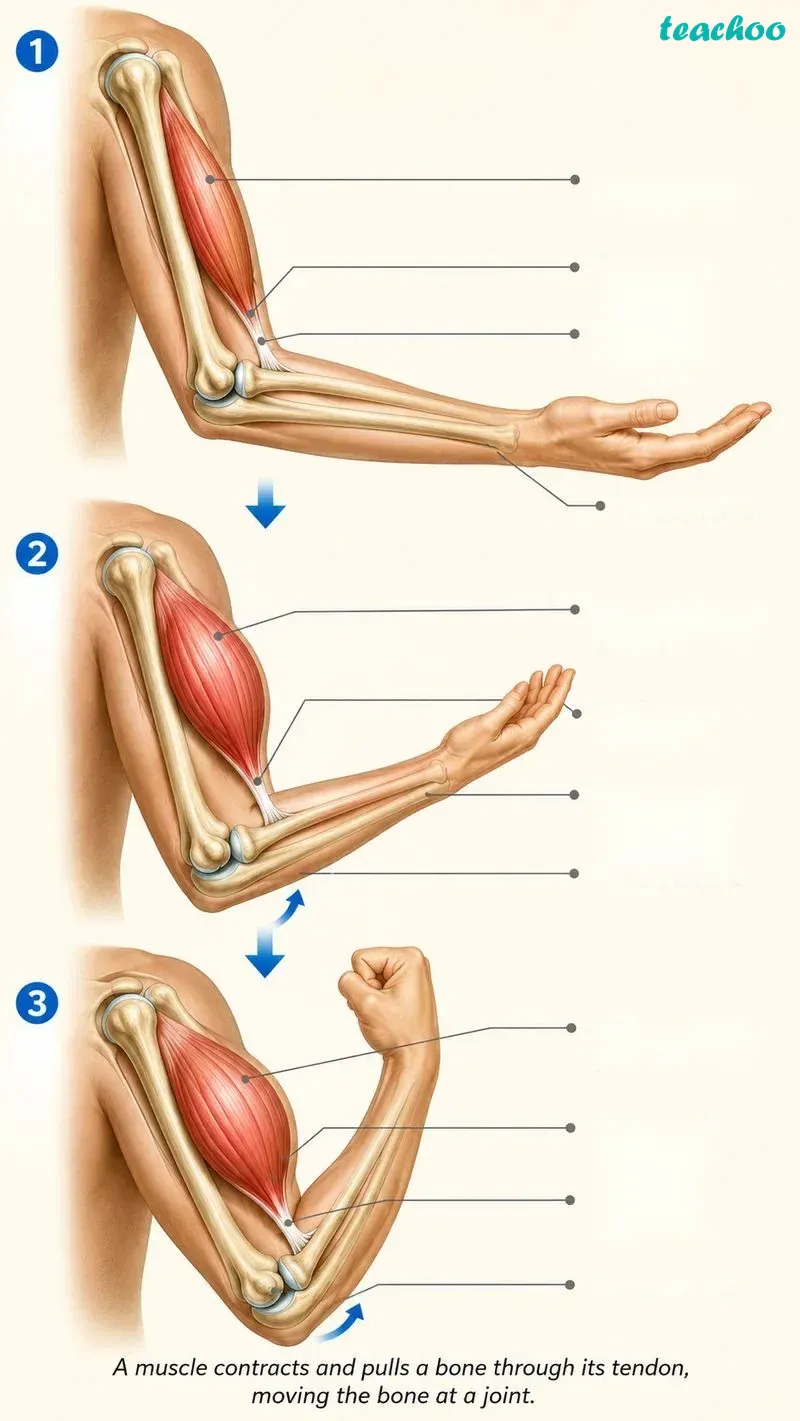
How Movement Happens
Muscle contracts
↓
Tendon pulls
It transmits the force to the bone.
↓
Bone moves at a joint
Muscle contracts
(shortens)
Tendon pulls
the bone
Bone moves
at the joint
The arm bends
Muscle contracts
(shortens)
Tendon pulls
the bone
Bone moves
at the joint
The arm bends
Muscle contracts
(shortens)
Tendon pulls
the bone
Bone moves
at the joint
The arm bends
- The muscle contracts (shortens).
- The tendon transmits this pull to the bone.
- The bone moves at the joint, and the body part (for example, the arm) bends.
- All of this happens under the control of the nervous system.
In this Activity, we will estimate what percentage of our total body weight comes from bones and muscles.
Procedure
1. Step on a weighing scale and record your total body weight.
2. Use health resources to find the average bone and muscle mass percentage for your age and gender (for example, adult males have about 40–50 per cent muscle, adult females about 30–40 per cent, and bone is about 12–15 per cent for all adults).
3. Multiply your body weight by the bone and muscle percentages to estimate their weights.
4. Record the estimated bone weight and muscle weight and compare them with your total body weight.
5. Compare your findings with classmates and calculate the class average.
2. Use health resources to find the average bone and muscle mass percentage for your age and gender (for example, adult males have about 40–50 per cent muscle, adult females about 30–40 per cent, and bone is about 12–15 per cent for all adults).
3. Multiply your body weight by the bone and muscle percentages to estimate their weights.
4. Record the estimated bone weight and muscle weight and compare them with your total body weight.
5. Compare your findings with classmates and calculate the class average.
Discussion
Discuss why bone and muscle mass differ between individuals, and how they add to overall body weight.
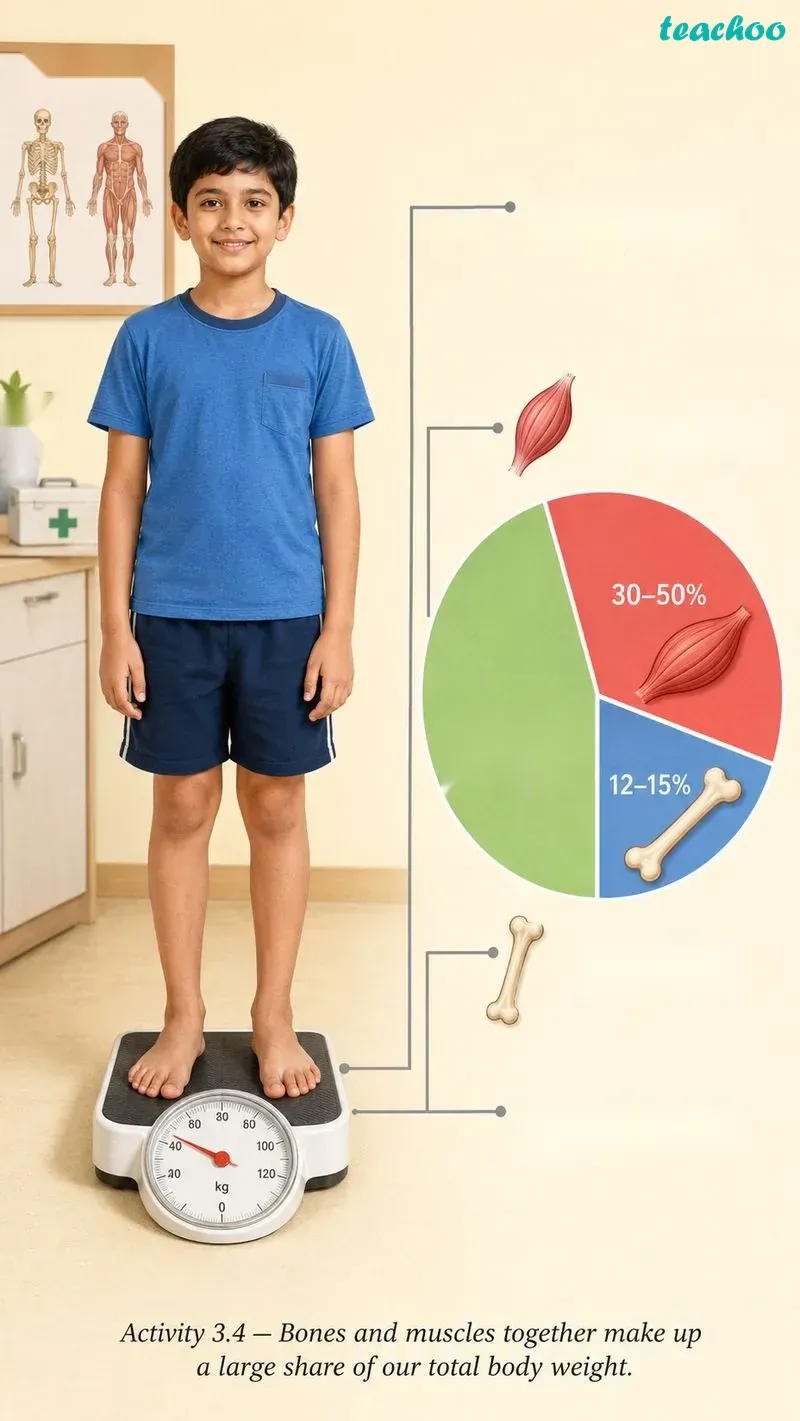
Step on the scale —
total body weight
Muscle =~ 30-50%
of body weight
Other tissues
(remainder)
= 35-55%
Bone = 12-15%
of body weight
Estimate their weights
and compare
◆ Summary
In this activity, we learnt that:
- After weighing ourselves, we found the bone and muscle percentages of body weight.
- We estimated the weight of bone and muscle from these percentages.
- We compared our values with our classmates.
Important Points
- The musculoskeletal system is made of the muscles and the skeleton (bones, joints, cartilage, tendons and ligaments) working together.
- It supports the body, allows movement, keeps posture and protects organs, all under nervous control.
- Tendons join muscle to bone and ligaments join bone to bone.
- Movement happens when a muscle contracts, the tendon pulls the bone, and the bone moves at a joint.
❓ Test Yourself
-
What is the musculoskeletal system made of?
View Answer
The muscles and the skeleton — bones, joints, cartilage, tendons and ligaments. -
Why is the musculoskeletal system required?
View Answer
To support the body, allow movement, keep posture and protect the organs. -
Which part joins muscle to bone, and which joins bone to bone?
View Answer
A tendon joins muscle to bone; a ligament joins bone to bone. -
What is the job of cartilage?
View Answer
It cushions the ends of the bones so they do not rub against each other. -
How does movement happen?
View Answer
A muscle contracts, the tendon pulls the bone, and the bone moves at a joint.
Important Definitions
- Musculoskeletal system — the system of muscles and the skeleton that supports and moves the body.
- Tendon — a tough band that joins muscle to bone.
- Ligament — a tough band that joins bone to bone.
- Cartilage — a soft, jelly-like tissue that cushions the ends of bones.
