 You are here

💬 Think about it
In a cricket team, there are many players
Some are batsmen, Some are bowlers
Each have a specific job to do
Similarly in our body
cells behave like a team
They form group called tissues
These tissues perform a specific function
Example
In our body, there are muscle tissues, nerve tissues etc
Each have a specific function
![Introduction - Tissues in Action - [Teachoo] - Concepts](https://cdn.teachoo.com/2c0ba5f9-b4ee-4fd8-a8ae-395548a68321/cells-team-up-like-a-cricket-team.webp)
Each player
has one job
Together they
win the match
Cells team up
the same way
A team of
similar cells =
a tissue
What is a cell?
Cell
Cell — the basic unit of life
↓
Every living organism
is made up of cells.
↓
Single cell
unicellular organism
(amoeba)
Many cells
multicellular organism (plants, animals)
- In Chapter 2, Cell: The Building Block of Life , we learnt that the cell is the basic unit of life .
- Every living organism is made up of cells.
- Some organisms have a single cell — these are called unicellular organisms (example: amoeba).
- Some organisms have many cells — these are called multicellular organisms (example: plants, animals).
What is a tissue?
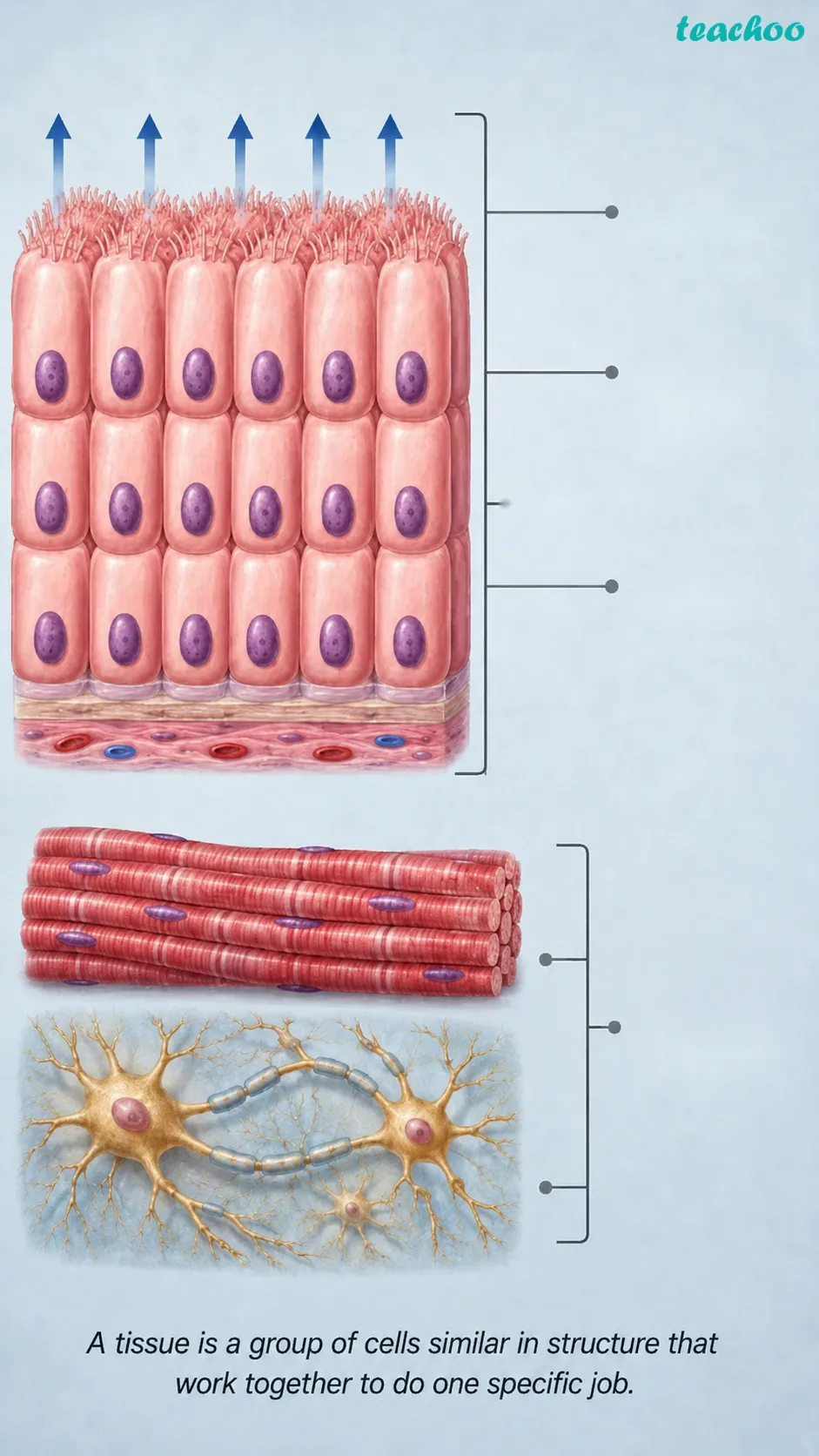
Tissue
Group of
cells
similar in structure
One specific function
they work together
↓
A tissue is a group of cells similar in structure that work together to perform a specific function.
Cells similar
in Structure
Working together
for one job
Tissue
This group = a tissue
Example -
Muscle Tissue,
Nervous Tissue
- A tissue is a group of cells (similar in structure) that work together to perform a specific function.
Example:
In animals,
muscle tissue
enables movement, and
nervous tissue
carries messages to different parts of the body.
Do all organisms have cells and tissues?
Which Organisms Have Tissues
All organisms have cells
But do they have tissues?
1. Unicellular
One cell does all the jobs of life
No tissues
Example:
Amoeba
2. Multicellular
Cells of similar type group together
Tissues present
Example:
Plants
Animals
↓
Only multicellular organisms have tissues.
- All organisms have cells — the cell is the basic unit of life, so nothing living is without a cell.
- But all organisms do not have tissues .
- In unicellular organisms , such as amoeba , a single cell performs all the functions of life . There is no group of cells, so there are no tissues .
- In multicellular organisms , many cells of similar type group together and form tissues.
- So, only multicellular organisms have tissues.
How is the body organised in multicellular organisms?
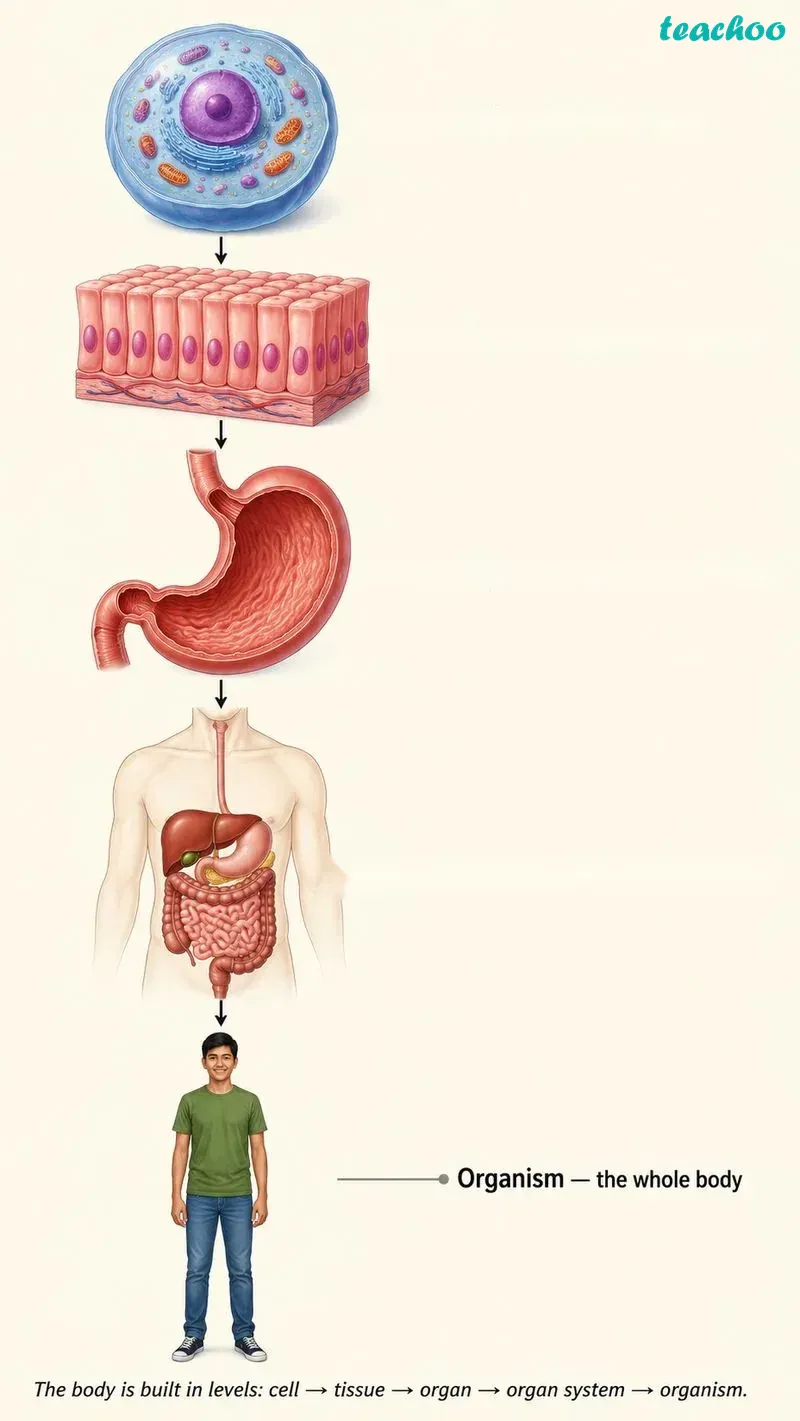
From a Cell to an Organism
Cell
↓
Tissue
Group of similar type of cells performing similar function is tissue
↓
Organ
More than one type of tissue forms up an organ
↓
Organ system
Different organs together form an organ system
↓
Organism
Cell — the building block
Tissue — similar cells, one job
Organ — more than one tissue
Organ system — organs together
Organism — the whole body
- In all multicellular organisms there is a hierarchy of organisation .
- Cells of similar type performing similar function, group together to form a tissue .
- More than one type of tissue forms an organ .
- Different organs form an organ system .
- Organ systems form an organism .
Why do multicellular organisms have tissues?
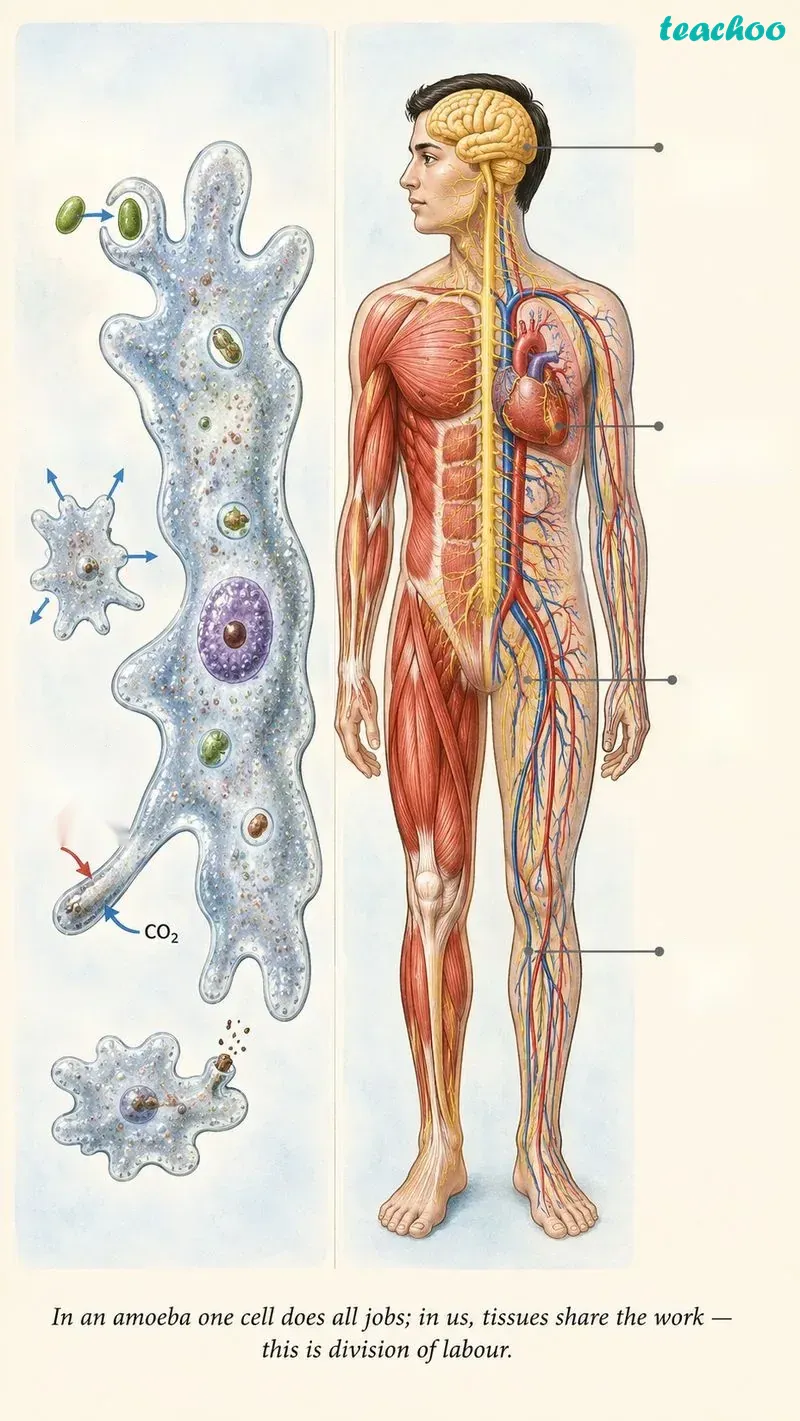
Division of Labour
Division
the work is divided
Labour
the functions the body must perform
↓
Different types of tissues perform different functions — this increases the efficiency of the body and enables it to carry out complex life processes.
Amoeba
Multicellular body
One cell performs all the functions of life
Each tissue performs one specific function
No division of labour
Division of labour between tissues
Efficiency is limited
Higher efficiency — complex life processes possible
Eating /
engulfing food
Moving with
pseudopodia
Our body —
each tissue
has its own task
Sharing of
jobs =
division of
labour
Breathing /
gas exchange
O2
This makes
the body
efficient
Removing
waste
Our body
each tissue has its own task
Amoeba -
one cell does everything
- In a multicellular organism, different groups of cells perform different functions .
- The formation of different types of tissues leads to the division of labour .
- Division of labour increases the efficiency of the body .
- It enables the body to carry out complex life processes .
Example:
In an
amoeba
, one single cell performs all the functions of life. In us, muscle tissue moves the body while nervous tissue carries messages.
What is the difference between a cell and a tissue?
| Basis | Cell | Tissue |
|---|---|---|
| Meaning | The basic unit of life | A group of cells similar in structure |
| Number of units | A single unit | Many cells together |
| Level of organisation | First level | The next level, above the cell |
- A cell is a single unit; a tissue is a group of cells.
- A cell is the basic unit of life ; a tissue is the next level in the hierarchy of organisation.
- In a unicellular organism, one cell performs all the functions of life; a tissue performs one specific function .
Example:
One muscle cell → many similar muscle cells together → muscle tissue.
Are tissues found only in animals, or in plants too?
Tissues in Plants and Animals
Tissues
↓
In animals
Muscle tissue — movement;
nervous tissue — messages
In plants
Xylem — water and minerals; phloem — food
- Tissues are found in both plants and animals , because both are multicellular.
- In animals — muscle tissue enables movement; nervous tissue carries messages to different parts of the body.
- In plants — conducting tissues: xylem transports water and minerals ; phloem transports food .
- But plant tissues and animal tissues are not the same .
What does the name of the chapter tell us?
Tissues in Action
Tissues
cells of similar type
grouped together
in Action
each tissue performs its specific function
↓
Different tissues coordinate with one another so that the body can carry out life processes.
- Tissues — groups of cells of similar type that work together for one specific function.
- In Action — each tissue is doing its own function in the body.
- So, this chapter is about how the different tissues of plants and animals work, and how their structure suits their specific function .
Topics we will study in this chapter
Topics We Will Study
Intro
Introduction
3.1
Why are Plant and Animal Tissues Different?
3.2
Tissues for Growth in Plants
3.2.1
Apical meristem — How do plants grow in length?
3.2.2
Lateral meristem — How do plants grow in girth?
3.2.3
Intercalary meristem — How do plants grow after being cut?
3.2.4
Permanent tissues
3.3
Animal Tissues
3.3.1
Epithelial tissues — Structure and functions
3.3.2
How are various parts connected in our body?
3.3.3
Can we control movement in our body?
3.3.4
How does the body sense, communicate and respond?
3.4
The Musculoskeletal System
3.5
Types of Joints
3.6
Skeletal System
💭 Think It Over
-
How is the study of cells and tissues significant for understanding the life processes and human welfare?
View Answer
It helps us understand growth and repair, and lets scientists grow tissues to treat disease and improve crops. -
How are tissues in plants and animals different, and why?
View Answer
Plant tissues give support and help fixed plants grow; animal tissues allow movement, since animals move about. -
How is the division of labour at various levels of organisation in multicellular organisms correlated with their structure and function?
View Answer
Each tissue's structure suits its job, so sharing work between specialised tissues makes the whole body work better.
❓ Test Yourself
-
What is a tissue?
View Answer
A group of cells (similar in structure) that work together to perform a specific function. -
Why does an amoeba have no tissues?
View Answer
It is unicellular — a single cell performs all the functions of life, so there is no group of cells. -
Put these in order: organ, cell, organism, tissue, organ system.
View Answer
Cell → tissue → organ → organ system → organism. -
What is division of labour?
View Answer
Different types of tissues performing different functions, which increases the efficiency of the body. -
Name one animal tissue and one plant tissue, with the function of each.
View Answer
Muscle tissue enables movement (animal); xylem transports water and minerals (plant).
Important Points
- The cell is the basic unit of life; a tissue is a group of cells similar in structure that work together for one specific function.
- All organisms have cells, but only multicellular organisms have tissues.
- The order of organisation is cell → tissue → organ → organ system → organism.
- Division of labour among tissues increases the efficiency of the body and enables complex life processes.
Important Definitions
- Cell — the basic unit of life.
- Tissue — a group of cells (similar in structure) that work together to perform a specific function.
- Organ — a structure made of more than one type of tissue.
- Organ system — different organs working together.
- Organism — organ systems together.
- Unicellular organism — an organism made of a single cell, which performs all the functions of life.
- Multicellular organism — an organism made of many cells, in which cells of similar type group together to form tissues.
- Division of labour — different types of tissues performing different functions, which increases the efficiency of the body and enables it to carry out complex life processes.
