
 You are here
💬 Think about it
Feel the bones down your back and around your chest.
They hold you up and shield your heart and lungs.
How is this framework built, and how does the rib cage move when you breathe?
Let us find out.
What is the skeletal system?
Skeletal System
Skeletal
made of
bones
System
parts working together
↓
The framework of skull, vertebral column and rib cage that gives strength and protects the organs.
- It is the framework of bones that gives the body strength, shape and support.
- It also protects the soft organs inside the body.
- Its main parts are the skull , the vertebral column (backbone) and the rib cage .
How is the skeletal system related to the musculoskeletal system?
- The musculoskeletal system is made of two parts working together — the muscular system (muscles) and the skeletal system (bones).
- So the skeletal system is a part of the musculoskeletal system .
- The bones give the framework, the muscles pull on the bones, and together they produce movement.
What are the different parts of the skeletal system?
![3.6 Skeletal System - Tissues in Action - [Teachoo] - Concepts](https://cdn.teachoo.com/32889d19-9308-40b2-800a-c106c9d4b123/the-skeletal-system-framework-of-bones.webp)
What is the skeleton built from?
Skeletal System
A framework of bones
1. Skull
A hard case of flat bones
Protects brain, eyes, ears
Example:
Joined by fixed joints
2. Vertebral column
Small bones called vertebrae
Lets us stand upright
Example:
A cartilage disc cushions each vertebra
3. Rib cage
12 pairs of ribs
Guards heart and lungs
Example:
Joined to the spine and the breast bone
| Part name | Where found | Function |
|---|---|---|
| Skull | The head | Protects the brain, eyes and ears |
| Vertebral column (backbone) | The back, from the neck down to the hip | Holds the body upright and protects the spinal cord |
| Rib cage | The chest | Protects the heart and lungs and helps in breathing |
Skull — protects the brain
Vertebral column (spine)
Rib cage — protects
heart and lungs
Framework gives
strength and shape
What is the vertebral column?
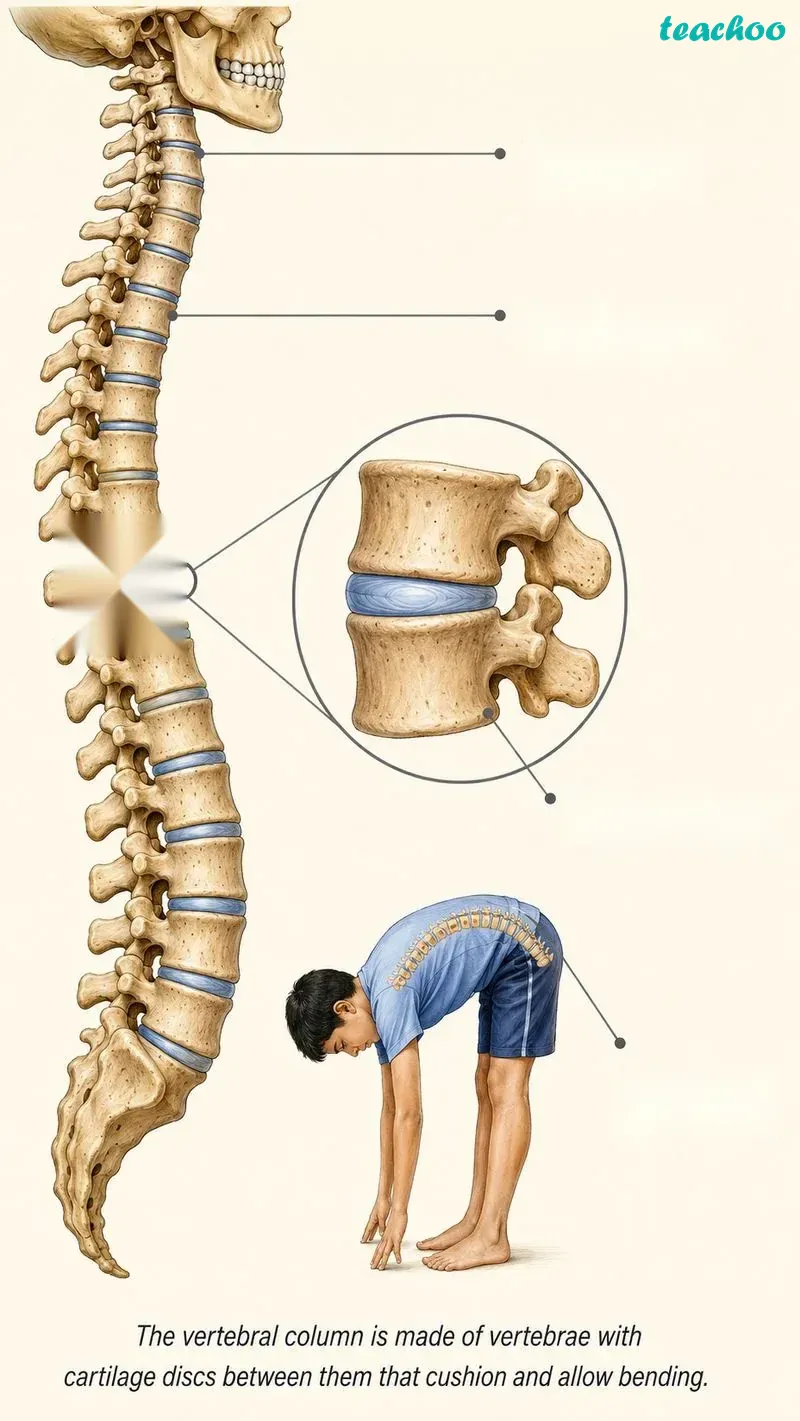
- The vertebral column is another name for the backbone .
- It is made of many small bones called vertebrae , stacked one above the other.
- A cartilage disc between the vertebrae cushions them and lets the back bend.
- It is used to hold the body upright, support the head and body, and protect the spinal cord .
Vertebrae
(small bones)
Stacked to form
the spine
Cartilage disc
between vertebrae
Cushions and
allows bending
What is the difference between the vertebral column and vertebrae?
| Vertebral column | Vertebrae |
|---|---|
| It is the whole backbone . | These are the single small bones that make up the backbone. |
| Made of many vertebrae joined together. | Each vertebra is just one bone of the column. |
| Runs from the neck down to the hip. | Stacked one above the other, with cartilage discs in between. |
What is the rib cage and why is it used?
Rib Cage
Ribs
12 pairs joining the spine and the breast bone
Cage
the basket where
ribs form
↓
The bony cage that protects the heart and lungs; flexible cartilage lets it expand and contract for breathing.
- The rib cage is a bony cage made of 12 pairs of ribs .
- The ribs join the spine at the back and the breast bone in front.
- It is used to protect the heart and the lungs inside the chest.
How does the rib cage move?
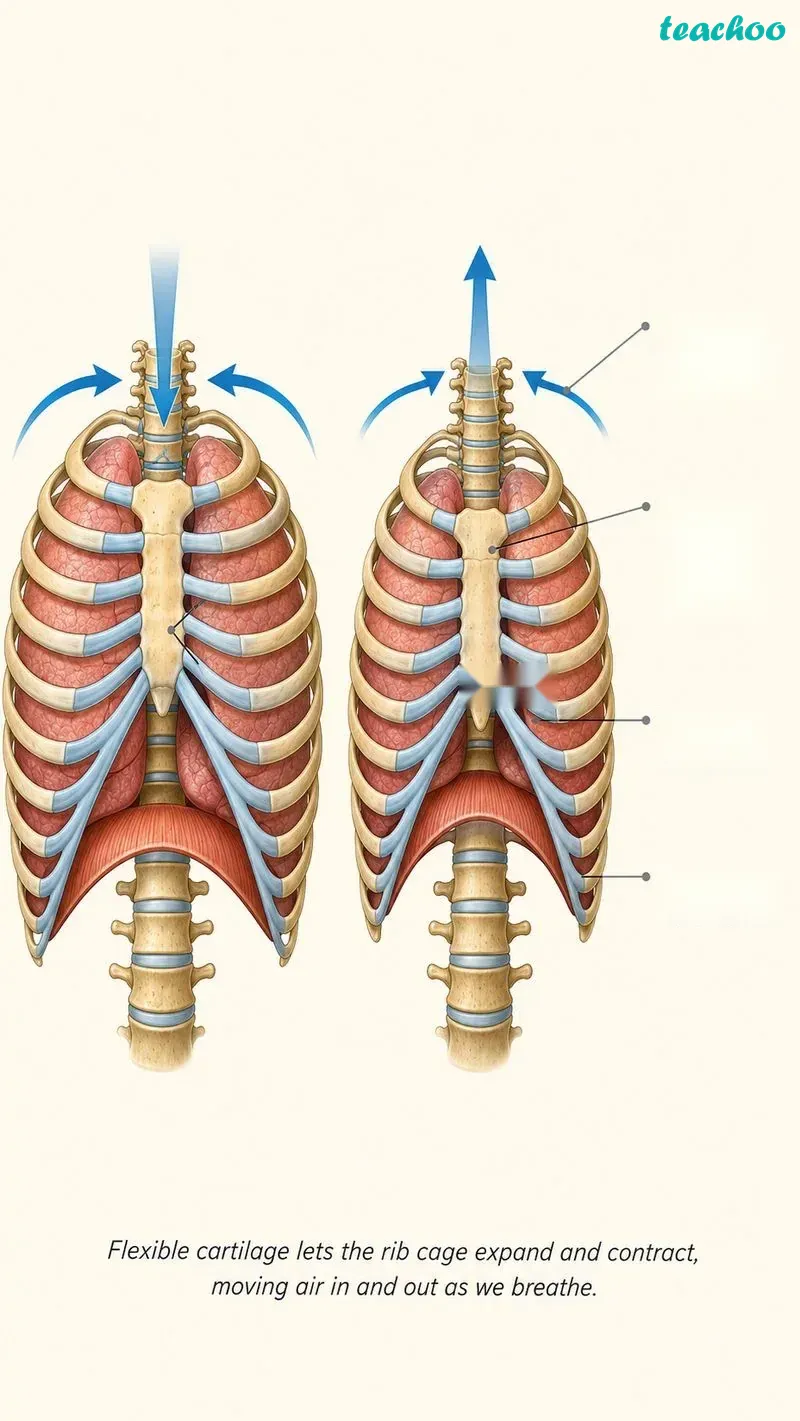
Rib Cage and Breathing
Flexible cartilage joins ribs
↓
Rib cage expands
Space in the chest increases, air moves in.
↓
Rib cage contracts
Space decreases, air moves out.
- Flexible cartilage joins the ribs, so the rib cage is able to move.
- When the rib cage expands , the space in the chest increases and air moves in.
- When the rib cage contracts , the space decreases and air moves out.
- This movement of the rib cage helps us breathe .
12 pairs of
ribs form the
rib cage
Joins spine
(back) and
breast bone
(front)
Expands —
air moves in
Contracts —
air moves out
Important Points
- The skeletal system is the framework of bones.
- It includes the skull, vertebral column and rib cage.
- The rib cage protects the heart and lungs and moves during breathing.
🔬 Meet the Scientists
- Sipra Guha Mukherjee worked with S. C. Maheshwari on plant tissue culture.
- They made a breakthrough by growing a complete plant through anther culture.
- They used an artificial nutrient medium under controlled conditions.
- Their work greatly helped crop improvement and modern agriculture.
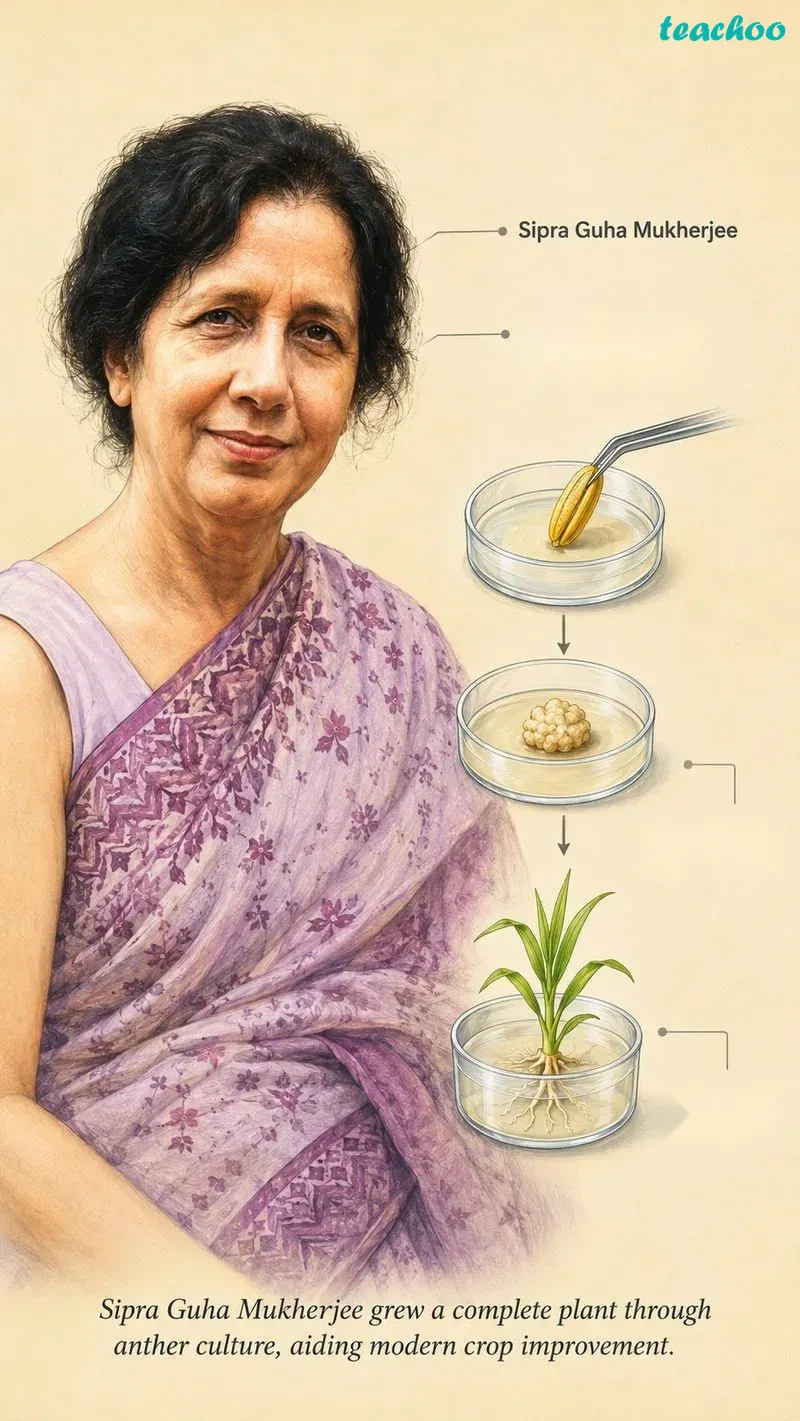
Worked on plant
tissue culture with
S. C. Maheshwari
Grew a complete
plant through
anther culture
Helped crop
improvement and
agriculture
🌎 Bridging Science and Society
- Yoga from ancient Indian texts includes postures, breathing and meditation.
- Research shows it improves flexibility, posture and breathing.
- It reduces stress and helps prevent lifestyle diseases.
- 21st June is observed every year as International Yoga Day.
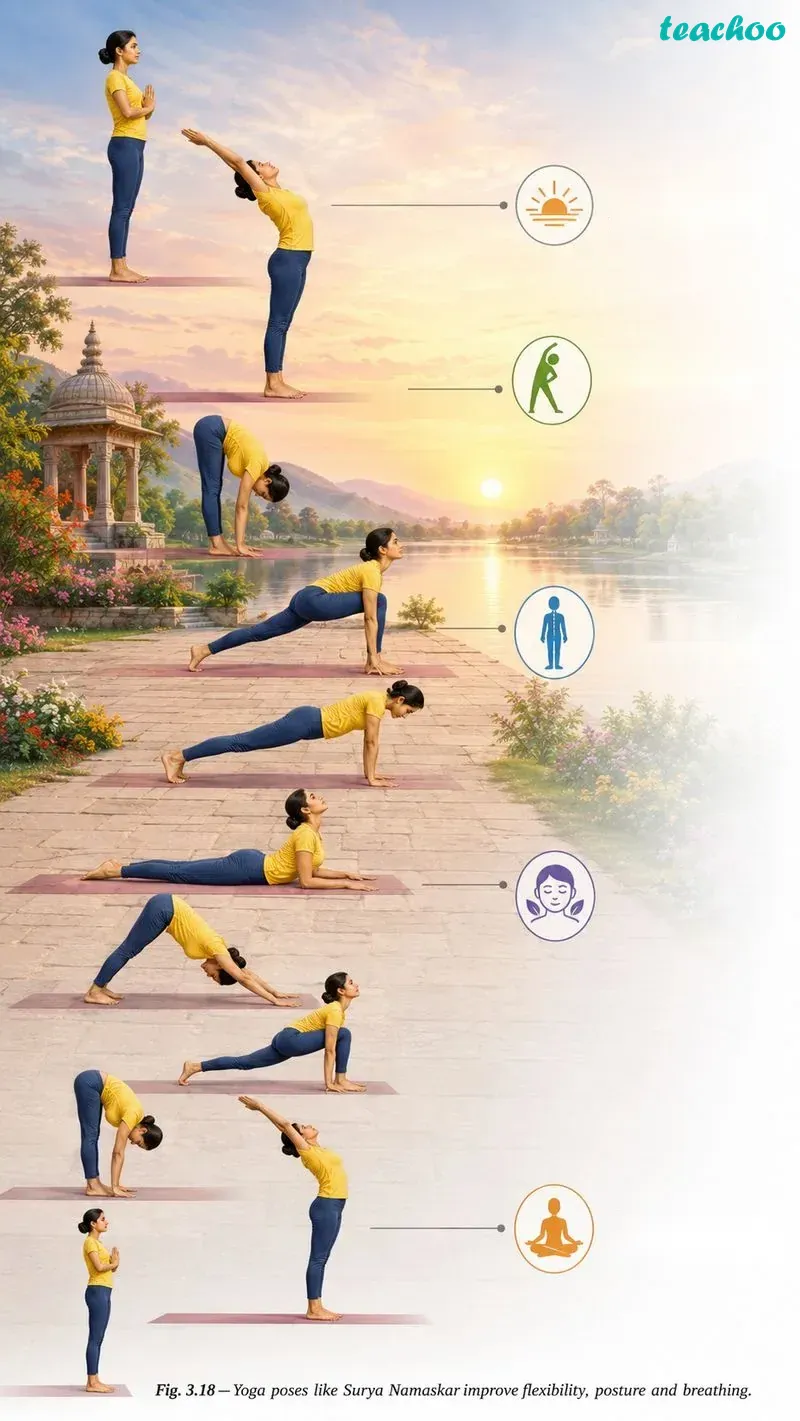
Surya Namaskar —
a sequence of poses
Improves flexibility
and posture
Improves breathing,
reduces stress
21st June —
International Yoga Day
🧪 Think as a Scientist
- In 1958, F. C. Steward showed single carrot phloem cells can grow into whole plants.
- The cells dedifferentiated into an unspecialised mass, then redifferentiated into a full plant.
- This ability of mature cells to form a whole new plant is called totipotency.
- It is like the way a zygote divides and develops into a whole organism.
Table 3.6 — Effect of light, air and nutrient medium on growth of the cultured plant cells
| Light | Air | Composition of nutrient medium | Increase in fresh weight (mg) of the cells from intial weight |
|---|---|---|---|
| Yes | No | Solid medium + nutrients | Reduced |
| Yes | Yes | Liquid medium + nutrients | 20% increased |
| No | Yes | Liquid medium + nutrients | Reduced |
-
What do you conclude about the characteristics of phloem cells of carrot?
They are totipotent — even mature phloem cells can divide and grow into a whole new plant. -
In which combination would you get the highest and lowest biomass, and why?
Highest with light, air and liquid medium (best supply of nutrients and oxygen); lowest when air or light is missing, since growth needs both. -
Will you get the same results with animal cells?
No — most mature animal cells are not totipotent and cannot regrow a whole animal this way. -
Mention two commercial applications of this study.
Growing many identical plants by tissue culture, and producing disease-free or improved crop plants.
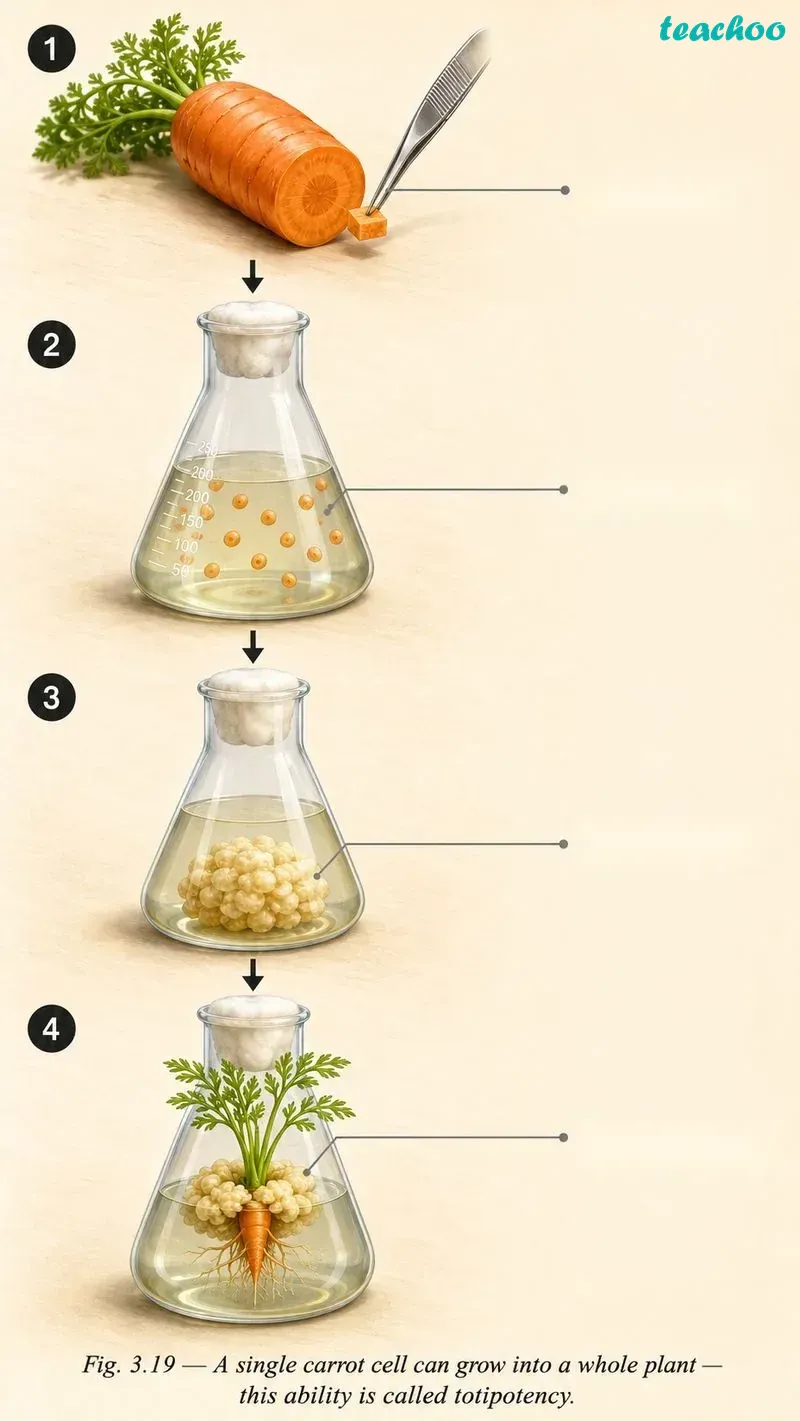
Piece of carrot
phloem tissue
Single cells in
nutrient medium
Cells divide into an
unspecialised mass
Grows into a whole
new plant (totipotency)
🌎 Bridging Science and Society
- Crown gall disease makes tumour-like swellings on plant stems.
- It is caused by rapid, uncontrolled cell division.
- The bacterium Agrobacterium tumefaciens causes it.
- Scientists now use this bacterium to put useful genes into plants for better crops.
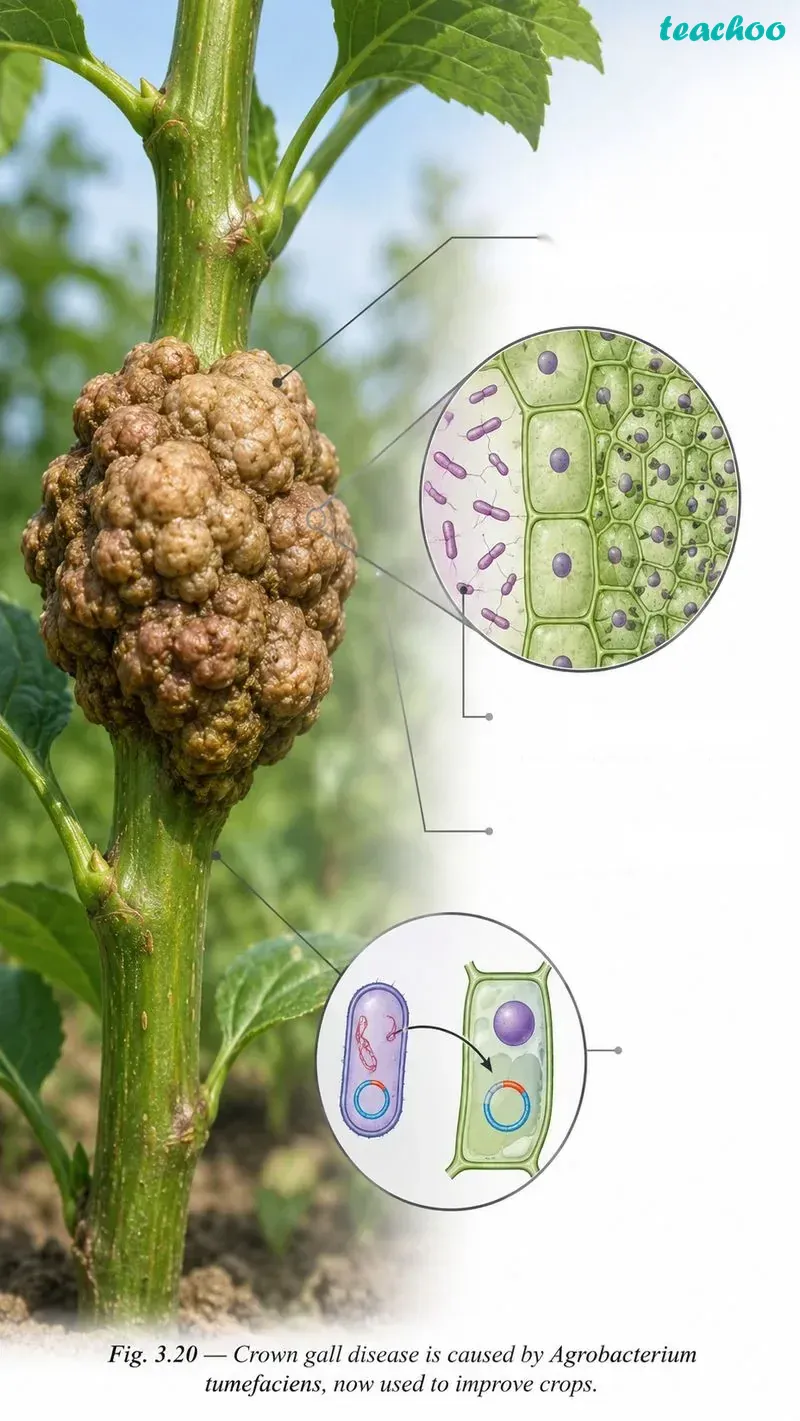
> Tumour-like
swelling (crown gall)
Caused by
uncontrolled cell division
Bacterium: Agrobacterium
tumefaciens
Used to put
useful genes
into plants
❓ Test Yourself
-
What three parts make up the skeletal system?
View Answer
The skull, vertebral column and rib cage. -
What is the vertebral column made of?
View Answer
Small bones called vertebrae, with cartilage discs between them. -
How many pairs of ribs form the rib cage?
View Answer
12 pairs. -
Why must the rib cage be able to move?
View Answer
So it can expand and contract to move air in and out during breathing.
Important Definitions
- Skeletal system — the framework of bones that supports the body and protects organs.
- Vertebral column — the backbone, made of small bones called vertebrae.
- Totipotency — the ability of some mature plant cells to grow into a whole new plant.
