
 You are here
💬 Think about it
Cut across a sunflower stem and look under a microscope.
You will see many different kinds of cells, not just one.
Each kind forms a tissue with a special job.
Now, let us meet the permanent tissues of a plant.
What are permanent tissues?
Permanent Tissue
Permanent
the cells have stopped dividing
Tissue
a group of similar cells
doing one job
↓
Tissue of cells that no longer divide and are specialised for a specific job —
simple (one cell type) or complex (more than one).
One cell type or many?
Permanent Tissue
Simple or complex
1. Simple
Only one type of cell
Supports the plant
Example:
Parenchyma
Collenchyma
Sclerenchyma
2. Complex
More than one cell type
Conducts water and food
Example:
Xylem
Phloem
- They are tissues made of cells that have stopped dividing.
- Each is specialised to do a specific job.
- They can be simple (one type of cell) or complex (more than one type).
![3.2.4 Permanent tissues - Tissues in Action - [Teachoo] - Concepts](https://cdn.teachoo.com/08173759-9e56-41dc-888c-14be2c44ae38/permanent-tissues-simple-and-complex.webp)
Complex
(more than one
type of cell)
Simple
(one type of cell)
Simple —
parenchyma,
collenchyma,
sclerenchyma
Complex —
xylem, phloem
e— Simple = one type of cell
e— Complex = more than one type of cell
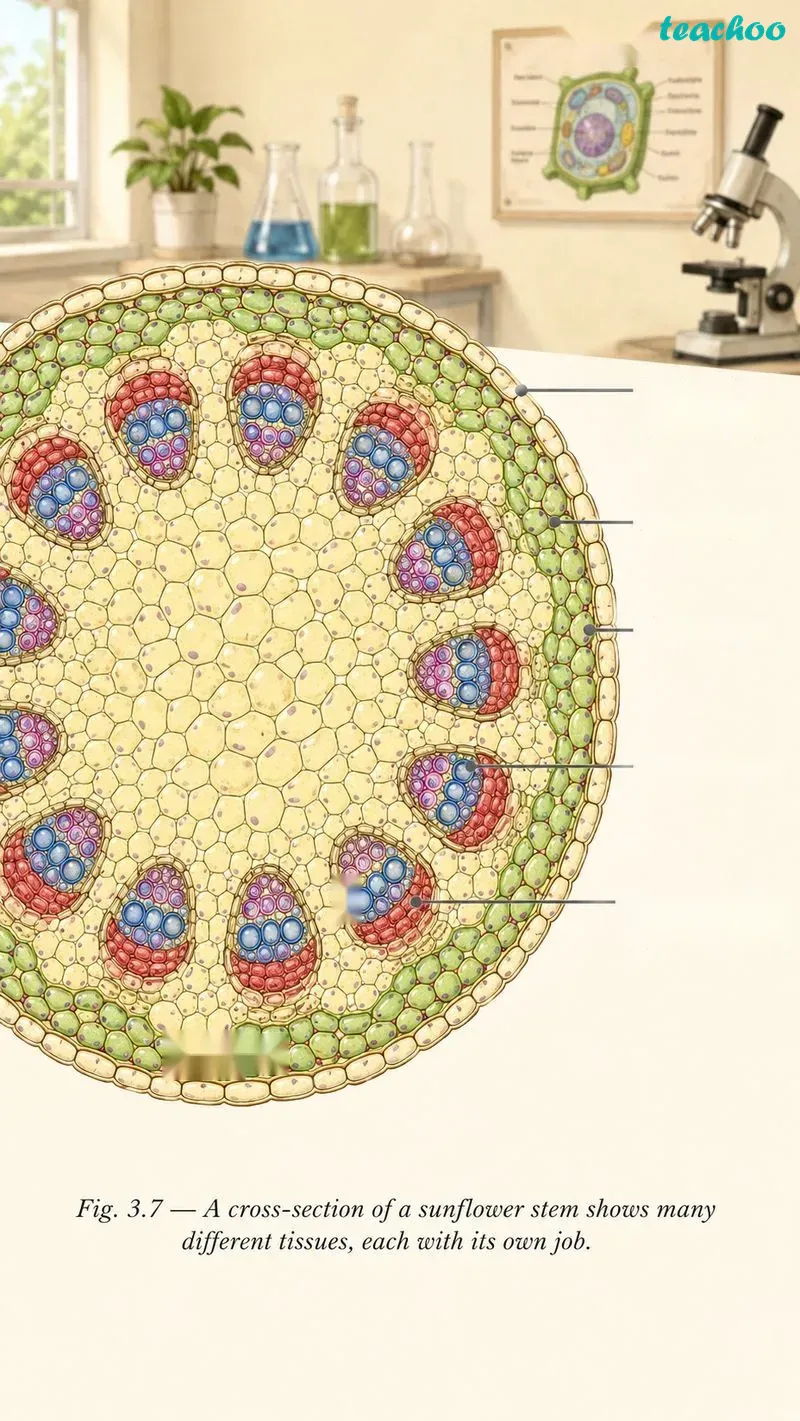
=
PLANT CELL
Epidermis
(outer layer)
Parenchyma
Collenchyma
Sclerenchyma
Wee
\\
Vascular bundle
(xylem + phloem)
rae
Ore
What is the protective tissue of a plant?
Epidermis
Epi-
upon, the outermost layer
-dermis
the skin-like covering
of the plant body
↓
The outermost single layer of flat, tightly packed cells, covered by a waxy cuticle, that protects against injury, water loss and microbes.
- The epidermis is the outermost layer of the plant body.
- It is a single layer of flat, tightly packed cells.
- It is covered by a waxy layer called the cuticle.
- It protects against injury, water loss and microbes.
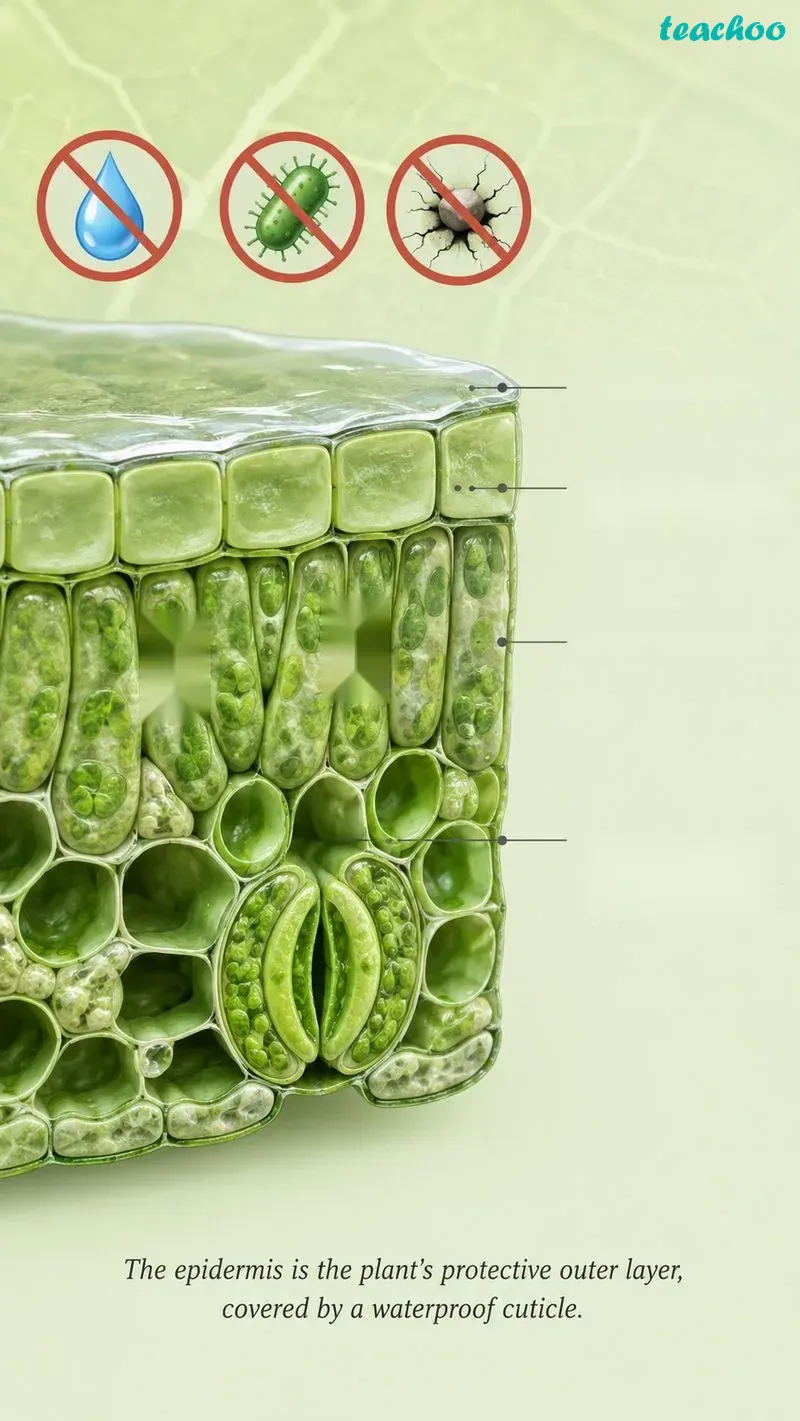
Cuticle (waxy layer)
Epidermis (single layer
of flat cells)
Tightly packed cells
Protects against
water loss, microbes,
injury
What extra features does the epidermis have?
In roots
In leaves
Forms root hairs
Has pores called stomata
Absorb water and minerals
Help in gas exchange and transpiration
Increase the absorbing surface
Transpiration pulls water up and removes wastes
- In roots, it forms root hairs that absorb water and minerals.
- In leaves, it has pores called stomata.
- Stomata help in gas exchange and transpiration.
- Transpiration helps pull water up and remove wastes.
Example:
Root hairs increase the surface area for soaking up water from the soil.
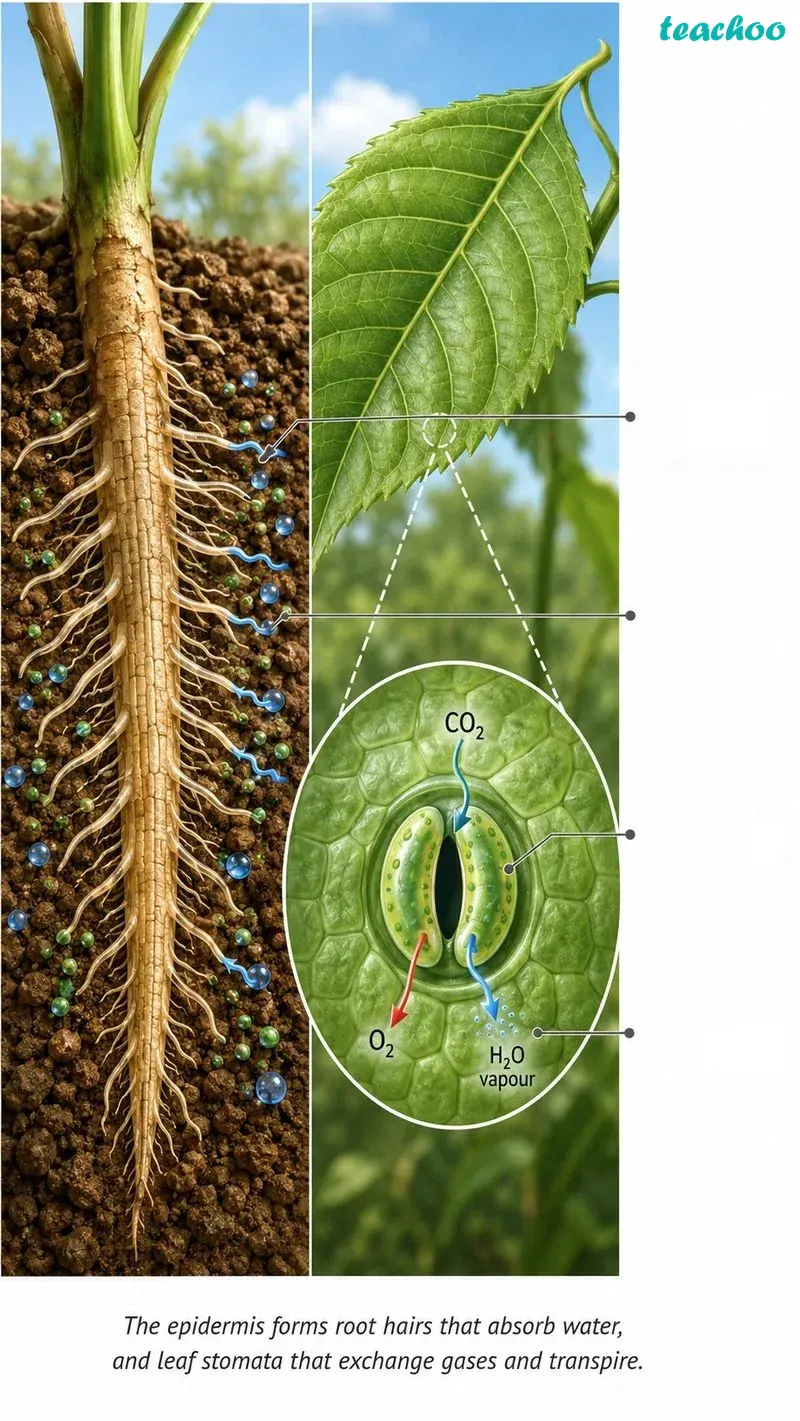
Root hairs —
absorb water
and minerals
Larger surface
for absorption
Stoma (pore)
with guard cells
Gas exchange
and transpiration
What are the simple permanent (supporting) tissues?
Simple Permanent Tissue
Simple
made of only
one type of cell
Permanent tissue
cells that have stopped dividing
↓
The supporting tissues of a plant — parenchyma, collenchyma and sclerenchyma — each giving support in its own way.
Which tissue keeps a plant up?
Simple Permanent Tissue
Three supporting tissues
1. Parenchyma
Living, thin walls
Stores food
Example:
Air spaces in a lotus
Green parts of a leaf
2. Collenchyma
Living, thick corners
Bends without breaking
Example:
A fresh twig
Stems and tendrils
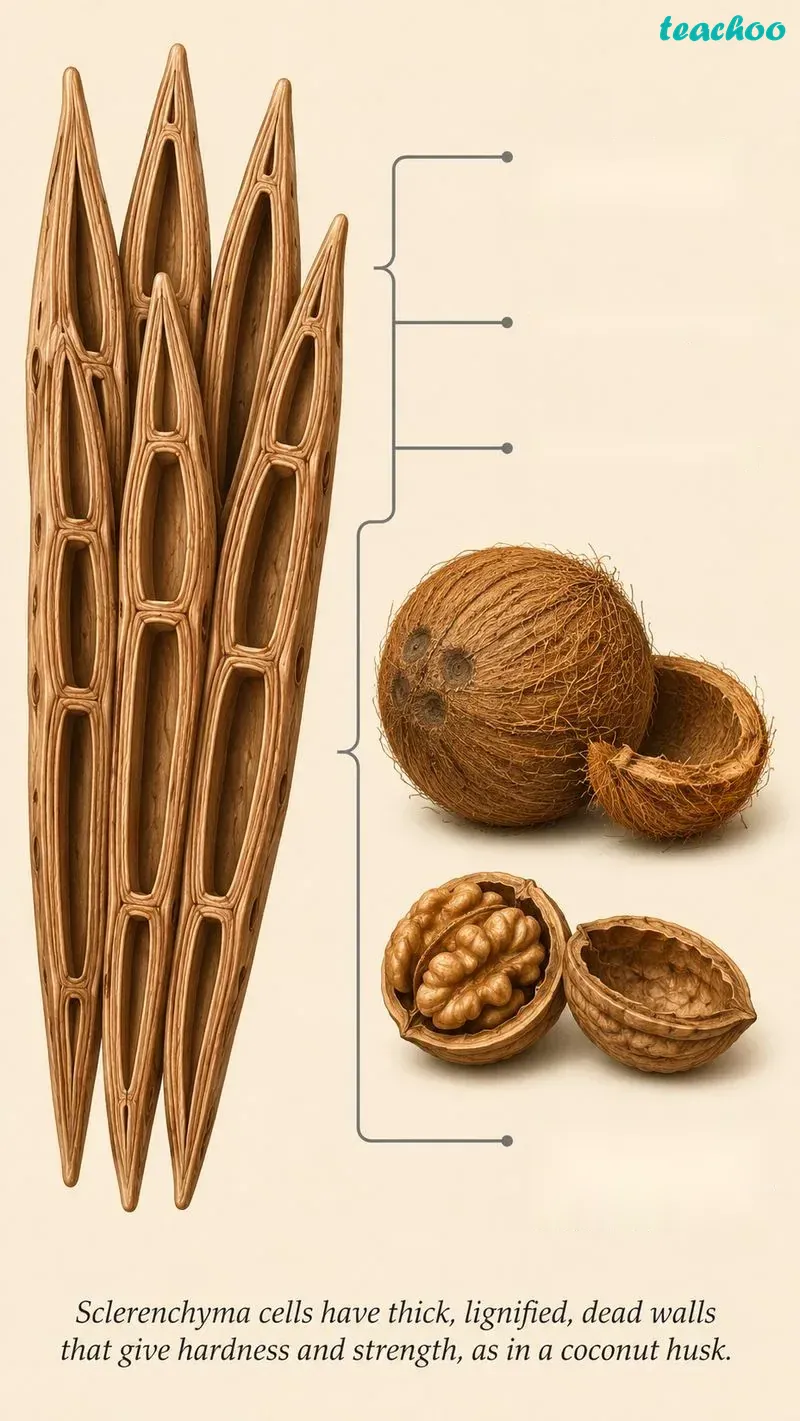
3. Sclerenchyma
Dead, lignified walls
Hard and strong
Example:
Coconut husk
Walnut shell
Leaf veins
Seed coats
- They are the supporting tissues of a plant.
- There are three types: parenchyma, collenchyma and sclerenchyma.
- Each differs in structure and gives support in its own way.
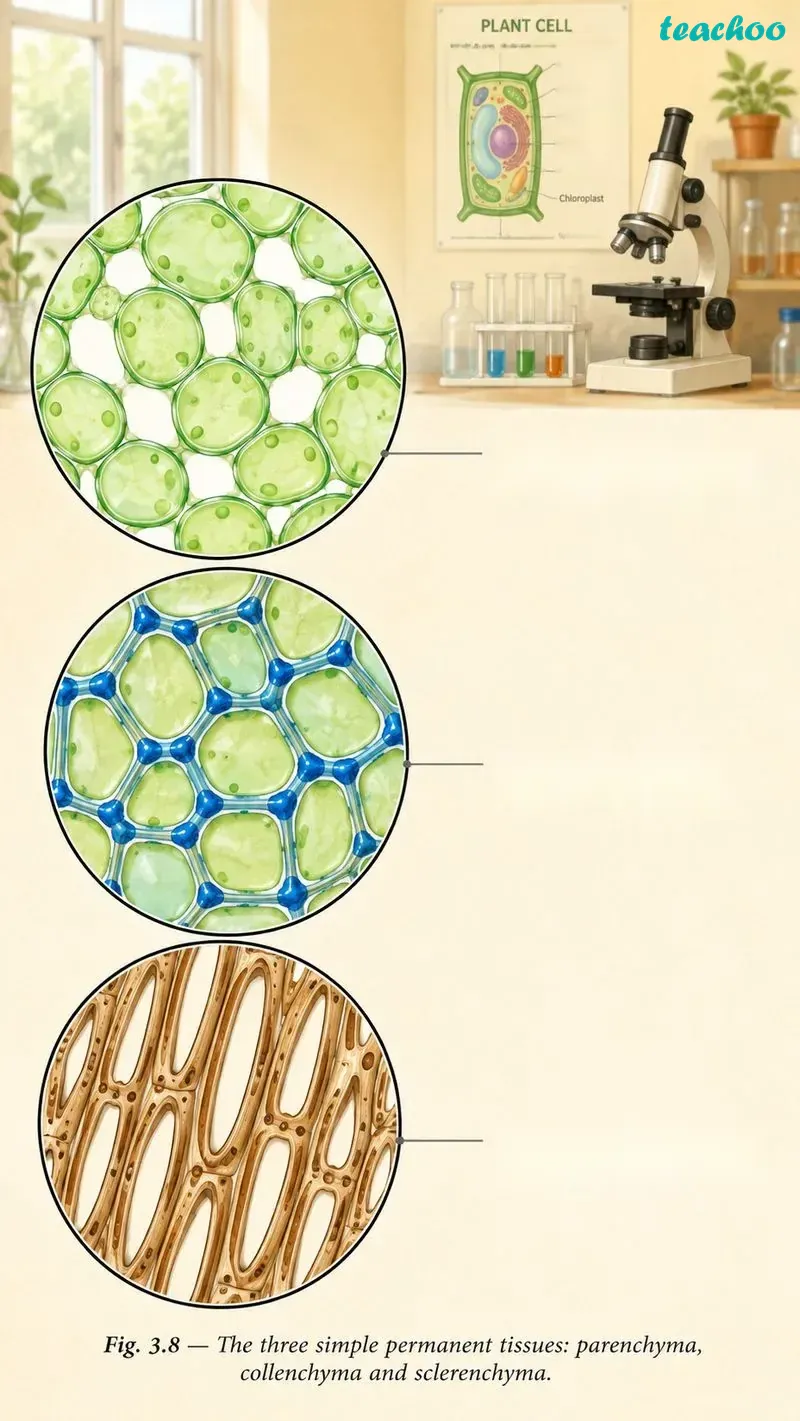
Cell wall
Celi membrane
Cytoplasm
Nucleus
Vacuole
(a) Parenchyma —
thin walls, loosely packed
(b) Collenchyma —
thick corners, flexible
(c) Sclerenchyma —
thick lignified walls, dead
What does parenchyma do?
Parenchyma
Living, thin-walled cells
the cell walls
are thin
Loosely packed
with spaces between the cells
↓
A simple permanent tissue that stores food, does photosynthesis in green parts, and forms floating air spaces in aquatic plants.
| Feature | Description |
|---|---|
| Cell wall | Thin |
| Living or dead | Living cells |
| Packing | Loosely packed, with spaces between cells |
| Function | Stores food; does photosynthesis in green parts |
| Special form | Air spaces in aquatic plants help floating |
- Parenchyma is made of living cells with thin walls.
- The cells are loosely packed with spaces between them.
- It mainly stores food and can do photosynthesis in green parts.
- In aquatic plants, special parenchyma forms air spaces that help floating.
Example:
The soft inner pulp of many fruits is parenchyma storing food.
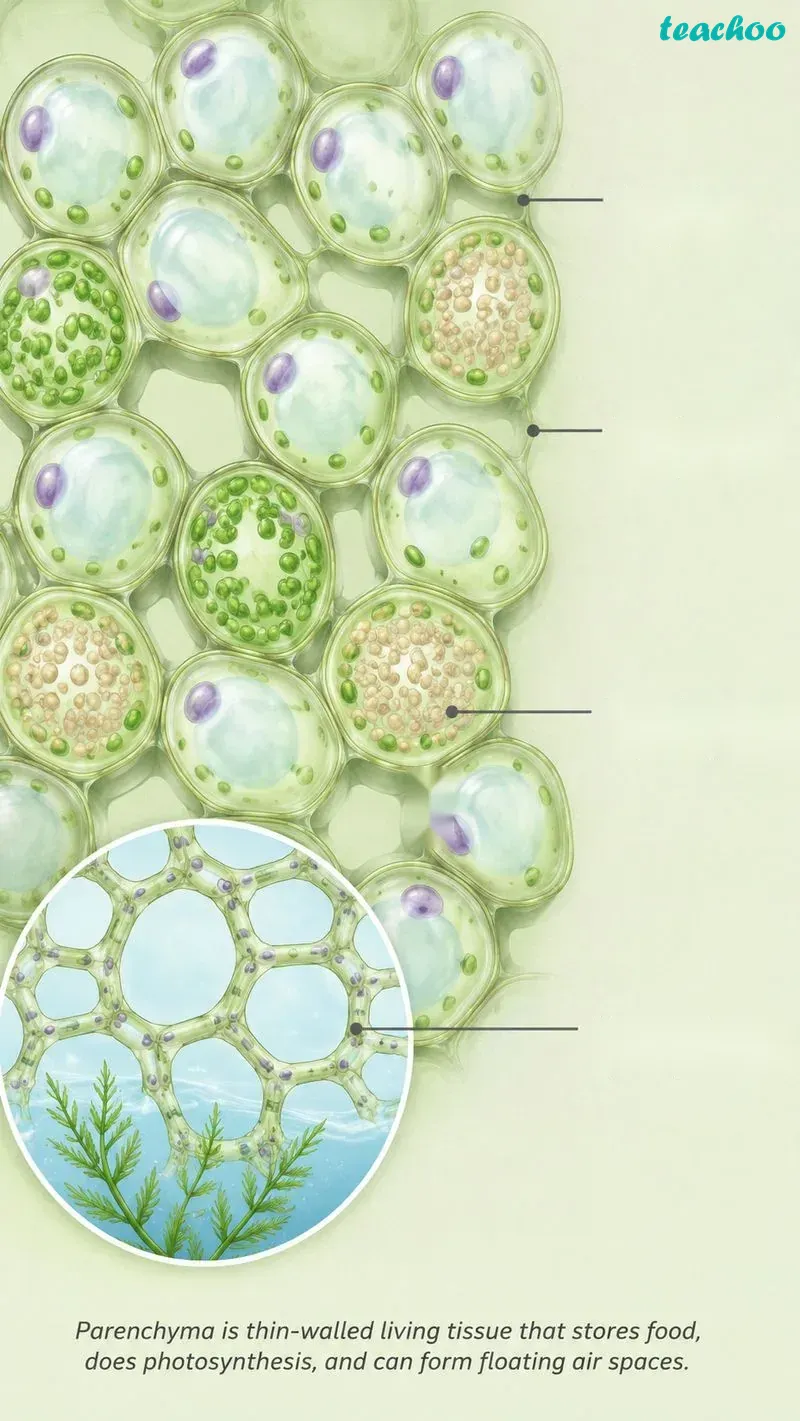
Thin-walled
living cells
Loosely packed,
with spaces
Stores food; can
do photosynthesis
Via
\
Air spaces help
aquatic plants float
What does collenchyma do?
Collenchyma
Living cells
the cells
are alive
Thickened corners
corners unevenly thickened with pectin
↓
A simple permanent tissue that is flexible like rubber, letting stems and tendrils bend without breaking.
| Feature | Description |
|---|---|
| Cell wall | Corners unevenly thickened with pectin |
| Living or dead | Living cells |
| Property | Pectin gives flexibility, like rubber |
| Function | Lets stems and tendrils bend without breaking |
- Collenchyma is made of living cells.
- Its corners are unevenly thickened with pectin.
- Pectin gives flexibility, like rubber.
- It lets stems and tendrils bend without breaking.
Example:
The soft, flexible leaf stalk of coriander is supported by collenchyma.
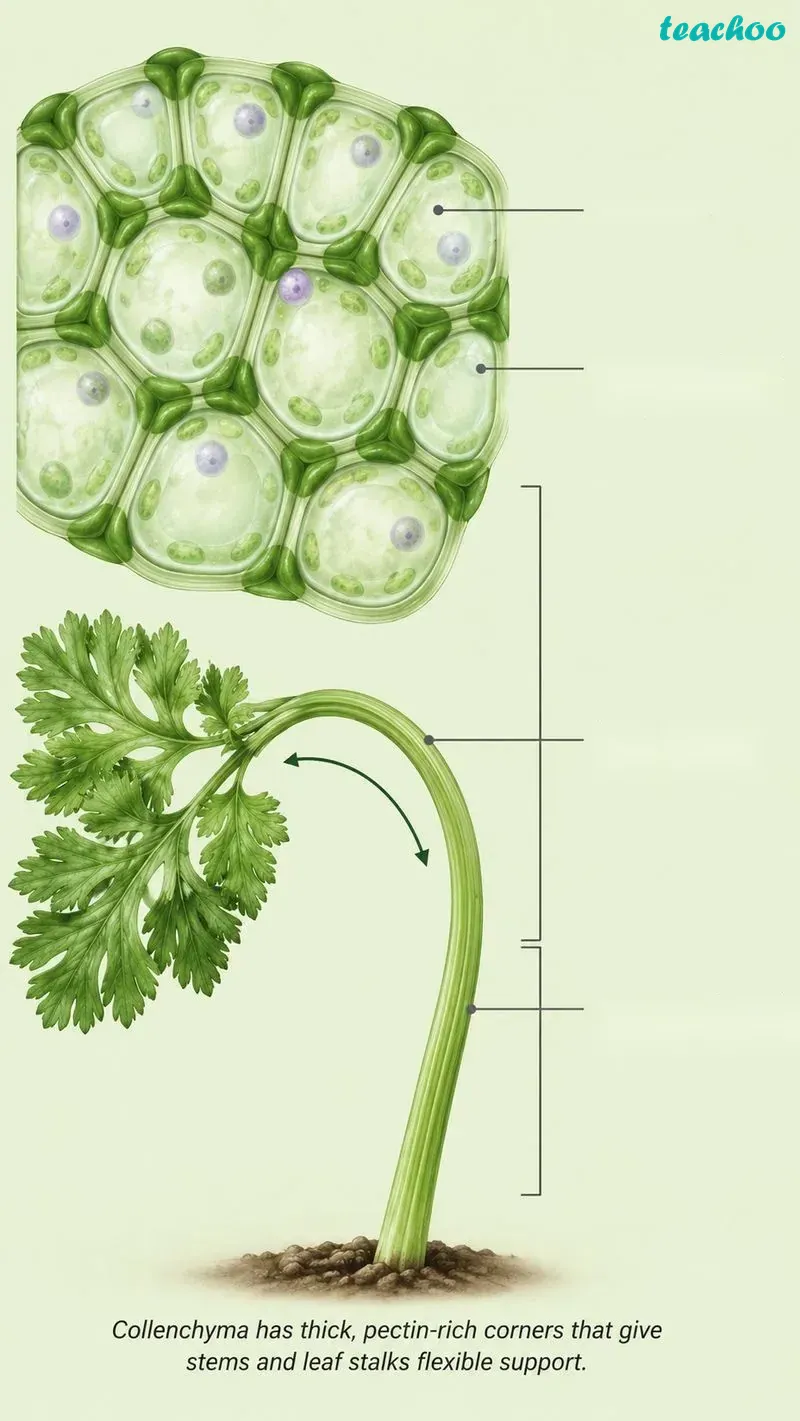
Living cells
Corners thickened
with pectin
Flexible, bends
without breaking
Supports soft stalks
(e.g. coriander)
What does sclerenchyma do?
Sclerenchyma
Thick walls
walls thickened
with lignin
Mostly dead cells
the cells are hard and strong
↓
A simple permanent tissue that forms woody parts; found in stems, leaf veins and hard seed coverings.
| Feature | Description |
|---|---|
| Cell wall | Thick, due to lignin |
| Living or dead | Most of these cells are dead |
| Property | Hard and strong; forms woody parts |
| Where found | Stems, leaf veins and hard seed coverings |
- Sclerenchyma cells have thick walls due to lignin.
- This makes them hard and strong, forming woody parts.
- Most of these cells are dead.
- It is found in stems, leaf veins and hard seed coverings.
Example:
The hard husk of a coconut and the shell of a walnut are sclerenchyma.
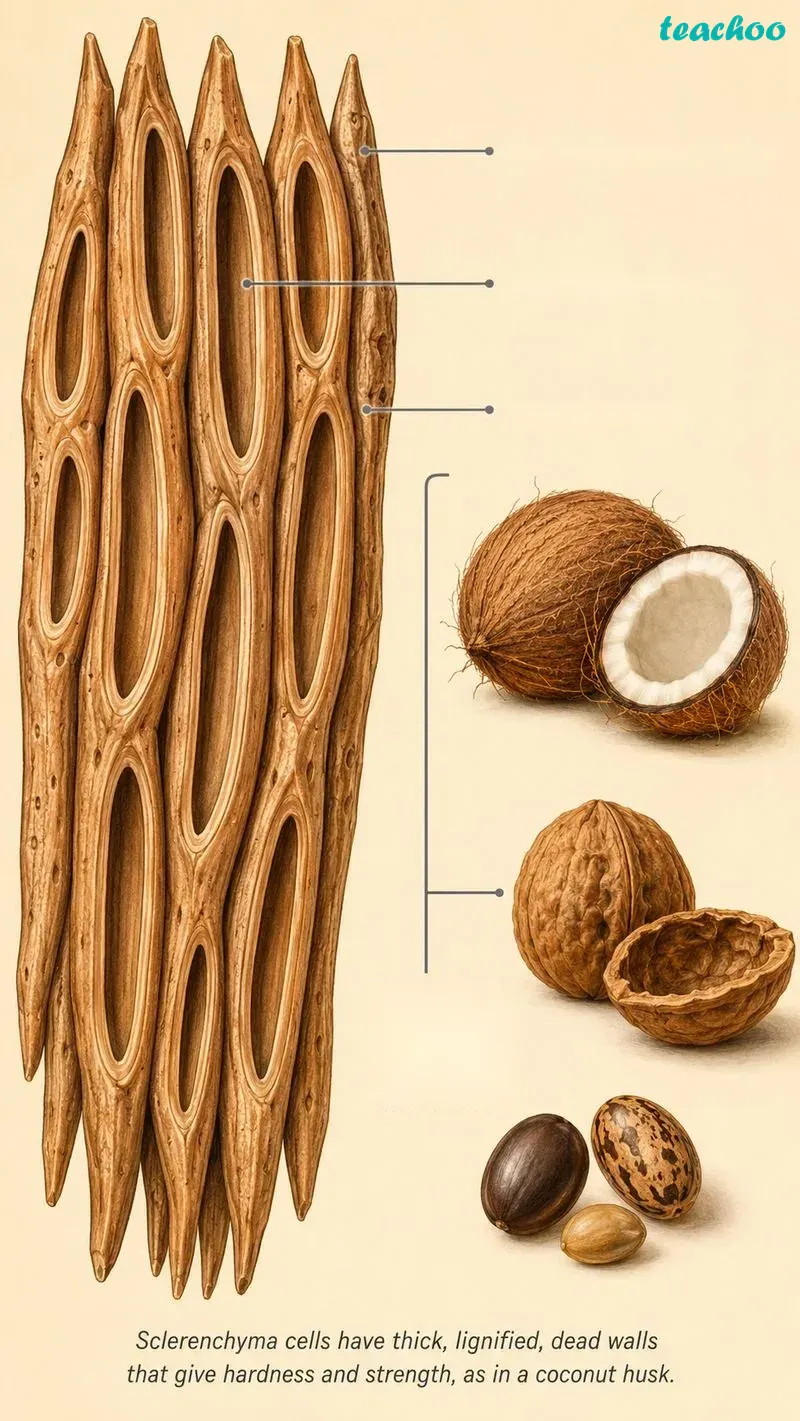
Very thick walls (lignin)
Cells mostly dead
Hard and strong
Found in
coconut husk,
walnut shell,
seed coats
What are complex permanent (conducting) tissues?
Complex Permanent Tissue
Complex
different types of cells
work together
Permanent tissue
the cells have stopped dividing
↓
The conducting tissues —
xylem, which carries water and minerals,
and phloem, which carries food.
Xylem
Phloem
Carries water and minerals
Carries food
A complex tissue
A complex tissue
Different cell types work together
Different cell types work together
- They are the conducting tissues, xylem and phloem.
- They are complex because they have different types of cells working together.
- Xylem carries water and minerals; phloem carries food.
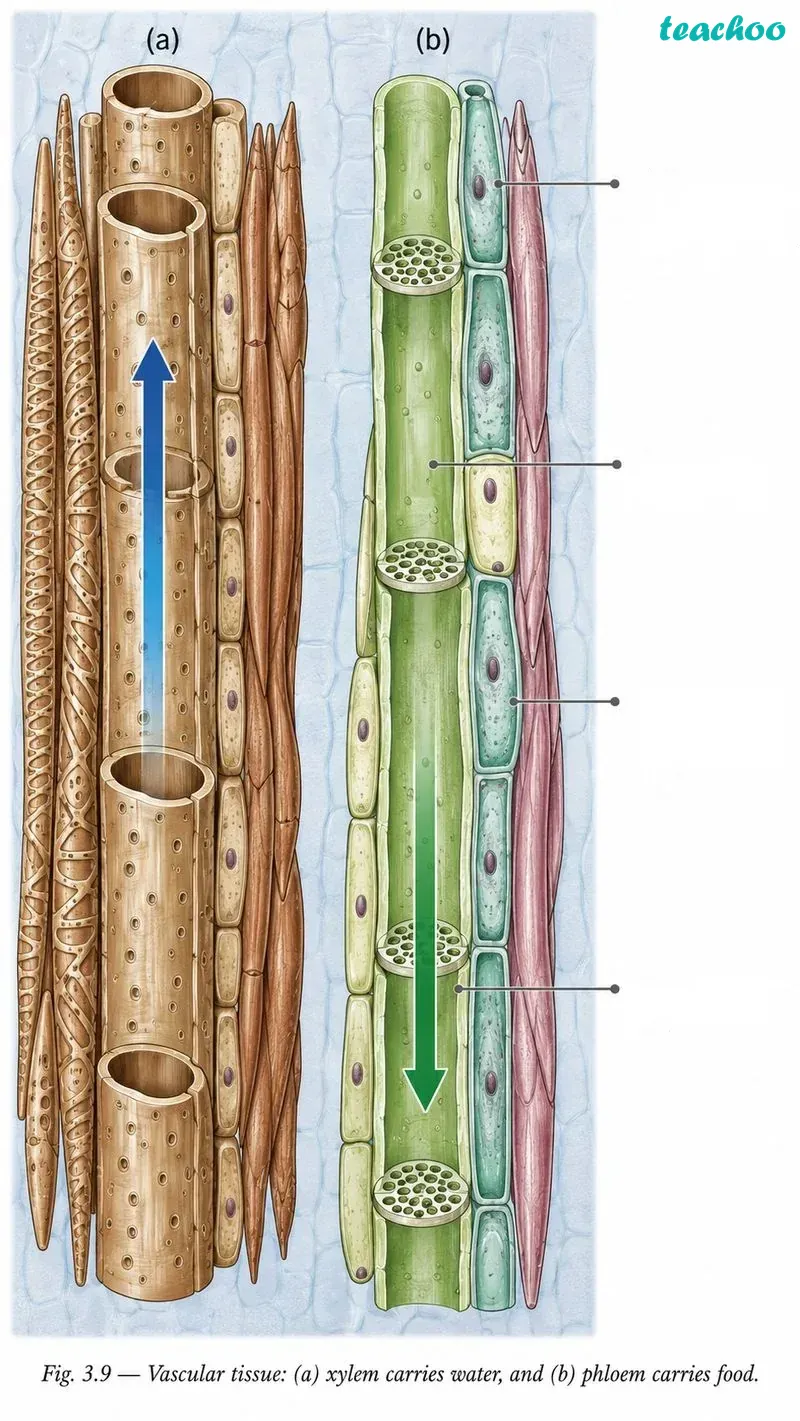
(a) Xylem —
vessels, tracheids,
fibres, parenchyma
Xylem carries
water upward
(b) Phloem —
sieve tubes,
companion cells
Phloem carries
food
What does xylem do?
Xylem
Tracheids and vessels
the tubes that carry water
Xylem parenchyma and fibres
only the parenchyma is living
↓
The conducting tissue that transports water and minerals from the roots to other parts, and also gives strength to the plant.
How Xylem Moves Water
Roots absorb water
↓
Up the xylem
Water and minerals rise through hollow tubes.
↓
Reach the leaves
Which parts of xylem are alive?
Xylem
Carries water upward
1. Living part
Xylem parenchyma only
Stores food
Example:
Xylem parenchyma
2. Dead part
Sclerenchymatous, thick
Makes the pipe strong
Example:
Tracheids
Vessels
Xylem fibres
- Xylem transports water and minerals from roots to other parts.
- It also gives strength to the plant.
- It has tracheids, vessels, xylem parenchyma and xylem fibres.
- Only xylem parenchyma is living; the rest are mostly sclerenchymatous.
Example:
Water from the soil reaches the top leaves of a tall tree through xylem.
Very thick walls
(lignin)
Cells mostly dead
Hard and strong
Found in coconut
husk, walnut shell,
seed coats
What does phloem do?
Phloem
Sieve tubes
carry food from the leaves
Companion cells
control the sieve tubes and sugar loading
↓
The mostly living conducting tissue that carries food from the leaves to other parts of the plant.
How Phloem Moves Food
Food made in leaves
↓
Through sieve tubes
Companion cells help load the food.
↓
Reaches stem and roots
Which parts of phloem are alive?
Phloem
Carries food to all parts
1. Living part
Mostly living cells
Moves and stores food
Example:
Sieve tubes
Companion cells
Phloem parenchyma
2. Dead part
Sclerenchymatous
Gives strength
Example:
Phloem fibres
- Phloem is mostly made of living cells.
- It has sieve tubes, companion cells, phloem parenchyma and phloem fibres.
- Sieve tubes carry food from leaves to other parts.
-
Companion cells control the sieve tubes and manage sugar loading.
Example:
Food made in leaves travels down to the roots through phloem.
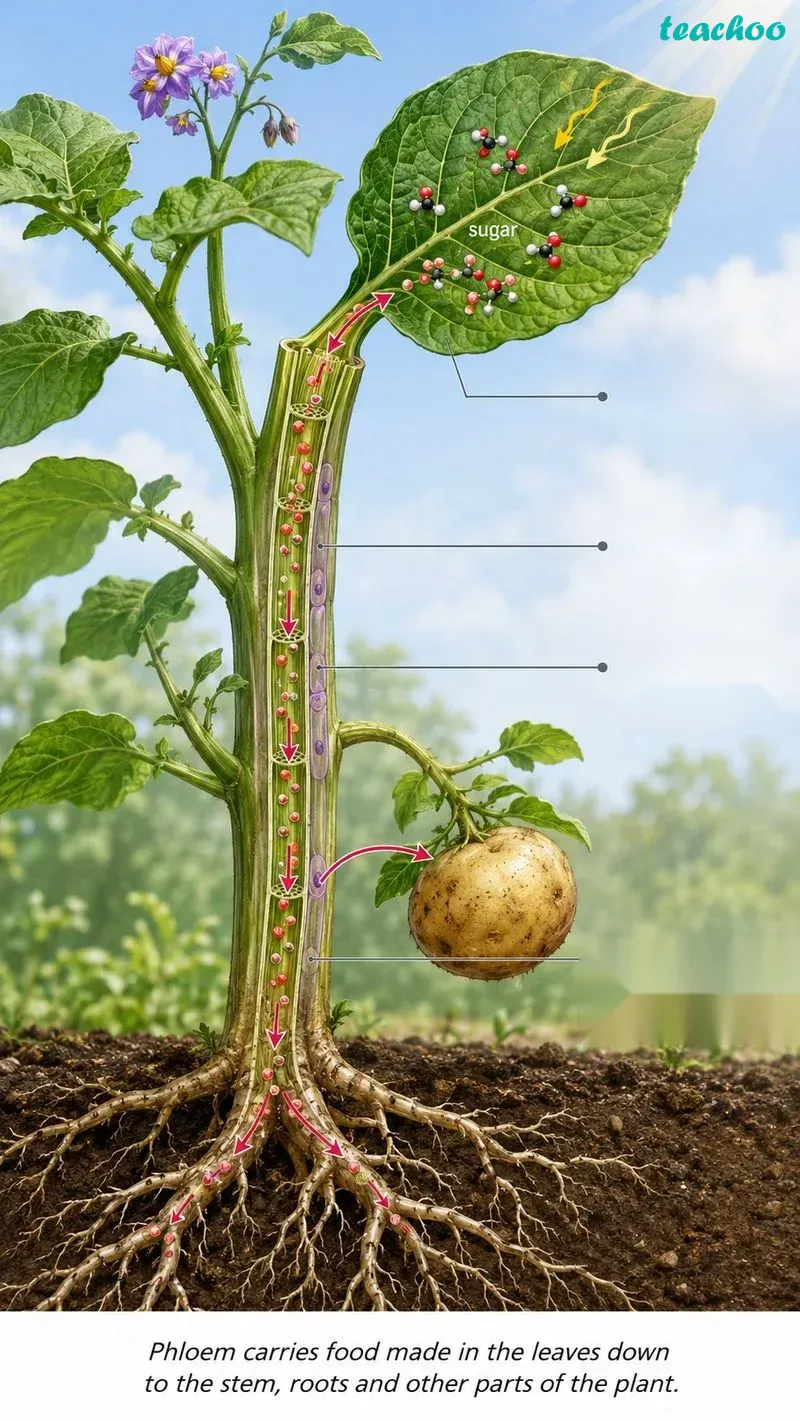
Food made
in leaves
Sieve tubes
carry the food
Companion cells
load the sugar
Food reaches
» stem and roots
”
How are plant tissues organised into systems?
How are plant tissues grouped?
Plant Tissue Systems
Three systems in a plant
1. Dermal
The outer covering
Cuts water loss
Example:
Epidermis
Cuticle
Root hair
Stomata
2. Ground
The main body of a plant
Fills, stores, supports
Example:
Parenchyma
Collenchyma
Sclerenchyma
3. Vascular
The conducting tissues
Moves water and food
Example:
Xylem
Phloem
- Plant tissues are grouped into three tissue systems.
- Dermal tissue system forms the outer covering and reduces water loss.
- Ground tissue system forms the main body (parenchyma, collenchyma, sclerenchyma).
- Vascular tissue system is the conducting tissues, xylem and phloem.
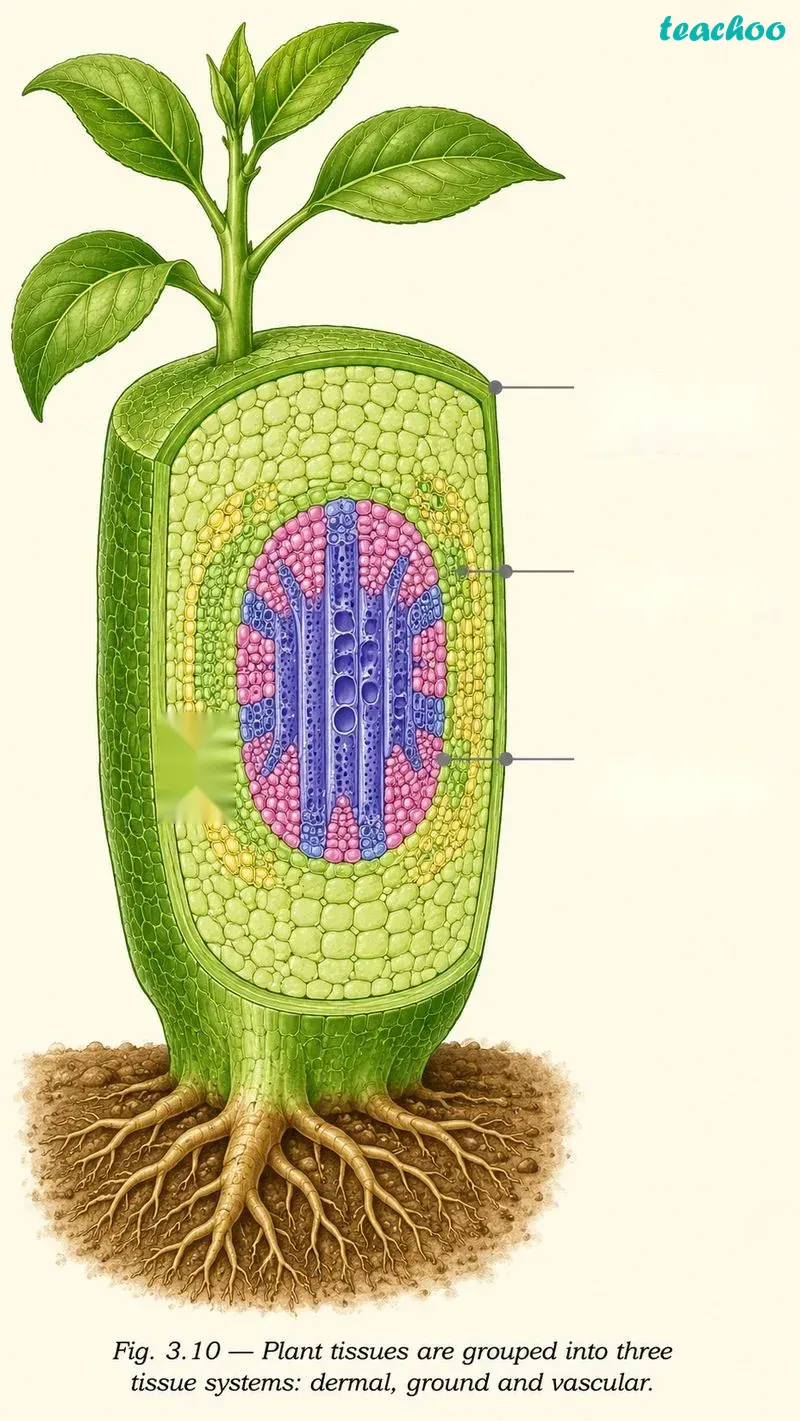
Dermal system —
outer covering,
reduces water loss
Ground system —
main body tissues
Vascular system —
xylem and phloem
(transport)
Important Points
- Permanent tissues are simple (one cell type) or complex (many cell types).
- Epidermis protects; parenchyma, collenchyma and sclerenchyma support.
- Xylem carries water; phloem carries food.
- Plant tissues form dermal, ground and vascular tissue systems.
🧬 Pause and Ponder
-
You may have noticed that fibres of coconut husk are hard and brittle, whereas the leaf stalks of coriander are soft and flexible. Find out the reason.
Coconut husk is made of thick, lignified, dead sclerenchyma, which is hard; coriander stalks have living collenchyma with flexible pectin-rich walls, so they bend.
🧬 Pause and Ponder
-
Why do you think that a thick cuticle on the outer wall of epidermis is advantageous for a plant living in the desert but disadvantageous for a plant living underwater?
In the desert a thick cuticle cuts down water loss, which is vital; underwater there is no water shortage, so a thick cuticle would only block the easy exchange of gases and materials. -
Once water is absorbed by plant roots, it has to travel against gravity through xylem. How do the 'dead' cells of the xylem work together with the living cells of leaves at the top to keep the water moving?
The dead xylem cells form hollow tubes; when leaves lose water through stomata by transpiration, the pull created drags water up the xylem tubes from root to leaf. -
What do you think will happen if there were no stomata in the epidermis of the stem or leaves?
Gas exchange and transpiration would stop, so the plant could not take in carbon dioxide for photosynthesis or pull water up, and it would not cool or remove wastes.
📚 Ready to Go Beyond
- In young plants the outer layer is a single-layered epidermis.
- As plants grow older, some cells below the epidermis start to divide.
- These act as lateral meristematic cells and form the cork cambium.
- Cork cambium makes cork cells, which are dead and waterproof, forming the bark.
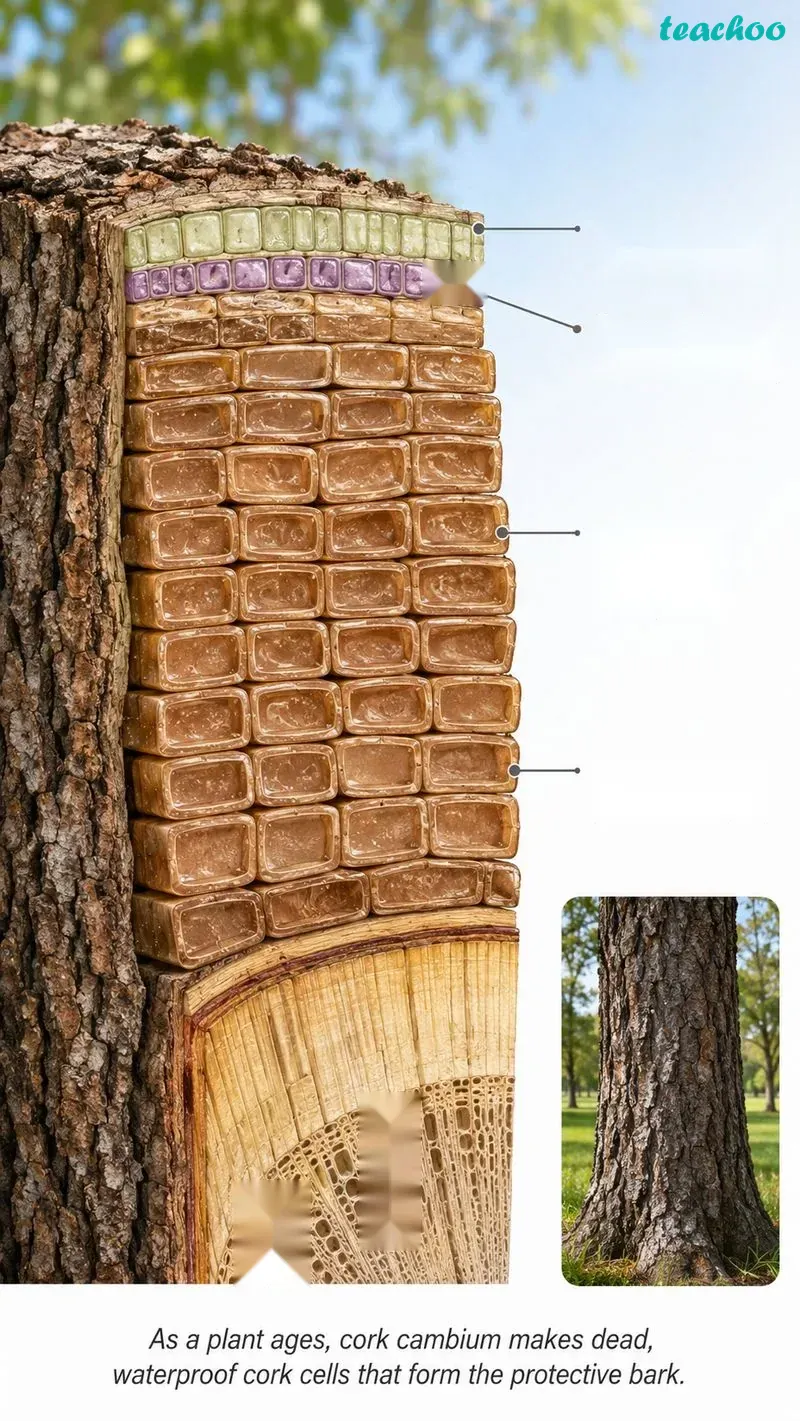
Epidermis
(in young plants)
Cork cambium
(lateral meristem)
Cork cells —
dead and
waterproof
Bark (outer
protective layer)
❓ Test Yourself
-
Which tissue is the protective tissue of a plant?
View Answer
The epidermis. -
Name the three simple permanent tissues.
View Answer
Parenchyma, collenchyma and sclerenchyma. -
Which tissue carries food, and which carries water?
View Answer
Phloem carries food; xylem carries water. -
Why are xylem and phloem called complex tissues?
View Answer
They are made of more than one type of cell working together. -
Name the three tissue systems of a plant.
View Answer
Dermal, ground and vascular tissue systems.
Important Definitions
- Permanent tissue — a tissue of specialised cells that have stopped dividing.
- Epidermis — the outermost protective layer of the plant body.
- Parenchyma — thin-walled living cells that store food and can do photosynthesis.
- Collenchyma — living cells with thickened corners that give flexible support.
- Sclerenchyma — thick, lignified, mostly dead cells that give hardness and strength.
- Xylem — complex tissue that carries water and minerals and gives strength.
- Phloem — complex tissue that carries food from leaves to other parts.
📋 NCERT Question 2 — If a plant is unable
If a plant is unable to transport food from leaves to roots, which tissue is malfunctioning?
(i) Xylem (ii) Phloem (iii) Epidermis (iv) Sclerenchyma
View Answer →
(i) Xylem (ii) Phloem (iii) Epidermis (iv) Sclerenchyma
📋 NCERT Question 9 — Aamrapali observed that a
Aamrapali observed that a young mango sapling’s stem bends flexibly during monsoon winds and does not break. Which tissue is responsible for this flexibility? Predict and provide your explanation of the impact if the existing tissue was replaced by sclerenchyma.
View Answer →
📋 NCERT Question 12 — Coconut husk fibres are
Coconut husk fibres are used for mats which are tough and fibrous. Which tissue has structural features suitable for providing this strength? Explain why living parenchyma couldn’t serve the same purpose.
View Answer →
📋 NCERT Question 8 — In a forest, it
A tree was severely debarked by an elephant (bark is rich in nutrients). (i) Which function(s) are hampered by debarking? (ii) Which plant tissue is affected by further damage to the trunk? (iii) Which function is hampered if the tissues beneath the bark are damaged? (iv) What assumptions are you making?
View Answer →
📋 NCERT Question 15 — A textbook states, "Each
A textbook states, “Each plant tissue performs only one specific function”. What questions would you ask to critically examine the correctness of this statement? What examples of tissues would you take to find out the answers to these questions?
View Answer →
📋 NCERT Question 11 — During the discussion in
Rohan says, "A tissue is a group of similar cells performing similar functions." Rajiv argues this is true for simple tissues but a little different for complex tissues. Provide your explanation.
View Answer →
