You are here
![[Class 9] For the following experiments write down the sample space S. - Exercise Set 7.3](https://cdn.teachoo.com/fb811c57-4e2f-4be8-8ee3-1349a88b48f9/slide82.jpg)
Last updated at June 5, 2026 by Teachoo
Transcript
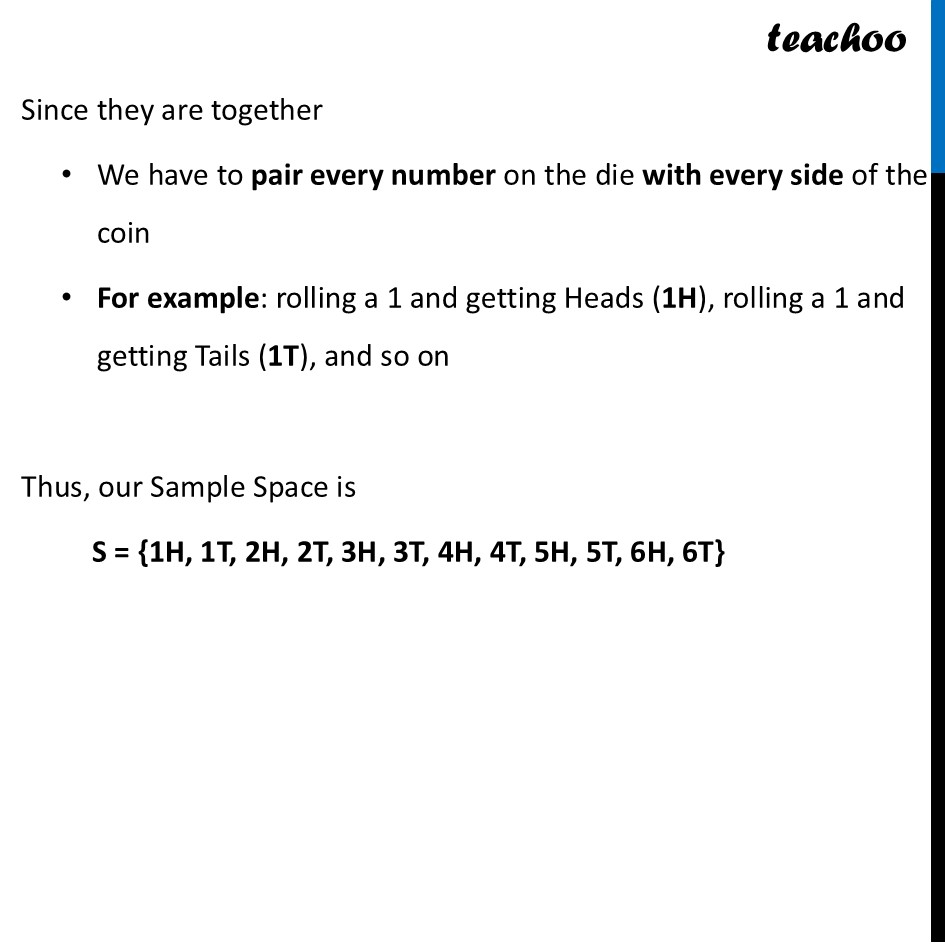
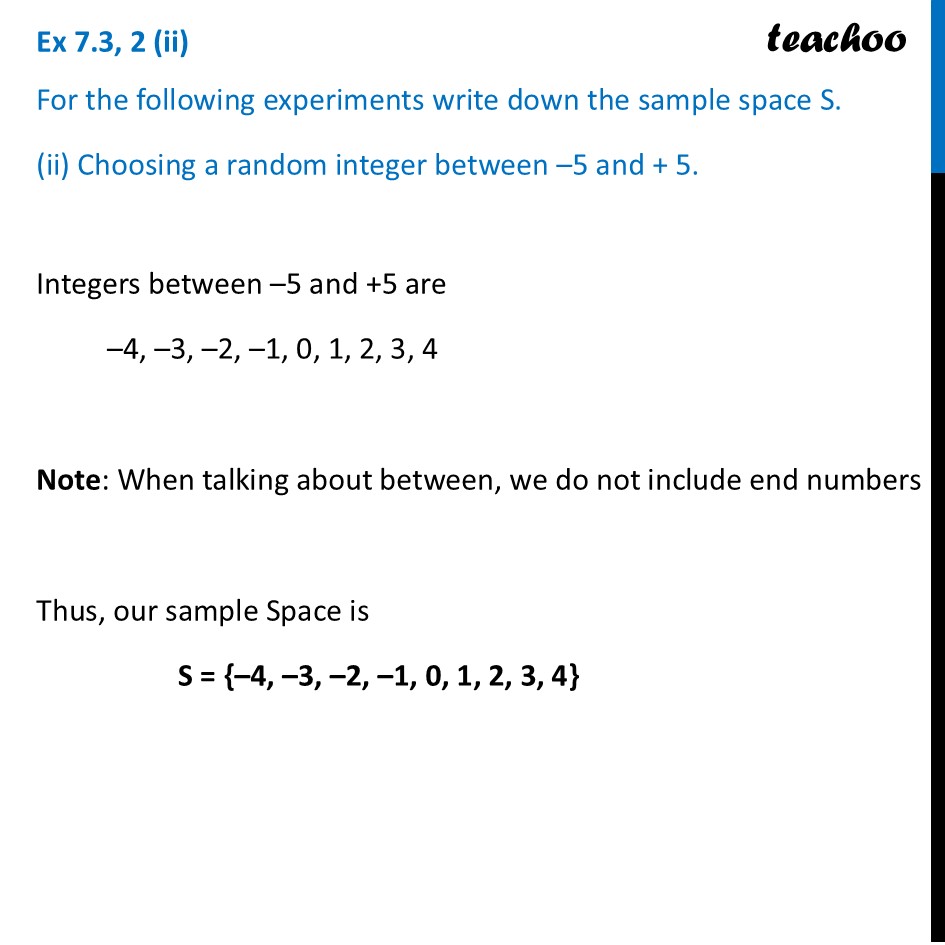
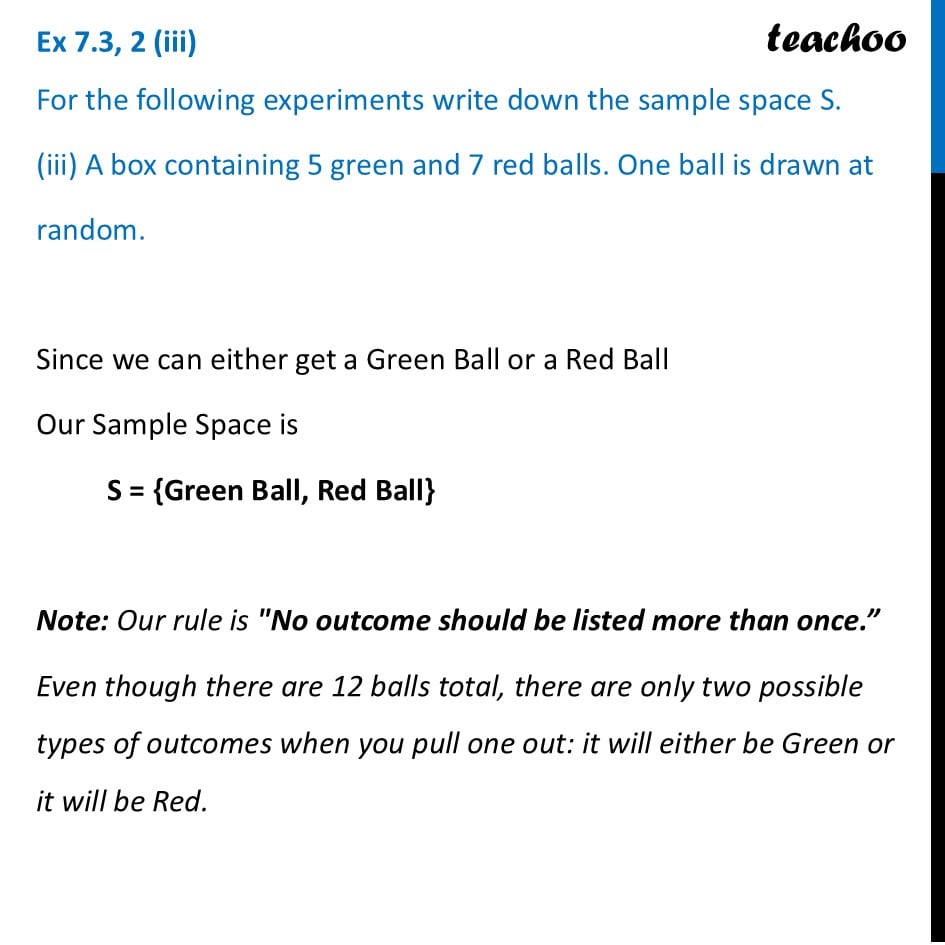
Ex 7.3, 2 (i) For the following experiments write down the sample space S. (i) Rolling a die and tossing a coin together. Let’s roll a 6-sided die & coin together Now, When a die is rolled, possible results are 1, 2, 3, 4, 5, 6 When a coin is tossed, possible results are Heads (H) or Tails (T) Since they are together We have to pair every number on the die with every side of the coin For example: rolling a 1 and getting Heads (1H), rolling a 1 and getting Tails (1T), and so on Thus, our Sample Space is S = {1H, 1T, 2H, 2T, 3H, 3T, 4H, 4T, 5H, 5T, 6H, 6T} Ex 7.3, 2 (ii) For the following experiments write down the sample space S. (ii) Choosing a random integer between –5 and + 5. Integers between –5 and +5 are –4, –3, –2, –1, 0, 1, 2, 3, 4 Note: When talking about between, we do not include end numbers Thus, our sample Space is S = {–4, –3, –2, –1, 0, 1, 2, 3, 4} Ex 7.3, 2 (iii) For the following experiments write down the sample space S. (iii) A box containing 5 green and 7 red balls. One ball is drawn at random. Since we can either get a Green Ball or a Red Ball Our Sample Space is S = {Green Ball, Red Ball} Note: Our rule is "No outcome should be listed more than once.” Even though there are 12 balls total, there are only two possible types of outcomes when you pull one out: it will either be Green or it will be Red.