You are here
![Different Types of Numbers - Summary [Ganita Manjari Class 9] - Real Numbers & Imaginary Numbers](https://cdn.teachoo.com/ea49cde9-05ae-4c4d-97d3-1a260929117d/slide25.jpg)
Real Numbers & Imaginary Numbers
Real Numbers & Imaginary Numbers
Last updated at August 14, 2026 by Teachoo
Transcript
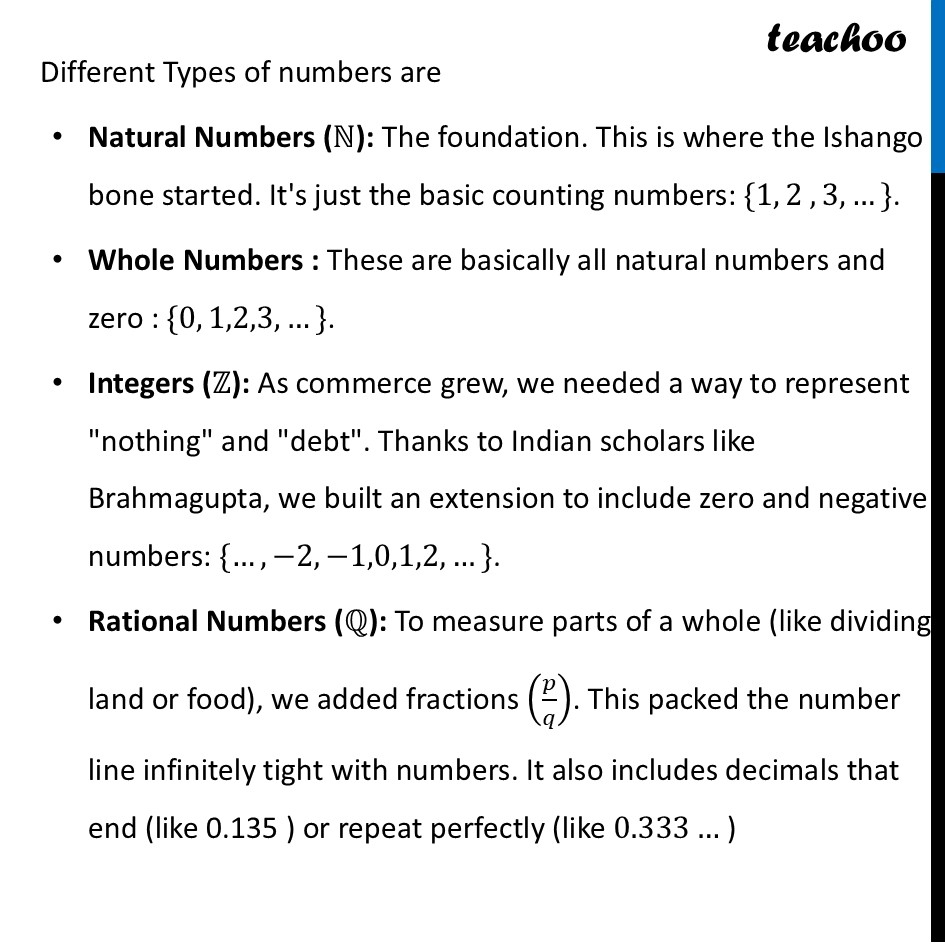
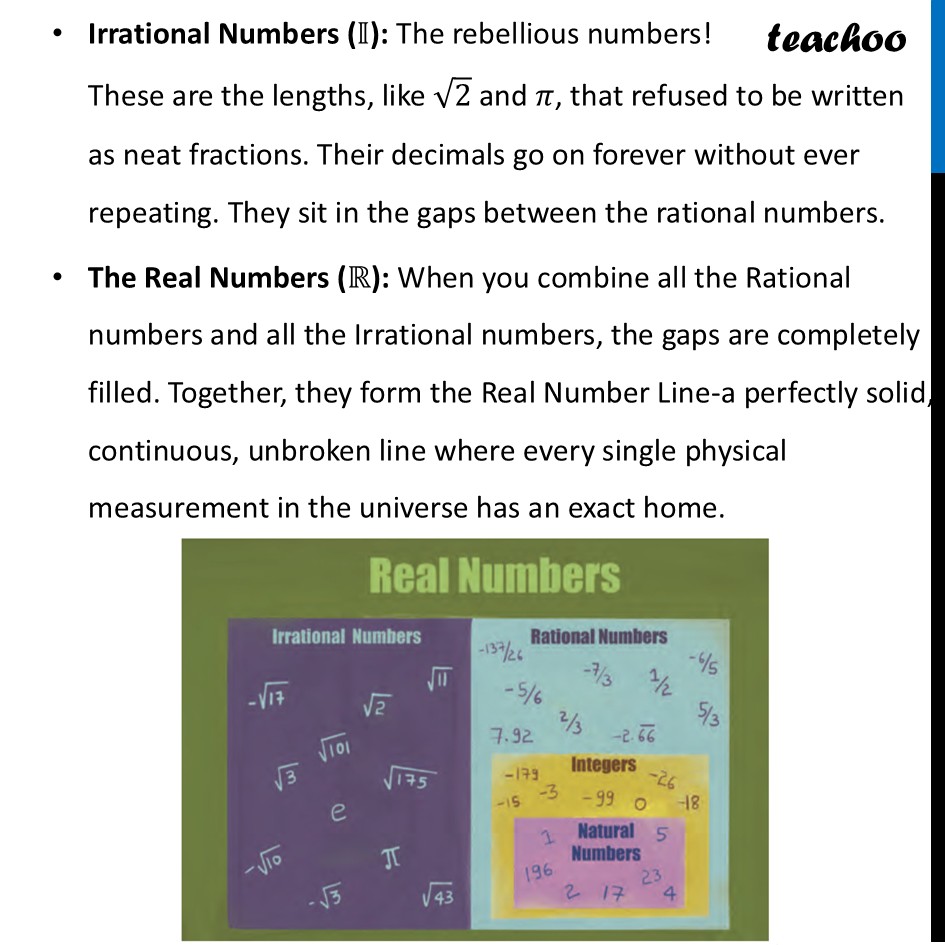
Different Types of Numbers RATIONAL NUMBERS(Q) Can be written as a fraction p/q ( are integers, ). INTEGERS(Z) Positive and Negative whole numbers,including 0. Examples: WHOLE NUMBERS(W) Non-negative integers, including 0 . 0,1,2,3,4,5... NATURAL NUMBERS(N) Counting numbers,starting from 1. Examples: IRRATIONAL NUMBERS(lor ) Cannot be written as simple fractions.Infinite, non-repeating decimals. Examples: (Square Root of 2) e(Euler's Number) Golden Ratio Different Types of numbers are Natural Numbers (ℕ): The foundation. This is where the Ishango bone started. It's just the basic counting numbers: {1, 2 , 3,…}. Whole Numbers : These are basically all natural numbers and zero : {0, 1,2,3,…}. Integers (ℤ): As commerce grew, we needed a way to represent "nothing" and "debt". Thanks to Indian scholars like Brahmagupta, we built an extension to include zero and negative numbers: {…,−2,−1,0,1,2,…}. Rational Numbers (ℚ): To measure parts of a whole (like dividing land or food), we added fractions (𝑝/𝑞). This packed the number line infinitely tight with numbers. It also includes decimals that end (like 0.135 ) or repeat perfectly (like 0.333… ) Irrational Numbers (𝕀): The rebellious numbers! These are the lengths, like √2 and 𝜋, that refused to be written as neat fractions. Their decimals go on forever without ever repeating. They sit in the gaps between the rational numbers. The Real Numbers (ℝ): When you combine all the Rational numbers and all the Irrational numbers, the gaps are completely filled. Together, they form the Real Number Line-a perfectly solid, continuous, unbroken line where every single physical measurement in the universe has an exact home.