You are here
Linear Growth and Linear Decay
Last updated at August 14, 2026 by Teachoo
Transcript
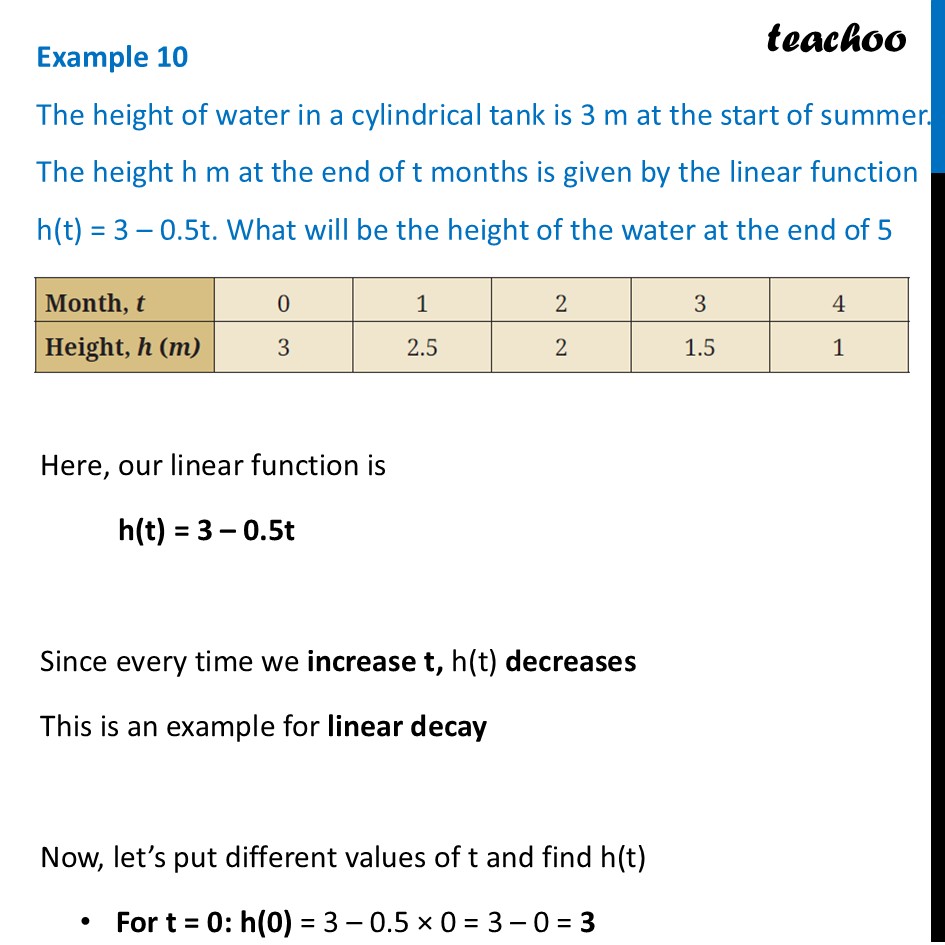
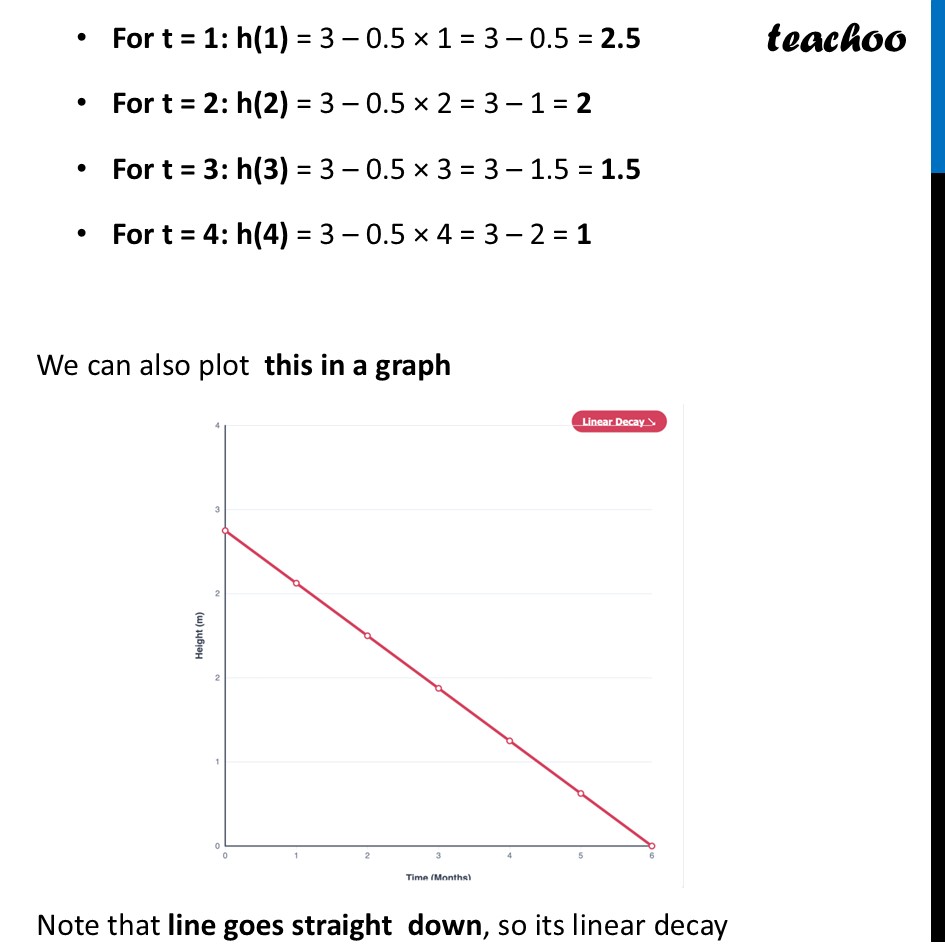
Example 10 The height of water in a cylindrical tank is 3 m at the start of summer. The height h m at the end of t months is given by the linear function h(t) = 3 – 0.5t. What will be the height of the water at the end of 5 months? Here, our linear function is h(t) = 3 – 0.5t Since every time we increase t, h(t) decreases This is an example for linear decay Now, let’s put different values of t and find h(t) For t = 0: h(0) = 3 – 0.5 × 0 = 3 – 0 = 3 For t = 1: h(1) = 3 – 0.5 × 1 = 3 – 0.5 = 2.5 For t = 2: h(2) = 3 – 0.5 × 2 = 3 – 1 = 2 For t = 3: h(3) = 3 – 0.5 × 3 = 3 – 1.5 = 1.5 For t = 4: h(4) = 3 – 0.5 × 4 = 3 – 2 = 1 We can also plot this in a graph Note that line goes straight down, so its linear decay Let’s answer our question from Think and Reflect Page 25 What will be the height of the water at the end of 5 months? Our linear function is h(t) = 3 – 0.5t Putting t = 5 h(t) = 3 – 0.5t = 3 – 0.5 × 5 = 3 – 2.5 = 0.5 Thus, height will be 0.5 m