You are here
Linear Growth and Linear Decay
Last updated at August 14, 2026 by Teachoo
Transcript
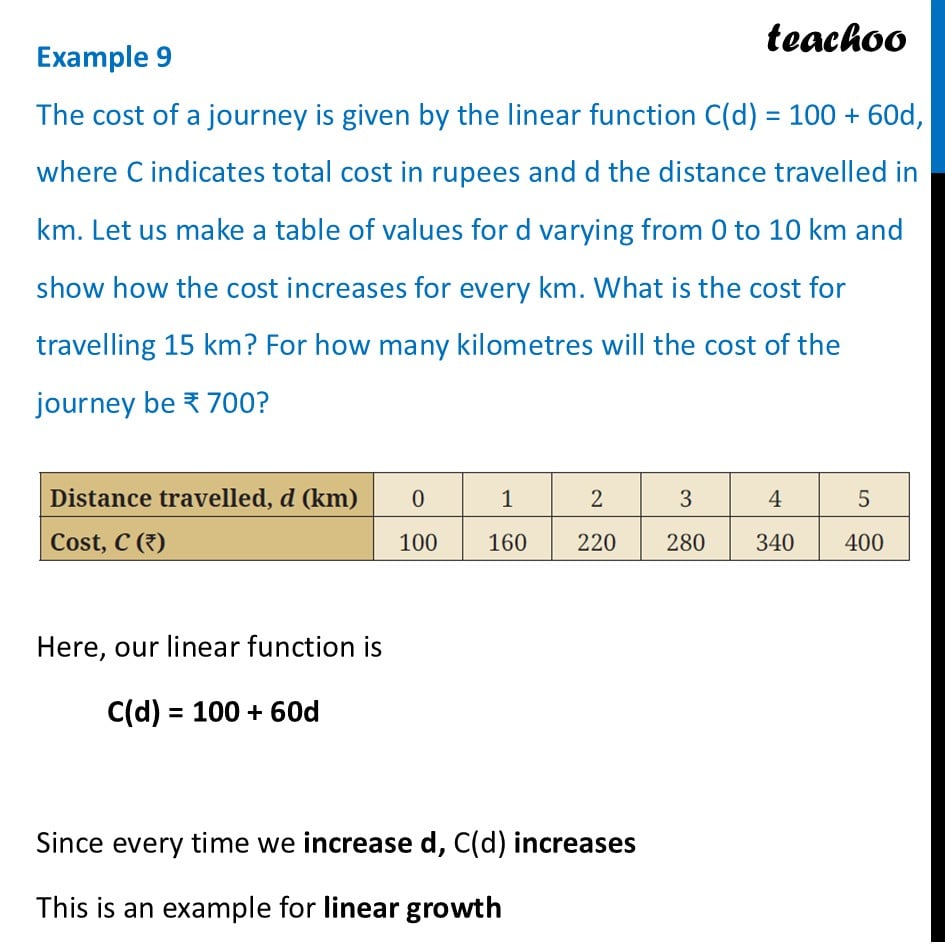
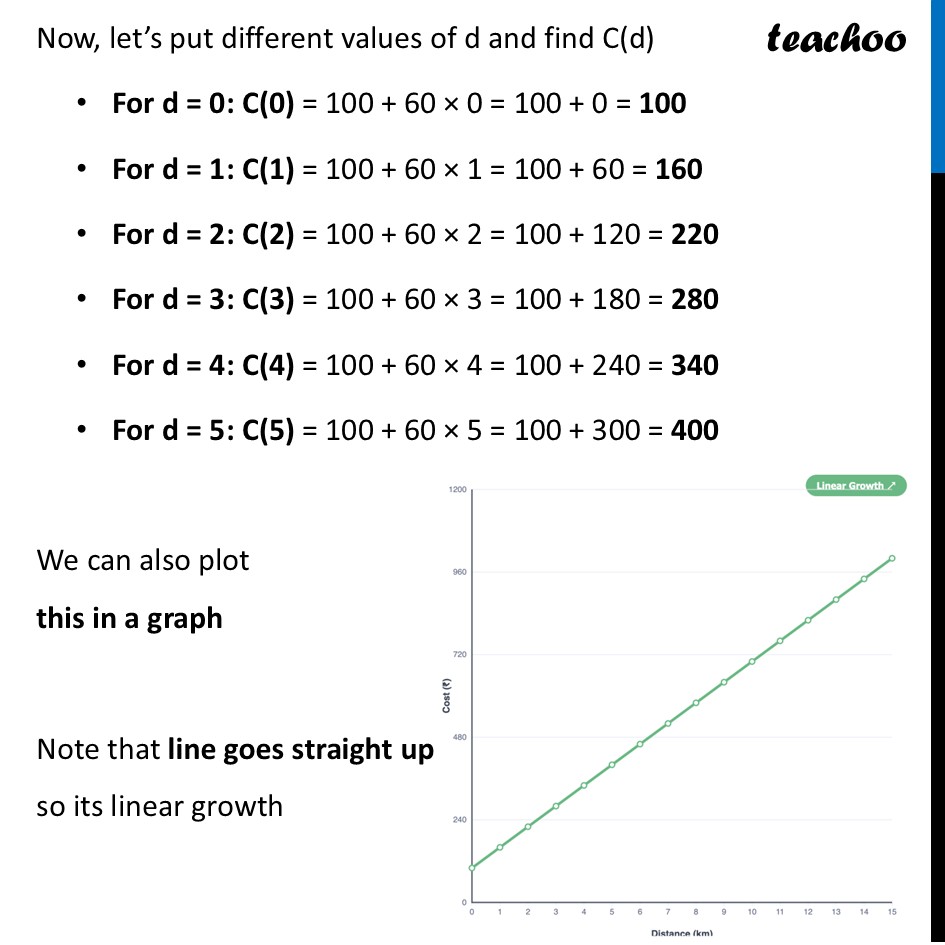
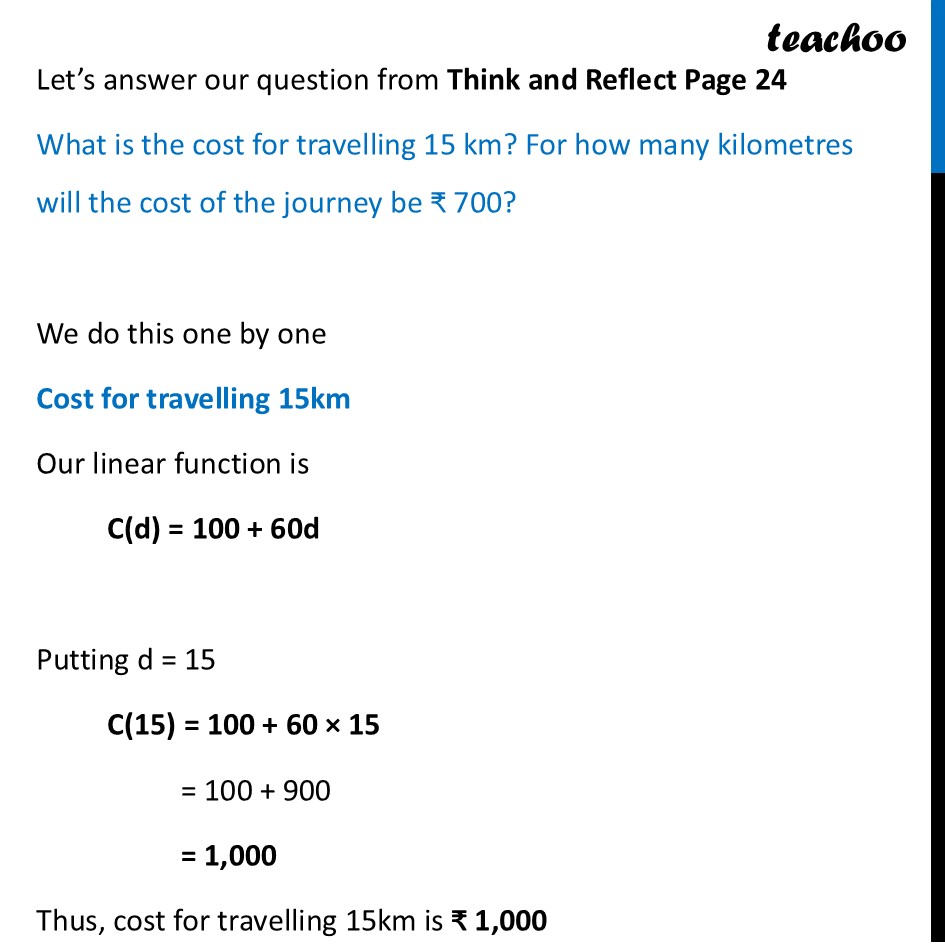
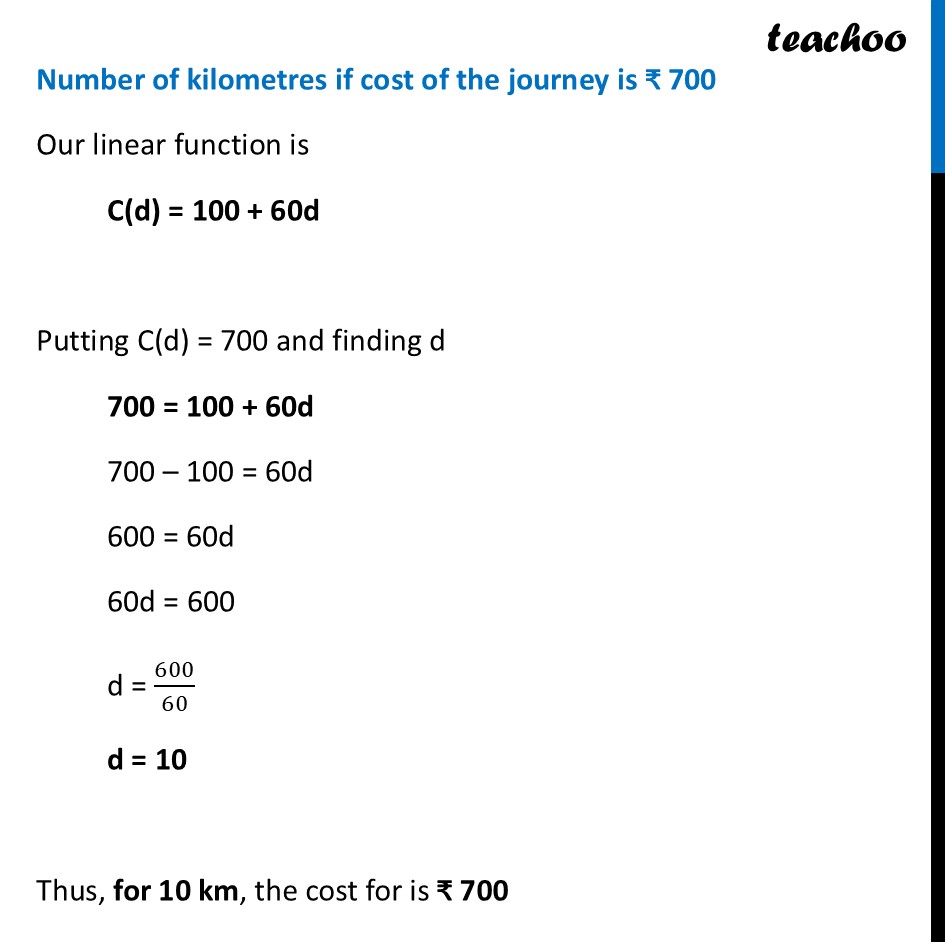
Example 9 The cost of a journey is given by the linear function C(d) = 100 + 60d, where C indicates total cost in rupees and d the distance travelled in km. Let us make a table of values for d varying from 0 to 10 km and show how the cost increases for every km. What is the cost for travelling 15 km? For how many kilometres will the cost of the journey be ₹ 700? Distance travelled, 0 1 2 3 4 5 Cost, ₹ 100 160 220 280 340 400Here, our linear function is C(d) = 100 + 60d Since every time we increase d, C(d) increases This is an example for linear growth Now, let’s put different values of d and find C(d) For d = 0: C(0) = 100 + 60 × 0 = 100 + 0 = 100 For d = 1: C(1) = 100 + 60 × 1 = 100 + 60 = 160 For d = 2: C(2) = 100 + 60 × 2 = 100 + 120 = 220 For d = 3: C(3) = 100 + 60 × 3 = 100 + 180 = 280 For d = 4: C(4) = 100 + 60 × 4 = 100 + 240 = 340 For d = 5: C(5) = 100 + 60 × 5 = 100 + 300 = 400 We can also plot this in a graph Note that line goes straight up, so its linear growth Let’s answer our question from Think and Reflect Page 24 What is the cost for travelling 15 km? For how many kilometres will the cost of the journey be ₹ 700? We do this one by one Cost for travelling 15km Our linear function is C(d) = 100 + 60d Putting d = 15 C(15) = 100 + 60 × 15 = 100 + 900 = 1,000 Thus, cost for travelling 15km is ₹ 1,000 Number of kilometres if cost of the journey is ₹ 700 Our linear function is C(d) = 100 + 60d Putting C(d) = 700 and finding d 700 = 100 + 60d 700 – 100 = 60d 600 = 60d 60d = 600 d = 600/60 d = 10 Thus, for 10 km, the cost for is ₹ 700