Inverse Proportions
 You are here

Last updated at February 24, 2026 by Teachoo
Transcript
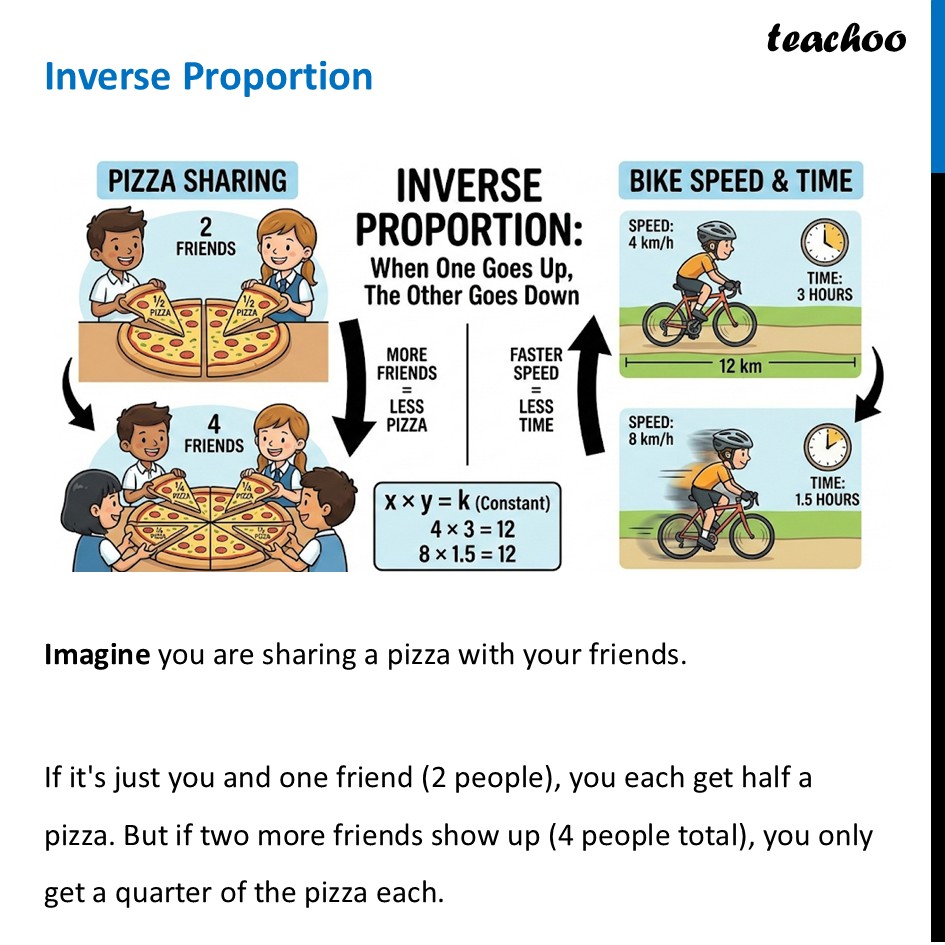
Inverse ProportionImagine you are sharing a pizza with your friends. If it's just you and one friend (2 people), you each get half a pizza. But if two more friends show up (4 people total), you only get a quarter of the pizza each. As the number of friends goes up, the number of pizza slices you get goes down. This is the basic idea behind inverse proportion. What is Inverse Proportion? In math, two quantities are in inverse proportion (or inversely proportional) if an increase in one quantity causes a proportional decrease in the other. It's a relationship where the two variables do the exact opposite of each other at the same rate. If you multiply one number by 2 , you have to divide the other number by 2 . A Classic Example: Speed and Time Let's say you are riding your bike to a park that is 12 kilometers away. Scenario 1: If you ride at a speed of 𝟒" " 𝒌𝒎 per hour, it will take you 𝟑 hours to get there. Scenario 2: If you pedal twice as fast and ride at 𝟖" " 𝒌𝒎 per hour, it will only take you 𝟏.𝟓 hours to get there. Your speed doubled, so your travel time was cut in half. The Mathematical Rule The most important rule to remember for inverse proportion is that if you multiply the two connected values together, they will always equal the same constant number. If we call our first value 𝑥 and our second value 𝑦, the formula looks like this: 𝒙 × 𝒚=𝒌 (Where 𝑘 is a constant number that never changes). Let's look back at the bike example: Speed (4) × Time (3)=𝟏𝟐 Speed (8) × Time (1.5)=𝟏𝟐 Because 𝑥 × 𝑦 always equals the same number (12), we know for sure it is an inverse proportion!
