Pythagorean triples

 You are here
Pythagorean triples
Last updated at February 20, 2026 by Teachoo
Transcript
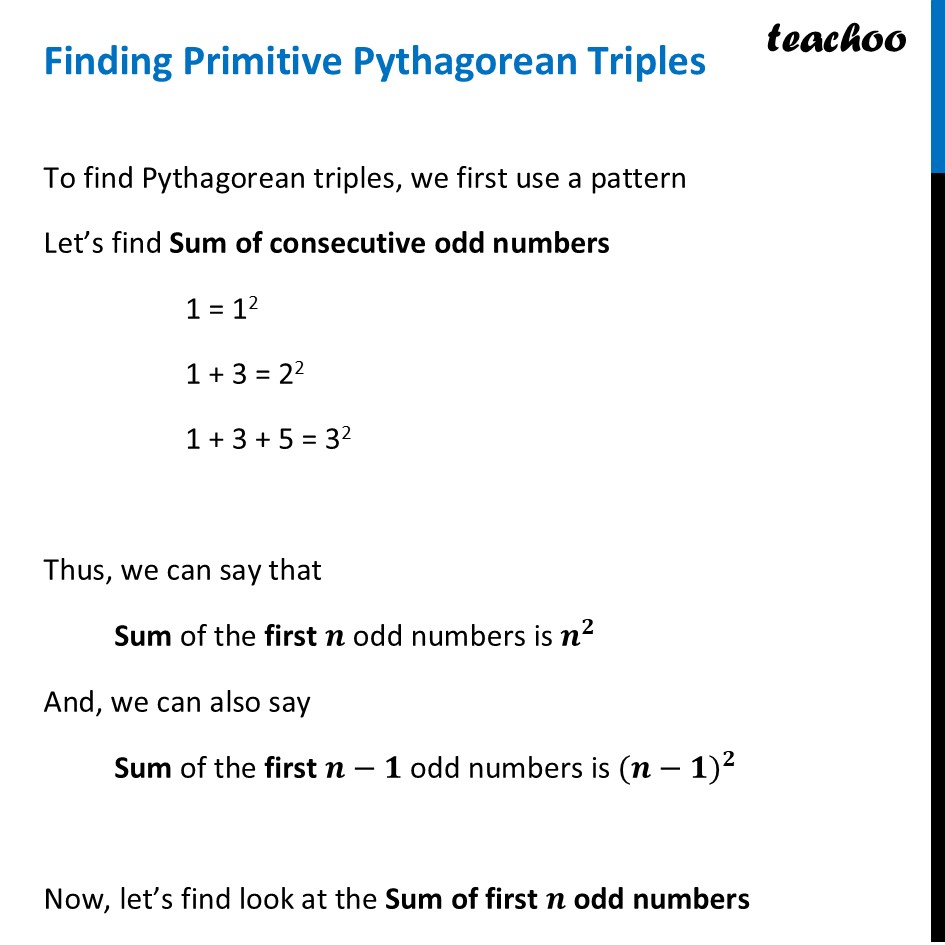
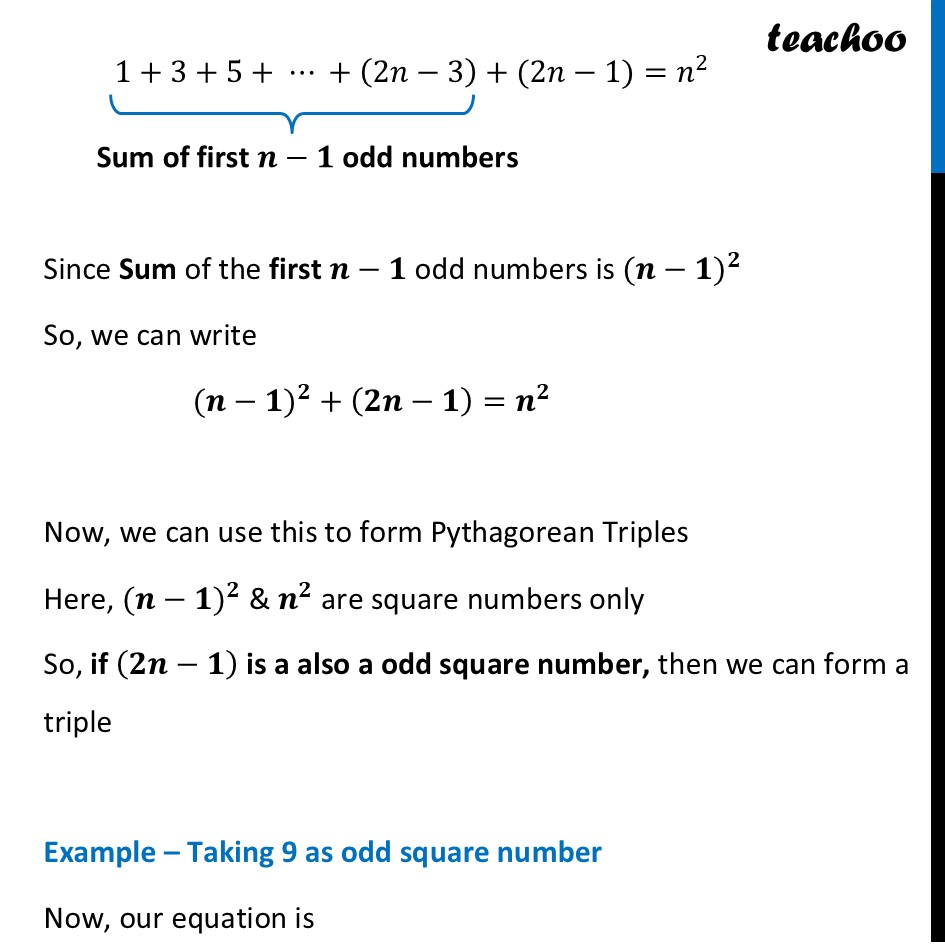
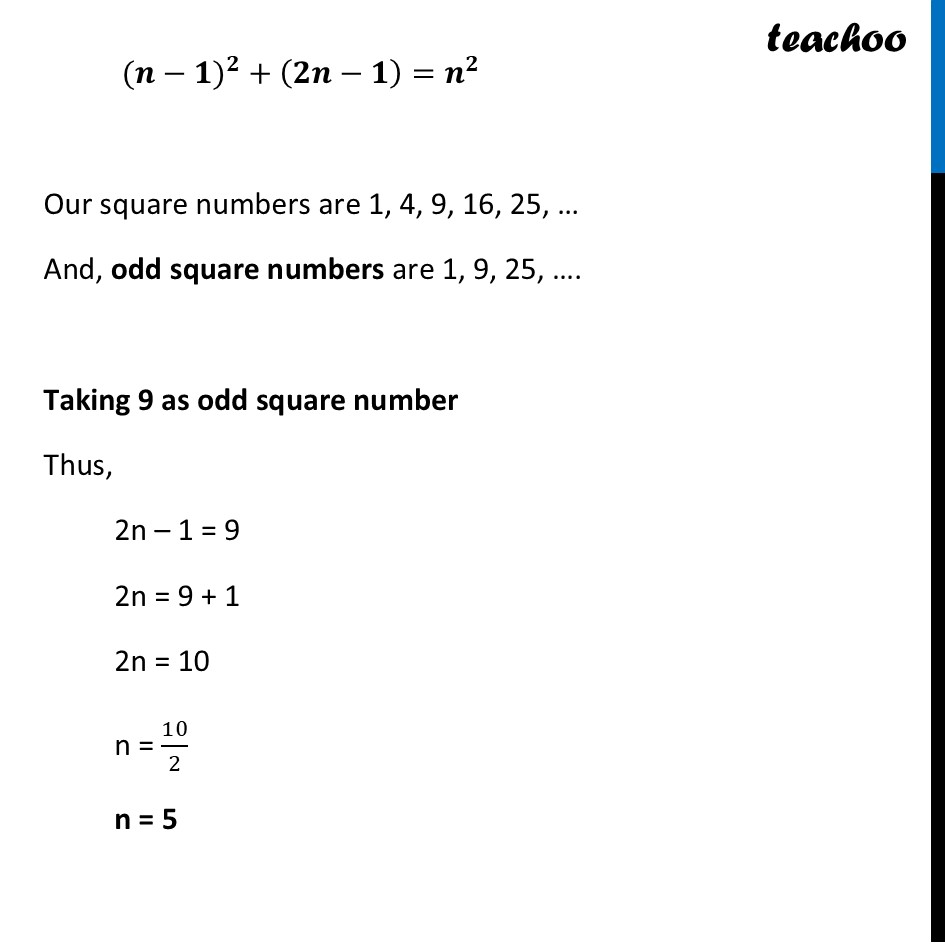
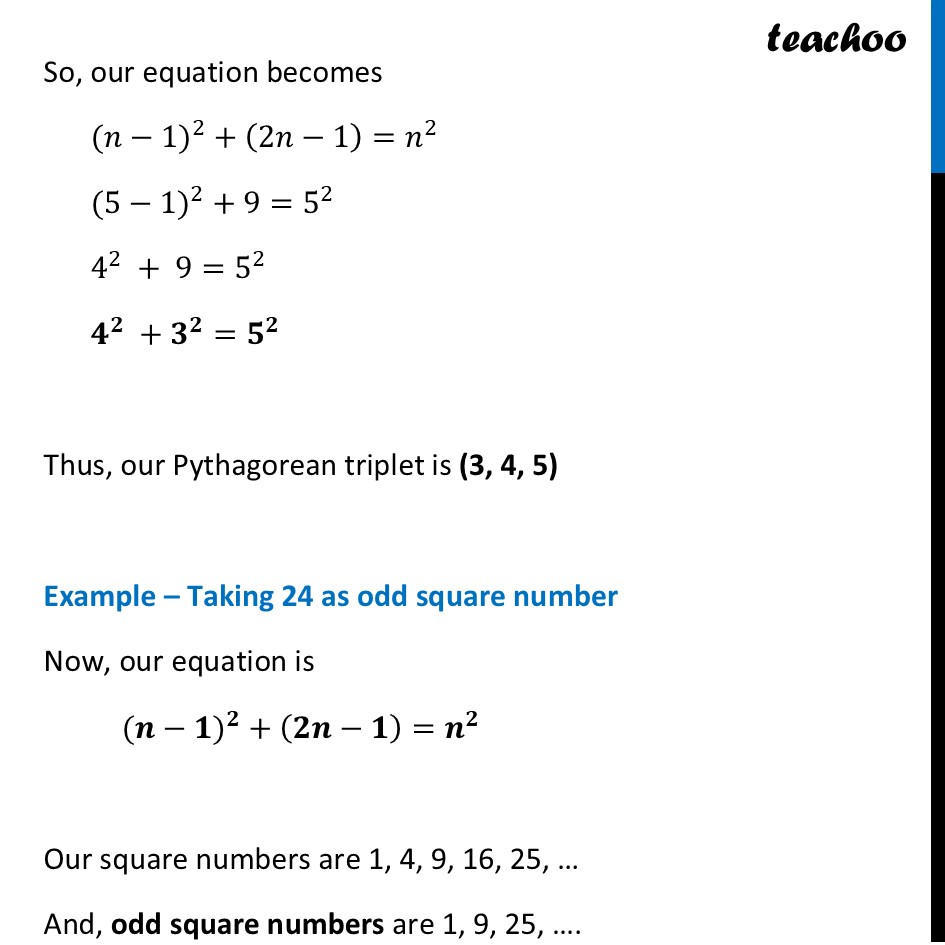
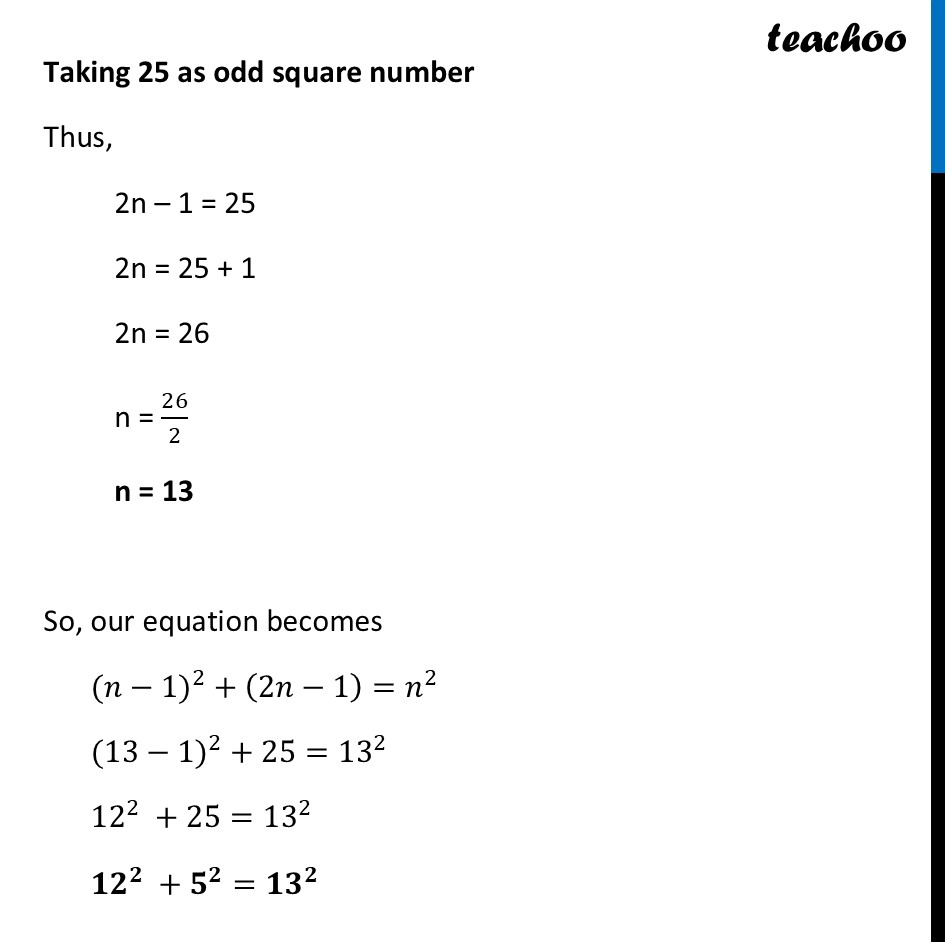
Finding Primitive Pythagorean TriplesTo find Pythagorean triples, we first use a pattern Let’s find Sum of consecutive odd numbers 1 = 12 1 + 3 = 22 1 + 3 + 5 = 32 Thus, we can say that Sum of the first 𝒏 odd numbers is 𝒏^𝟐 And, we can also say Sum of the first 𝒏−𝟏 odd numbers is 〖(𝒏−𝟏)〗^𝟐 Now, let’s find look at the Sum of first 𝒏 odd numbers 1+3+5+ ⋯ +(2𝑛−3)+(2𝑛−1)=𝑛^2 Since Sum of the first 𝒏−𝟏 odd numbers is 〖(𝒏−𝟏)〗^𝟐 So, we can write 〖(𝒏−𝟏)〗^𝟐 + (𝟐𝒏−𝟏)=𝒏^𝟐 Now, we can use this to form Pythagorean Triples Here, 〖(𝒏−𝟏)〗^𝟐 & 𝒏^𝟐 are square numbers only So, if (𝟐𝒏−𝟏) is a also a odd square number, then we can form a triple Example – Taking 9 as odd square number Now, our equation is 〖(𝒏−𝟏)〗^𝟐 + (𝟐𝒏−𝟏)=𝒏^𝟐 Our square numbers are 1, 4, 9, 16, 25, … And, odd square numbers are 1, 9, 25, …. Taking 9 as odd square number Thus, 2n – 1 = 9 2n = 9 + 1 2n = 10 n = 10/2 n = 5 So, our equation becomes 〖(𝑛−1)〗^2 + (2𝑛−1)=𝑛^2 〖(5−1)〗^2 + 9=5^2 4^2 + 9=5^2 𝟒^𝟐 +𝟑^𝟐=𝟓^𝟐 Thus, our Pythagorean triplet is (3, 4, 5) Example – Taking 24 as odd square number Now, our equation is 〖(𝒏−𝟏)〗^𝟐 + (𝟐𝒏−𝟏)=𝒏^𝟐 Our square numbers are 1, 4, 9, 16, 25, … And, odd square numbers are 1, 9, 25, …. Taking 25 as odd square number Thus, 2n – 1 = 25 2n = 25 + 1 2n = 26 n = 26/2 n = 13 So, our equation becomes 〖(𝑛−1)〗^2 + (2𝑛−1)=𝑛^2 〖(13−1)〗^2 + 25=13^2 12^2 +25=13^2 〖𝟏𝟐〗^𝟐 +𝟓^𝟐=〖𝟏𝟑〗^𝟐 Thus, our Pythagorean triplet is (5, 12, 13)
