Pythagorean triples

 You are here
Pythagorean triples
Last updated at August 14, 2026 by Teachoo
Transcript
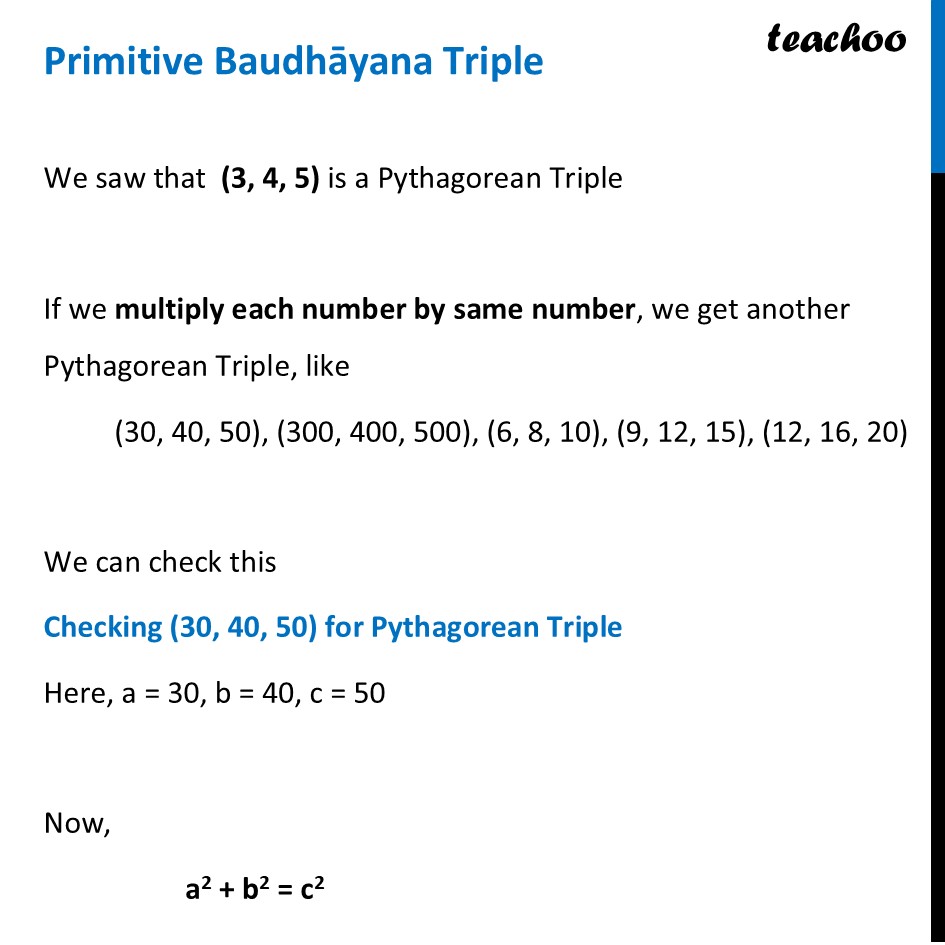
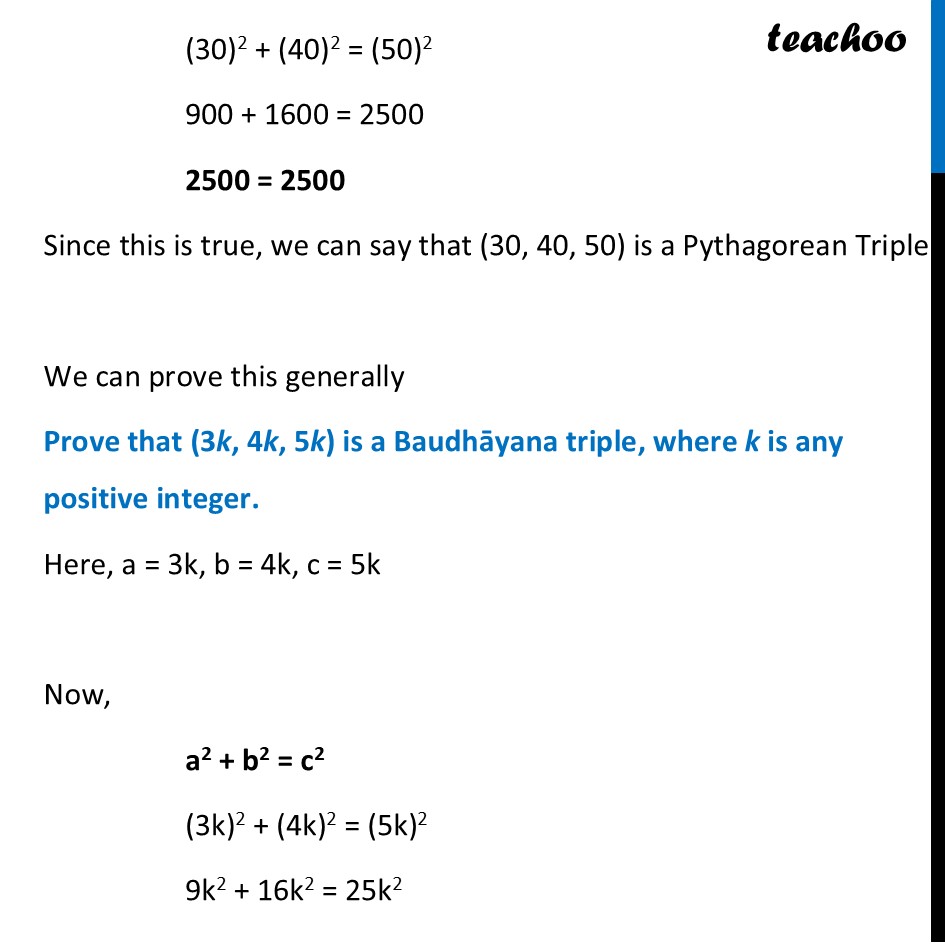
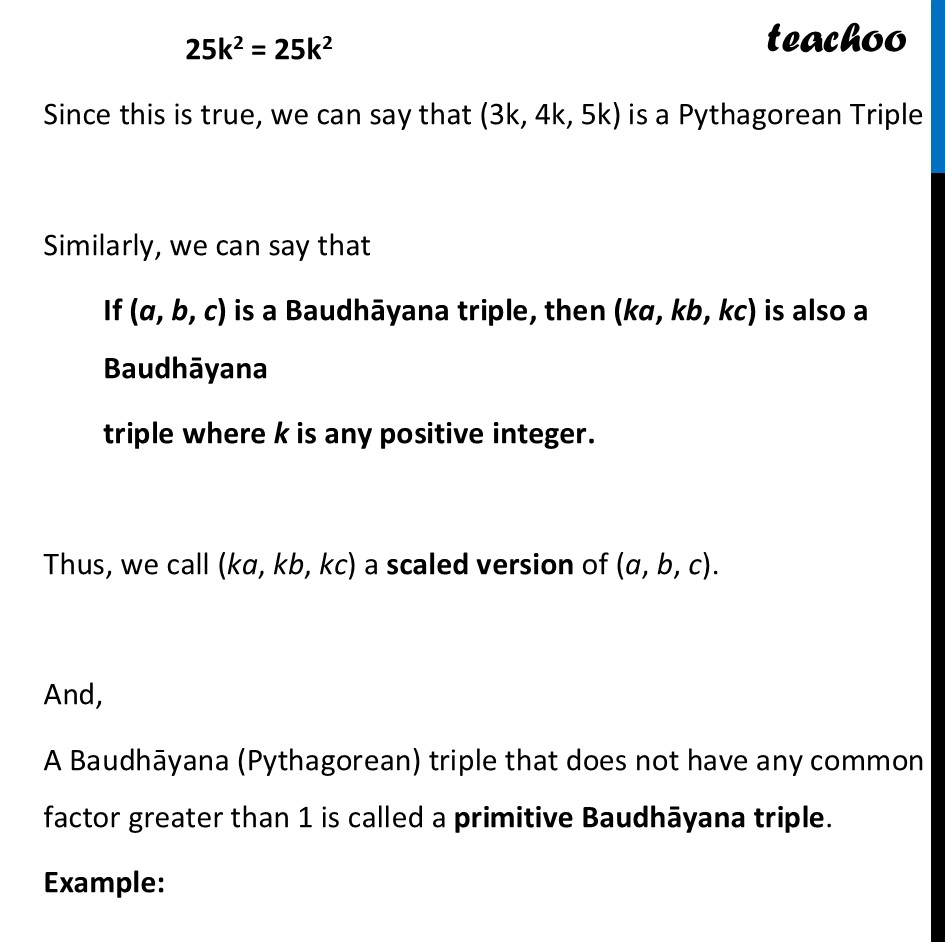
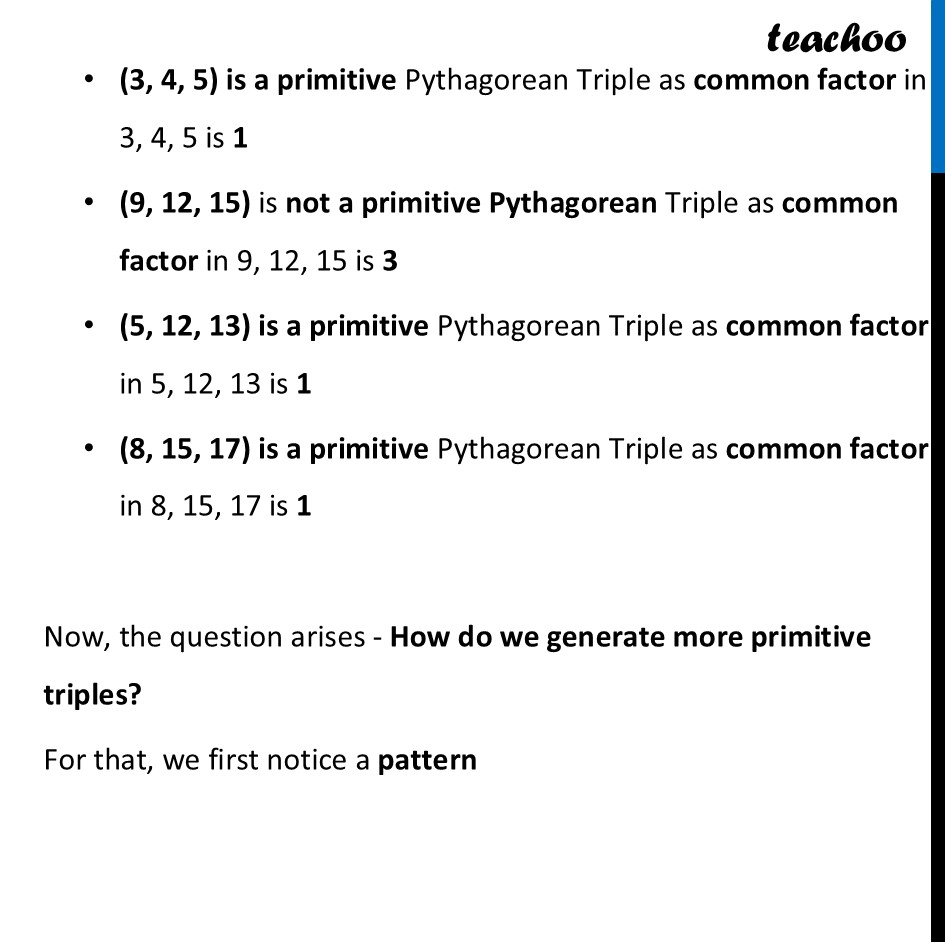
Primitive Baudhāyana TripleWe saw that (3, 4, 5) is a Pythagorean Triple If we multiply each number by same number, we get another Pythagorean Triple, like (30, 40, 50), (300, 400, 500), (6, 8, 10), (9, 12, 15), (12, 16, 20) We can check this Checking (30, 40, 50) for Pythagorean Triple Here, a = 30, b = 40, c = 50 Now, a2 + b2 = c2 (30)2 + (40)2 = (50)2 900 + 1600 = 2500 2500 = 2500 Since this is true, we can say that (30, 40, 50) is a Pythagorean Triple We can prove this generally Prove that (3k, 4k, 5k) is a Baudhāyana triple, where k is any positive integer. Here, a = 3k, b = 4k, c = 5k Now, a2 + b2 = c2 (3k)2 + (4k)2 = (5k)2 9k2 + 16k2 = 25k2 25k2 = 25k2 Since this is true, we can say that (3k, 4k, 5k) is a Pythagorean Triple Similarly, we can say that If (a, b, c) is a Baudhāyana triple, then (ka, kb, kc) is also a Baudhāyana triple where k is any positive integer. Thus, we call (ka, kb, kc) a scaled version of (a, b, c). And, A Baudhāyana (Pythagorean) triple that does not have any common factor greater than 1 is called a primitive Baudhāyana triple. Example: (3, 4, 5) is a primitive Pythagorean Triple as common factor in 3, 4, 5 is 1 (9, 12, 15) is not a primitive Pythagorean Triple as common factor in 9, 12, 15 is 3 (5, 12, 13) is a primitive Pythagorean Triple as common factor in 5, 12, 13 is 1 (8, 15, 17) is a primitive Pythagorean Triple as common factor in 8, 15, 17 is 1 Now, the question arises - How do we generate more primitive triples? For that, we first notice a pattern

