
 You are here
![Halving a square using Paper - Steps [Class 8 Ganita Prakash II] - Halving a square](https://cdn.teachoo.com/58bdf70a-9a66-4a17-aae6-5b0305e58d46/slide15.jpg)
Halving a square
Last updated at August 14, 2026 by Teachoo
Transcript
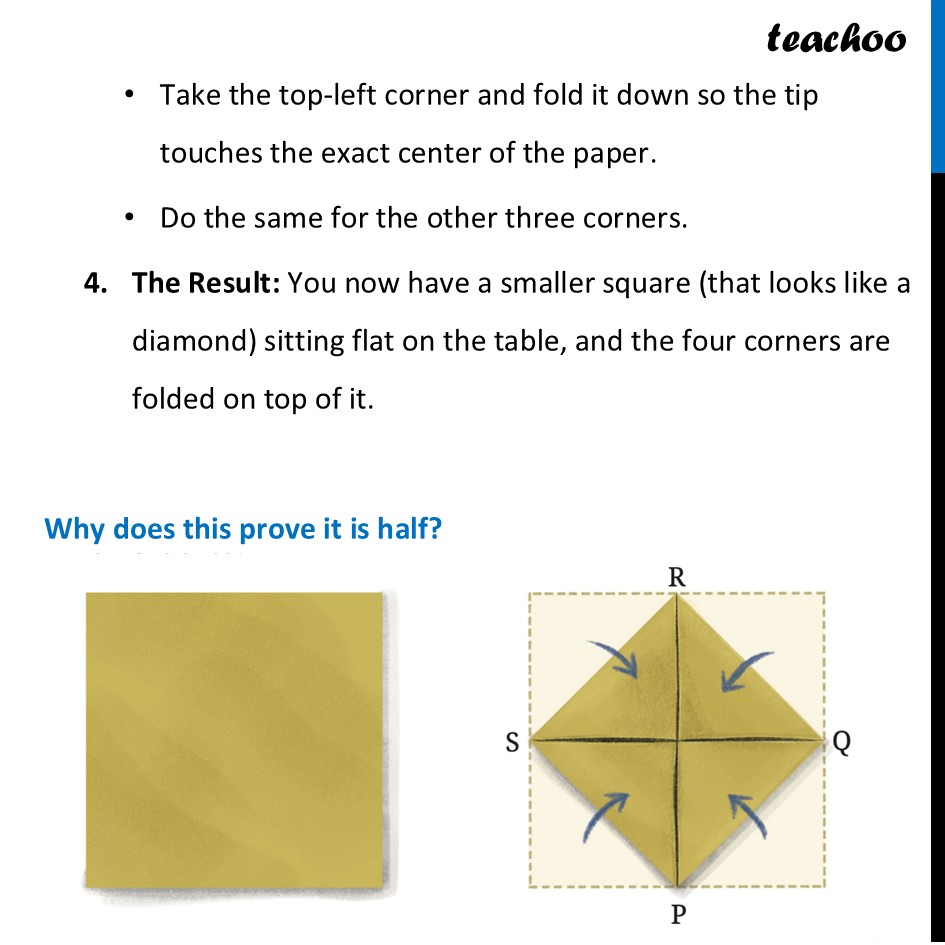
Halving a square using PaperHere are the exact steps to do it yourself with a real piece of paper (or as shown in the "Halving" tab of our lab): Start with a Square Paper: Take any square piece of paper (like origami paper). Let's say its total area is the "Whole." Find the Midpoints: Mark the exact middle point of the top edge, bottom edge, left edge, and right edge. Fold the Corners to the Center: Take the top-left corner and fold it down so the tip touches the exact center of the paper. Do the same for the other three corners. The Result: You now have a smaller square (that looks like a diamond) sitting flat on the table, and the four corners are folded on top of it. Why does this prove it is half? Think about the paper thickness. Where the corners are folded over, the paper is now two layers thick everywhere. The bottom layer is the "Inner Diamond." The top layer is the "Four Corners" you just folded in. Since the corners perfectly cover the diamond with no gaps and no overlaps, the Area of the Corners = Area of the Diamond. If the corners equal the diamond, they must each be exactly 𝟓𝟎% of the original paper. So, the new square you made has exactly half the area of the paper you started with!
