Estimating Sums and Differences - in Decimals (with examples) - Estimating Sums and Differences

part 2 - Estimating Sums and Differences - in Decimals - Estimating Sums and Differences - Chapter 3 Class 7 - A peek beyond the Point (Ganita Prakash) - Class 7 (Ganita Prakash 1, 2 & old NCERT)
part 3 - Estimating Sums and Differences - in Decimals - Estimating Sums and Differences - Chapter 3 Class 7 - A peek beyond the Point (Ganita Prakash) - Class 7 (Ganita Prakash 1, 2 & old NCERT)

Take a fresh quiz. Then take another.
Every attempt is a new AI-adaptive Teachoo quiz with 5 questions, selected from your answers, mistakes, and progress.
Remove Ads

Transcript

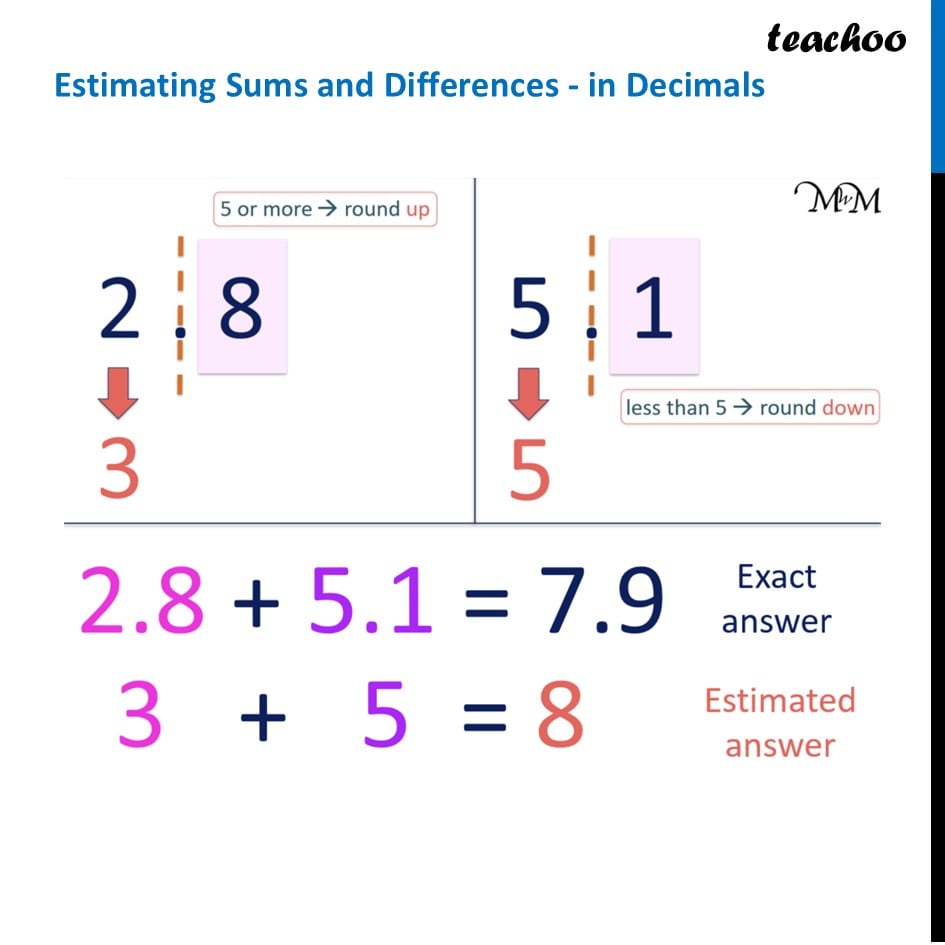
Estimating Sums and Differences - in Decimals Estimating means to change a number to another number that is close to it. Estimating is used to make calculations easier and it gives us an answer that is close to the actual answer. 2.8 can be estimated to be close to 3 . 5.1 can be estimated to be close to 5 . The sum of 2.8 + 5.1 can be estimated to be 3 + 5 = 8 2.8 + 5.1 = 7.9 which is the exact answer. This is very close to 3 + 5 = 8, our estimated answer. And, how to estimate a decimal?

Davneet Singh's photo - Co-founder, Teachoo

Made by

Davneet Singh

Davneet Singh is an IIT Kanpur graduate and has been teaching for 16+ years. At Teachoo, he breaks down Maths, Science and Computer Science into simple steps so students understand concepts deeply and score with confidence.

Many students prefer Teachoo Black for a smooth, ad-free learning experience.