You are here

Equation of plane - Passing Through Intersection Of Planes
Equation of plane - Passing Through Intersection Of Planes
Last updated at August 8, 2026 by Teachoo
Transcript
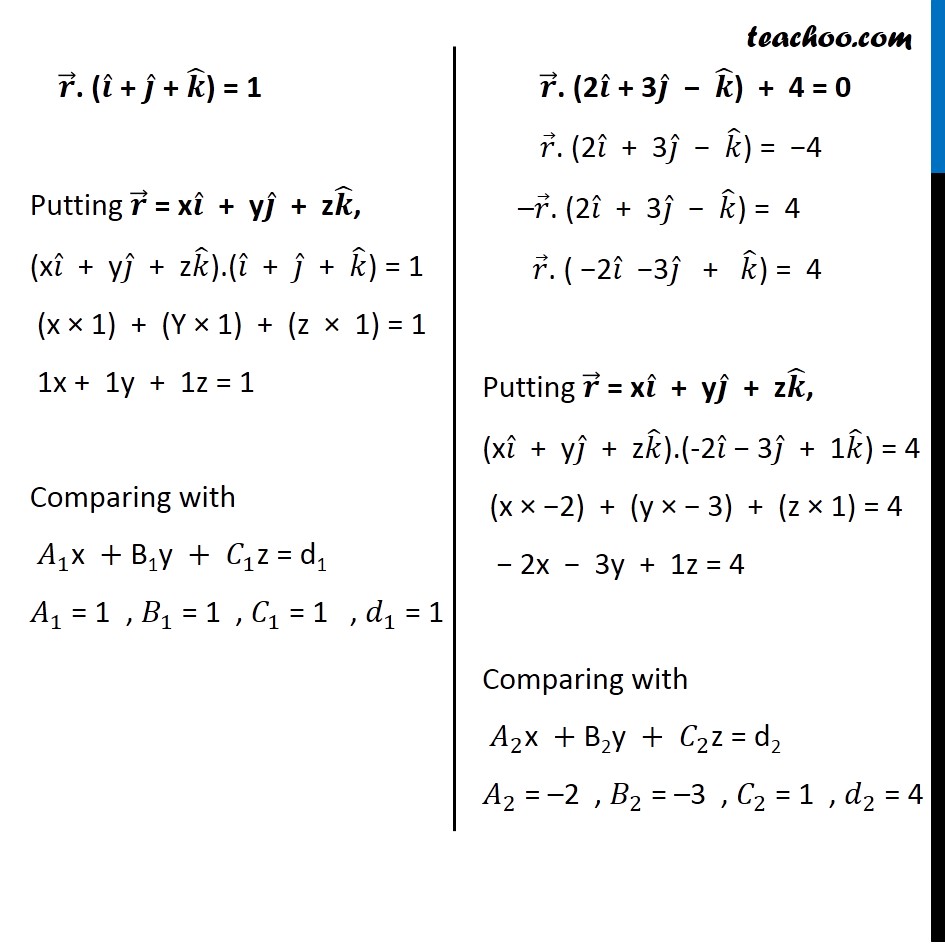
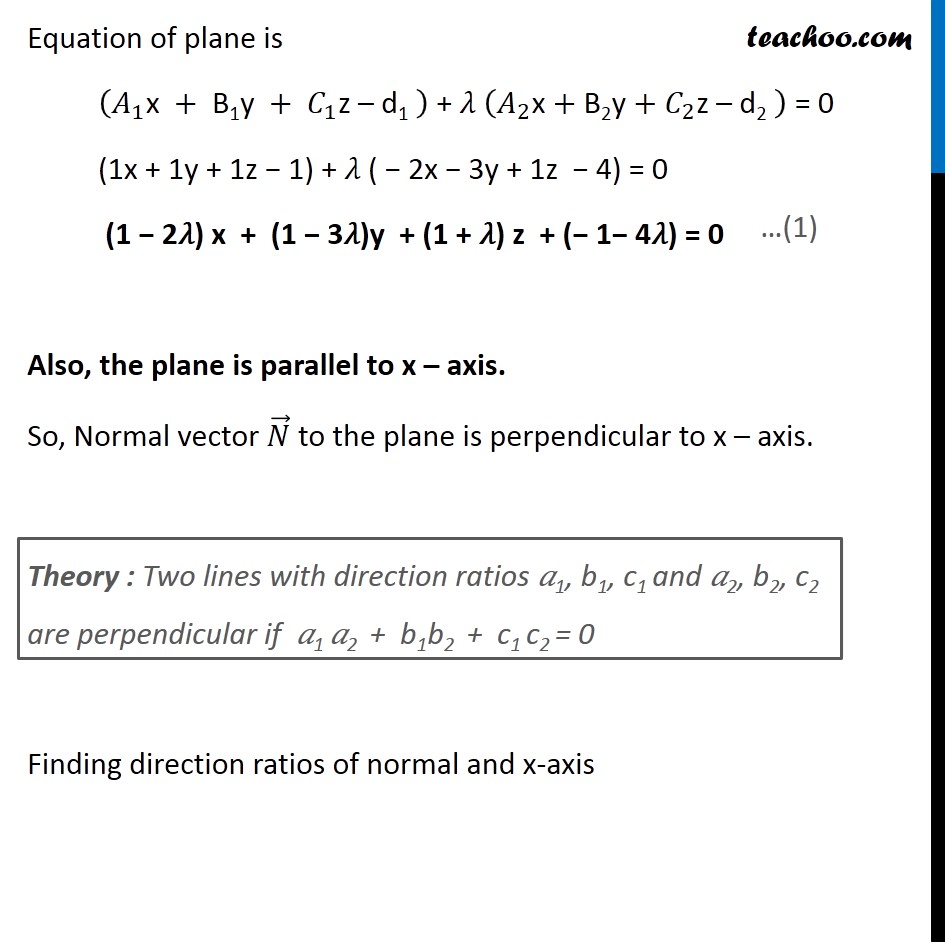
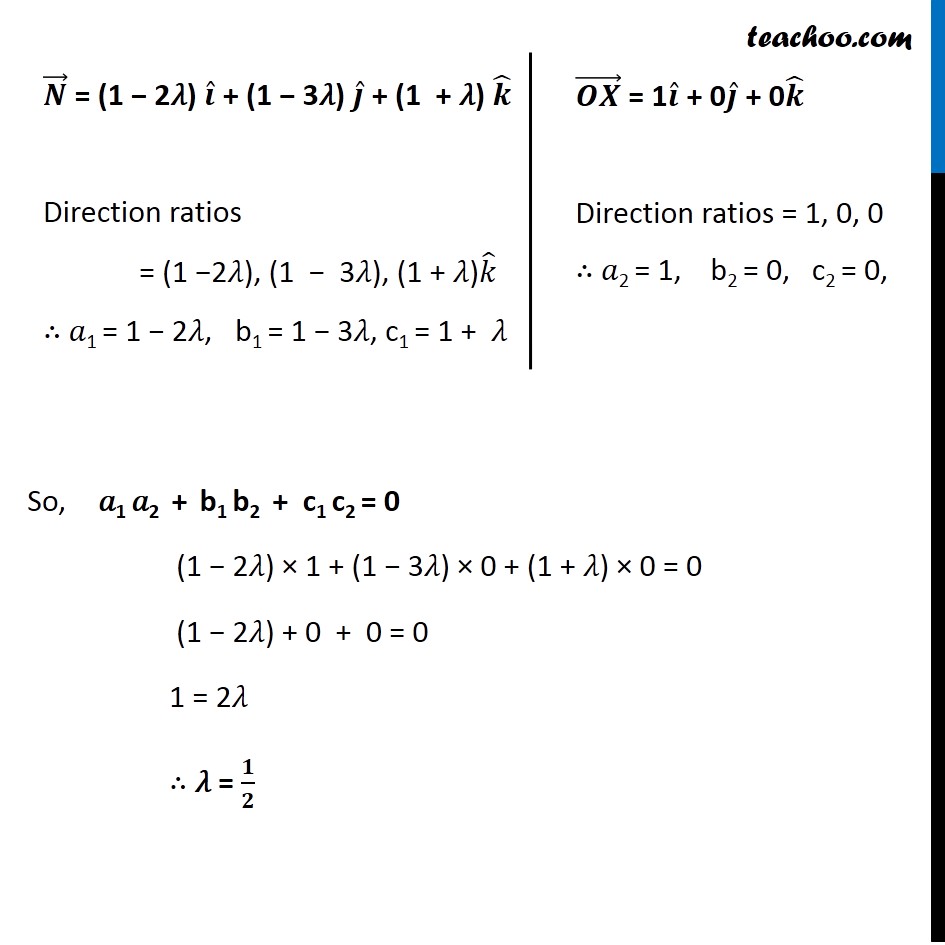
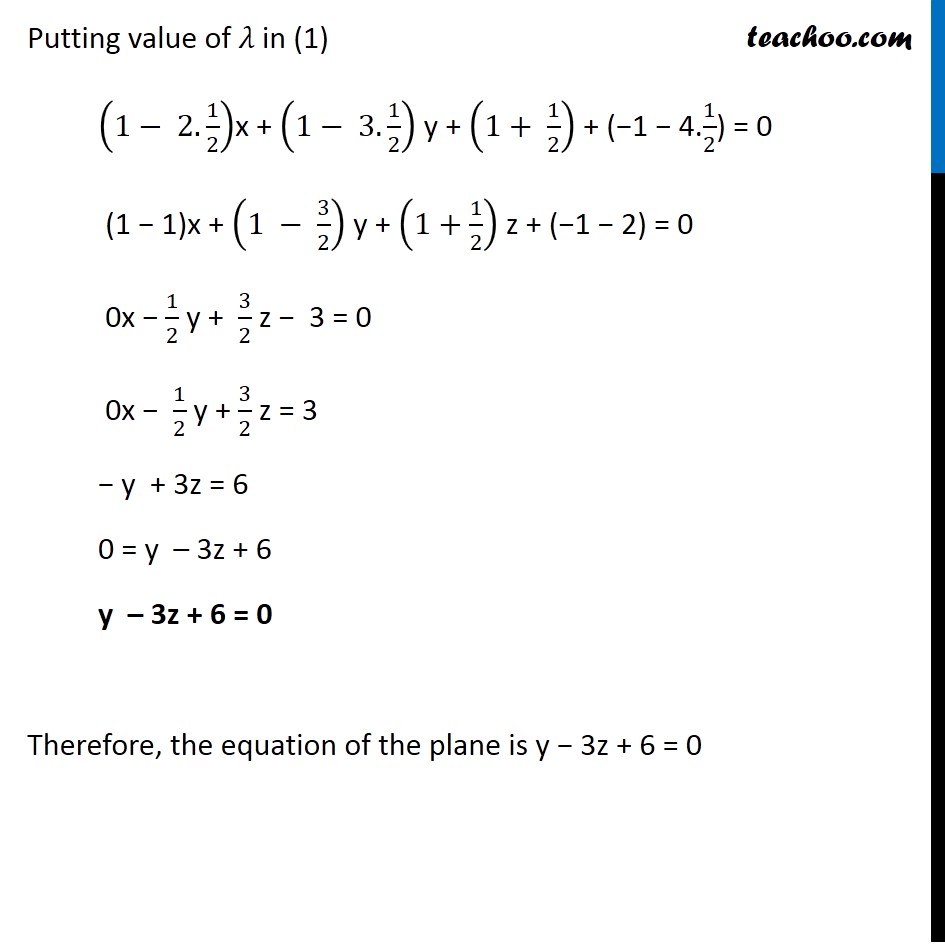
Question 11 Find the equation of the plane passing through the line of intersection of the planes 𝑟 ⃗ . (𝑖 ̂ + 𝑗 ̂ + 𝑘 ̂) =1 and 𝑟 ⃗ . (2𝑖 ̂ + 3𝑗 ̂ – 𝑘 ̂) + 4 = 0 and parallel to x-axis. Equation of a plane passing through the intersection of two planes 𝐴_1x + B1y + 𝐶_1z = d1 and 𝐴_2x + B2y + 𝐶_2z = d2 is (𝑨_𝟏 "x " +" B1y" + 𝑪_𝟏 "z – d1 " ) + 𝜆 (𝑨_𝟐 "x" +"B2y" +𝑪_𝟐 "z – d2 " ) = 0. Converting equation of planes to Cartesian form to find A1, B1, C1, d1 & A2, B2, C2, d2 𝒓 ⃗. (𝒊 ̂ + 𝒋 ̂ + 𝒌 ̂) = 1 Putting 𝒓 ⃗ = x𝒊 ̂ + y𝒋 ̂ + z𝒌 ̂, (x𝑖 ̂ + y𝑗 ̂ + z𝑘 ̂).(𝑖 ̂ + 𝑗 ̂ + 𝑘 ̂) = 1 (x × 1) + (Y × 1) + (z × 1) = 1 1x + 1y + 1z = 1 Comparing with 𝐴_1 "x "+"B1y "+" " 𝐶_1 "z = d1" 𝐴_1 = 1 , 𝐵_1 = 1 , 𝐶_1 = 1 , 𝑑_1 = 1 𝒓 ⃗. (2𝒊 ̂ + 3𝒋 ̂ − 𝒌 ̂) + 4 = 0 𝑟 ⃗. (2𝑖 ̂ + 3𝑗 ̂ − 𝑘 ̂) = −4 –𝑟 ⃗. (2𝑖 ̂ + 3𝑗 ̂ − 𝑘 ̂) = 4 𝑟 ⃗. ( −2𝑖 ̂ −3𝑗 ̂ + 𝑘 ̂) = 4 Putting 𝒓 ⃗ = x𝒊 ̂ + y𝒋 ̂ + z𝒌 ̂, (x𝑖 ̂ + y𝑗 ̂ + z𝑘 ̂).(-2𝑖 ̂ − 3𝑗 ̂ + 1𝑘 ̂) = 4 (x × −2) + (y × − 3) + (z × 1) = 4 − 2x − 3y + 1z = 4 Comparing with 𝐴_2 "x "+"B2y "+" " 𝐶_2 "z = d2" 𝐴_2 = –2 , 𝐵_2 = –3 , 𝐶_2 = 1 , 𝑑_2 = 4 Equation of plane is (𝐴_1 "x " +" B1y" + 𝐶_1 "z – d1 " ) + 𝜆 (𝐴_2 "x" +"B2y" +𝐶_2 "z – d2 " ) = 0 (1x + 1y + 1z − 1) + 𝜆 ( − 2x − 3y + 1z − 4) = 0 (1 − 2𝜆) x + (1 − 3𝜆)y + (1 + 𝜆) z + (− 1− 4𝜆) = 0 Also, the plane is parallel to x – axis. So, Normal vector 𝑁 ⃗ to the plane is perpendicular to x – axis. Finding direction ratios of normal and x-axis Theory : Two lines with direction ratios 𝑎1, b1, c1 and 𝑎2, b2, c2 are perpendicular if 𝑎1 𝑎2 + b1b2 + c1 c2 = 0 𝑵 ⃗ = (1 − 2𝜆) 𝒊 ̂ + (1 − 3𝜆) 𝒋 ̂ + (1 + 𝜆) 𝒌 ̂ Direction ratios = (1 −2𝜆), (1 − 3𝜆), (1 + 𝜆)𝑘 ̂ ∴ 𝑎1 = 1 − 2𝜆, b1 = 1 − 3𝜆, c1 = 1 + 𝜆 (𝑶𝑿) ⃗ = 1𝒊 ̂ + 0𝒋 ̂ + 0𝒌 ̂ Direction ratios = 1, 0, 0 ∴ 𝑎2 = 1, b2 = 0, c2 = 0, So, 𝑎1 𝑎2 + b1 b2 + c1 c2 = 0 (1 − 2𝜆) × 1 + (1 − 3𝜆) × 0 + (1 + 𝜆) × 0 = 0 (1 − 2𝜆) + 0 + 0 = 0 1 = 2𝜆 ∴ 𝜆 = 𝟏/𝟐 Putting value of 𝜆 in (1) (1− 2. 1/2)x + (1− 3. 1/2) y + (1+ 1/2) + (−1 − 4.1/2) = 0 (1 − 1)x + (1 − 3/2) y + (1+1/2) z + (−1 − 2) = 0 0x − 1/2 y + 3/2 z − 3 = 0 0x − 1/2 y + 3/2 z = 3 − y + 3z = 6 0 = y – 3z + 6 y – 3z + 6 = 0 Therefore, the equation of the plane is y − 3z + 6 = 0