Exercise Set 9.1

 You are here
Exercise Set 9.1
Last updated at October 5, 2026 by Teachoo
Transcript
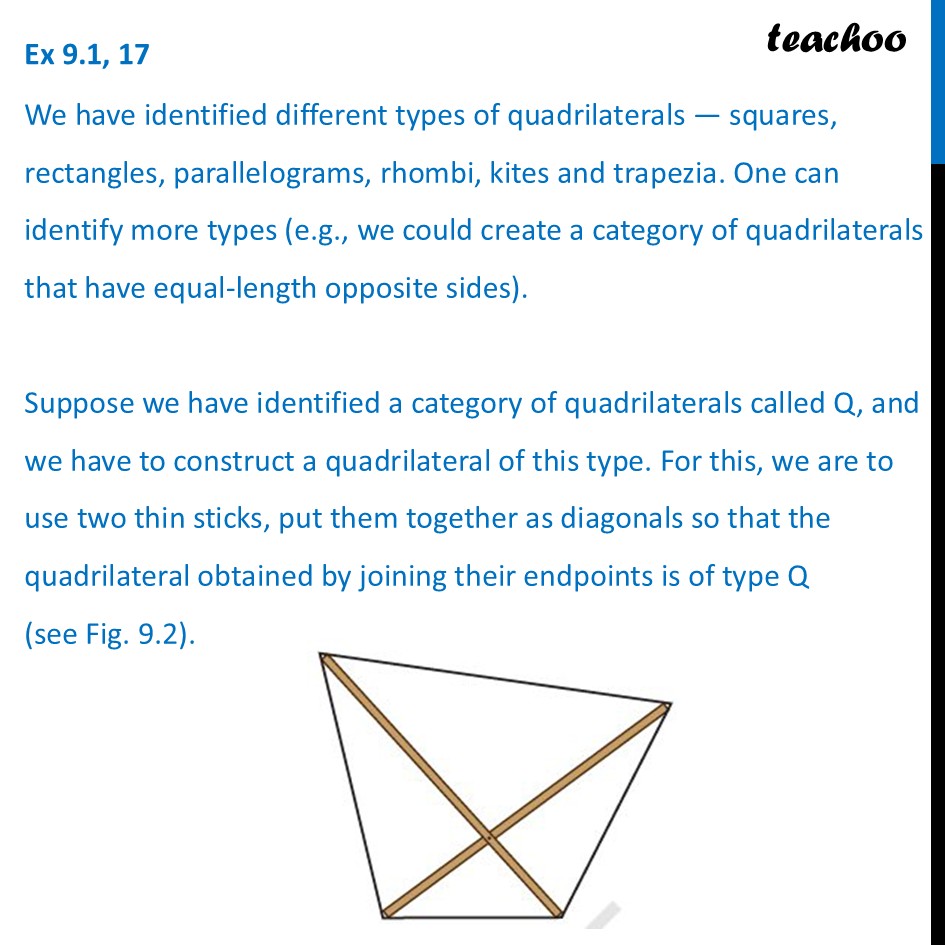
Ex 9.1, 17 We have identified different types of quadrilaterals — squares, rectangles, parallelograms, rhombi, kites and trapezia. One can identify more types (e.g., we could create a category of quadrilaterals that have equal-length opposite sides). Suppose we have identified a category of quadrilaterals called Q, and we have to construct a quadrilateral of this type. For this, we are to use two thin sticks, put them together as diagonals so that the quadrilateral obtained by joining their endpoints is of type Q (see Fig. 9.2). Ex 9.1, 17 (i) Suppose Q satisfies the following property. If a quadrilateral is of type Q, then it has equal-length diagonals. (a) Should the two sticks be of equal length? Why or why not? (b) Will it matter how the two sticks are put together? Our statement is a Proposition Proposition: If a quadrilateral is of type Q, then it has equal-length diagonals. Let’s answer this one by one (a) Should the sticks be of equal length? Yes Every quadrilateral of type 𝑄 must have equal diagonals. Therefore, to construct one, the sticks must have equal lengths. Equal-length sticks are necessary. (b) Will it matter how the sticks are put together? It may matter. Equal lengths alone do not guarantee type 𝑄. For example: Suppose 𝑸 means square. Now, Every square has equal diagonals. However, placing two equal sticks so that they bisect each other at an angle of 60° produces a rectangle that is not a square. To form a square, the equal sticks must bisect each other and meet at 90°. So, their arrangement can matter. Therefore, to construct one, the sticks must have equal lengths. Equal-length sticks are necessary. (b) Will it matter how the sticks are put together? Yes, it matters Equal lengths alone do not guarantee type 𝑄. For example: Suppose 𝑸 means square. Now, Every square has equal diagonals. However, placing two equal sticks so that they bisect each other at an angle of 60° produces a rectangle that is not a square. To form a square, the equal sticks must bisect each other and meet at 90°. So, their arrangement can matter. Ex 9.1, 17 (ii) Instead of the property mentioned above, suppose Q satisfies the following property. If a quadrilateral has equal diagonals, then it is of type Q. What will be your answers to (a) and (b) now? Here, it is in the converse of part (i) Converse: If a quadrilateral has equal diagonals, then it is of type Q Now, we need to answer our questions (a) Should the sticks be of equal length? Yes. Choose equal-length sticks to guarantee type 𝑸. The resulting quadrilateral will have equal diagonals. By the given statement, it must therefore be of type 𝑄. (b) Will it matter how the sticks are put together? NO, it will NOT matter. With equal-length sticks, any arrangement that forms a proper quadrilateral will give type 𝑄. Whatever their angle or intersection point, the diagonals remain equal in length. The given statement therefore guarantees that the quadrilateral is of type 𝑄. The sticks must still cross inside both sticks to form a proper, non-degenerate quadrilateral as shown in the book. (b) Will it matter how the sticks are put together? NO, it will NOT matter. With equal-length sticks, any arrangement that forms a proper quadrilateral will give type 𝑄. Whatever their angle or intersection point, the diagonals remain equal in length. The given statement therefore guarantees that the quadrilateral is of type 𝑄. The sticks must still cross inside both sticks to form a proper, non-degenerate quadrilateral as shown in the book.
