
Exercise Set 9.1

 You are here
Exercise Set 9.1
Last updated at October 5, 2026 by Teachoo
Transcript
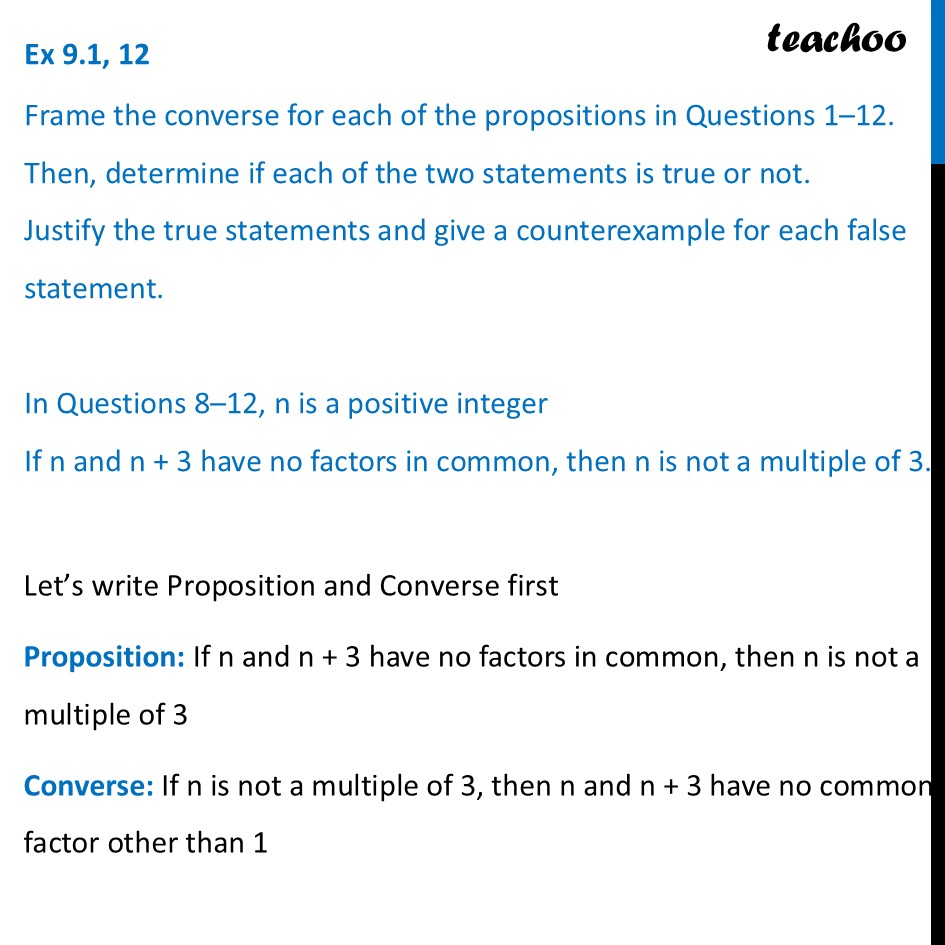
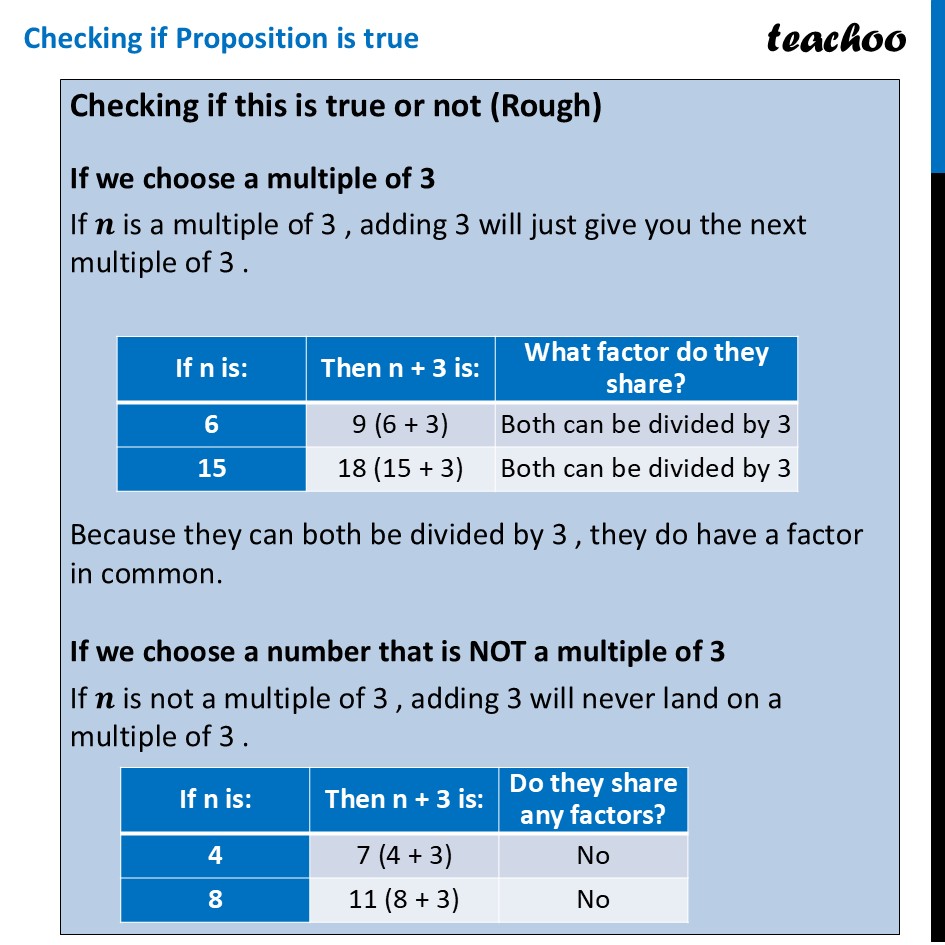
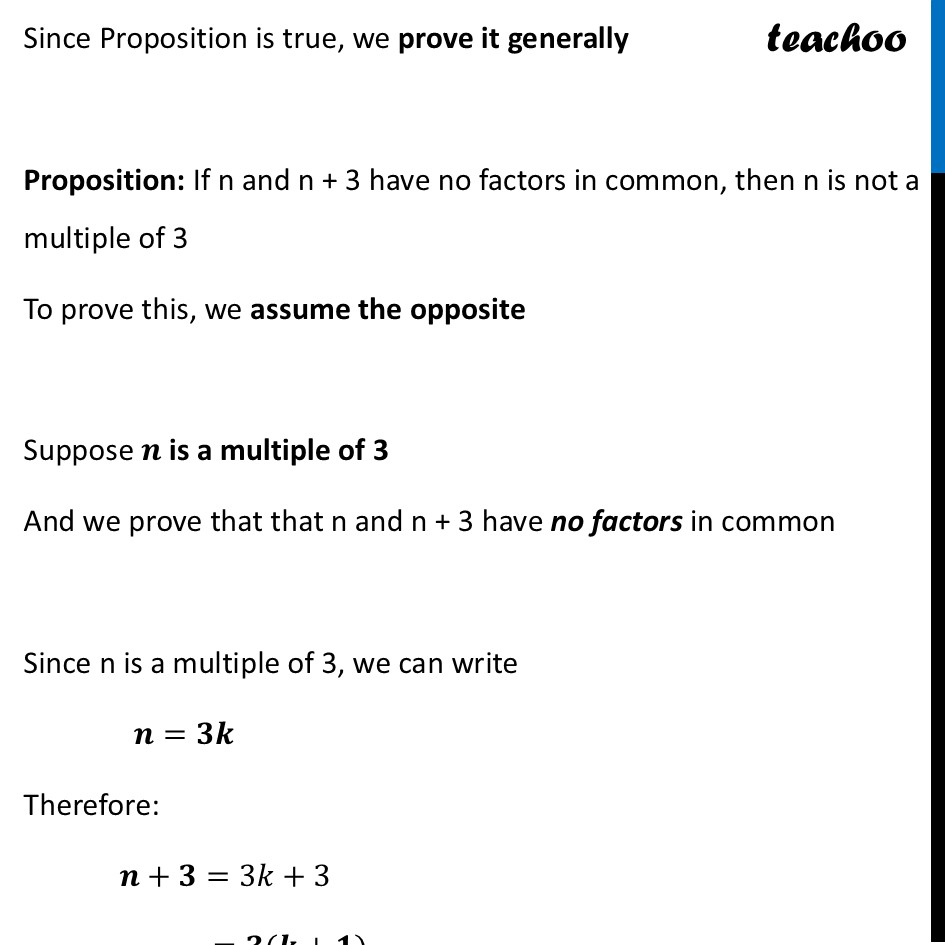
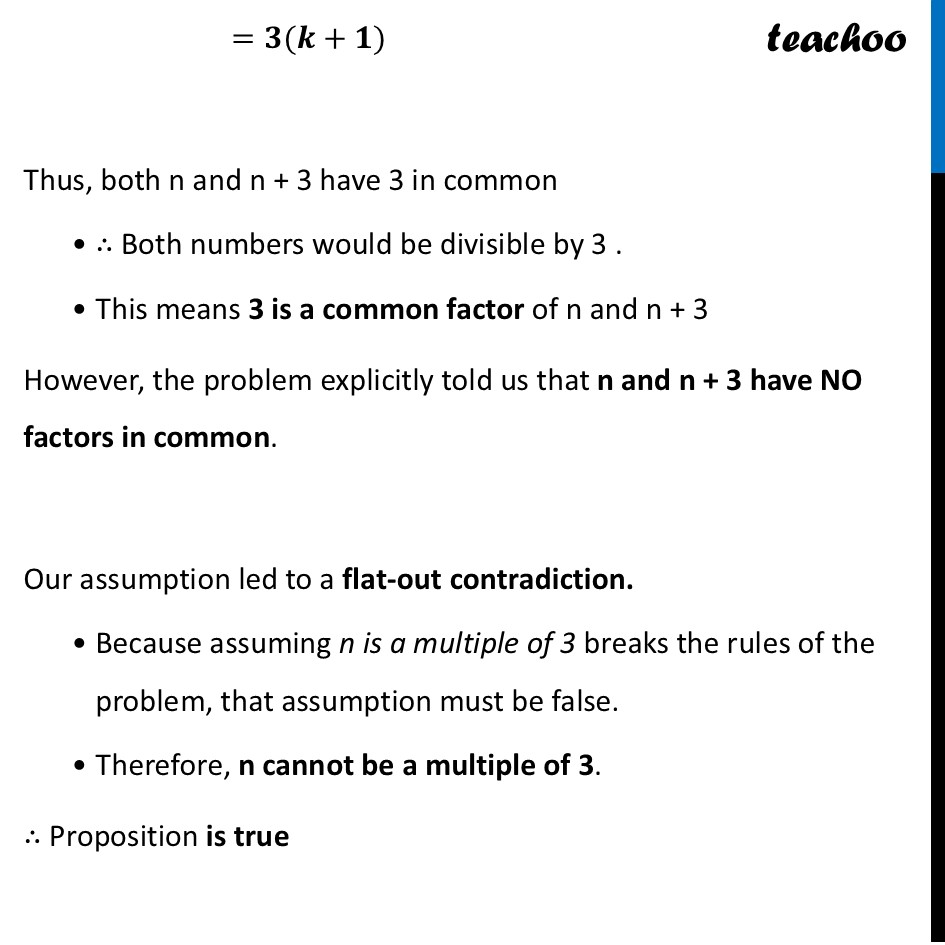
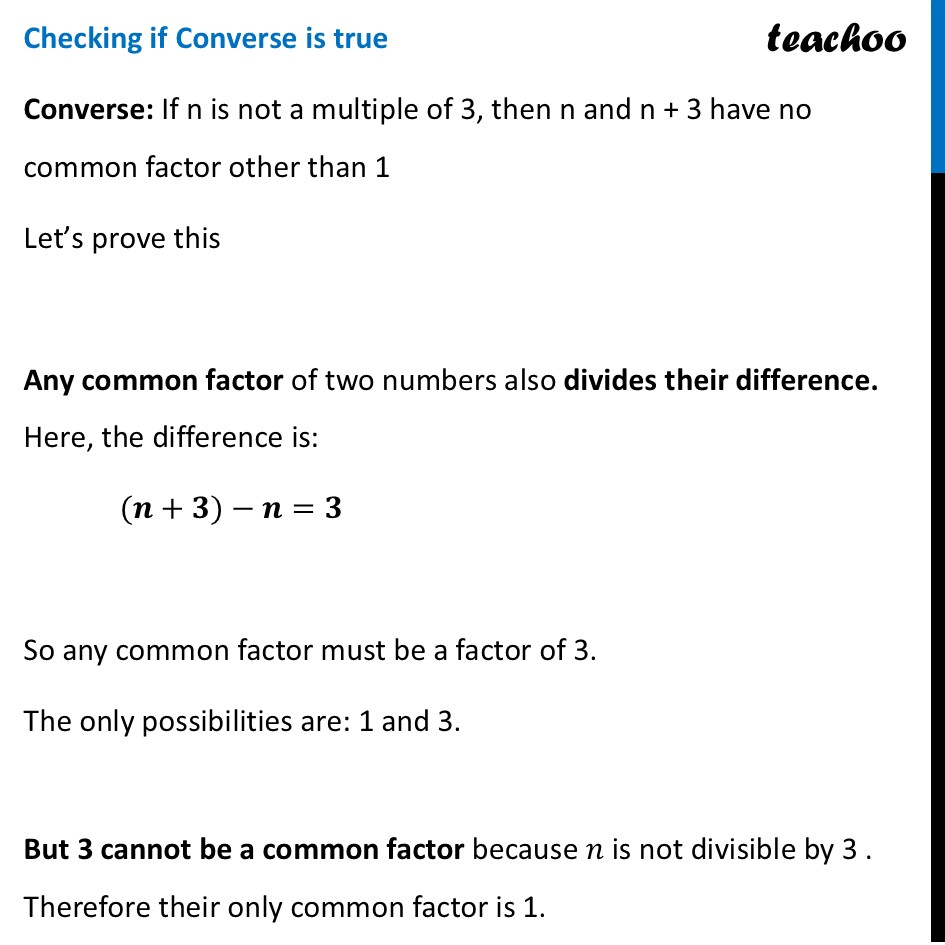
Ex 9.1, 12 Frame the converse for each of the propositions in Questions 1–12. Then, determine if each of the two statements is true or not. Justify the true statements and give a counterexample for each false statement. In Questions 8–12, n is a positive integer If n and n + 3 have no factors in common, then n is not a multiple of 3. Let’s write Proposition and Converse first Proposition: If n and n + 3 have no factors in common, then n is not a multiple of 3 Converse: If n is not a multiple of 3, then n and n + 3 have no common factor other than 1 Checking if Proposition is true Checking if this is true or not (Rough) If we choose a multiple of 3 If 𝒏 is a multiple of 3 , adding 3 will just give you the next multiple of 3 . Because they can both be divided by 3 , they do have a factor in common. If we choose a number that is NOT a multiple of 3 If 𝒏 is not a multiple of 3 , adding 3 will never land on a multiple of 3 . Since Proposition is true, we prove it generally Proposition: If n and n + 3 have no factors in common, then n is not a multiple of 3 To prove this, we assume the opposite Suppose 𝒏 is a multiple of 3 And we prove that that n and n + 3 have no factors in common Since n is a multiple of 3, we can write 𝒏=𝟑𝒌 Therefore: 𝒏+𝟑=3𝑘+3 =𝟑(𝒌+𝟏)" " Thus, both n and n + 3 have 3 in common ∴ Both numbers would be divisible by 3 . This means 3 is a common factor of n and n + 3 However, the problem explicitly told us that n and n + 3 have NO factors in common. Our assumption led to a flat-out contradiction. Because assuming n is a multiple of 3 breaks the rules of the problem, that assumption must be false. Therefore, n cannot be a multiple of 3. ∴ Proposition is true Checking if Converse is true Converse: If n is not a multiple of 3, then n and n + 3 have no common factor other than 1 Let’s prove this Any common factor of two numbers also divides their difference. Here, the difference is: (𝒏+𝟑)−𝒏=𝟑 So any common factor must be a factor of 3. The only possibilities are: 1 and 3. But 3 cannot be a common factor because 𝑛 is not divisible by 3 . Therefore their only common factor is 1. ∴ Converse is true Since Proposition is true, we prove it generally Proposition: If n and n + 3 have no factors in common, then n is not a multiple of 3 To prove this, we assume the opposite Suppose 𝒏 is a multiple of 3 And we prove that that n and n + 3 have no factors in common Since n is a multiple of 3, we can write 𝒏=𝟑𝒌 Therefore: 𝒏+𝟑=3𝑘+3 =𝟑(𝒌+𝟏)" " Thus, both n and n + 3 have 3 in common ∴ Both numbers would be divisible by 3 . This means 3 is a common factor of n and n + 3 However, the problem explicitly told us that n and n + 3 have NO factors in common. Our assumption led to a flat-out contradiction. Because assuming n is a multiple of 3 breaks the rules of the problem, that assumption must be false. Therefore, n cannot be a multiple of 3. ∴ Proposition is true Checking if Converse is true Converse: If n is not a multiple of 3, then n and n + 3 have no common factor other than 1 Let’s prove this Any common factor of two numbers also divides their difference. Here, the difference is: (𝒏+𝟑)−𝒏=𝟑 So any common factor must be a factor of 3. The only possibilities are: 1 and 3. But 3 cannot be a common factor because 𝑛 is not divisible by 3 . Therefore their only common factor is 1. ∴ Converse is true =𝟑(𝒌+𝟏)" " Thus, both n and n + 3 have 3 in common ∴ Both numbers would be divisible by 3 . This means 3 is a common factor of n and n + 3 However, the problem explicitly told us that n and n + 3 have NO factors in common. Our assumption led to a flat-out contradiction. Because assuming n is a multiple of 3 breaks the rules of the problem, that assumption must be false. Therefore, n cannot be a multiple of 3. ∴ Proposition is true Checking if Converse is true Converse: If n is not a multiple of 3, then n and n + 3 have no common factor other than 1 Let’s prove this Any common factor of two numbers also divides their difference. Here, the difference is: (𝒏+𝟑)−𝒏=𝟑 So any common factor must be a factor of 3. The only possibilities are: 1 and 3. But 3 cannot be a common factor because 𝑛 is not divisible by 3 . Therefore their only common factor is 1. ∴ Converse is true
