Exercise Set 9.1

 You are here
Exercise Set 9.1
Last updated at October 5, 2026 by Teachoo
Transcript
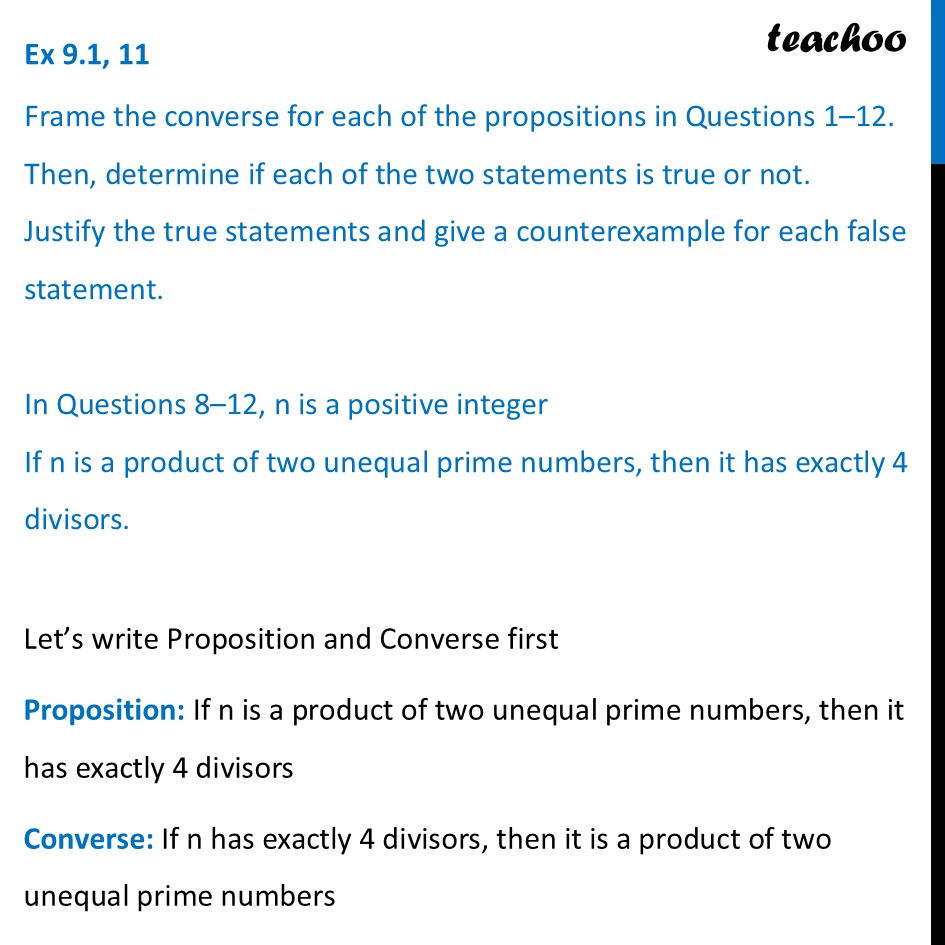
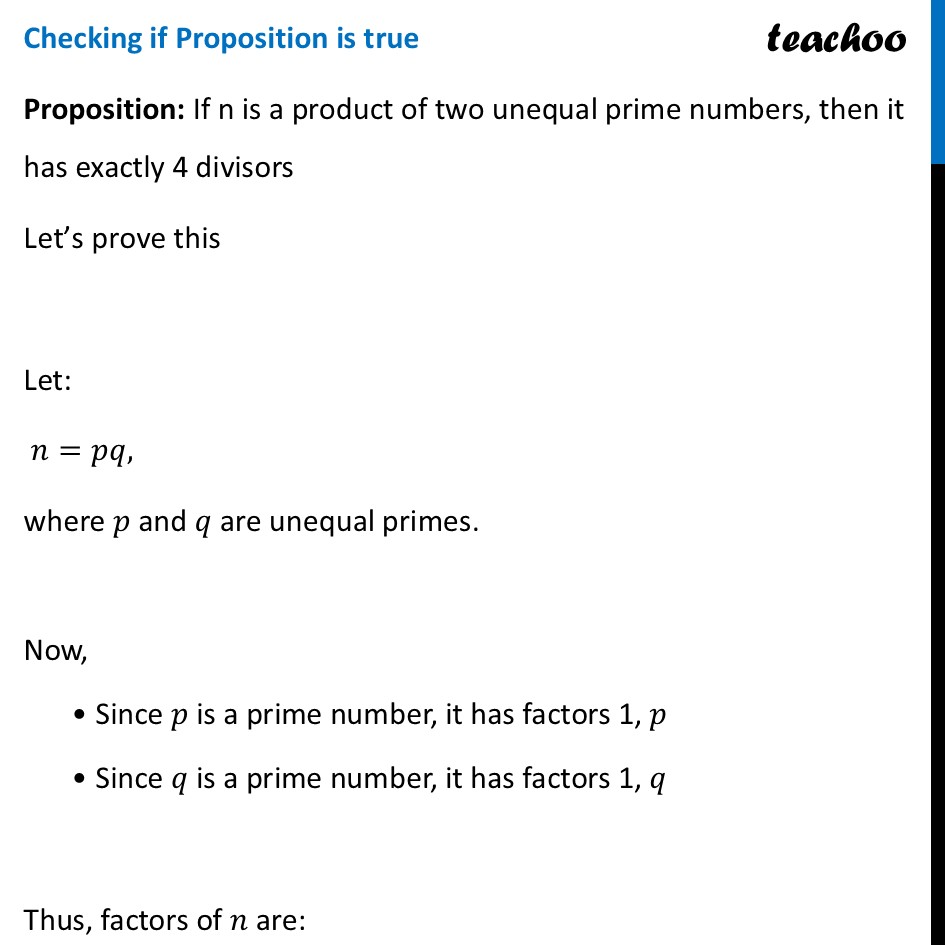
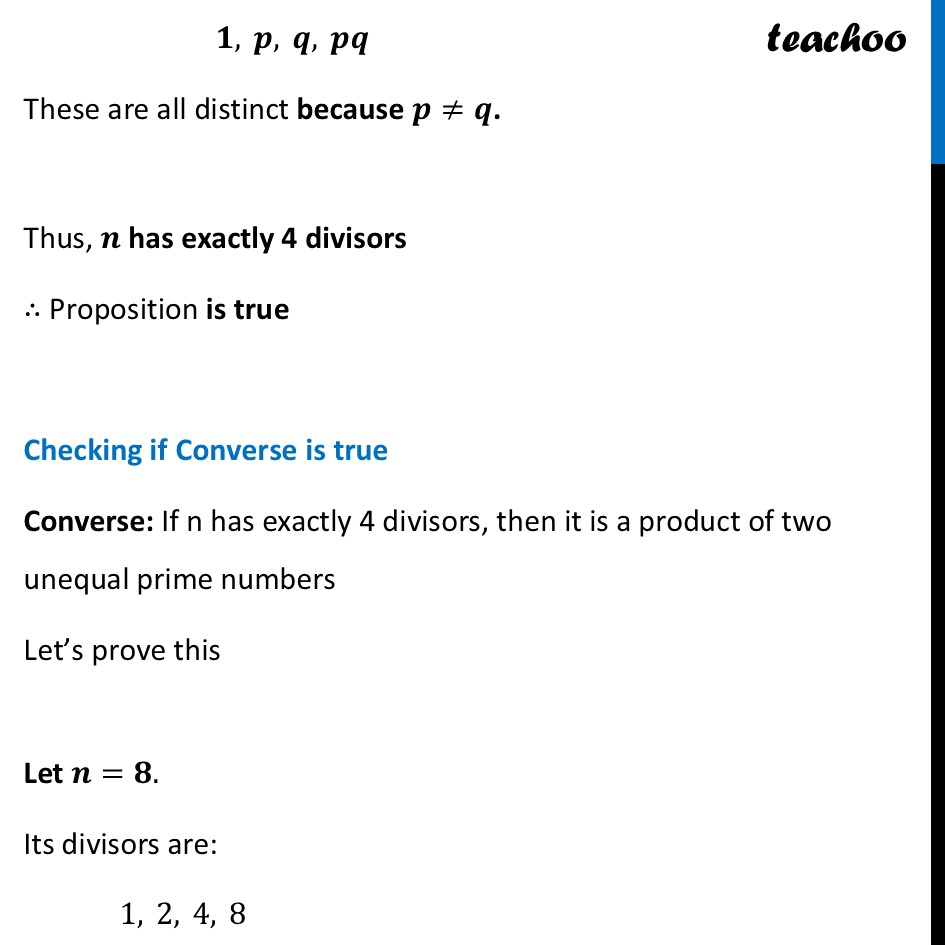
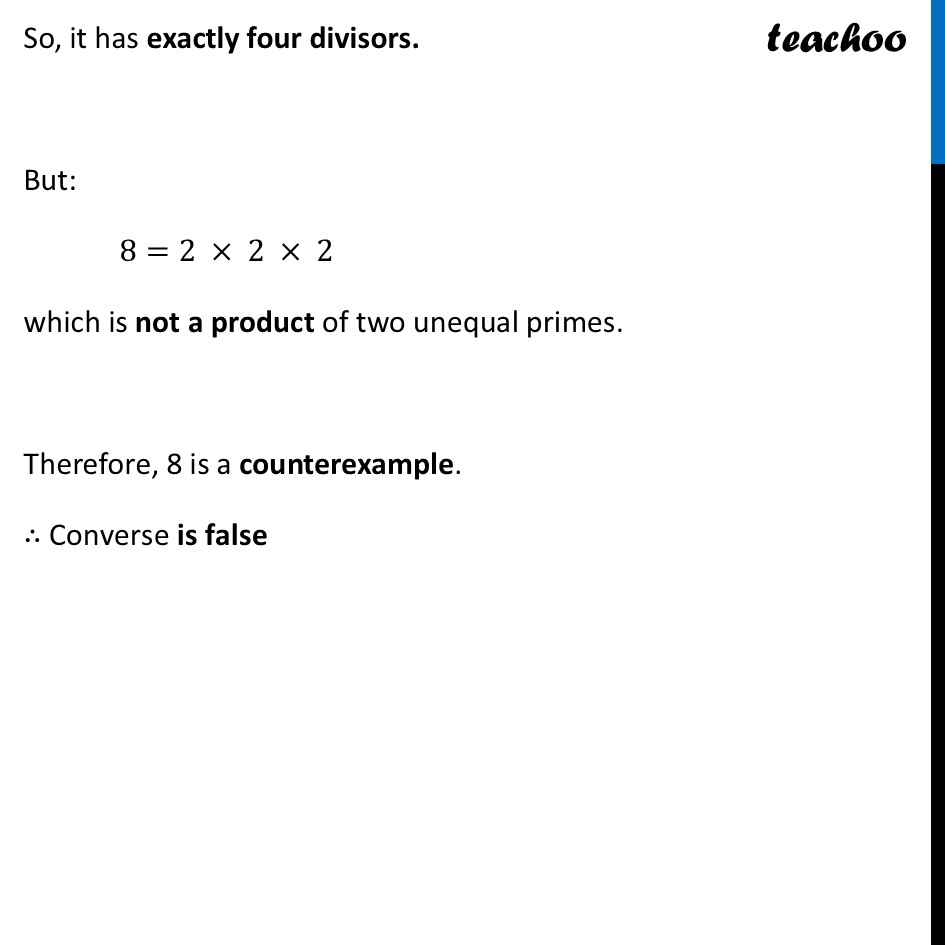
Ex 9.1, 11 Frame the converse for each of the propositions in Questions 1–12. Then, determine if each of the two statements is true or not. Justify the true statements and give a counterexample for each false statement. In Questions 8–12, n is a positive integer If n is a product of two unequal prime numbers, then it has exactly 4 divisors. Let’s write Proposition and Converse first Proposition: If n is a product of two unequal prime numbers, then it has exactly 4 divisors Converse: If n has exactly 4 divisors, then it is a product of two unequal prime numbers Checking if Proposition is true Proposition: If n is a product of two unequal prime numbers, then it has exactly 4 divisors Let’s prove this Let: 𝑛=𝑝𝑞, where 𝑝 and 𝑞 are unequal primes. Now, Since 𝑝 is a prime number, it has factors 1, 𝑝 Since 𝑞 is a prime number, it has factors 1, 𝑞 Thus, factors of 𝑛 are: 𝟏,□( ) 𝒑,□( ) 𝒒,□( ) 𝒑𝒒 These are all distinct because 𝒑≠𝒒. Thus, 𝒏 has exactly 4 divisors ∴ Proposition is true Checking if Converse is true Converse: If n has exactly 4 divisors, then it is a product of two unequal prime numbers Let’s prove this Let 𝒏=𝟖. Its divisors are: 1,□( ) 2,□( ) 4,□( ) 8 So, it has exactly four divisors. But: 8=2 × 2 × 2 which is not a product of two unequal primes. Therefore, 8 is a counterexample. ∴ Converse is false Checking if Proposition is true Proposition: If n is a product of two unequal prime numbers, then it has exactly 4 divisors Let’s prove this Let: 𝑛=𝑝𝑞, where 𝑝 and 𝑞 are unequal primes. Now, Since 𝑝 is a prime number, it has factors 1, 𝑝 Since 𝑞 is a prime number, it has factors 1, 𝑞 Thus, factors of 𝑛 are: 𝟏,□( ) 𝒑,□( ) 𝒒,□( ) 𝒑𝒒 These are all distinct because 𝒑≠𝒒. Thus, 𝒏 has exactly 4 divisors ∴ Proposition is true Checking if Converse is true Converse: If n has exactly 4 divisors, then it is a product of two unequal prime numbers Let’s prove this Let 𝒏=𝟖. Its divisors are: 1,□( ) 2,□( ) 4,□( ) 8 So, it has exactly four divisors. But: 8=2 × 2 × 2 which is not a product of two unequal primes. Therefore, 8 is a counterexample. ∴ Converse is false
