
 You are here
💬 Think about it
Blood flows to every corner of your body, and bones hold you up from head to toe.
Both connect and support parts of the body, yet one is a liquid and the other is hard.
How can both be the same kind of tissue?
Let us find out.
What is connective tissue?
- A tissue that connects and supports other tissues.
- It holds the different organs and tissues of the body together and supports the body from head to toe.
Give two examples of connective tissue.
- Blood
- Bone
- (Other examples include cartilage, tendon and ligament.)
Why do blood and bone differ so much even though both are connective tissues?
- Because their matrix (the material between the cells) is different.
- In blood the matrix is watery, soft and jelly-like, so blood is a fluid .
- In bone the matrix is hard, solid and rigid, so bone is hard .
What are the different components of blood?
![3.3.2 How are various parts conn - Tissues in Action - [Teachoo] - Concepts](https://cdn.teachoo.com/6874350d-3159-4723-aed7-bb4ecf3bcac6/3.3.2-how-are-various-parts-connected-in-our-body-image-37.webp)
- Blood has a liquid part called plasma (about 55% of its volume).
- Floating in the plasma are the formed elements (about 45%) — RBCs, WBCs and platelets.
| Component | What it is / does |
|---|---|
| Plasma | The liquid part of blood (about 55% of its volume) that carries the cells and dissolved substances |
| Red Blood Cells (RBCs) | Hold haemoglobin, an iron-rich protein, and carry oxygen around the body; they live about 4 months |
| White Blood Cells (WBCs) | Collect at infected areas to fight germs and infection |
| Platelets | Help the blood to clot at the site of a cut |
What are the different types of bone?
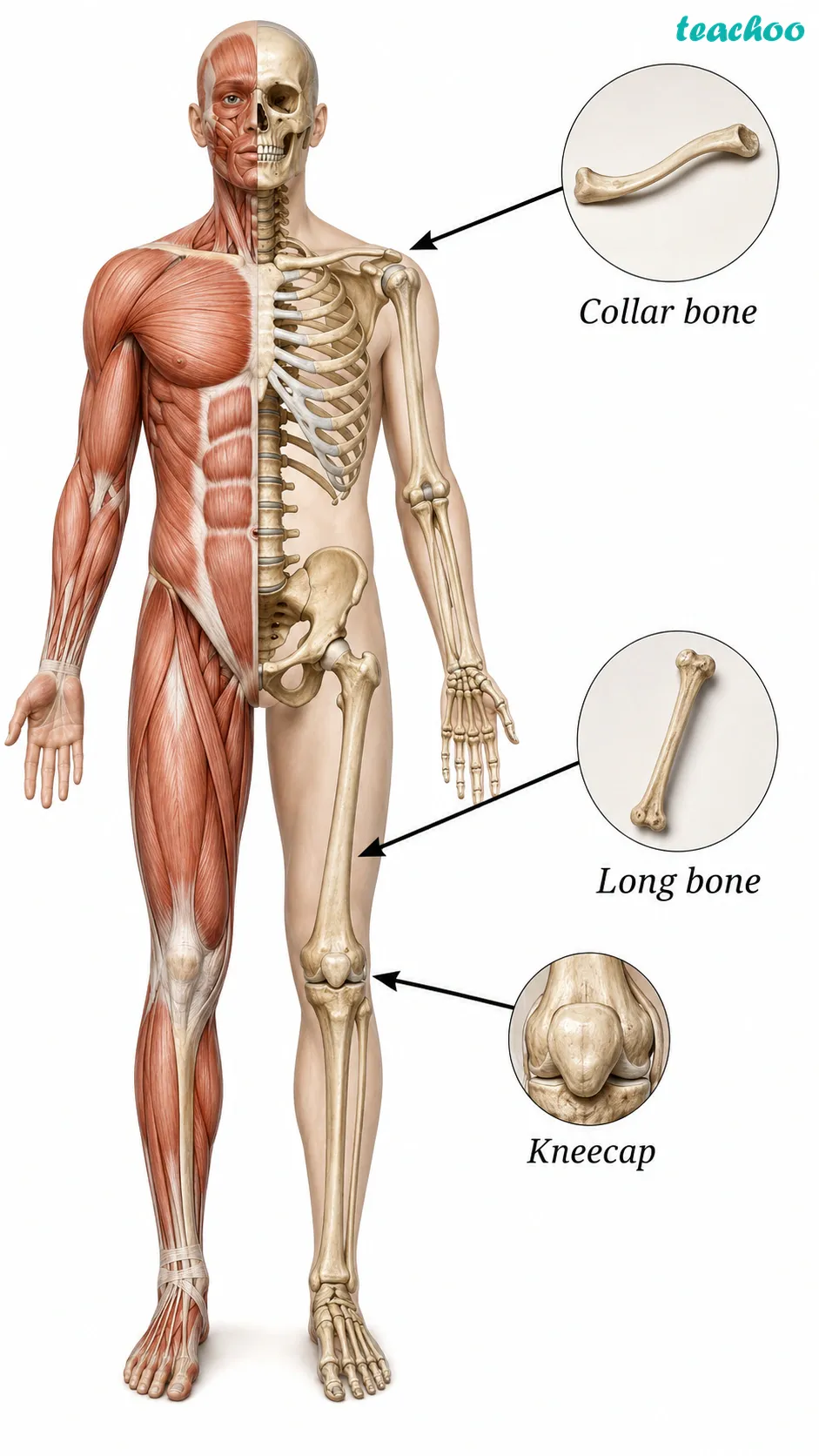
| Bone | What it is |
|---|---|
| Collar bone | The bone across the top of the chest that joins the arm to the body |
| Long bone | A long limb bone, like the bone of the upper arm or thigh |
| Kneecap | The small bone at the front of the knee joint |
Are there more connective tissues apart from bone and blood?
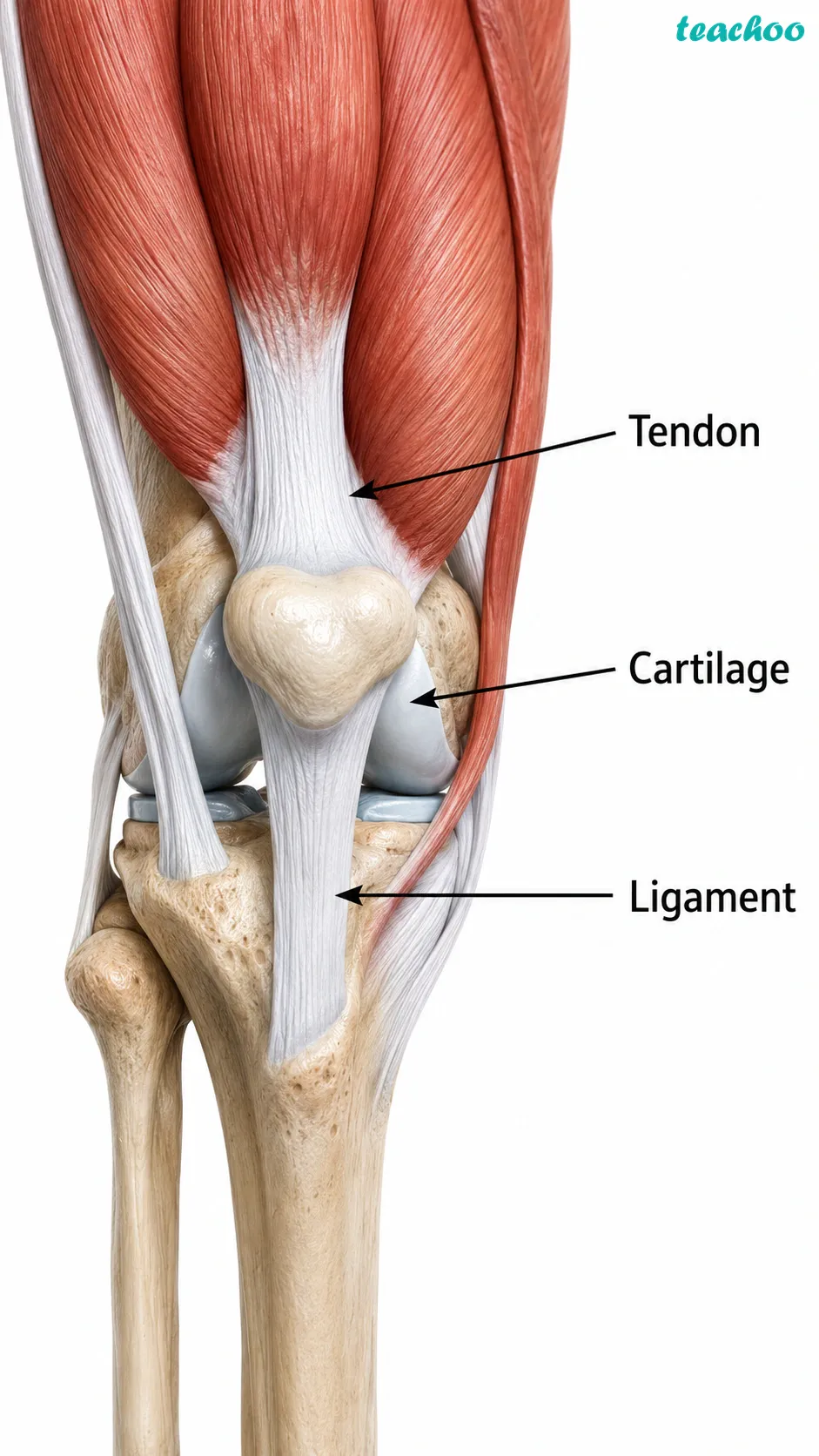
| Connective tissue | Function |
|---|---|
| Bone | Gives the body strength, support and protection |
| Cartilage | Provides flexibility and cushions the ends of bones |
| Tendon | Connects muscle to bone, and thus brings about movement |
| Ligament | Connects bone to bone, gives stability and prevents dislocation |
Difference between - bone, cartilage and tendon
| Tissue | Matrix / makeup | Property | Function |
|---|---|---|---|
| Bone | Rigid matrix with calcium and phosphorus | Strong and rigid | Gives the body strength and support |
| Cartilage | Soft, jelly-like matrix | Flexible | Provides flexibility and cushioning |
| Tendon | Tough, fibrous tissue | Strong and slightly stretchy | Connects muscle to bone to bring about movement |
Important Points
- Connective tissue connects and supports other tissues.
- Blood, bone, cartilage, tendon and ligament are connective tissues.
- Blood and bone differ because their matrices are different.
- Tendons join muscle to bone; ligaments join bone to bone.
Connective tissues at a glance
Connective Tissue
Connects and supports the body
Fluid
Blood
Carries:
Oxygen, nutrients
Fights infection
Supporting
Bone
Cartilage
Fibrous connectors
Tendon (muscle → bone)
Ligament (bone → bone)
❓ Test Yourself
-
What is the job of connective tissue?
View Answer
To connect and support other tissues. -
Why do blood and bone differ, though both are connective tissues?
View Answer
Because their matrices are different — liquid in blood, hard in bone. -
What does a tendon connect?
View Answer
Muscle to bone. -
What does a ligament connect?
View Answer
Bone to bone.
Important Definitions
- Connective tissue — a tissue that connects and supports other tissues.
- Matrix — the material between the cells of a connective tissue (liquid in blood, hard in bone).
- Tendon — connective tissue joining muscle to bone.
- Ligament — connective tissue joining bone to bone.
In this Activity, we will recall everyday experiences about blood and match them with observations to understand blood and its components.
Procedure
Recall the everyday experiences in the first column of Table 3.3. Write your observations and questions in your notebook. Compare your observations with those given in Table 3.3.
Table 3.3 — Your experiences, observations and questions from daily life
| Experiences | Observations | Questions |
|---|---|---|
| When you get a small cut on your skin | Red blood oozes out from the cut. A clot is formed after some time. | What causes blood to clot? |
| When you get a skin infection | The area turns red and perhaps slightly swollen. You may have a fever. | Why does the area swell and turn red? |
| When you exercise or run | You breathe faster. Your face may turn red. | Why does breathing become faster? |
Explanation
1. The red colour of blood is due to haemoglobin, an iron-rich protein in the Red Blood Cells (RBCs). RBCs live for about 4 months and are replaced regularly.
2. Platelets help in blood clotting at the site of injury.
3. During exercise, muscles need more oxygen, so breathing becomes faster and blood flow increases (the face appears red).
4. White Blood Cells (WBCs) collect at infected areas, causing pus and inflammation (redness and swelling).
2. Platelets help in blood clotting at the site of injury.
3. During exercise, muscles need more oxygen, so breathing becomes faster and blood flow increases (the face appears red).
4. White Blood Cells (WBCs) collect at infected areas, causing pus and inflammation (redness and swelling).
◆ Summary
In this activity, we learnt that:
- Our everyday experiences with blood matched the observations.
- RBCs, WBCs and platelets each do their own job.
- Blood is a connective tissue.
In this Activity, we will perform simple body actions and match each to the connective tissue responsible for it.
Procedure
Perform the actions given in Table 3.4. Record your experiences and compare them with the experiences given in Table 3.4. Study their functions and identify the connective tissues.
Table 3.4 — Connective tissues
| Action | Experience | Function | Identified connective tissue |
|---|---|---|---|
| Touch your elbow gently | A hard and rigid structure | Gives strength, support and protection | Bone |
| Press and fold your ear or gently press your nose | A soft and flexible structure that retains shape again | Provides flexibility and cushions the ends of bones for shock absorption | Cartilage |
| Touch your forearm muscles and wiggle your fingers | Feel movement in the forearm even though fingers are far away | Connects muscle to bone, and thus brings about movement | Tendon |
| Sit on a chair and move your leg upwards till your knee allows | The joint does not go beyond a limit | Connects bone to bone, gives stability, limits movement and prevents dislocation | Ligament |
◆ Summary
In this activity, we learnt that:
- Doing simple body actions lets us feel hard, soft and pulling structures.
- Each structure can be matched to a tissue.
- The body has four connective tissues.
