
 You are here
💬 Think about it
Mow a lawn and the grass grows back.
Trim a hedge and it turns bushy.
If the tips were cut, how does the plant still grow?
There must be growth tissue somewhere else too.
Let us find it.
How do plants grow after being cut?
![3.2.3 Intercalary meristem — How - Tissues in Action - [Teachoo] - Concepts](https://cdn.teachoo.com/202ced33-e5a7-4d73-8dc3-b85f2d978990/figs.-3.5-3.6-intercalary-meristem-regrowth-after-cutting.webp)
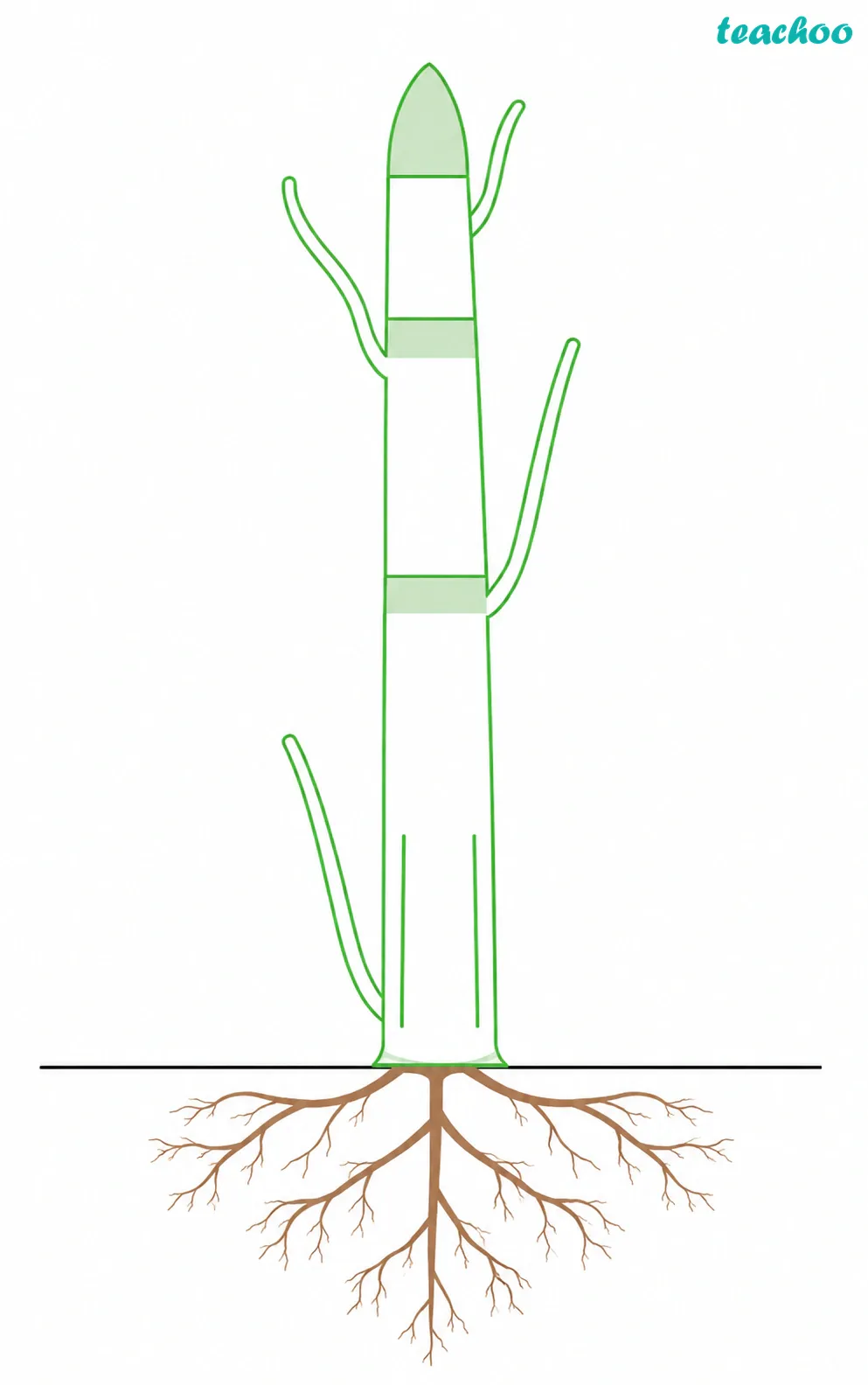
Node (where
leaves/branches
arise)
Internode
(stem between
nodes)
Intercalary
meristem
(near the node)
Grass regrows
after mowing
- If the tip of a young stem is cut , the apical meristem is removed . The stem then stops growing in length .
- But new branches arise from the nodes of the stem (Fig. 3.5). So there must be dividing cells somewhere else as well.
- When a hedge around a garden is cut, more branches appear after some time, giving the hedge a bushy appearance . Grass also appears again after being mowed or grazed by animals.
- These dividing cells lie near the nodes , in between — this tissue is the intercalary meristem .
- This happens because of the presence of the intercalary meristem at the nodes of the stem .
What is the intercalary meristem?
Intercalary Meristem
Intercalary
in between — at the base of an internode, just above a node
Meristem
tissue of actively
dividing cells
↓
Meristem between the nodes which helps plants like grasses regrow after cutting or grazing.
- It is meristem at the base of an internode , just above a node .
- Its cells divide actively , like every meristem.
- It helps plants like grasses regrow after being cut or grazed.
Where is the intercalary meristem found?
Intercalary
Meristem
- It is found at the base of the internodes , just above the nodes .
- A node is the point on the stem where branches or leaves arise.
- An internode is the part of the stem between two nodes.
- It is found mainly in grasses and similar plants, which regenerate after cutting.
Comparison of all three types of meristematic tissue
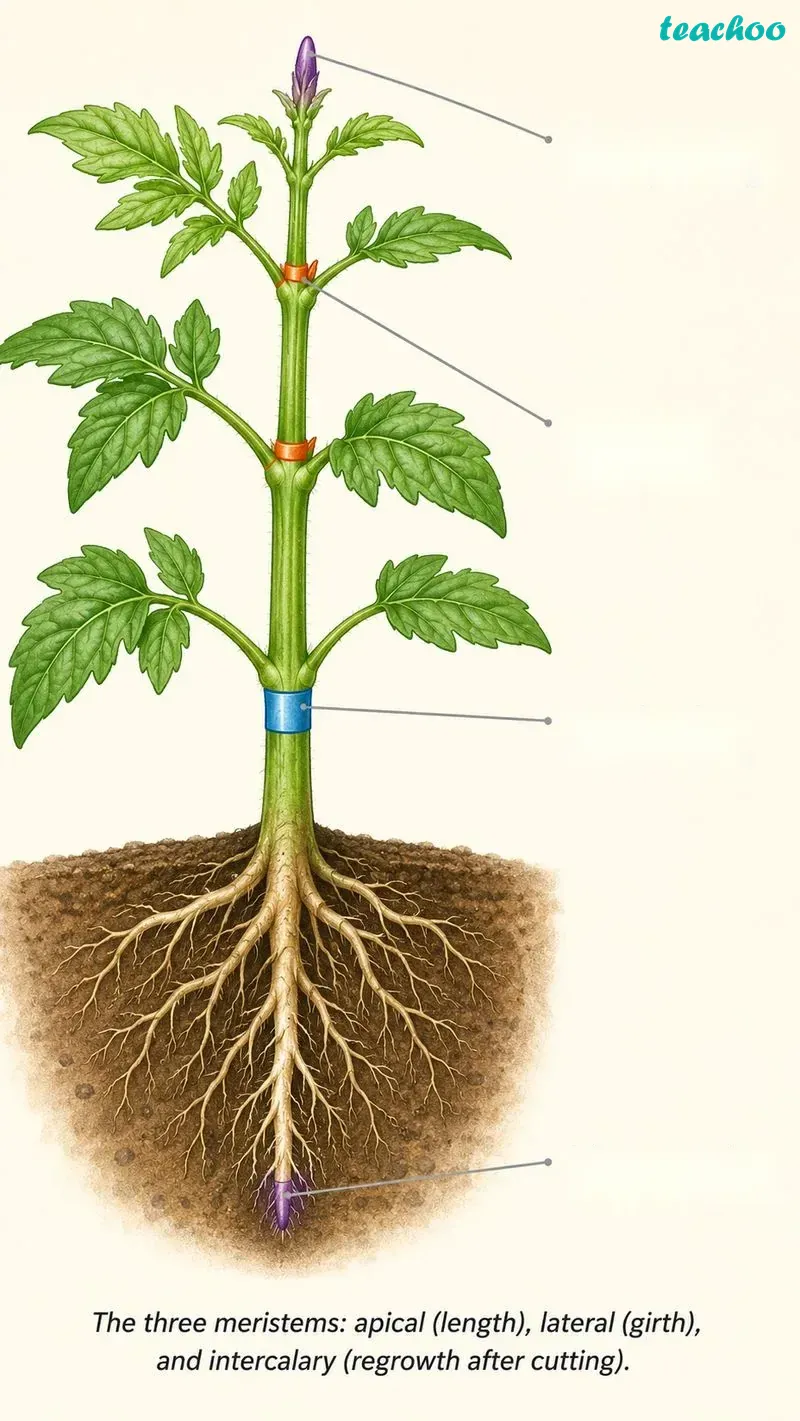
| Meristem | Where found | What it does |
|---|---|---|
| Apical | Root tips and shoot tips | Increases length |
| Lateral | A ring along the circumference of the stem | Increases girth |
| Intercalary | Base of the internodes, near the nodes | Helps regrowth after cutting |
Apical — root &
shoot tips — length
Intercalary —
near nodes —
regrowth
Lateral — ring
in stem — girth
Apical — root &
shoot tips — length
What do meristematic cells look like?
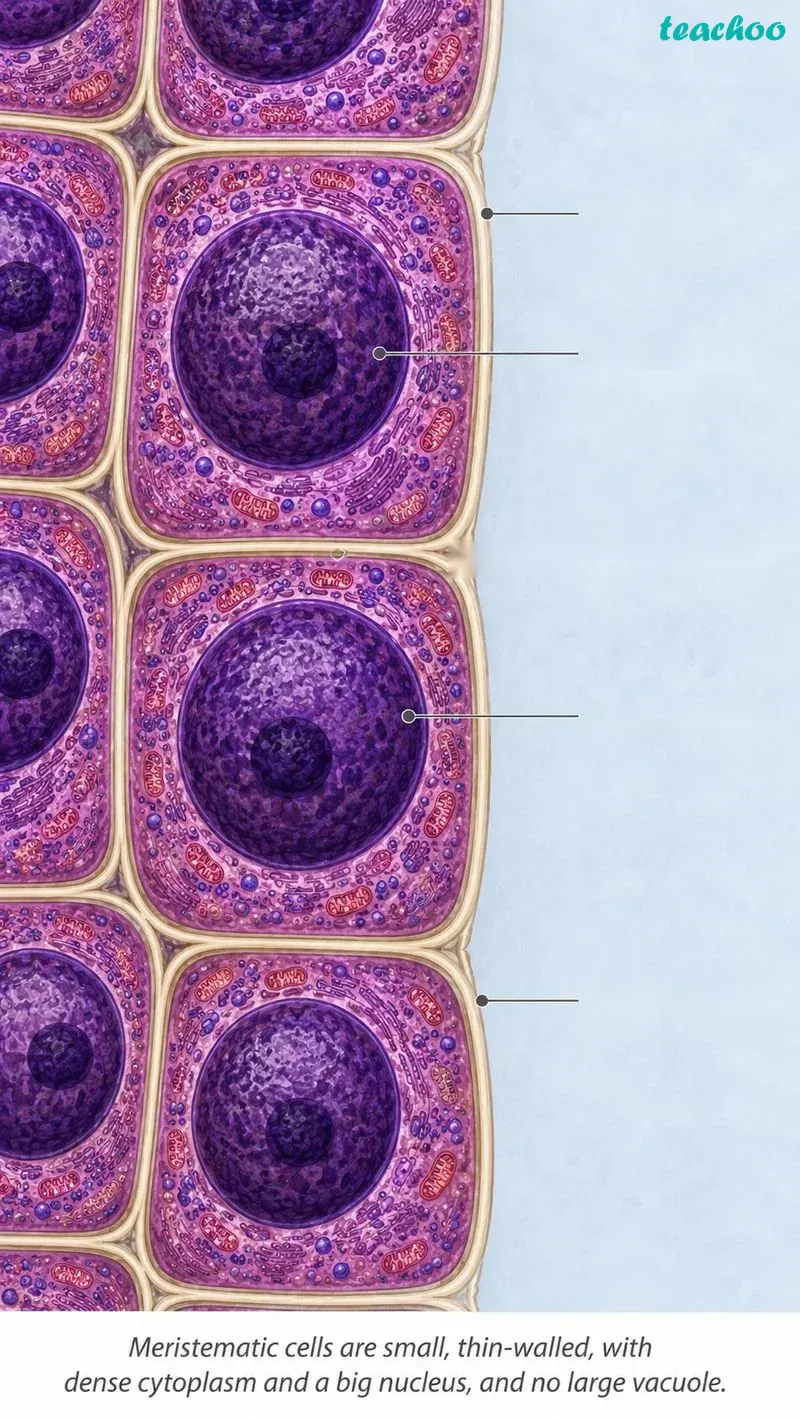
| Feature | Description |
|---|---|
| Size and wall | Small cells with thin cell walls |
| Nucleus | Large and prominent |
| Cytoplasm | Dense, with many organelles |
| Vacuoles | Generally absent |
| Packing | Tightly packed, with little or no intercellular space |
Thin cell wall
Large prominent
nucleus
Dense cytoplasm
No large vacuole
Cells tightly packed
- They are small , with thin cell walls .
- They have a large and prominent nucleus , and dense cytoplasm with many organelles .
- Vacuoles are generally absent .
- The cells are tightly packed , with little or no intercellular space .
- These characteristics allow them continuous and rapid cell division .
Differentiation Process
What happens when meristematic tissue divides?
What happens to a new cell?
New Cells Formed
Two possible fates
1. Stays meristematic
Keeps the power to divide
Adds more new cells
Example:
Apical Meristem
Lateral Meristem
Intercalary Meristem
Intercalary Meristem
2. Differentiates
Loses the power to divide
Becomes permanent tissue
Example:
Parenchyma
Collenchyma
Sclerenchyma
Xylem and phloem
- When meristematic tissue divides, new cells are formed .
- Some of these cells continue dividing — they remain meristematic tissue.
-
The cells that stop dividing become
permanent tissue
.
They lose the ability to divide — they take up a fixed, specialised job. -
This process is called differentiation .
What is differentiation?
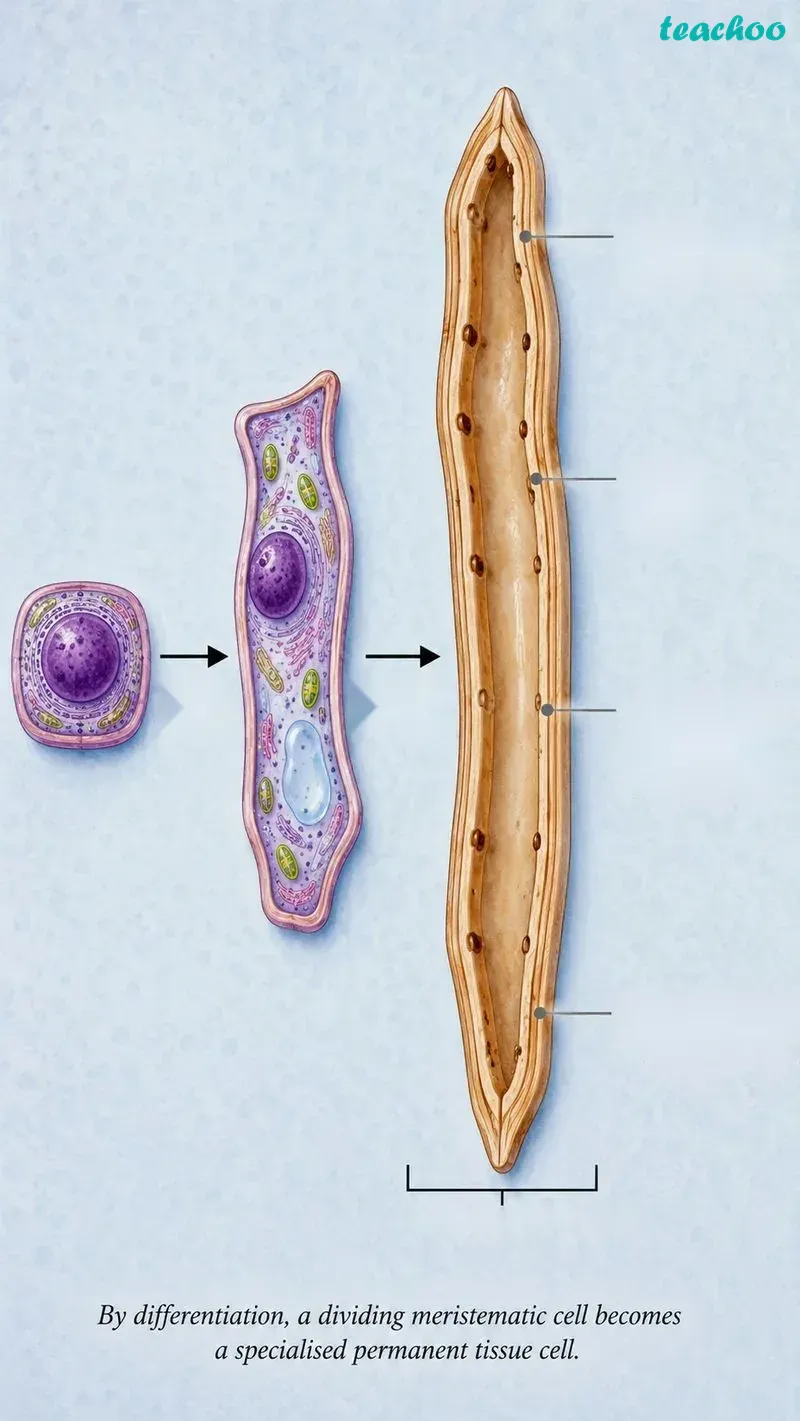
Differentiation
Meristematic Tissue
cells that keep dividing
→
Permanent
Tissue
cells with a
fixed job
↓
Differentiation is the process by which meristematic tissue becomes specialised to perform specific functions (support, transport, storage) and so becomes permanent tissue.
Dividing
meristematic cell
Stops
dividing
becomes
specialised
stops
dividing
Changes shape
and job
(specialises)
Permanent tissue
(e.g. sclerenchyma)
Permanent tissue
- The cells that lose the ability to divide undergo changes in structure and function , and become permanent tissues .
- These cells become specialised to perform specific functions , such as support, transport or storage .
- This process of taking up a fixed job is called differentiation .
- Through differentiation, meristematic tissue becomes permanent tissue .
In short:
Meristematic tissue becomes permanent by the process of differentiation.
Important Points
- Plants have three meristems: apical, lateral and intercalary.
- Meristematic cells are small, thin-walled and lack vacuoles.
- By differentiation, meristematic tissue becomes permanent tissue.
📋 NCERT Question 1 — Meristematic tissues divide repeatedly
Meristematic tissues divide repeatedly. What property of their cells allows them to do this?
(i) They have thick walls for protection.
(ii) They contain large vacuoles that store nutrients.
(iii) They have thin walls, dense cytoplasm and large prominent nucleus.
(iv) They are functionally differentiated cells.
View Answer →
(i) They have thick walls for protection.
(ii) They contain large vacuoles that store nutrients.
(iii) They have thin walls, dense cytoplasm and large prominent nucleus.
(iv) They are functionally differentiated cells.
❓ Test Yourself
-
Which meristem helps grass grow back after mowing?
View Answer
The intercalary meristem. -
What is a node?
View Answer
The point on a stem where branches or leaves arise. -
Why do meristematic cells lack large vacuoles?
View Answer
So they stay small and packed for rapid, continuous division. -
What is differentiation?
View Answer
Differentiation is a process by which meristematic tissue becomes specialised to perform specific functions (support, transport, storage) and so becomes permanent tissue.
Important Definitions
- Intercalary meristem — meristem near the nodes that helps regrowth after cutting.
- Node — the point on a stem where branches or leaves arise.
- Internode — the part of the stem between two nodes.
- Differentiation — the process by which meristematic tissue becomes specialised to perform specific functions, such as support, transport or storage, and so becomes permanent tissue.
📋 NCERT Question 13 — Vibha claims to her
Vibha claims, "Meristematic cells are located only at the root and shoot apices." What do you think? What question could Neha ask to help her understand if the statement is incorrect?
View Answer →
📋 NCERT Question 10 — Sohan designed an experiment
Sohan designed an experiment for the regeneration of sugarcane, where he used cuttings to grow sugarcane. He used two types of cuttings, type ‘A’ and type ‘B’ (Fig. 3.23). After a few weeks, type ‘B’ cuttings sprouted and developed into sugarcane plants, whereas the type ‘A’ cuttings did not sprout.
(i) Why were the type ‘B’ cuttings able to grow as sugarcane but type ‘A’ could not?
(ii) What difference was present in type ‘B’ compared to type ‘A’?
(iii) What observation or measurement was made to determine whether this change had an effect?
(iv) What parameters should be kept the same for both types of cuttings to ensure a fair comparison?
View Answer →
(i) Why were the type ‘B’ cuttings able to grow as sugarcane but type ‘A’ could not?
(ii) What difference was present in type ‘B’ compared to type ‘A’?
(iii) What observation or measurement was made to determine whether this change had an effect?
(iv) What parameters should be kept the same for both types of cuttings to ensure a fair comparison?
