You are here


Chapter 16 Class 11 Probability
Last updated at August 17, 2026 by Teachoo
Transcript
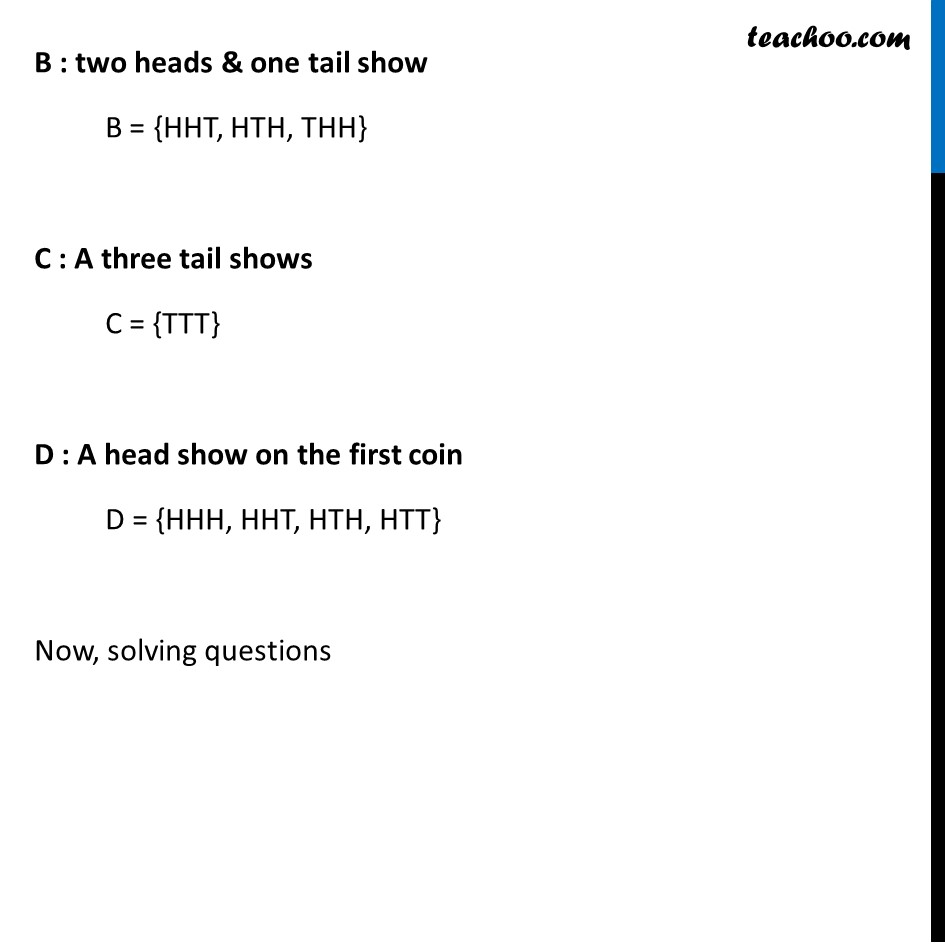
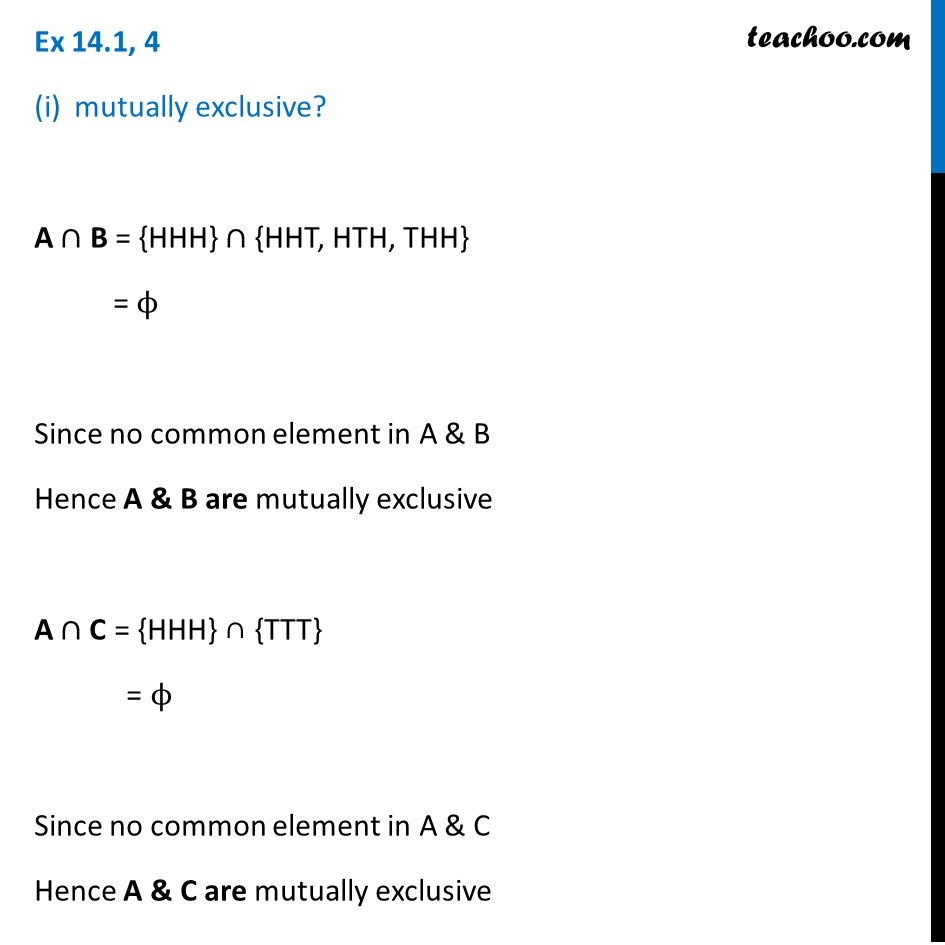
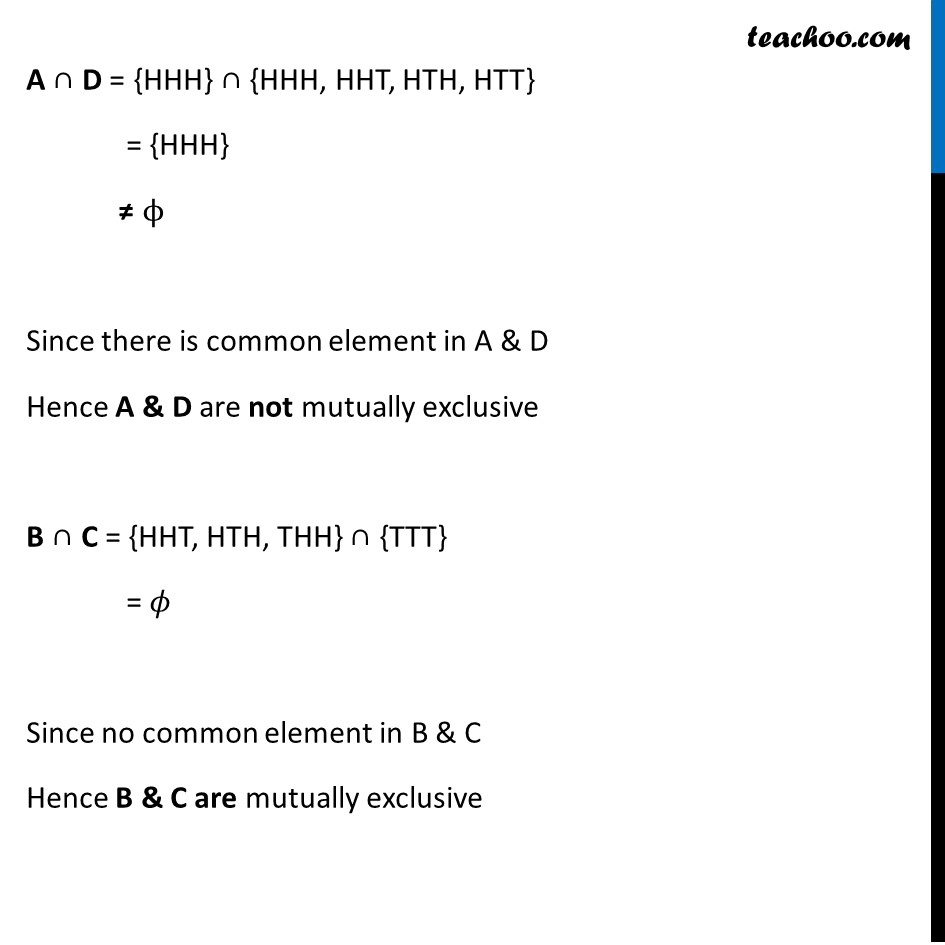
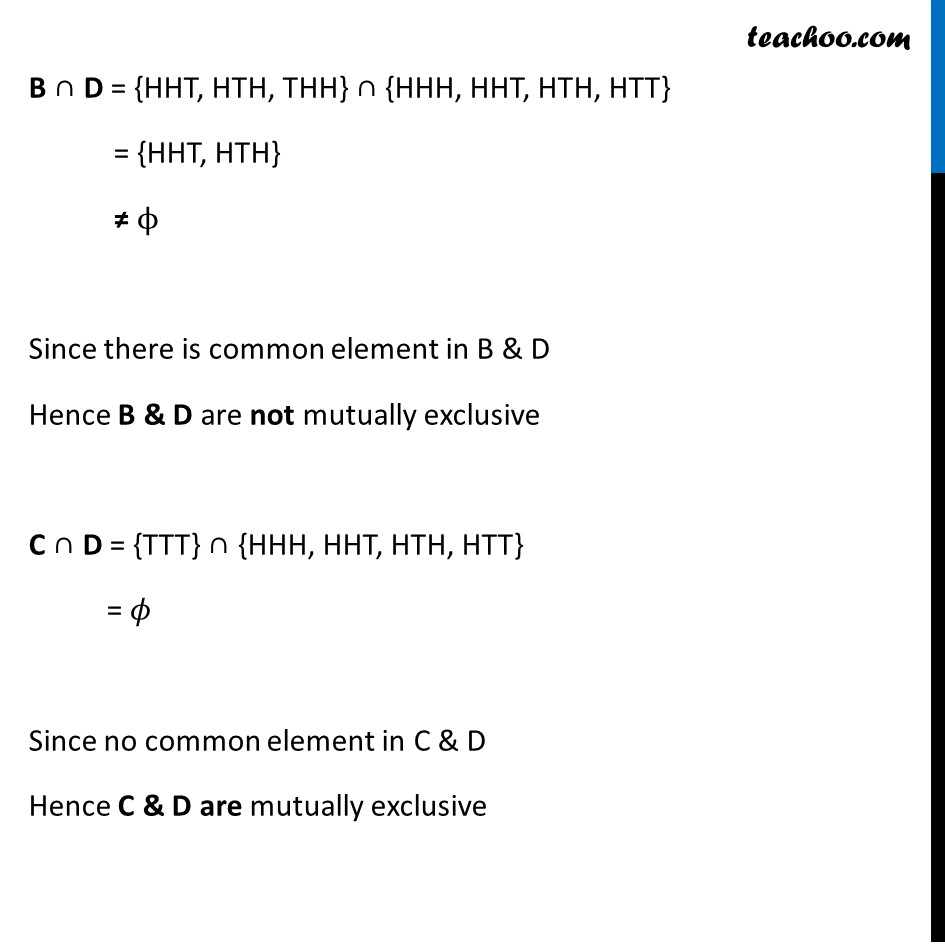
Ex 14.1, 4 Three coins are tossed once. Let A denote the event ‘three heads show”, B denote the event “two heads and one tail show”. C denote the event “three tails show” and D denote the event ‘a head shows on the first coin”. Which events are Finding A, B, C, D When 3 coins are tossed, possible results are S = {HHH, HHT, HTH, THH, HTT, THT, TTH, TTT} A : Three head shows A = {HHH} B : two heads & one tail show B = {HHT, HTH, THH} C : A three tail shows C = {TTT} D : A head show on the first coin D = {HHH, HHT, HTH, HTT} Now, solving questions Ex 14.1, 4 mutually exclusive? A ∩ B = {HHH} ∩ {HHT, HTH, THH} = ϕ Since no common element in A & B Hence A & B are mutually exclusive A ∩ C = {HHH} ∩ {TTT} = ϕ Since no common element in A & C Hence A & C are mutually exclusive A ∩ D = {HHH} ∩ {HHH, HHT, HTH, HTT} = {HHH} ≠ ϕ Since there is common element in A & D Hence A & D are not mutually exclusive B ∩ C = {HHT, HTH, THH} ∩ {TTT} = 𝜙 Since no common element in B & C Hence B & C are mutually exclusive B ∩ D = {HHT, HTH, THH} ∩ {HHH, HHT, HTH, HTT} = {HHT, HTH} ≠ ϕ Since there is common element in B & D Hence B & D are not mutually exclusive C ∩ D = {TTT} ∩ {HHH, HHT, HTH, HTT} = 𝜙 Since no common element in C & D Hence C & D are mutually exclusive Ex 14.1, 4 (ii) Simple A = {HHH} C = {TTT} Since A & C have only one element ∴ A and C are simple events (iii) Compound event B = {HHT, HTH, THH} D = {HHH, HHT, HTH, HTT} Since B & D have more than one element ∴ B and D are compound events Simple events If an event has only one sample point of a sample space , it is simple event Compound events If an event has more than one sample point of a sample space , it is compound event