Check whether the following sequences are geometric progressions - Geometric Progressions

part 2 - Exercise Question 1 (Page 188) - Geometric Progressions - Chapter 8 - Predicting What Comes Next: Exploring Sequences & Progress - Class 9
part 3 - Exercise Question 1 (Page 188) - Geometric Progressions - Chapter 8 - Predicting What Comes Next: Exploring Sequences & Progress - Class 9 part 4 - Exercise Question 1 (Page 188) - Geometric Progressions - Chapter 8 - Predicting What Comes Next: Exploring Sequences & Progress - Class 9 part 5 - Exercise Question 1 (Page 188) - Geometric Progressions - Chapter 8 - Predicting What Comes Next: Exploring Sequences & Progress - Class 9 part 6 - Exercise Question 1 (Page 188) - Geometric Progressions - Chapter 8 - Predicting What Comes Next: Exploring Sequences & Progress - Class 9 part 7 - Exercise Question 1 (Page 188) - Geometric Progressions - Chapter 8 - Predicting What Comes Next: Exploring Sequences & Progress - Class 9 part 8 - Exercise Question 1 (Page 188) - Geometric Progressions - Chapter 8 - Predicting What Comes Next: Exploring Sequences & Progress - Class 9

Remove Ads Share on WhatsApp

Transcript

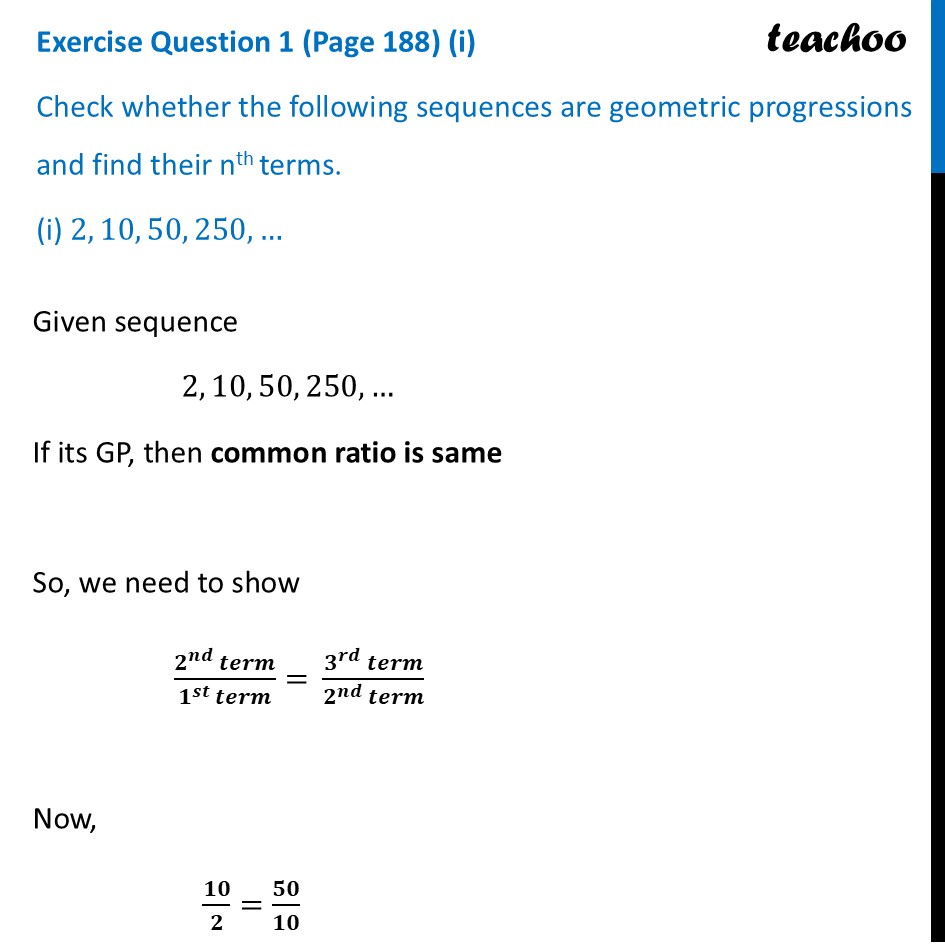
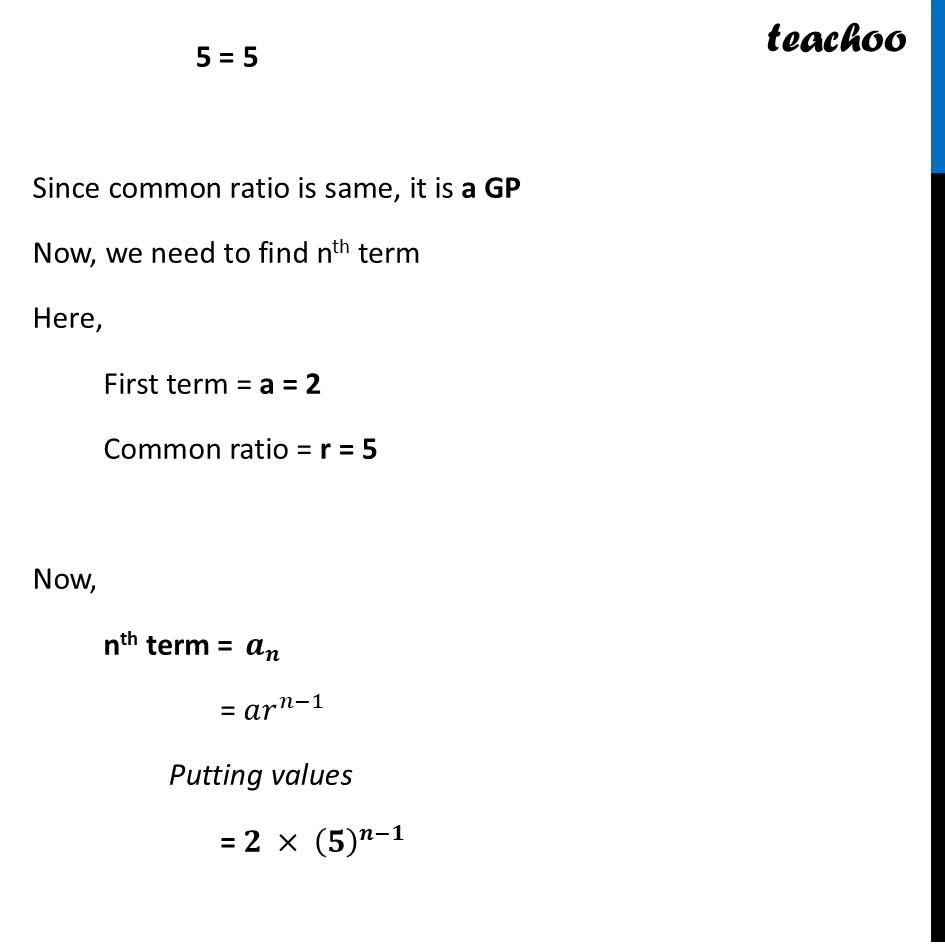
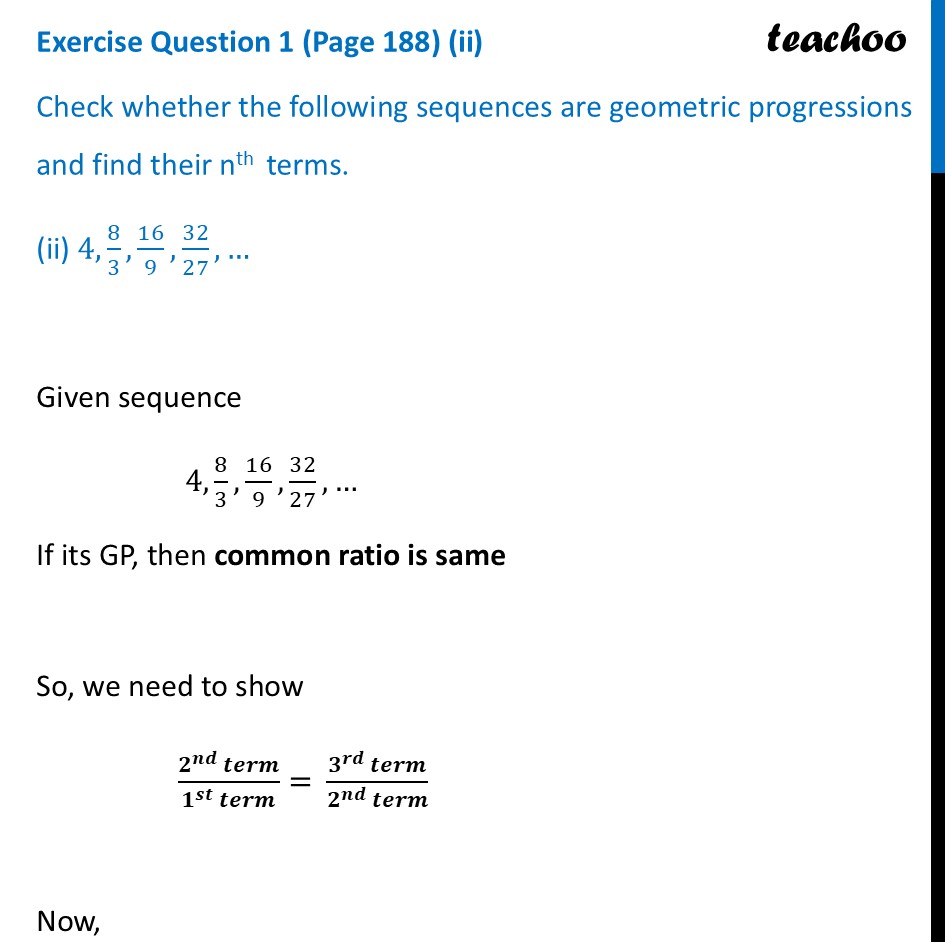
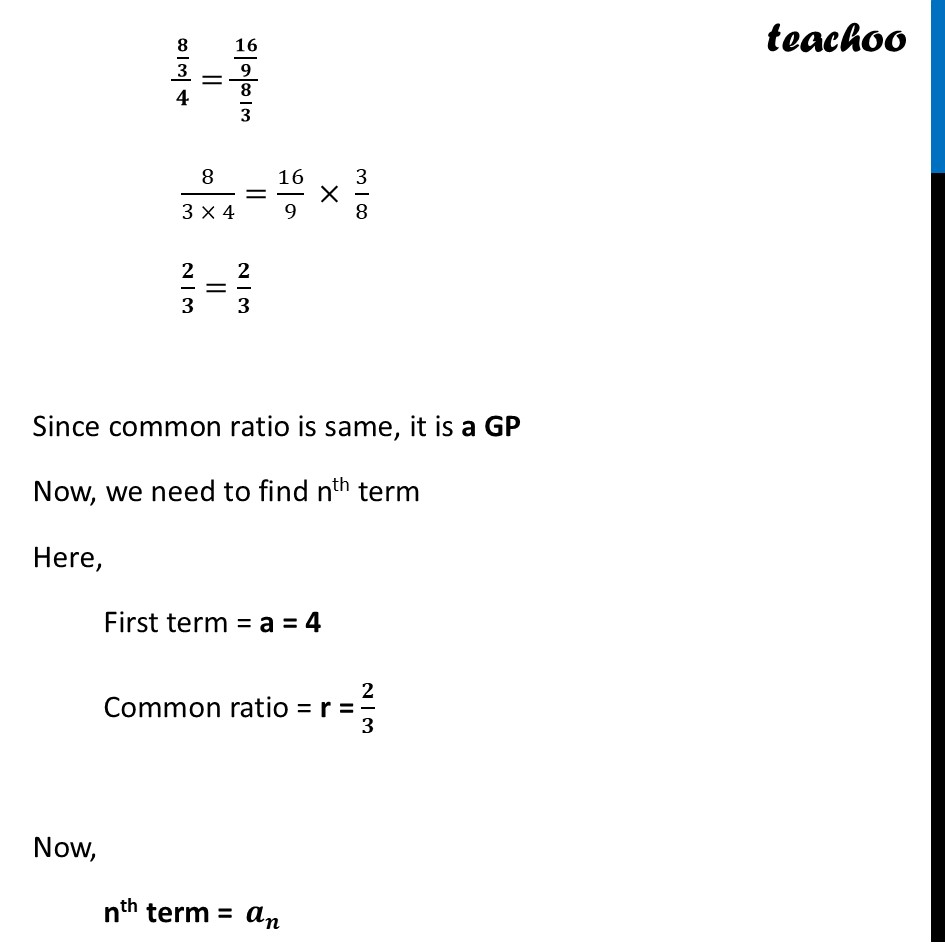
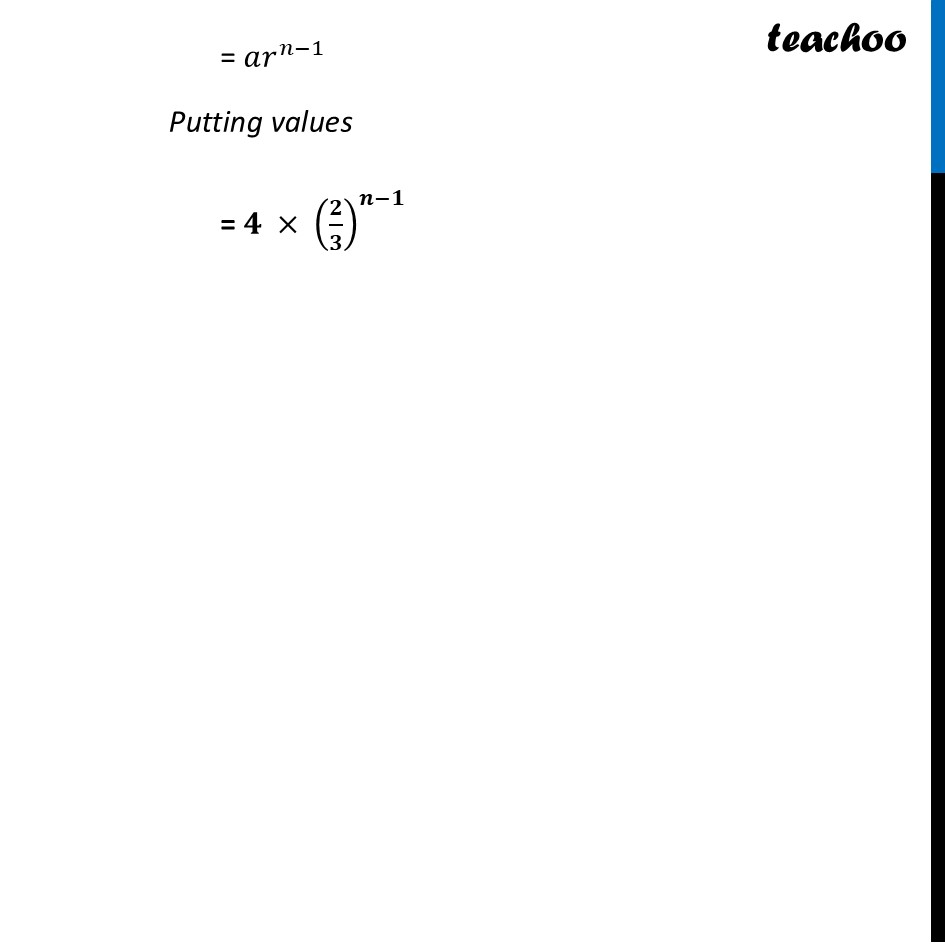
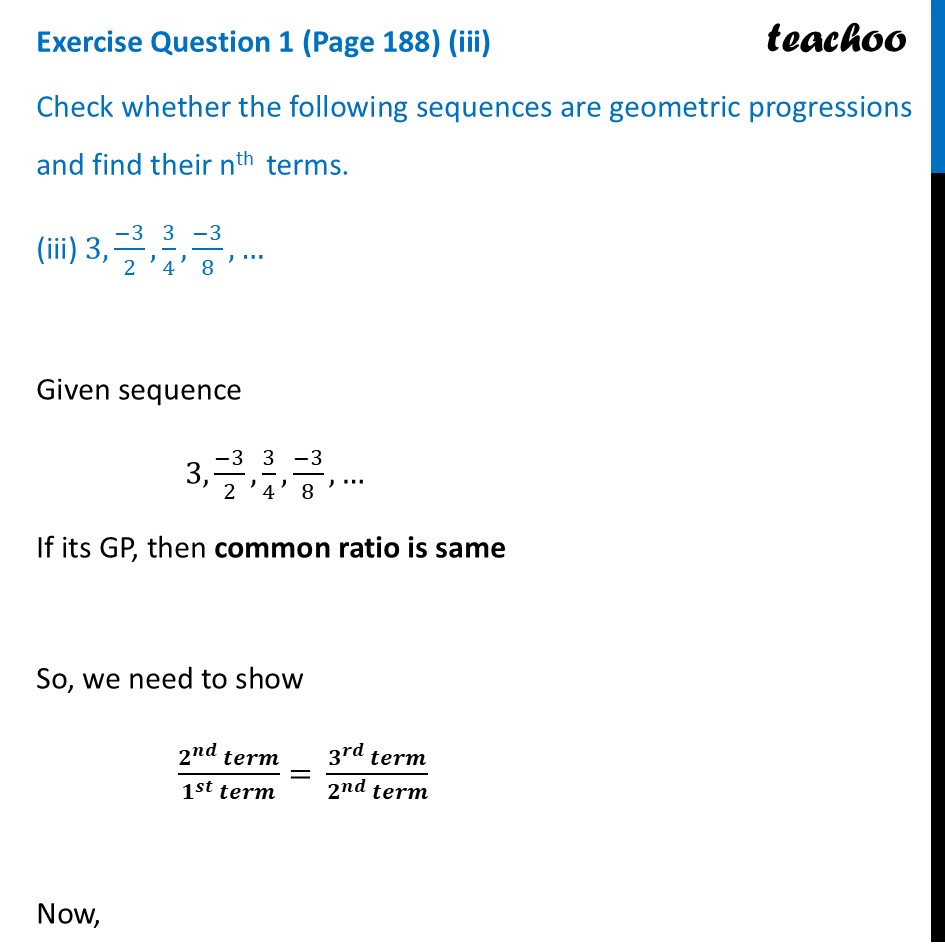
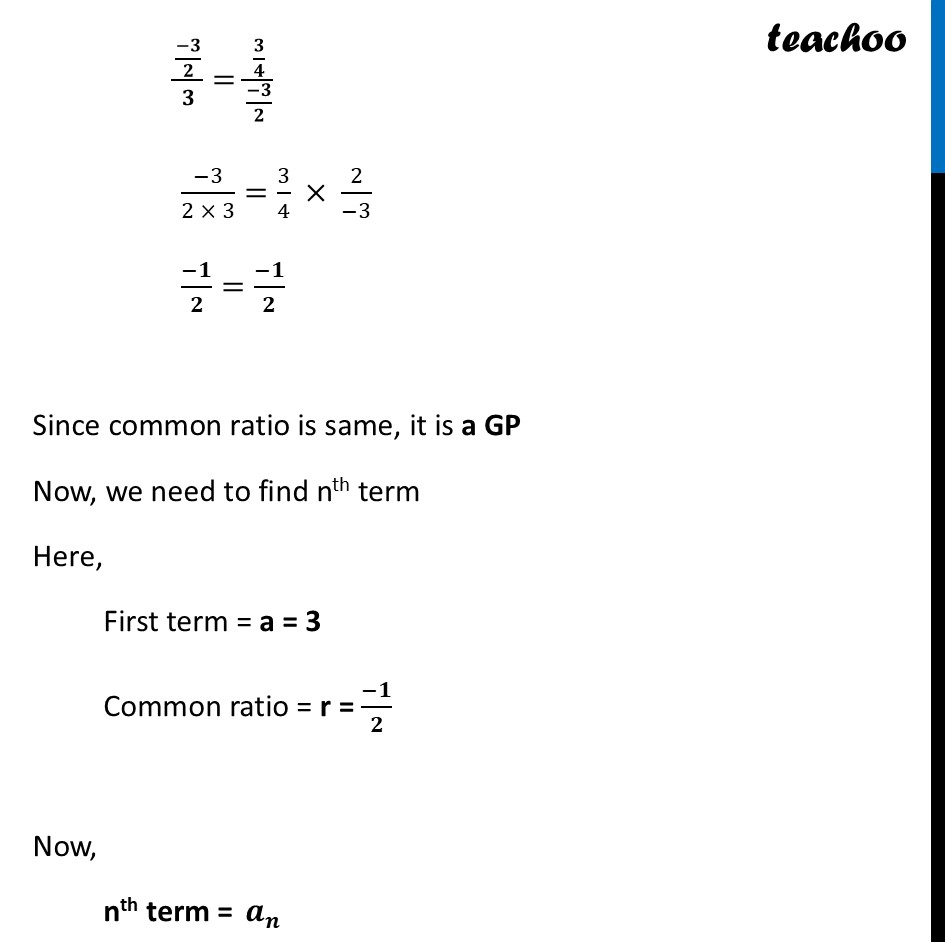
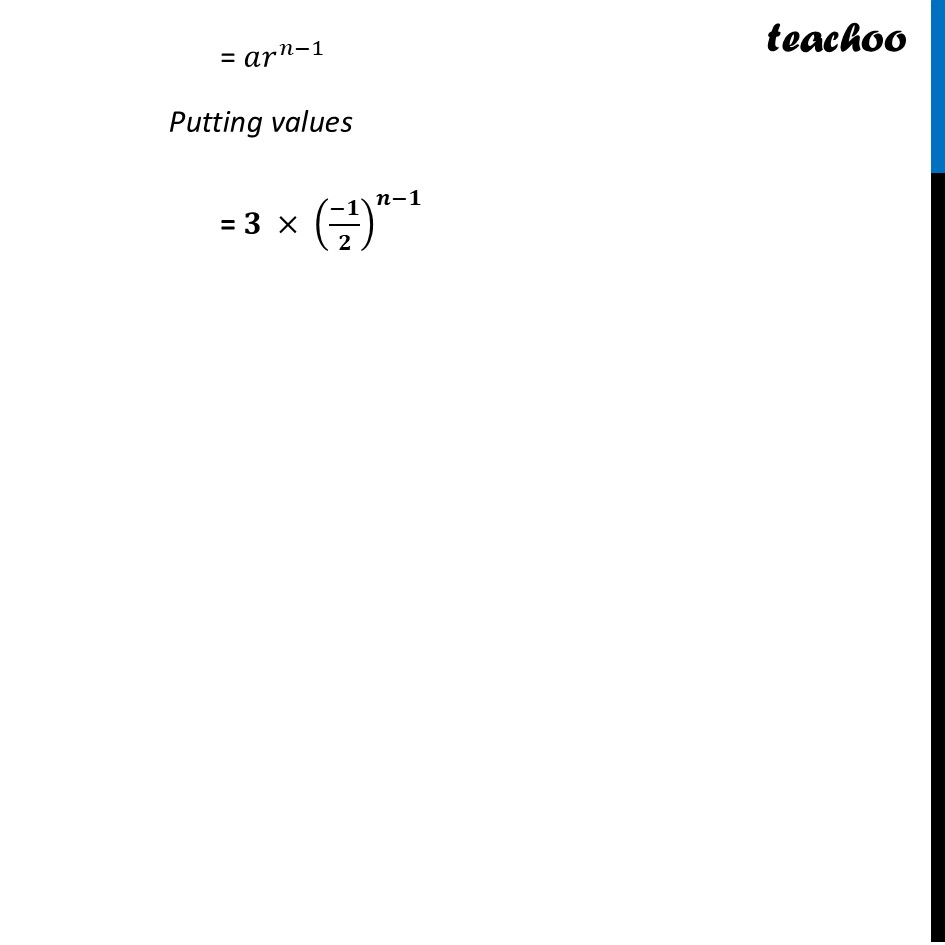
Exercise Question 1 (Page 188) (i) Check whether the following sequences are geometric progressions and find their nth terms. (i) 2, 10, 50, 250,… Given sequence 2, 10, 50, 250,… If its GP, then common ratio is same So, we need to show (𝟐^𝒏𝒅 π’•π’†π’“π’Ž)/(𝟏^𝒔𝒕 π’•π’†π’“π’Ž)=" " (πŸ‘^𝒓𝒅 π’•π’†π’“π’Ž)/(𝟐^𝒏𝒅 π’•π’†π’“π’Ž) Now, 𝟏𝟎/𝟐=πŸ“πŸŽ/𝟏𝟎 5 = 5 Since common ratio is same, it is a GP Now, we need to find nth term Here, First term = a = 2 Common ratio = r = 5 Now, nth term = 𝒂_𝒏 = π‘Žπ‘Ÿ^(π‘›βˆ’1) Putting values = 𝟐 Γ— (πŸ“)^(π’βˆ’πŸ) Exercise Question 1 (Page 188) (ii) Check whether the following sequences are geometric progressions and find their nth terms. (ii) 4, 8/3, 16/9, 32/27,… Given sequence 4, 8/3, 16/9, 32/27,… If its GP, then common ratio is same So, we need to show (𝟐^𝒏𝒅 π’•π’†π’“π’Ž)/(𝟏^𝒔𝒕 π’•π’†π’“π’Ž)=" " (πŸ‘^𝒓𝒅 π’•π’†π’“π’Ž)/(𝟐^𝒏𝒅 π’•π’†π’“π’Ž) Now, (πŸ–/πŸ‘)/πŸ’=(πŸπŸ”/πŸ—)/(πŸ–/πŸ‘) 8/(3 Γ— 4)=16/9 Γ— 3/8 𝟐/πŸ‘=𝟐/πŸ‘ Since common ratio is same, it is a GP Now, we need to find nth term Here, First term = a = 4 Common ratio = r = 𝟐/πŸ‘ Now, nth term = 𝒂_𝒏 = π‘Žπ‘Ÿ^(π‘›βˆ’1) Putting values = πŸ’ Γ— (𝟐/πŸ‘)^(π’βˆ’πŸ) Exercise Question 1 (Page 188) (iii) Check whether the following sequences are geometric progressions and find their nth terms. (iii) 3,(βˆ’3)/2, 3/4,(βˆ’3)/8,… Given sequence 3,(βˆ’3)/2, 3/4,(βˆ’3)/8,… If its GP, then common ratio is same So, we need to show (𝟐^𝒏𝒅 π’•π’†π’“π’Ž)/(𝟏^𝒔𝒕 π’•π’†π’“π’Ž)=" " (πŸ‘^𝒓𝒅 π’•π’†π’“π’Ž)/(𝟐^𝒏𝒅 π’•π’†π’“π’Ž) Now, ((βˆ’πŸ‘)/𝟐)/πŸ‘=(πŸ‘/πŸ’)/((βˆ’πŸ‘)/𝟐) (βˆ’3)/(2 Γ— 3)=3/4 Γ— 2/(βˆ’3) (βˆ’πŸ)/𝟐=(βˆ’πŸ)/𝟐 Since common ratio is same, it is a GP Now, we need to find nth term Here, First term = a = 3 Common ratio = r = (βˆ’πŸ)/𝟐 Now, nth term = 𝒂_𝒏 = π‘Žπ‘Ÿ^(π‘›βˆ’1) Putting values = πŸ‘ Γ— ((βˆ’πŸ)/𝟐)^(π’βˆ’πŸ)

Davneet Singh's photo - Co-founder, Teachoo

Made by

Davneet Singh

Davneet Singh is an IIT Kanpur graduate and has been teaching for 16+ years. At Teachoo, he breaks down Maths, Science and Computer Science into simple steps so students understand concepts deeply and score with confidence.

Many students prefer Teachoo Black for a smooth, ad-free learning experience.