Check whether the sequence 5, 15/4 , 45/16 , 135/64 , … is a geometric - Geometric Progressions

part 2 - Example 9 - Geometric Progressions - Chapter 8 - Predicting What Comes Next: Exploring Sequences & Progress - Class 9
part 3 - Example 9 - Geometric Progressions - Chapter 8 - Predicting What Comes Next: Exploring Sequences & Progress - Class 9

Remove Ads Share on WhatsApp

Transcript

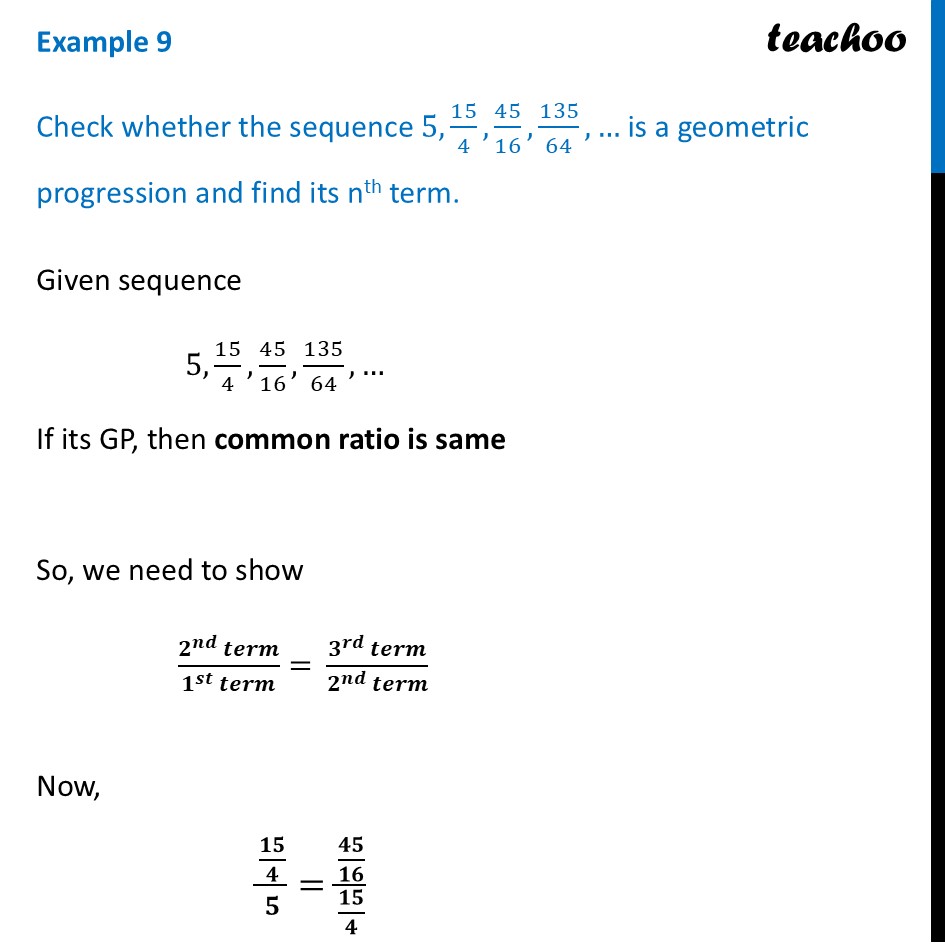
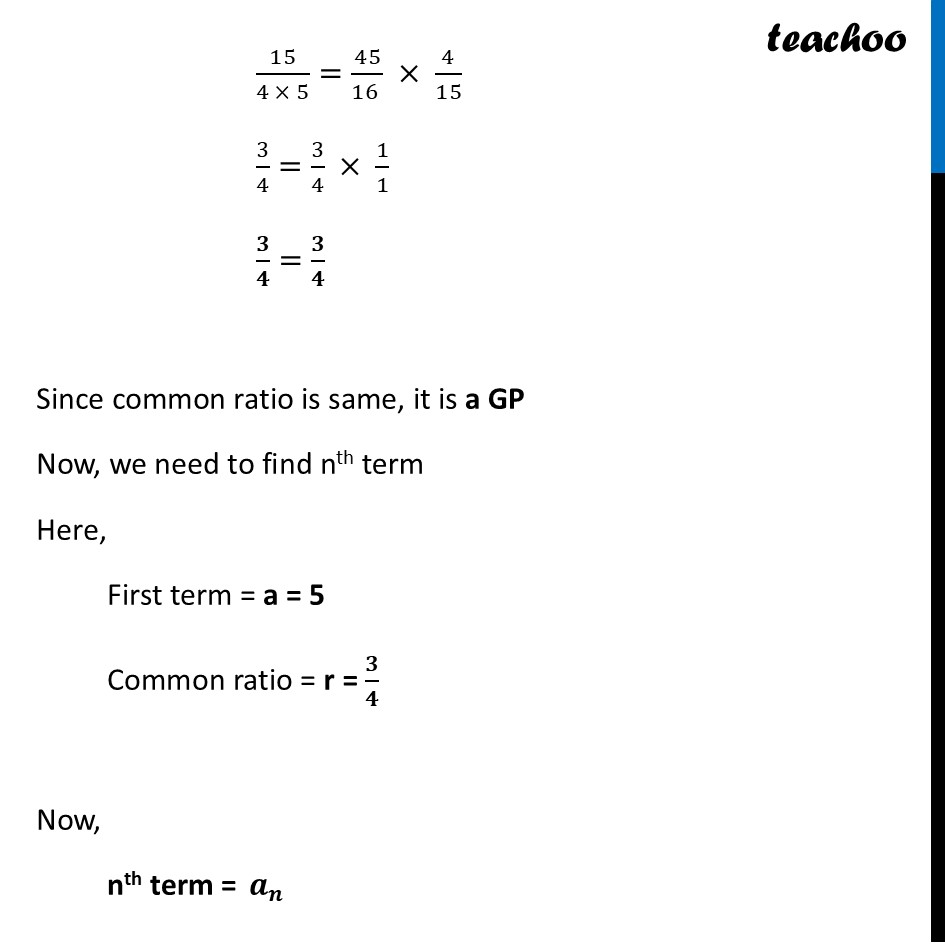
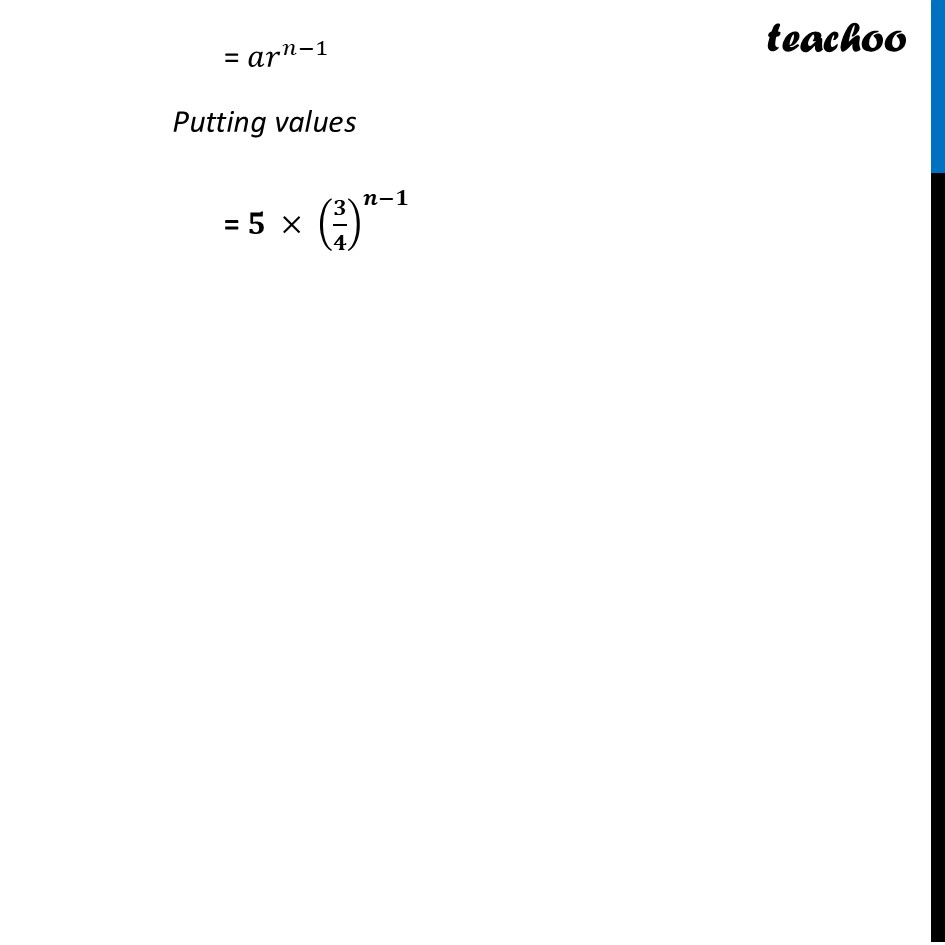
Example 9 Check whether the sequence 5, 15/4, 45/16, 135/64,… is a geometric progression and find its nth term. Given sequence 5, 15/4, 45/16, 135/64,… If its GP, then common ratio is same So, we need to show (𝟐^𝒏𝒅 π’•π’†π’“π’Ž)/(𝟏^𝒔𝒕 π’•π’†π’“π’Ž)=" " (πŸ‘^𝒓𝒅 π’•π’†π’“π’Ž)/(𝟐^𝒏𝒅 π’•π’†π’“π’Ž) Now, (πŸπŸ“/πŸ’)/πŸ“=(πŸ’πŸ“/πŸπŸ”)/(πŸπŸ“/πŸ’) 15/(4 Γ— 5)=45/(16 ) Γ— 4/15 3/4=3/4 Γ— 1/1 πŸ‘/πŸ’=πŸ‘/πŸ’ Since common ratio is same, it is a GP Now, we need to find nth term Here, First term = a = 5 Common ratio = r = πŸ‘/πŸ’ Now, nth term = 𝒂_𝒏 = π‘Žπ‘Ÿ^(π‘›βˆ’1) Putting values = πŸ“ Γ— (πŸ‘/πŸ’)^(π’βˆ’πŸ)

Davneet Singh's photo - Co-founder, Teachoo

Made by

Davneet Singh

Davneet Singh is an IIT Kanpur graduate and has been teaching for 16+ years. At Teachoo, he breaks down Maths, Science and Computer Science into simple steps so students understand concepts deeply and score with confidence.

Many students prefer Teachoo Black for a smooth, ad-free learning experience.