
 You are here
What Is Uniform Linear Motion?
A train covering exactly 90 km every hour — this is uniform linear motion.
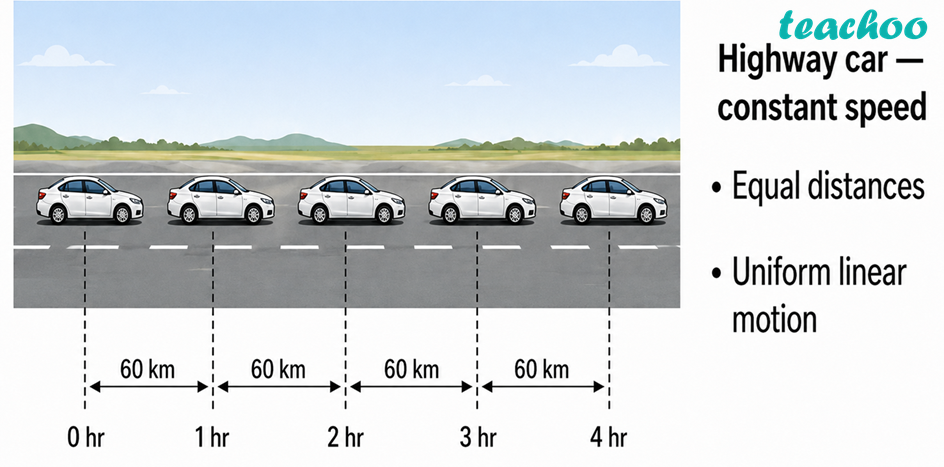
Imagine a car on a straight road moving at exactly 60 km/h.
It never speeds up or slows down.
In every 1 hour, it covers exactly 60 km.
This is called uniform linear motion .
It never speeds up or slows down.
In every 1 hour, it covers exactly 60 km.
This is called uniform linear motion .
🌟 Example 1
How can we tell that a highway car is in uniform motion?
It covers equal distances in every equal time interval.
Its speed does not change throughout the journey.
It covers equal distances in every equal time interval.
Its speed does not change throughout the journey.
Definition — Uniform Linear Motion
It is motion in a straight line at constant speed.
Equal distance is covered in every equal time interval.
Equal distance is covered in every equal time interval.
What Is Non-uniform Linear Motion?
City car — different distances in each time interval because speed keeps changing.
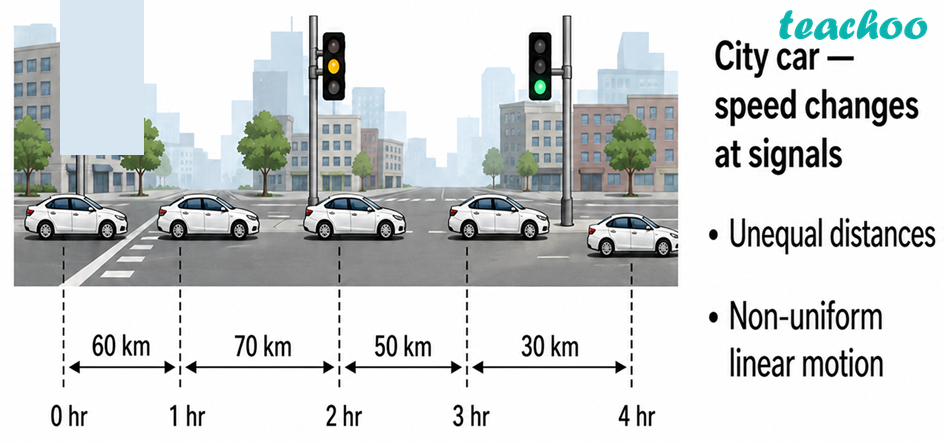
Now think of a car in city traffic.
It speeds up between signals.
It slows down and stops at red lights.
The speed is always changing.
This is called non-uniform linear motion .
It speeds up between signals.
It slows down and stops at red lights.
The speed is always changing.
This is called non-uniform linear motion .
🌟 Example 1
How can we tell that a city car is in non-uniform motion?
It covers different distances in each equal time interval.
Its speed keeps changing due to traffic and signals.
It covers different distances in each equal time interval.
Its speed keeps changing due to traffic and signals.
Definition — Non-uniform Linear Motion
It is motion in a straight line where speed keeps changing.
Unequal distances are covered in equal time intervals.
Unequal distances are covered in equal time intervals.
Highway Car — Uniform Motion
It covers 100 km every hour.
Speed stays constant.
Equal distance in every equal time interval.
Speed stays constant.
Equal distance in every equal time interval.
City Car — Non-uniform Motion
It covers 30 km in hour 1, 20 km in hour 2, 40 km in hour 3.
Speed keeps changing.
Unequal distances in equal time intervals.
Speed keeps changing.
Unequal distances in equal time intervals.
Quick fact: Uniform motion is an idealisation.
Non-uniform motion
is far more common in real life.
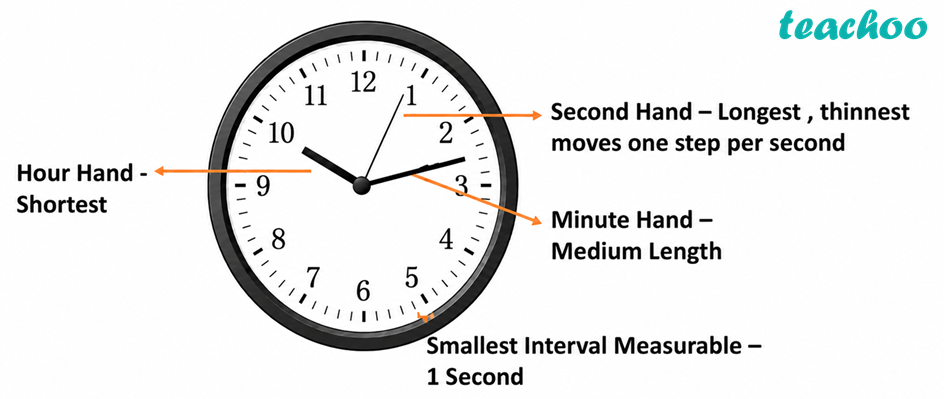
Activity 8.3 — wall clock: the second hand moves one step per second — minimum measurable interval = 1 s.
What to do
Look at a wall clock carefully.
Identify the smallest interval of time you can measure with it.
Identify the smallest interval of time you can measure with it.
Observation
The second hand moves in steps of one second.
One second is the smallest measurable interval.
One second is the smallest measurable interval.
◆ Summary
The second hand of a wall clock moves one step per second. One second is the smallest time interval a wall clock can measure.
✓ Quick Check — Section 8.4
-
Is a car on a highway uniform or non-uniform?
Show Answer
Approximately uniform on an empty highway with no signals.
Speed is roughly constant, covering equal distances in equal times. -
Give two real-life examples of non-uniform motion.
Show Answer
1. A car in city traffic — speed changes at every signal and turn.
2. A ball thrown upward — speed decreases as it rises, increases as it falls.
