
 You are here
The SDT triangle — cover what you want to find; the rest shows the formula.
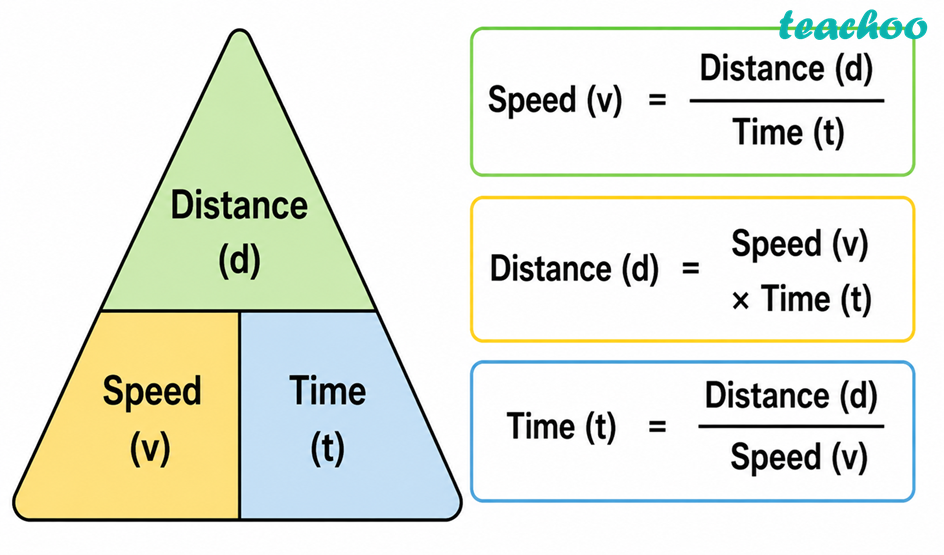
From the definition of speed, we get three formulas.
They are all the same equation rearranged.
They are all the same equation rearranged.
Speed
Speed = Distance ÷ Time
Use this when you know distance and time.
Use this when you know distance and time.
Distance
Distance = Speed × Time
Use this when you know speed and time.
Use this when you know speed and time.
Time
Time = Distance ÷ Speed
Use this when you know distance and speed.
Use this when you know distance and speed.
Quick fact: To convert m/s to km/h, multiply by 3.6. To convert km/h to m/s, divide by 3.6.
On most journeys, speed keeps changing.
So we calculate average speed .
Average speed = Total distance ÷ Total time.
It gives one number that represents the whole journey.
So we calculate average speed .
Average speed = Total distance ÷ Total time.
It gives one number that represents the whole journey.
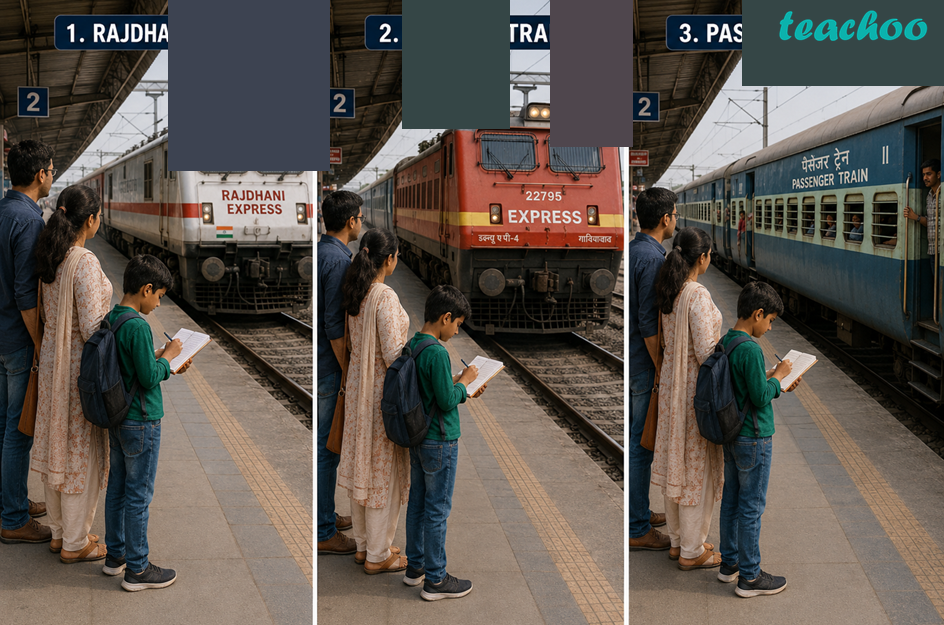
Activity 8.4 — use timetable to find distance and time for different trains; calculate speed = distance ÷ time.
What to do
Look up the railway timetable online.
Find a train stopping near you and the next station’s distance.
Note departure and arrival times.
Find the time taken.
Calculate speed = distance ÷ time.
Repeat for 4–5 trains.
Find a train stopping near you and the next station’s distance.
Note departure and arrival times.
Find the time taken.
Calculate speed = distance ÷ time.
Repeat for 4–5 trains.
Table 8.2 — Speed of Trains
Nearest railway station: ____________________
| S.No. | Train name | Next station | Distance (km) | Time taken (h) | Speed (km/h) |
|---|---|---|---|---|---|
| 1 | Rajdhani Express | Agra | 200 km | 2 h | 100 km/h |
| 2 | Express Train | Agra | 200 km | 4 h | 50 km/h |
| 3 | Passenger Train | Agra | 200 km | 10 h | 20 km/h |
◆ Summary
Speed = Distance ÷ Time. The train covering the most distance per hour has the highest speed.
