
 You are here
The second — the internationally agreed unit of time used by scientists everywhere.

Imagine if every country used a different unit for time.
Sharing results would be impossible!
So scientists agreed on one standard unit — the second .
It is used all over the world.
Sharing results would be impossible!
So scientists agreed on one standard unit — the second .
It is used all over the world.
🌟 Example 1
Why do scientists use seconds instead of minutes in experiments?
The second is the SI unit of time.
It is precise and universally agreed.
All scientific experiments worldwide use the same unit.
The second is the SI unit of time.
It is precise and universally agreed.
All scientific experiments worldwide use the same unit.
🌟 Example 2
How do sports officials measure race times so accurately?
They use electronic stopwatches that measure in milliseconds.
One millisecond is one-thousandth of a second.
This level of accuracy decides gold and silver medals!
They use electronic stopwatches that measure in milliseconds.
One millisecond is one-thousandth of a second.
This level of accuracy decides gold and silver medals!
📌 Important Points — SI Unit Rules
The SI unit of time is the
second (s)
.
60 seconds = 1 minute. 60 minutes = 1 hour.
60 seconds = 1 minute. 60 minutes = 1 hour.
Lowercase Names
Unit names always start with lowercase: write ‘second’, not ‘Second’.
Exception: symbols named after scientists use capitals (e.g., N for Newton).
Exception: symbols named after scientists use capitals (e.g., N for Newton).
No Full Stop After Symbol
Write ‘5 s’ not ‘5 s.’ — the symbol is not an abbreviation.
No Plural Symbol
Write ‘5 s’, not ‘5 ss’ — unit symbols never take a plural ‘s’.
Space Between Number and Unit
Write ‘5 s’, not ‘5s’ — always leave one space.
Definition — SI Unit of Time
The SI unit of time is the
second (s)
.
60 s = 1 minute. 60 minutes = 1 hour.
It is used by scientists and engineers worldwide.
60 s = 1 minute. 60 minutes = 1 hour.
It is used by scientists and engineers worldwide.
🕐
Fascinating Fact — The Ghatika Unit
Ghatika-yantra — bowl sinks every 24 minutes = 1 ghatika.
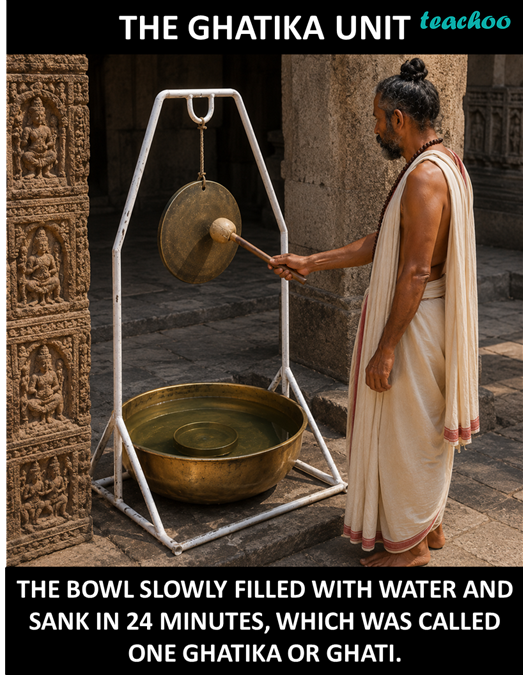
The bowl would slowly fill with water and sink in exactly 24 minutes.
This interval was called ghatika or ghati .
60 ghatikas made one full day.
So the day was divided into 60 equal parts.
It was a clever and accurate system for ancient times!
This interval was called ghatika or ghati .
60 ghatikas made one full day.
So the day was divided into 60 equal parts.
It was a clever and accurate system for ancient times!
🌎
Science and Society — Why Milliseconds Matter
Milliseconds matter in sports, medicine, music, and computing.
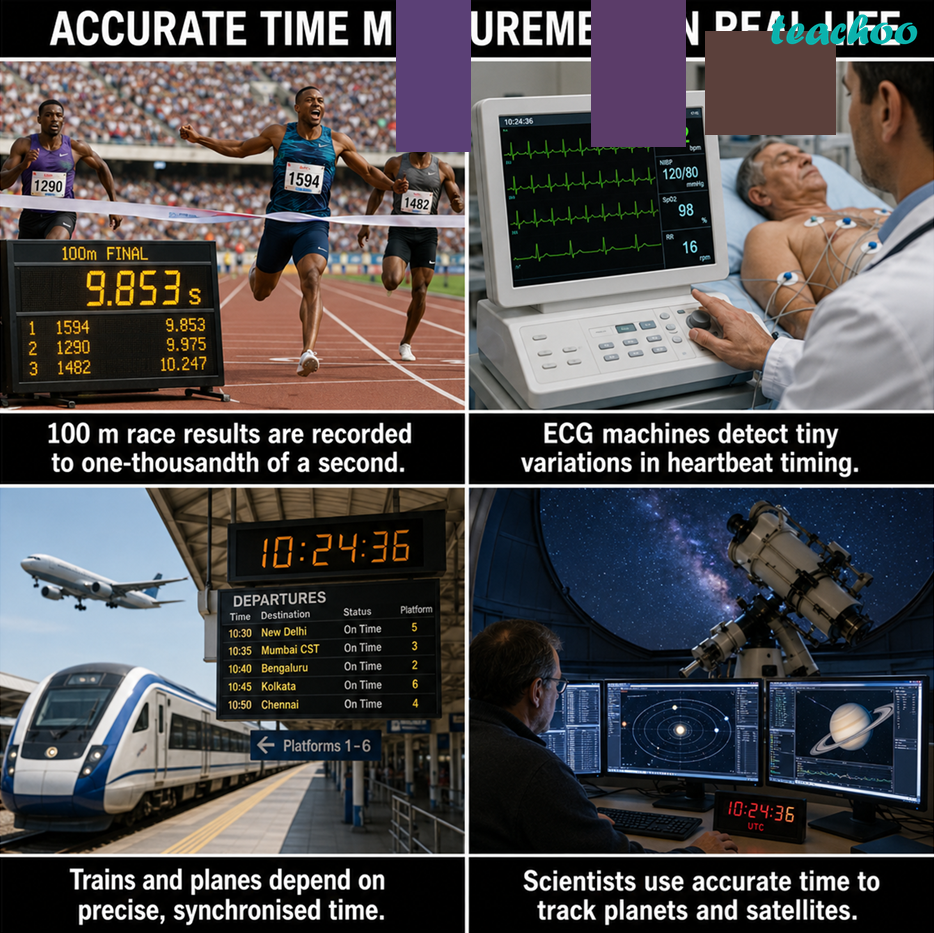
Accurate time measurement matters in many fields.
Sports: Race results are recorded to one-thousandth of a second.
Medicine: ECG machines detect tiny variations in heartbeat timing.
Transport: Trains and planes depend on precise, synchronised time.
Astronomy: Scientists use accurate time to track planets and satellites.
Sports: Race results are recorded to one-thousandth of a second.
Medicine: ECG machines detect tiny variations in heartbeat timing.
Transport: Trains and planes depend on precise, synchronised time.
Astronomy: Scientists use accurate time to track planets and satellites.
