
 You are here
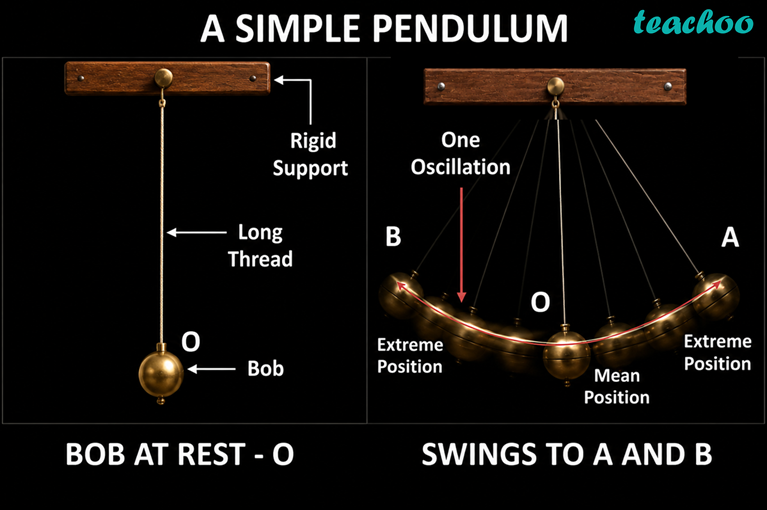
A simple pendulum: bob at rest at O, swings to A and B — one full swing = one oscillation.
Before the pendulum clock, people could not measure time very accurately.
In 1656, a scientist named Christiaan Huygens invented the pendulum clock.
He got the idea from Galileo Galilei ’s experiments with pendulums.
It was the first clock accurate enough to use at sea for navigation.
In 1656, a scientist named Christiaan Huygens invented the pendulum clock.
He got the idea from Galileo Galilei ’s experiments with pendulums.
It was the first clock accurate enough to use at sea for navigation.
🧑🔬
Know a Scientist — Huygens and Galileo
Huygens (1656 pendulum clock) and Galileo (discovered constant time period).
Before the pendulum clock, people could not measure time very accurately.
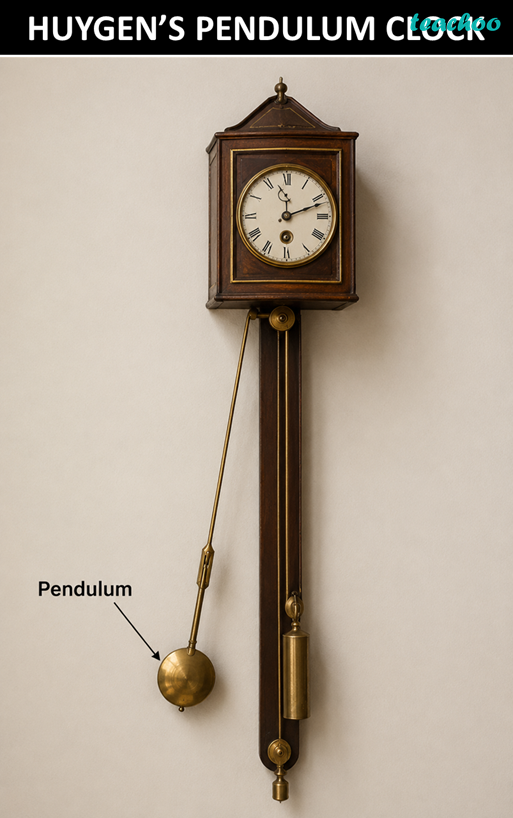
In 1656, a scientist named Christiaan Huygens invented the pendulum clock.
He got the idea from Galileo Galilei ’s experiments with pendulums.
It was the first clock accurate enough to use at sea for navigation.
In 1656, a scientist named Christiaan Huygens invented the pendulum clock.
He got the idea from Galileo Galilei ’s experiments with pendulums.
It was the first clock accurate enough to use at sea for navigation.
What Is a Simple Pendulum?
Making a pendulum: hang a bob, pull to one side, release — it swings back and forth.
A simple pendulum is easy to make.
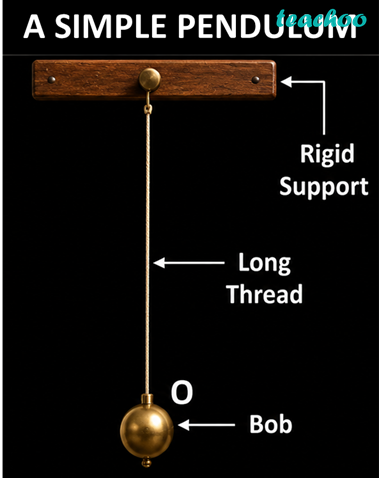
Take a small heavy ball (the bob) and hang it from a fixed support using a thread.
When the bob is at rest, it hangs straight down.
Pull it to one side and let go.
It swings back and forth.
One complete back-and-forth swing is called an oscillation .
Take a small heavy ball (the bob) and hang it from a fixed support using a thread.
When the bob is at rest, it hangs straight down.
Pull it to one side and let go.
It swings back and forth.
One complete back-and-forth swing is called an oscillation .
📌 Important Points
Mean Position (O)
It is where the bob rests when not swinging.
The bob hangs straight down here.
It passes through this point twice in every oscillation.
The bob hangs straight down here.
It passes through this point twice in every oscillation.
Extreme Positions (A and B)
These are the two highest points the bob reaches — one on each side.
The bob stops here for a moment before swinging back.
The bob stops here for a moment before swinging back.
Oscillation
It is one complete to-and-fro movement: O → A → O → B → O.
The time for one oscillation is called the time period .
The time for one oscillation is called the time period .
What Is Time Period?
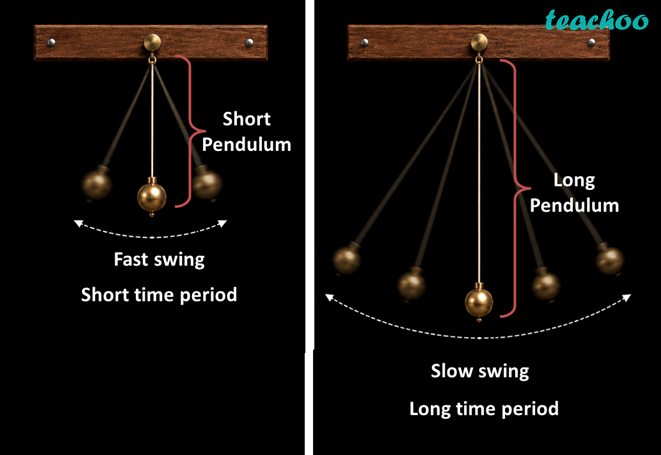
Short pendulum = fast swing = short time period. Long pendulum = slow swing = long time period.
Watch a pendulum swing left and right.
The time for one complete swing is its time period .
A short pendulum swings fast. It has a short time period.
A long pendulum swings slow. It has a long time period.
The time for one complete swing is its time period .
A short pendulum swings fast. It has a short time period.
A long pendulum swings slow. It has a long time period.
🌟 Example 1
How does a pendulum clock keep accurate time?
Every swing of the pendulum takes exactly the same time.
This steady rhythm moves the clock hands at a fixed rate.
Every swing of the pendulum takes exactly the same time.
This steady rhythm moves the clock hands at a fixed rate.
🌟 Example 2
Why does a longer pendulum swing more slowly?
A longer pendulum has more distance to travel.
This increases its time period.
So it takes more time to complete one oscillation.
A longer pendulum has more distance to travel.
This increases its time period.
So it takes more time to complete one oscillation.
Quick fact: Time period depends only on the pendulum’s
length
— not on the bob’s mass.
Definition — Time Period
It is the time for one complete oscillation of a pendulum.
It stays the same as long as the pendulum length does not change.
This is why pendulums make good timekeepers — every swing takes exactly the same time.
It stays the same as long as the pendulum length does not change.
This is why pendulums make good timekeepers — every swing takes exactly the same time.
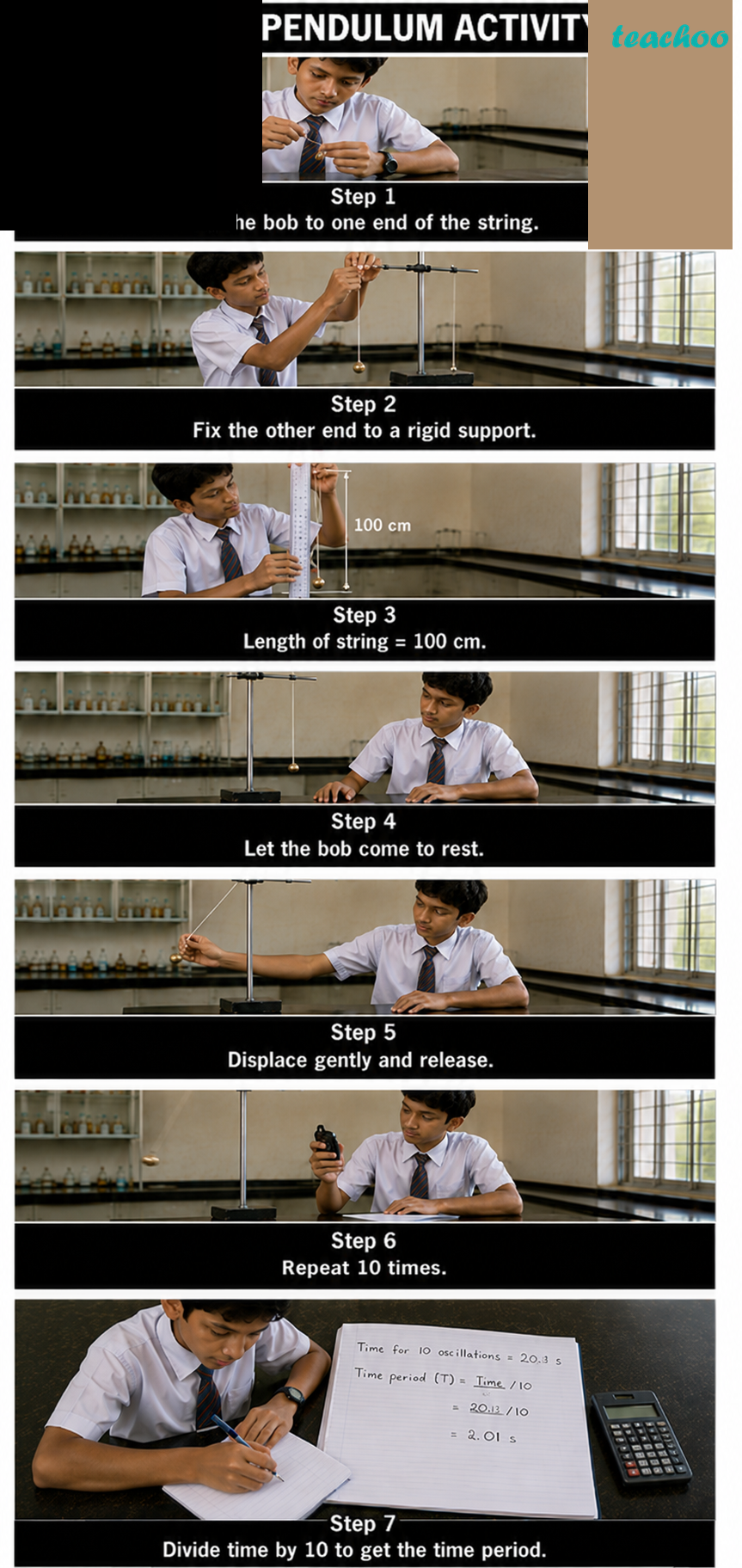
Activity 8.2 setup — pendulum of 100 cm, stopwatch timing 10 oscillations; time period ≈ 2 s.
Materials needed
String (~100 cm long), heavy metal ball with hook (bob), stopwatch, ruler
Procedure
Tie the bob to one end of the string.
Fix the other end to a rigid support.
Length of string = 100 cm.
Let the bob come to rest (mean position).
Gently displace the bob to one side and release (do not push).
Measure the time for 10 oscillations.
Record in Table 8.1.
Repeat 3 times.
Divide time by 10 to get the time period.
Fix the other end to a rigid support.
Length of string = 100 cm.
Let the bob come to rest (mean position).
Gently displace the bob to one side and release (do not push).
Measure the time for 10 oscillations.
Record in Table 8.1.
Repeat 3 times.
Divide time by 10 to get the time period.
Table 8.1 — Time Period of a Simple Pendulum (Length = 100 cm)
| S.No. | Time for 10 oscillations (s) | Time period (s) |
|---|---|---|
| 1 | 20.1 | 2.01 |
| 2 | 20.0 | 2.00 |
| 3 | 20.2 | 2.02 |
Observation
The time period is almost the same in every trial.
A 100 cm pendulum has a time period of about 2 s.
A 100 cm pendulum has a time period of about 2 s.
Explanation
The time period is constant for a given length.
This is the property used in pendulum clocks.
This is the property used in pendulum clocks.
◆ Summary
The time period of a 100 cm pendulum is about 2 seconds. It depends only on length, not on the bob’s mass.
✓ Quick Check — Section 8.1.1
-
What is one oscillation of a pendulum?
Show Answer
It is one complete back-and-forth movement.
O → A → B → O counts as one oscillation. -
Does a heavier bob change the time period?
Show Answer
No. The time period depends only on the length of the pendulum.
Bob mass has no effect.
Every clock uses something that repeats at a steady rate.
Old clocks used pendulums.
Quartz clocks use tiny vibrations of a quartz crystal.
Atomic clocks use vibrations of caesium atoms.
They lose only 1 second in 300 million years!
Old clocks used pendulums.
Quartz clocks use tiny vibrations of a quartz crystal.
Atomic clocks use vibrations of caesium atoms.
They lose only 1 second in 300 million years!
⏱
Dive Deeper — Modern Clocks
Pendulum clock → quartz clock → atomic clock — accuracy improves each generation.
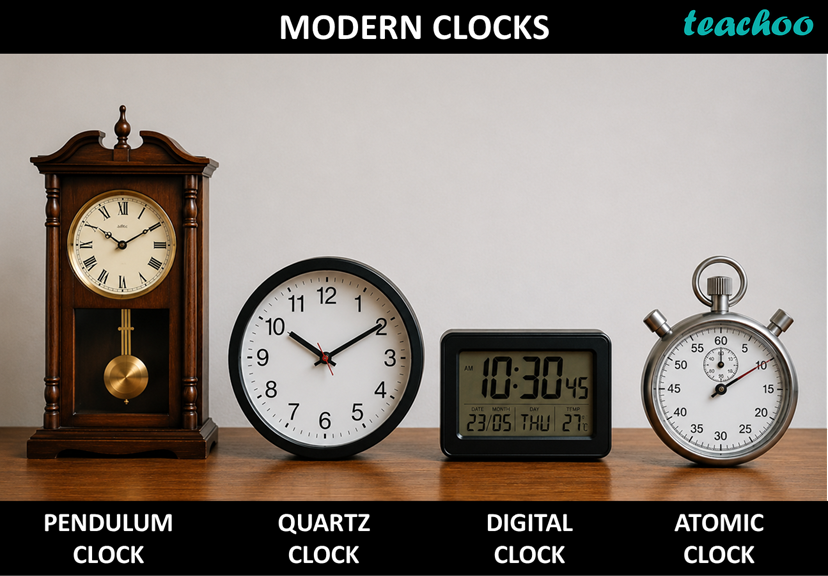
Every clock uses something that repeats at a steady rate.
Old clocks used pendulums.
Quartz clocks use tiny vibrations of a quartz crystal.
Atomic clocks use vibrations of caesium atoms.
They lose only 1 second in 300 million years!
Old clocks used pendulums.
Quartz clocks use tiny vibrations of a quartz crystal.
Atomic clocks use vibrations of caesium atoms.
They lose only 1 second in 300 million years!
