
 You are here
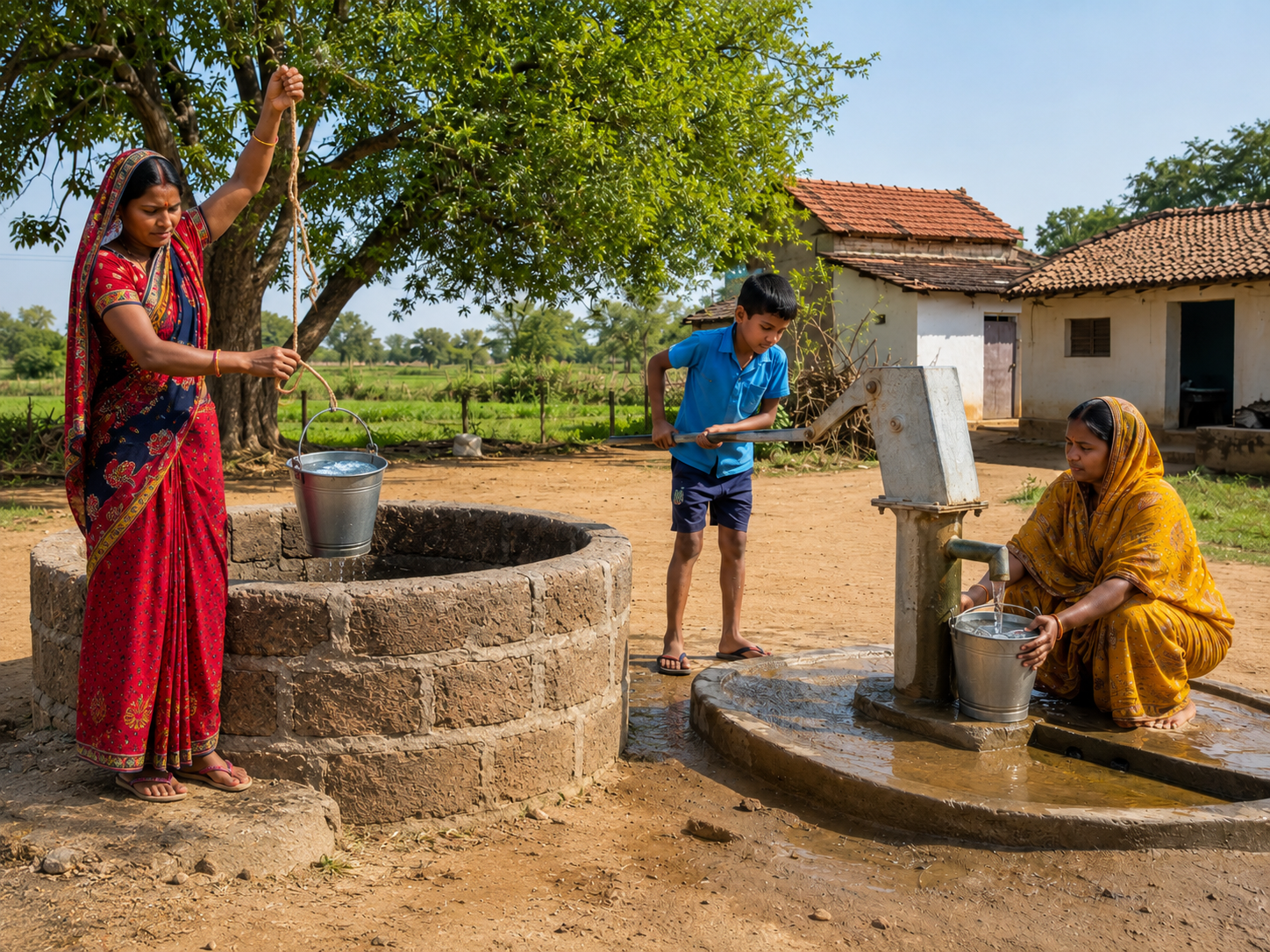
People draw groundwater from wells and handpumps.
Where does this water come from?
Let us understand
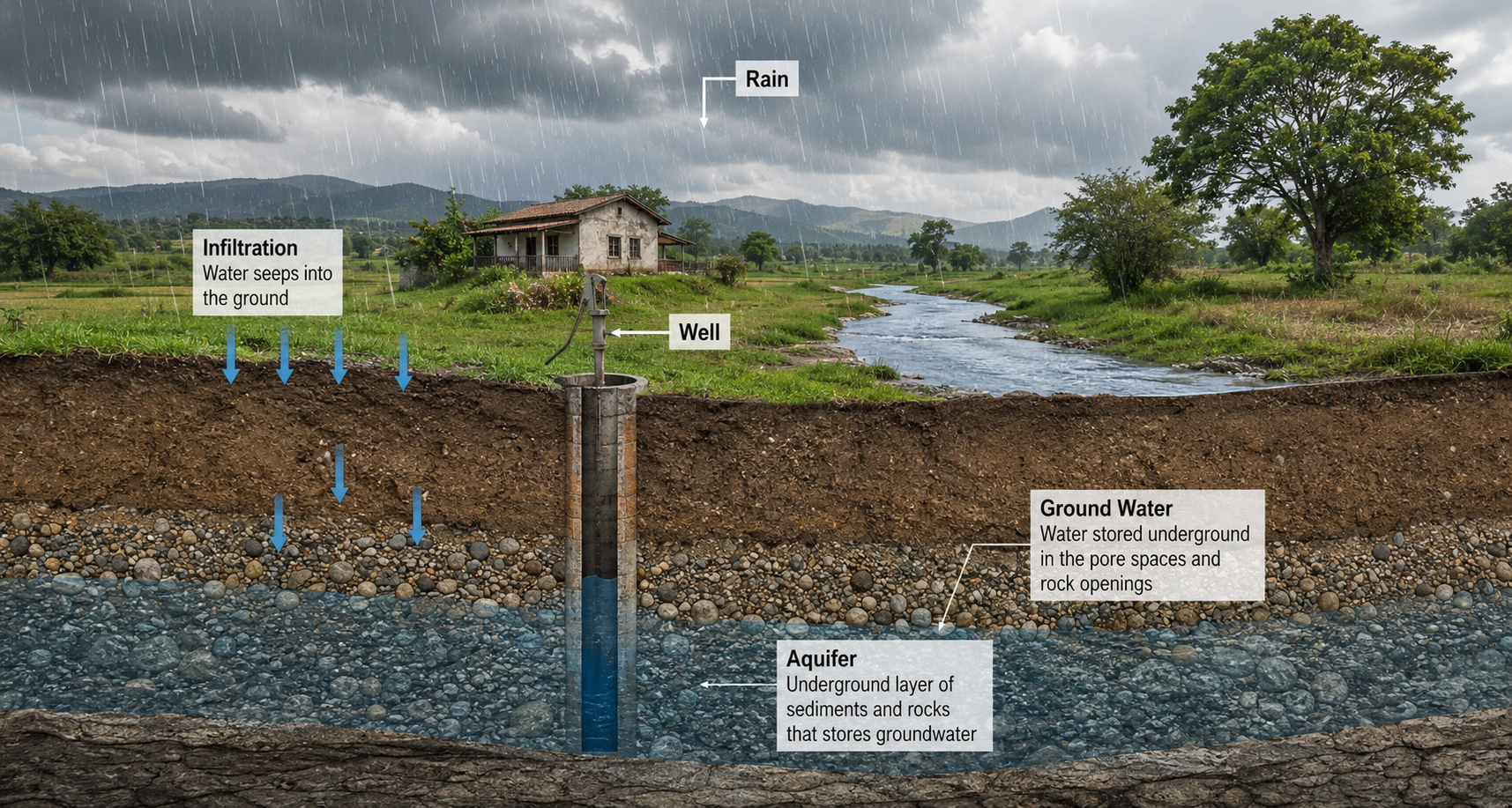
- Explanation:-
- When Rainwater fall s on the Earth’s surface. some rainwater seeps into the soil .
- This seeping of water into the ground is called infiltration .
- The water moves down through soil, sand, and small cracks in rocks.
- This stored underground water is called groundwater .
- Groundwater is stored in underground layers of sediments and rocks called aquifers .
- A well is dug deep enough to reach the aquifer to collect the water
-
Summary
So, wells collect water from groundwater stored in aquifers after rainwater infiltrates into the ground .
Key Terms
Infiltration — When surface water seeps through soil and rocks, it is called Infiltration
Groundwater — The water that seeps underground is called Groundwater.
It gets stored in the pore spaces of sediments and rocks.
Aquifer — It is the underground layer of sediment or rock.
It stores groundwater.
What to do
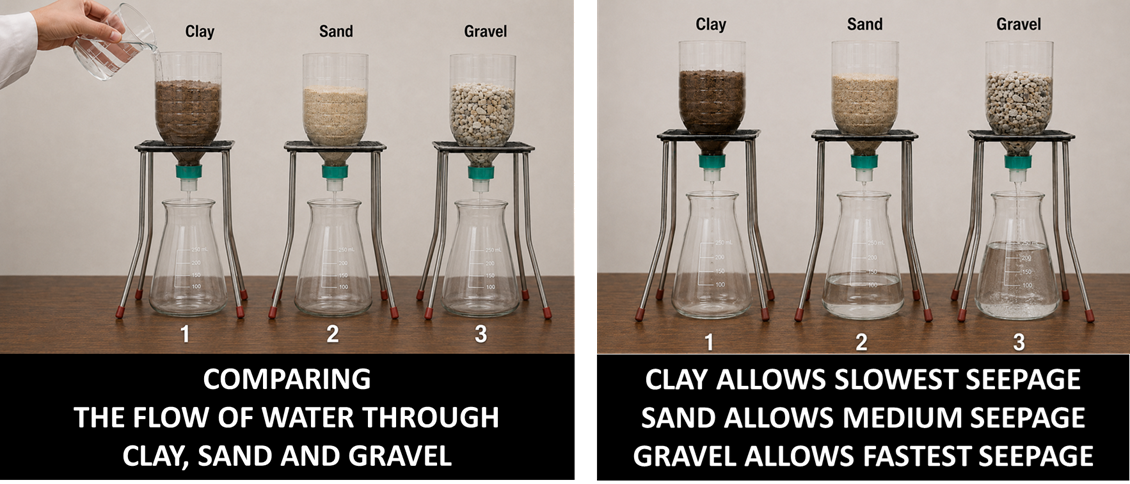
- Take three 1 L plastic bottles, cut in the middle, make a small hole in each cap. Invert each.
- Fill: Bottle 1 with clay, Bottle 2 with sand, Bottle 3 with gravel.
- Place a beaker under each. Add 200 mL of water to each. Collect seepage for 10 minutes.
Table 7.5 — Seepage of Water
| Bottles filled with | Prediction (very slow / slow / fast) | Observation (very slow / slow / fast) |
|---|---|---|
| Bottle 1 — Clay | Very slow | Very slow — clay has tiny pore spaces that strongly resist water flow |
| Bottle 2 — Sand | Slow | Slow — sand pores are larger than clay but smaller than gravel |
| Bottle 3 — Gravel | Fast | Fast — gravel has the widest, most open and connected spaces for water to flow through |
🏝
Science and Society — Ice Stupa (Ladakh)
- During spring in Ladakh, mountain streams dry up.
- This causes water scarcity .
- Engineer Sonam Wangchuk innovated the Ice Stupa to solve this.
- In winter, mountain stream water is piped underground.
- It reaches lower altitudes this way.
- It is sprayed into freezing air.
- It freezes layer by layer.
- It forms a tall cone-shaped structure .
- The cone shape has less surface area exposed to sunlight.
- This helps the stupa last longer into summer.
- The ice stupa melts slowly in spring and summer .
- It provides fresh water for farming.
- This is when natural streams are still dry.
📋 NCERT Question 9 — Water Seepage and Groundwater
Explain how water seeps through the surface of the Earth and gets stored as groundwater.
View Answer →
✓ Quick Check — Section 7.4
-
Which allows faster seepage of water — clay or gravel? Why?
Show Answer
Gravel allows faster seepage.
Its particles have wider spaces than clay.
Wider spaces = easier water flow. -
What is the role of the water cycle in replenishing groundwater?
Show Answer
Rainwater seeps into ground through infiltration .
It recharges aquifers continuously.
The water cycle ensures groundwater is always replenished.
Concept Map
💡 Hover over nodes to highlight them. In Edit Mode, click any text in the map to edit it.
Heat Transfer in Nature
has three processes
Conduction
in solids
Particles don't move · Needs medium · Metals = good conductors
Convection
in fluids
Particles move · Sea/land breeze · Water cycle
Radiation
no medium needed
Sunlight, fireplace · All objects radiate
Sun's radiation powers
Water Cycle
leads to
Infiltration & Groundwater in Aquifers
