
 You are here
-
Note
- Radiation: Heat from the Sun reaches Earth by radiation and warms oceans, rivers, lakes, and land. This heat helps water evaporate and start the water cycle.
- Conduction: Warm land or water heats the air touching it by direct contact. This makes the nearby air warmer.
- Convection: Warm, moist air becomes lighter and rises upward. As it rises, it cools and forms clouds.
In Water cycle, all 3 methods of heat transfer are used
Conduction, Convection and Radiation
Explanation
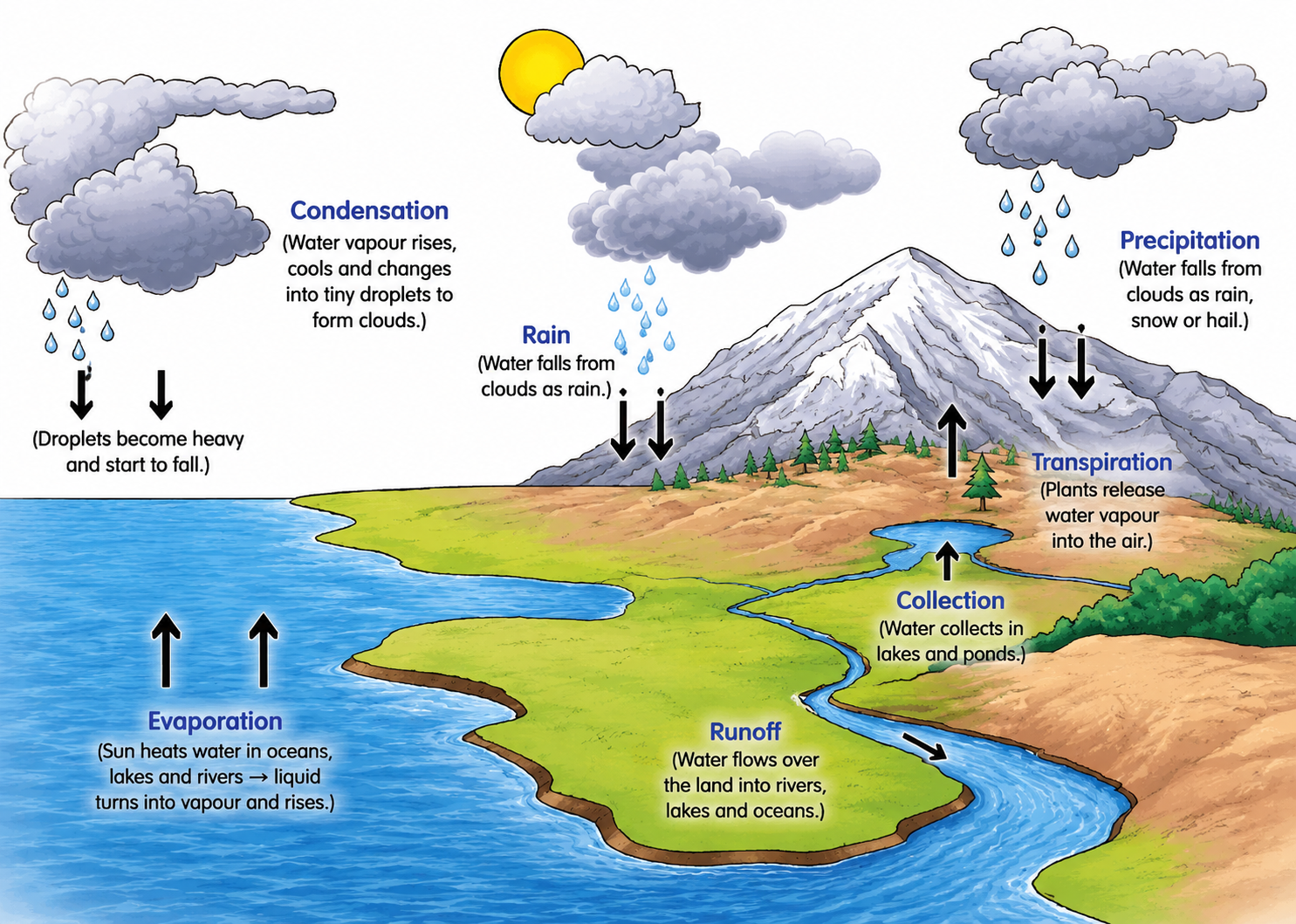
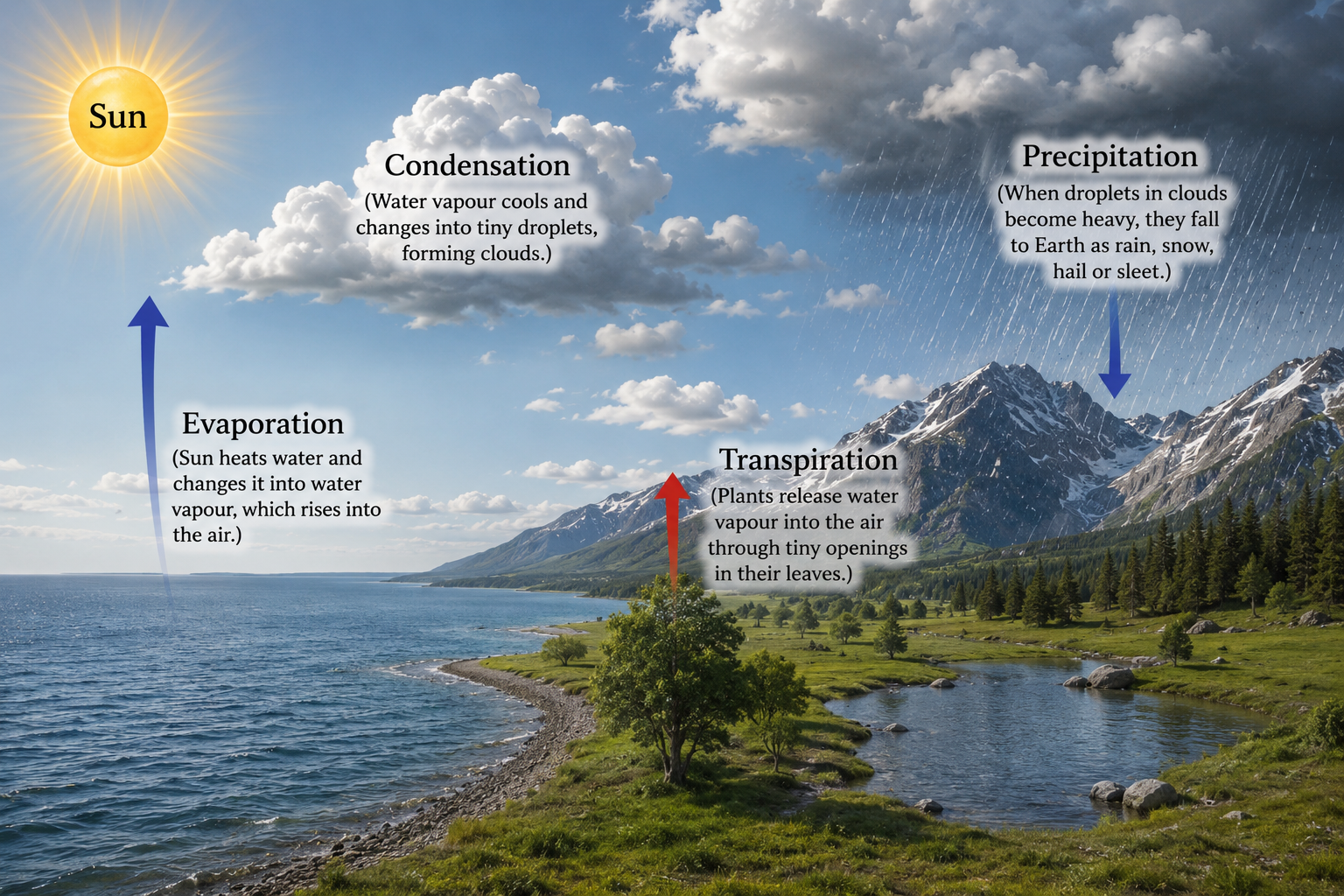
☀️ Evaporation
Sun’s heat reaches Earth by
R
adiation
and warms oceans, rivers, lakes, and land.
Water evaporates into vapour, and plants add water vapour through transpiration.
↓
☁️ Condensation
Warm land and water heat the air touching them by
C
onduction
.
This warm, moist air becomes lighter and rises upward by
C
onvection
.
As warm water vapour rises,
it cools and condenses into tiny water droplets.
These droplets collect together to form clouds.
↓
🌧️ Precipitation
When cloud droplets become heavy, they fall back to Earth as rain, snow, hail, or sleet.
↓
💦 Infiltration & Runoff
Rainwater flows into ponds, lakes, rivers, and oceans as
runoff
, or seeps into the ground as
groundwater
.
🧑🔬
Know a Scientist — Varahamihira
- He was a sixth-century CE astronomer and mathematician .
- He lived in Ujjaini (modern Ujjain), Madhya Pradesh.
- His work Brihatsamhita gave methods to predict seasonal rainfall .
- His predictions used cloud formation, wind patterns, and star positions.
- This was an early scientific approach.
- It helped understand the water cycle.
📋 NCERT Question 10 — Water Cycle Redistribution
The water cycle helps in redistribution and replenishment of water on Earth — justify this statement.
View Answer →
