
 You are here
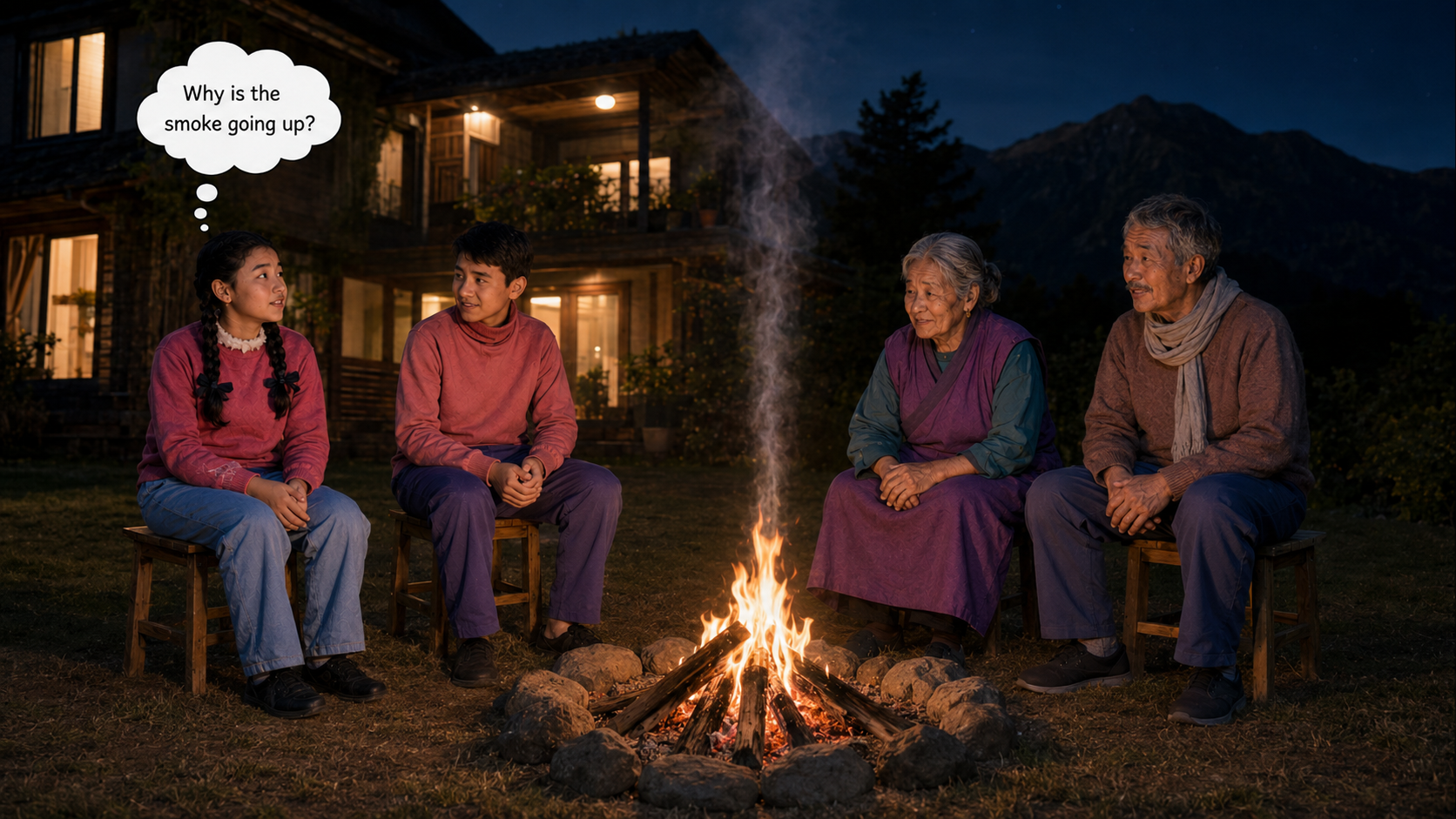
Pema notices smoke rising from the burning firewood.
She wonders — why does smoke always go up?
This is because of Convection
What is Convection?
It transfers heat by actual movement of particles.
Particles move from a hotter region to a cooler one.
They carry heat along with them.
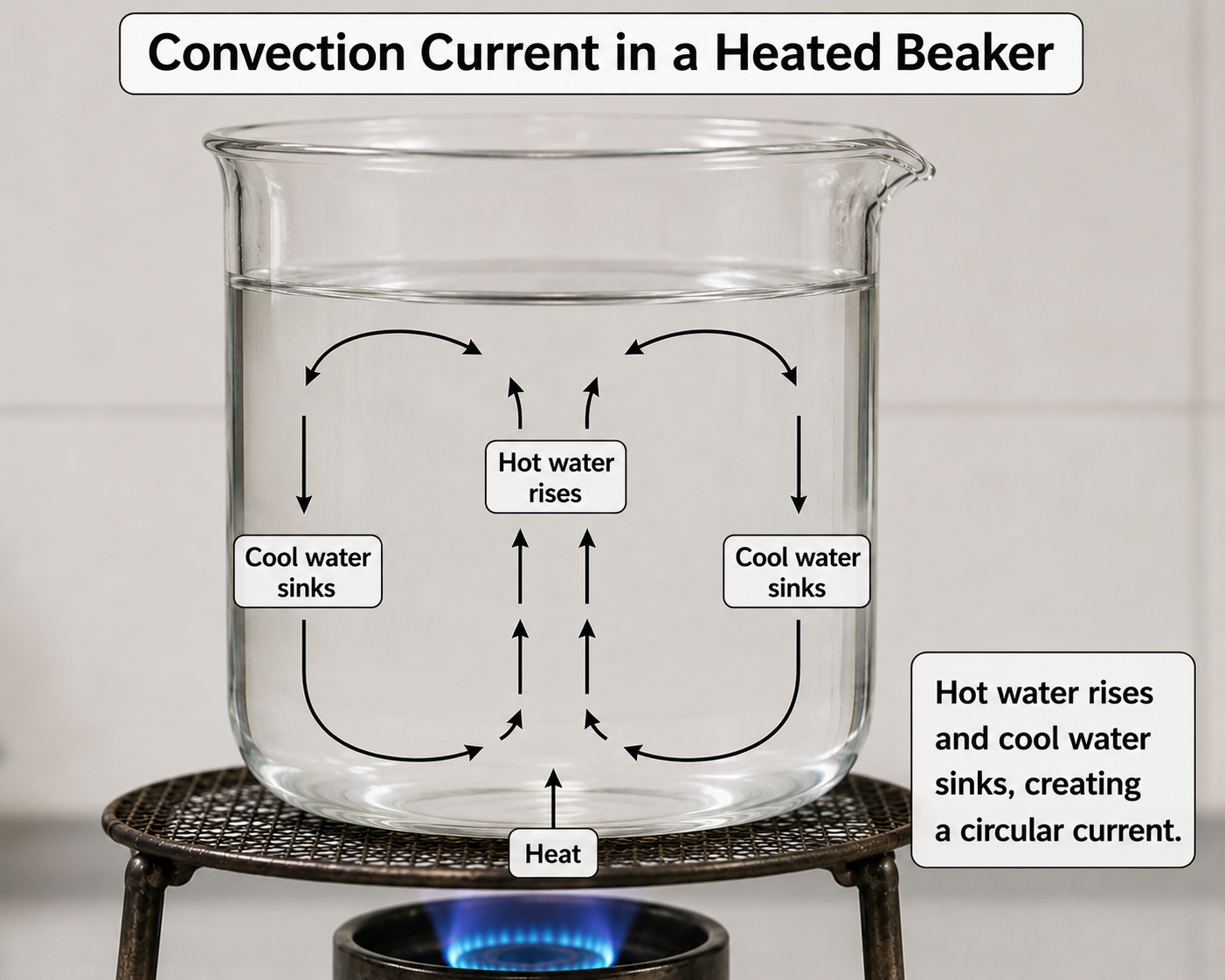
- When a fluid is heated, it expands .
- It becomes lighter (less dense) and rises .
- Cooler, denser fluid sinks to replace the rising hot fluid.
- It heats up and rises again.
- This cycle creates a convection current .
- In liquids and gases , heat travels by convection.
- Smoke is a mix of hot gases and tiny particles.
- It is lighter than surrounding cool air → rises by convection.
Definition
It transfers heat by actual movement of particles.
Works in liquids and gases.
Particles carry heat as they physically move.
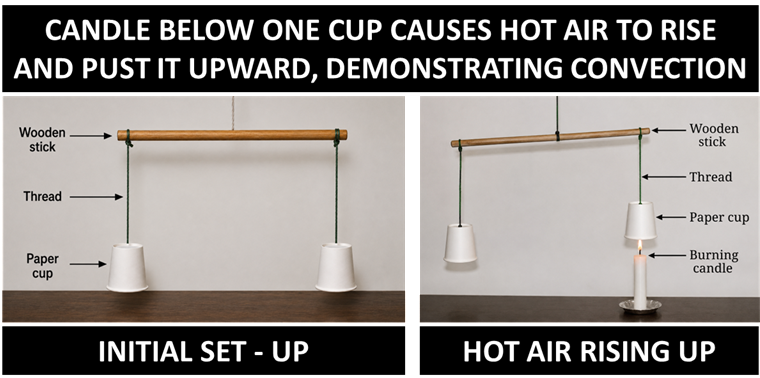
What to do
- Hang two identical paper cups inverted on two ends of a wooden stick (like a balance). Balance the stick horizontally.
- Place a burning candle under one of the cups.
- Observe which cup rises.
Table 7.3 — Recording Observations
| Observation about the cups | Probable reason for the observation |
|---|---|
| The cup placed above the candle rises upward | Air inside the cup heats up, expands, and becomes lighter — the cup rises as warm, lighter air pushes up against it |
⚠️
Caution
— Adult supervision required.
What to do
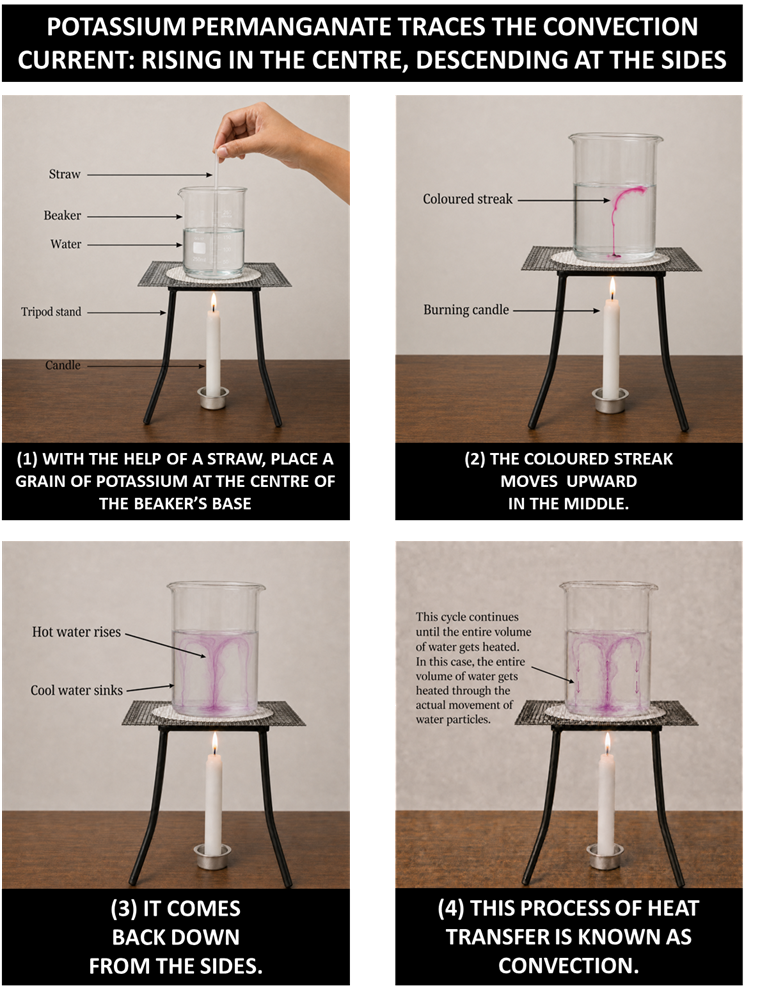
- Half-fill a 500 mL beaker with water. Place a grain of potassium permanganate at the center of the base using a straw.
- Place a candle directly below the centre of the beaker's base.
- Observe the movement of the coloured streak as the water heats.
What you will observe
The coloured streak moves upward in the middle .
It comes back down from the sides.
This is the convection current .
Hot water rises; cool water sinks.
Convection Current in Heated Water
Water at the bottom gets heated by the candle
The candle heats water directly above it. Bottom water warms up first.
Heated water expands → becomes lighter → rises up
Warm water is less dense and rises toward the surface, carrying heat with it.
Cooler water from the sides sinks to replace it
Cooler, denser water moves in from the sides to fill the gap left by rising warm water.
Cycle repeats until all water is heated
Continuous circulation — this is the
convection current
. Heat is carried by the actual movement of water particles.
Quick fact: A
partially inflated balloon
placed in the Sun grows larger — the air inside heats up, expands, and occupies more space. Same principle as convection.
📋 NCERT Question 1(iii) — Smoke Detector Placement
A smoke detector should be placed on the ceiling — why?
View Answer →
📋 NCERT Question 5 — Incense Stick Pointing Down
A burning incense stick is fixed pointing downwards — in which direction will the smoke move?
View Answer →
📋 NCERT Question 6 — Two Test Tubes
Two test tubes with water are heated — one from below, one from the side. Which thermometer records a higher temperature?
View Answer →
