 You are here

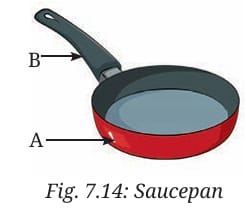
Your father bought a saucepan made of two different materials, A and B, as shown in Fig. 7.14. The materials A and B have the following properties—
- (a) Both A and B are good conductors of heat
- (b) Both A and B are poor conductors of heat
- (c) A is a good conductor and B is a poor conductor of heat
- (d) A is a poor conductor and B is a good conductor of heat
🔗 Concept: 7.1 Conduction of Heat
Show Answer
Explanation
- Body (A) is made of metal → good conductor → heats up quickly for cooking.
- Handle (B) is wood or plastic → poor conductor.
- Safe to hold even when the pan is hot.
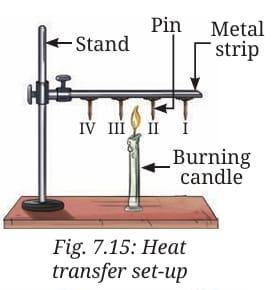
Pins are stuck to a metal strip with wax and a burning candle is kept below the rod, as shown in Fig. 7.15. Which of the following will happen?
- (a) All the pins will fall almost at the same time
- (b) Pins I and II will fall earlier than pins III and IV
- (c) Pins I and II will fall later than pins III and IV
- (d) Pins II and III will fall almost at the same time
🔗 Concept: 7.1 Conduction of Heat
Show Answer
Explanation
- Heat travels by conduction from the candle end toward pin IV.
- Pin I is closest to the flame → wax melts first → pin I falls first.
- Pin II falls next, then III, then IV.
- Each falls as the heat reaches it.
A smoke detector is a device that detects smoke and sounds an alarm. Suppose you are fitting a smoke detector in your room. The most suitable place for this device will be:
- (a) Near the floor
- (b) In the middle of a wall
- (c) On the ceiling
- (d) Anywhere in the room
🔗 Concept: 7.2 Convection
Show Answer
Explanation
- Smoke is hot and lighter than surrounding air.
- By convection , smoke rises and collects near the ceiling.
- A detector on the ceiling catches smoke first → triggers alarm fastest.
