
 You are here
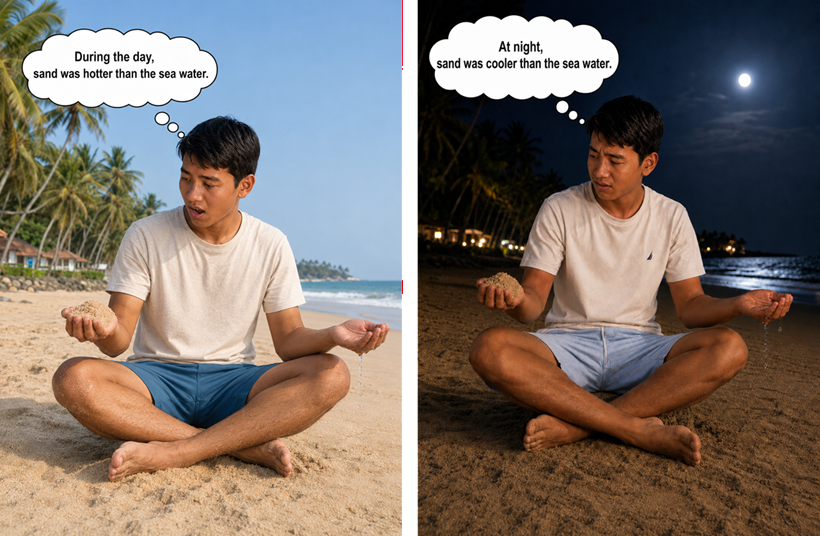
Palden visited a beach in Kerala.
During the day, sand was hotter than the sea.
At night, sand was cooler than the sea. Why?
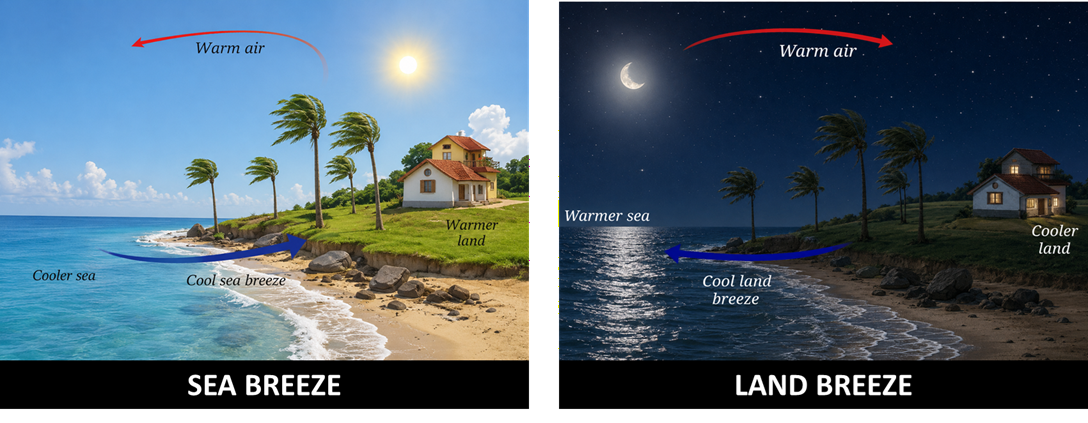
- Land heats up faster than water in sunlight.
- It also cools faster than water at night.
-
What happens during Day
We get sea breeze
Explanation
During day, Land gets hotter than sea.
Warm air above land rises.
Cool air from the sea moves inland
This is sea breeze, where cooler air from sea moves towards land. -
What happens during Night
We get land breeze
Explanation
During night, Land cools faster than sea.
Warm air above the sea rises.
Cool air from land moves toward sea
This is land breeze, where cooler air from land moves towards sea. -
Note
In coastal areas, windows face sea to catch the sea breeze
Sea Breeze — During the Day
Land Breeze — At Night
Land is warmer than the sea
Sea is warmer than the land
Warm air above land rises
Warm air above sea rises
Cool air flows from sea → land
Cool air flows from land → sea
Provides relief from daytime heat in coastal areas
Wind direction is the reverse of sea breeze

⚠️
Caution
— Carry out on a clear, sunny day under adult supervision.
What to do
- Fill two identical bowls — one with soil, one with water. Fix a thermometer in each, bulb submerged.
- Place both bowls in direct sunlight. Record temperature every 5 minutes for 20 minutes.
- Bring indoors and let cool for 20 minutes. Compare cooling rates.
Table 7.4 — Temperature of Soil and Water When Heated
| S.No. | Time (min) | Temperature of Soil (°C) | Temperature of Water (°C) |
|---|---|---|---|
| 1 | 0 | 25 | 25 |
| 2 | 5 | 30 | 26 |
| 3 | 10 | 35 | 27 |
| 4 | 15 | 40 | 28 |
| 5 | 20 | 45 | 29 |
HENCE
SOIL HAS HIGHER TEMPERATURE THAN WATER
SO WE CAN SAY
SOIL HEATS UP FASTER THAN WATER
SIMILARLY, IF WE BRING SOIL AND WATER INDOORS
SOIL WILL COOL FASTER THAN WATER
📋 NCERT Question 8 — Large Water Bodies
How do large water bodies prevent extreme temperatures in areas around them?
View Answer →
✓ Quick Check — Section 7.2
-
How is convection different from conduction?
Show Answer
Conduction: particles do not move — they pass heat to nearby particles
Example- if we put spoon in a hot water cup,it becomes hot due to conduction
Convection: particles physically move from hotter to cooler regions, carrying heat.
Example-Boiling water -
Why does a sea breeze blow toward the land during the day?
Show Answer
Land heats up faster than water.
Warm air above land rises by convection.
Cool air from the sea rushes in → sea breeze.
