
 You are here
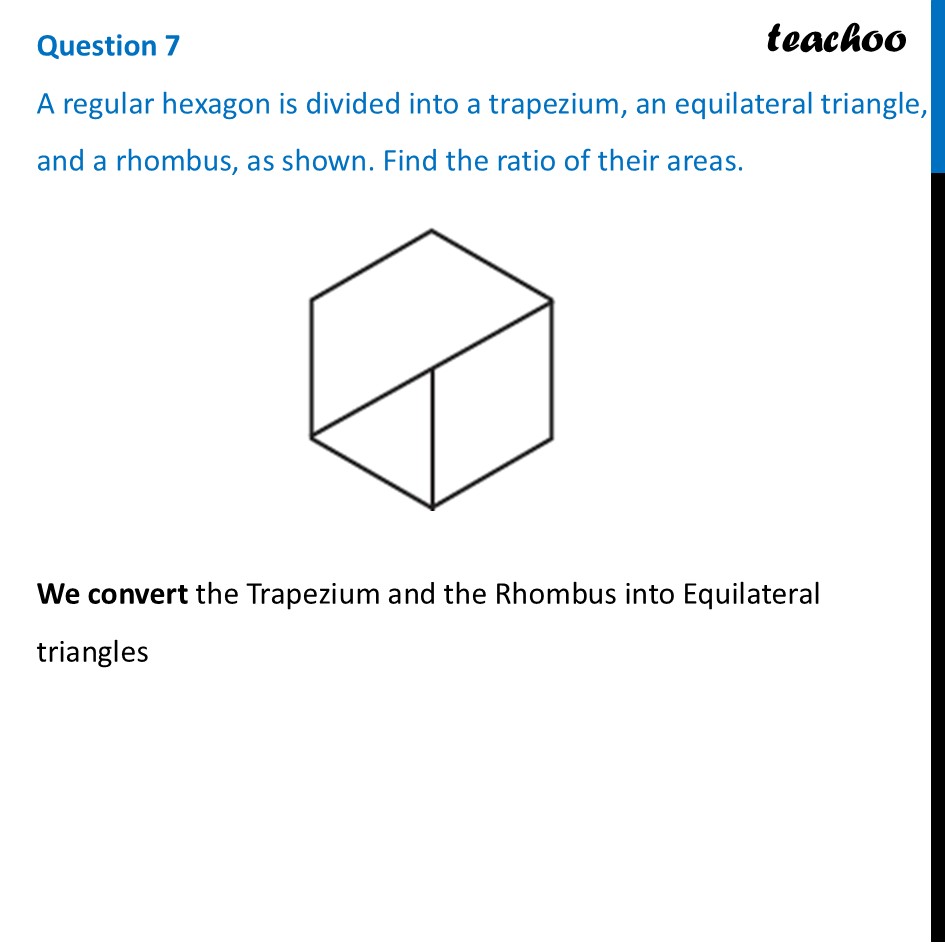



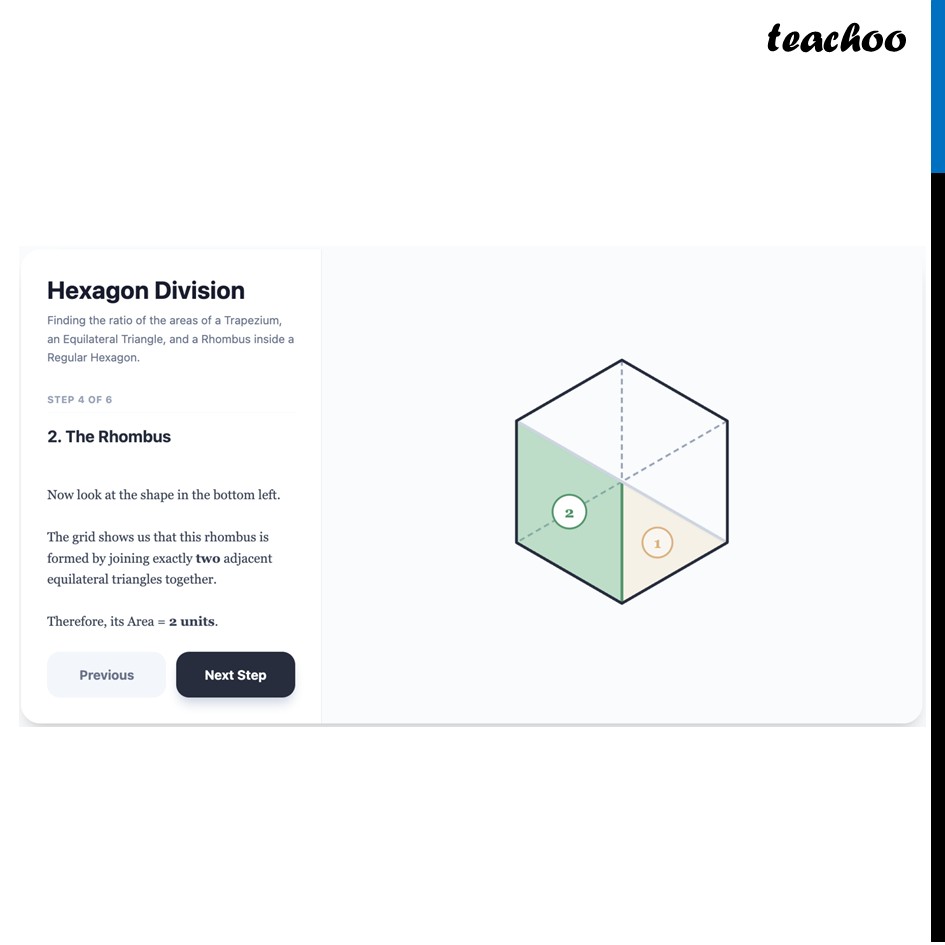


Figure it out - Page 169-170
Last updated at March 16, 2026 by Teachoo
Transcript
Question 7 A regular hexagon is divided into a trapezium, an equilateral triangle, and a rhombus, as shown. Find the ratio of their areas.We convert the Trapezium and the Rhombus into Equilateral triangles Hexagon Division Finding the ratio of the areas of a Trapezium, an Equilateral Triangle, and a Rhombus inside a Regular Hexagon. STEP 1 OF 6 The Divided Hexagon We are given a regular hexagon divided into three distinct shapes: A Trapezium (Top) A Rhombus (Bottom-Left) An Equilateral Triangle (BottomRight) Previous Next StepHexagon Division Finding the ratio of the areas of a Trapezium, an Equilateral Triangle, and a Rhombus inside a Regular Hexagon. STEP 2 OF 6 The Geometric Secret To solve this without complex math, we use a fundamental property: Every regular hexagon can be perfectly divided into exactly 6 identical equilateral triangles by connecting its vertices to the center. Let's say 1 triangle Unit of Area. Previous Next StepHexagon Division Finding the ratio of the areas of a Trapezium, an Equilateral Triangle, and a Rhombus inside a Regular Hexagon. STEP 3 OF 6 The Equilateral Triangle Look at the shape in the bottom right. It perfectly perfectly outlines exactly one of the constituent equilateral triangles of the hexagon grid. Therefore, its Area = 1 unit. Previous Next Step Hexagon Division Finding the ratio of the areas of a Trapezium, an Equilateral Triangle, and a Rhombus inside a Regular Hexagon. STEP 4 OF 6 2. The Rhombus Now look at the shape in the bottom left. The grid shows us that this rhombus is formed by joining exactly two adjacent equilateral triangles together. Therefore, its Area = 2 units. Previous Next Step Hexagon Division Finding the ratio of the areas of a Trapezium, an Equilateral Triangle, and a Rhombus inside a Regular Hexagon. STEP 6 OF 6 3. The Trapezium Finally, look at the large shape across the top. This trapezium occupies exactly half of the entire hexagon. By counting the grid pieces, we see it is formed by three adjacent triangles. Therefore, its Area = 3 units. Previous Next Step Hexagon Division Finding the ratio of the areas of a Trapezium, an Equilateral Triangle, and a Rhombus inside a Regular Hexagon. STEP 6 OF 6 The Final Ratio Because all the shapes are built from the exact same fundamental building blocks (the 6 identical triangles), their area ratio is simply the ratio of how many blocks they contain! Final Ratio Trapezium: 3 units Triangle: 1 unit Rhombus: 2 units Ratio Previous Restart Analysis
