![[Class 8] What can we say about the areas of all these parallelograms? - Area of Parallelogram](https://cdn.teachoo.com/248b9c0f-dfff-459b-a42e-d445f955ed07/slide40.jpg)
Area of Parallelogram

 You are here
Area of Parallelogram
Last updated at March 16, 2026 by Teachoo
Transcript
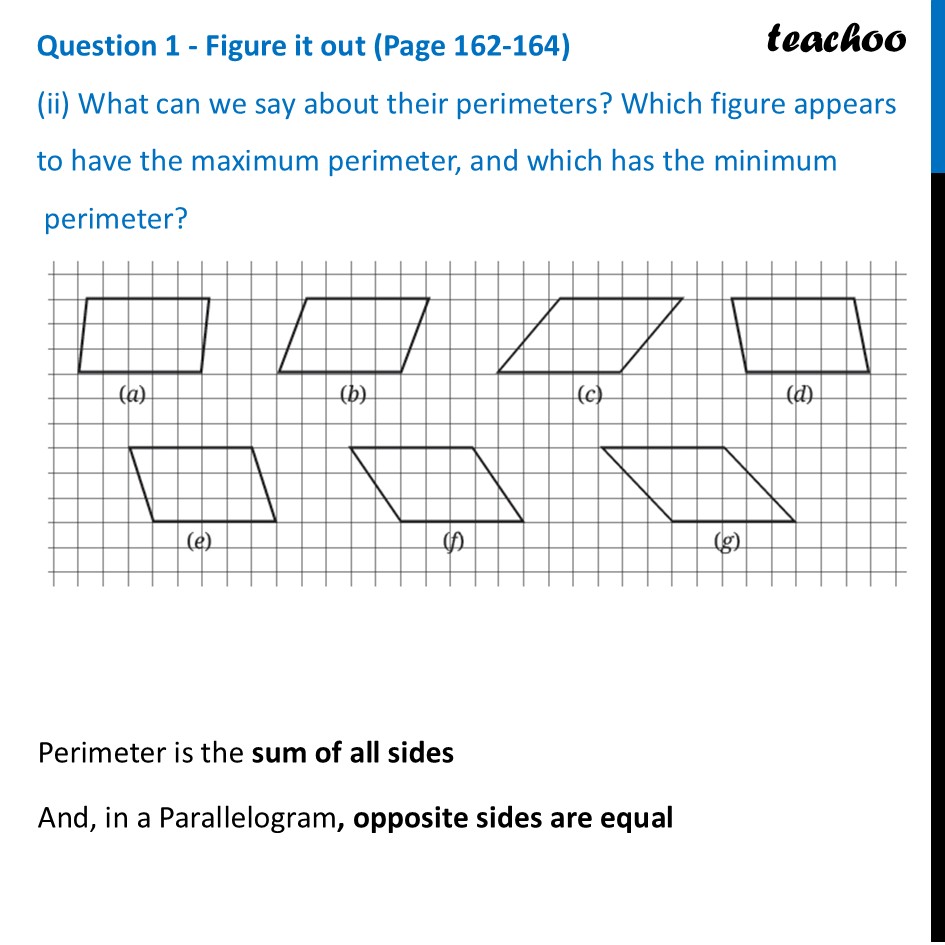
Question 1 - Figure it out (Page 162-164) Observe the parallelograms in the figure below. (i) What can we say about the areas of all these parallelograms?We know that Area of Parallelogram = Base × Height Finding Base and Height for each shape Look closely at the grid for shapes (a) through (g) Base: Every single parallelogram has a base that is exactly 3 grid squares wide. Height: Every parallelogram is exactly 3 grid squares tall. Thus, Area of each shape = Base × Height = 3 × 3 = 9 square units Thus, their areas are all exactly the same. Question 1 - Figure it out (Page 162-164) (ii) What can we say about their perimeters? Which figure appears to have the maximum perimeter, and which has the minimum perimeter?Perimeter is the sum of all sides And, in a Parallelogram, opposite sides are equal Since base of each shape is same – 3 units We need to look at other two sides Now, in general Slant sides have more length than straight sides (imagine how Hypotenuse > Sides) Thus, figures with more Slant sides have more perimeter, and vice versa Minimum Perimeter Figure (a) has the minimum perimeter They are the "most upright," meaning their slanted sides are the shortest possible distances between the top and bottom lines. Maximum Perimeter Figure (g) has the maximum perimeter. It leans over the furthest, which stretches that slanted side to be much longer than any of the others.
