
 You are here
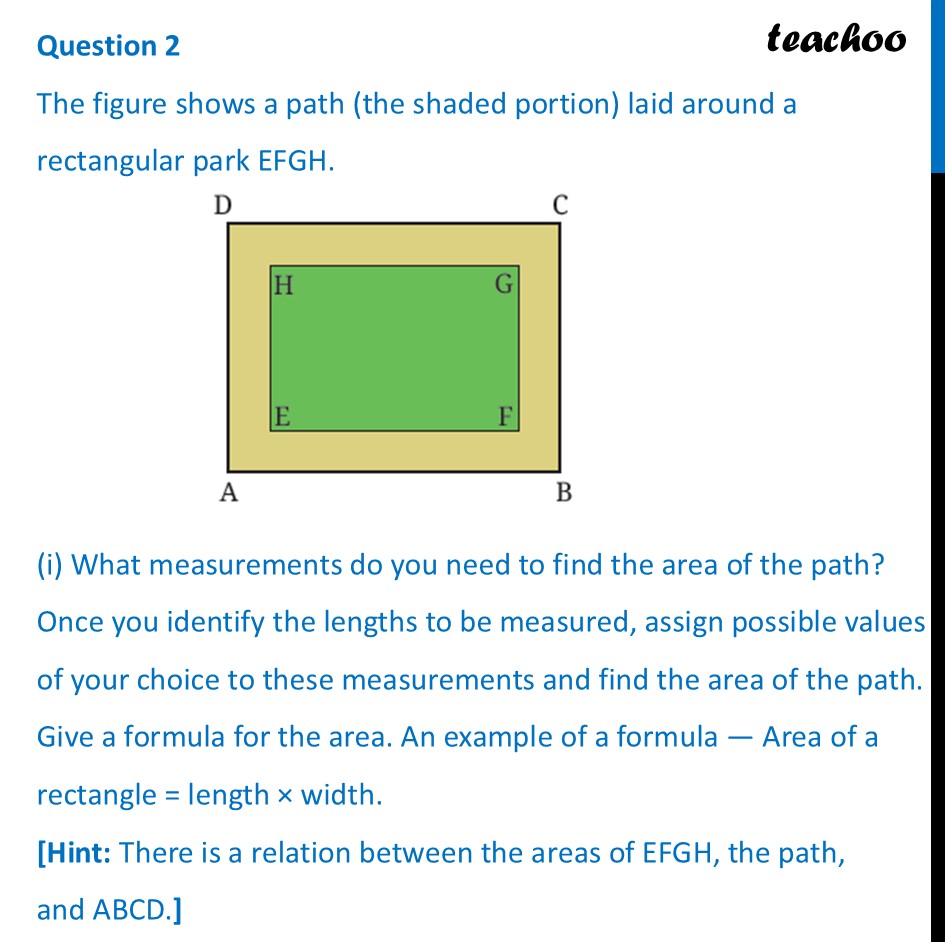
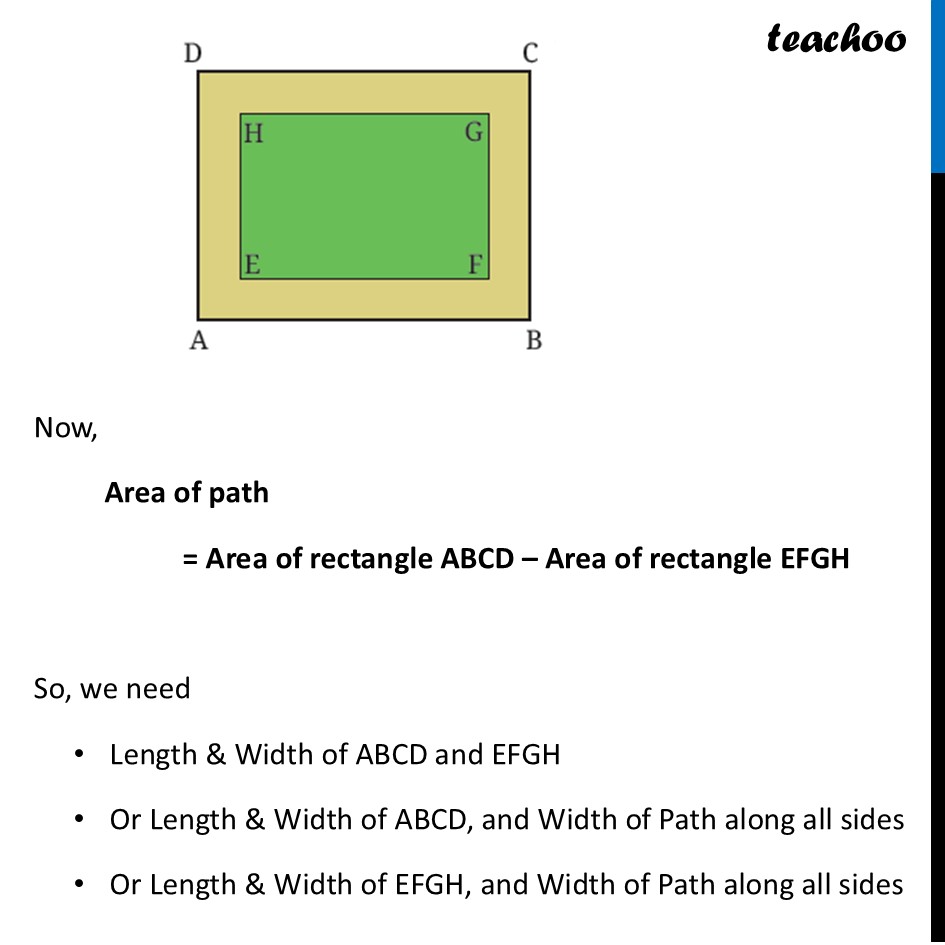
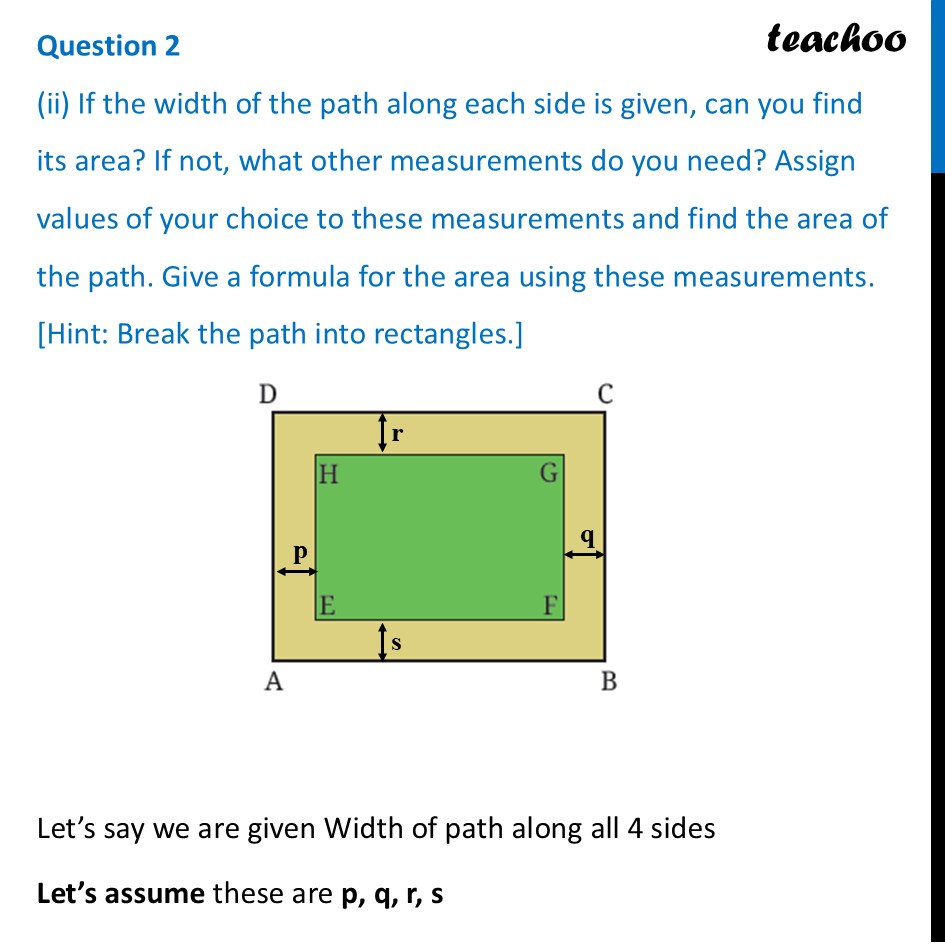
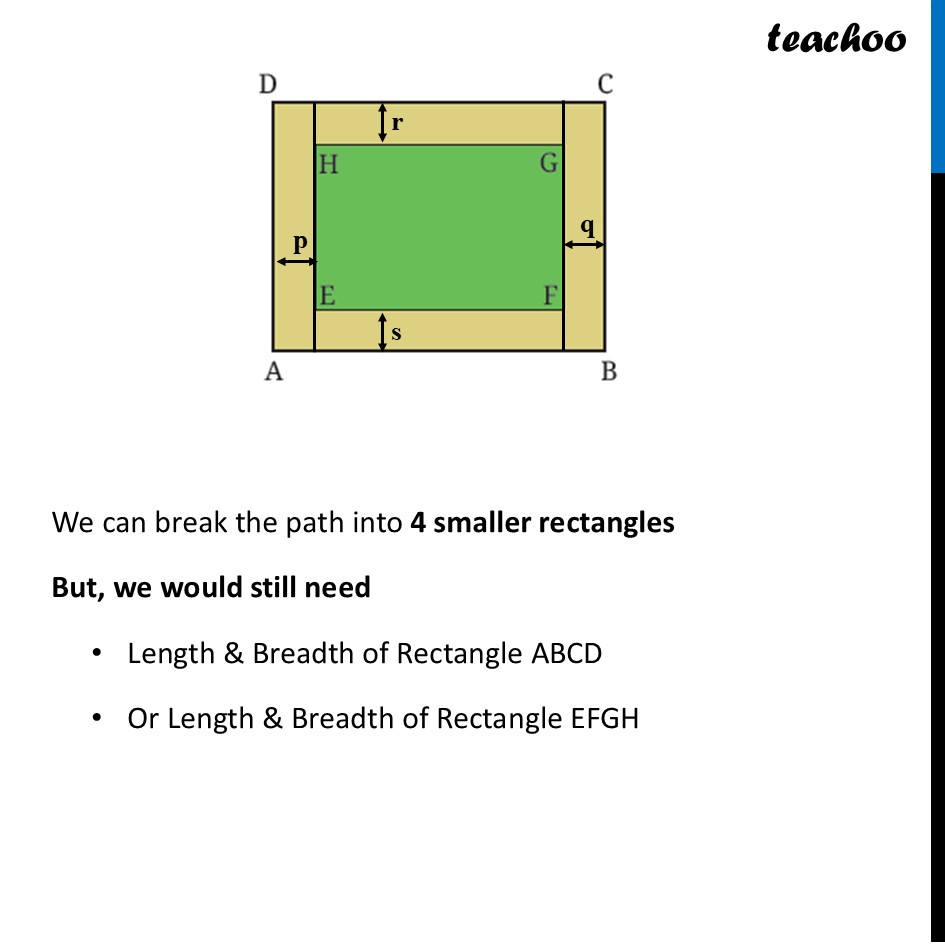
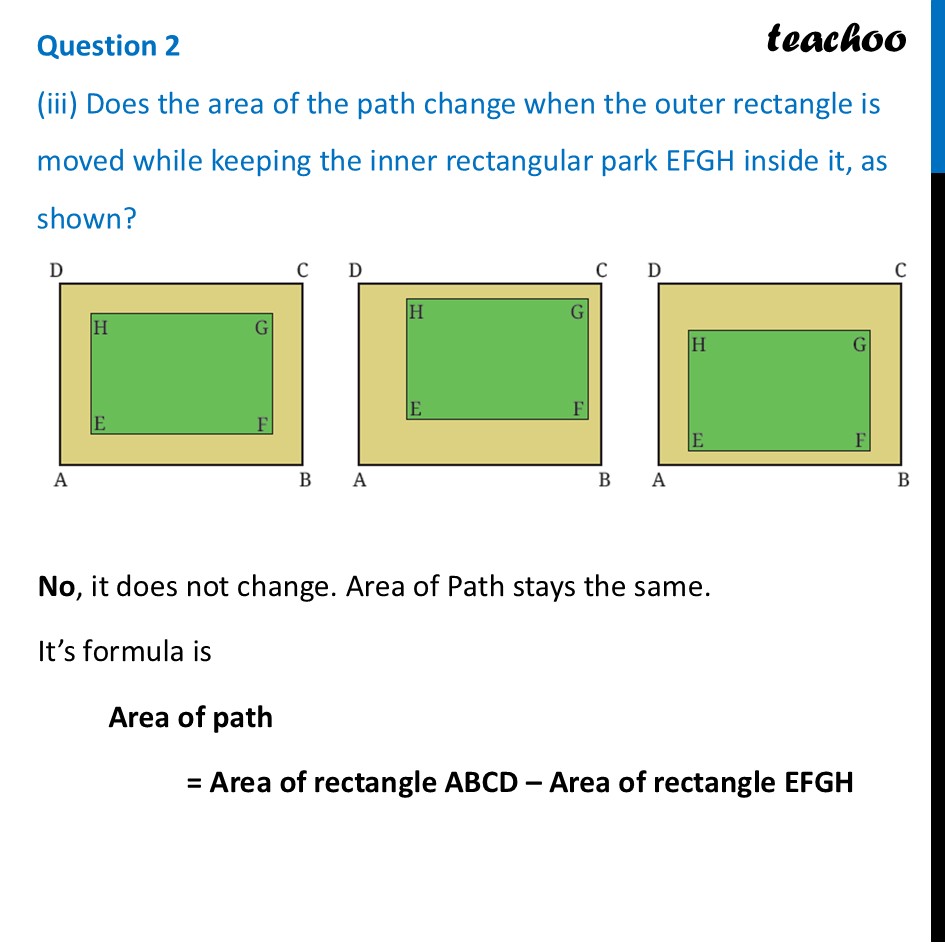
Figure it out - Page 150-152
Last updated at March 13, 2026 by Teachoo
Transcript
Question 2 The figure shows a path (the shaded portion) laid around a rectangular park EFGH. (i) What measurements do you need to find the area of the path? Once you identify the lengths to be measured, assign possible values of your choice to these measurements and find the area of the path. Give a formula for the area. An example of a formula — Area of a rectangle = length × width. [Hint: There is a relation between the areas of EFGH, the path, and ABCD.]Now, Area of path = Area of rectangle ABCD – Area of rectangle EFGH So, we need Length & Width of ABCD and EFGH Or Length & Width of ABCD, and Width of Path along all sides Or Length & Width of EFGH, and Width of Path along all sides Question 2 (ii) If the width of the path along each side is given, can you find its area? If not, what other measurements do you need? Assign values of your choice to these measurements and find the area of the path. Give a formula for the area using these measurements. [Hint: Break the path into rectangles.]We can break the path into 4 smaller rectangles But, we would still need Length & Breadth of Rectangle ABCD Or Length & Breadth of Rectangle EFGH Question 2 (iii) Does the area of the path change when the outer rectangle is moved while keeping the inner rectangular park EFGH inside it, as shown?No, it does not change. Area of Path stays the same. It’s formula is Area of path = Area of rectangle ABCD – Area of rectangle EFGH As long as the sizes of ABCD and EFGH don't change, the area of the path (which is just ABCD minus EFGH) stays exactly the same.
