 You are here


Further Applications of the Baudhāyana - Pythagoras Theorem
Further Applications of the Baudhāyana - Pythagoras Theorem
Last updated at February 23, 2026 by Teachoo
Transcript
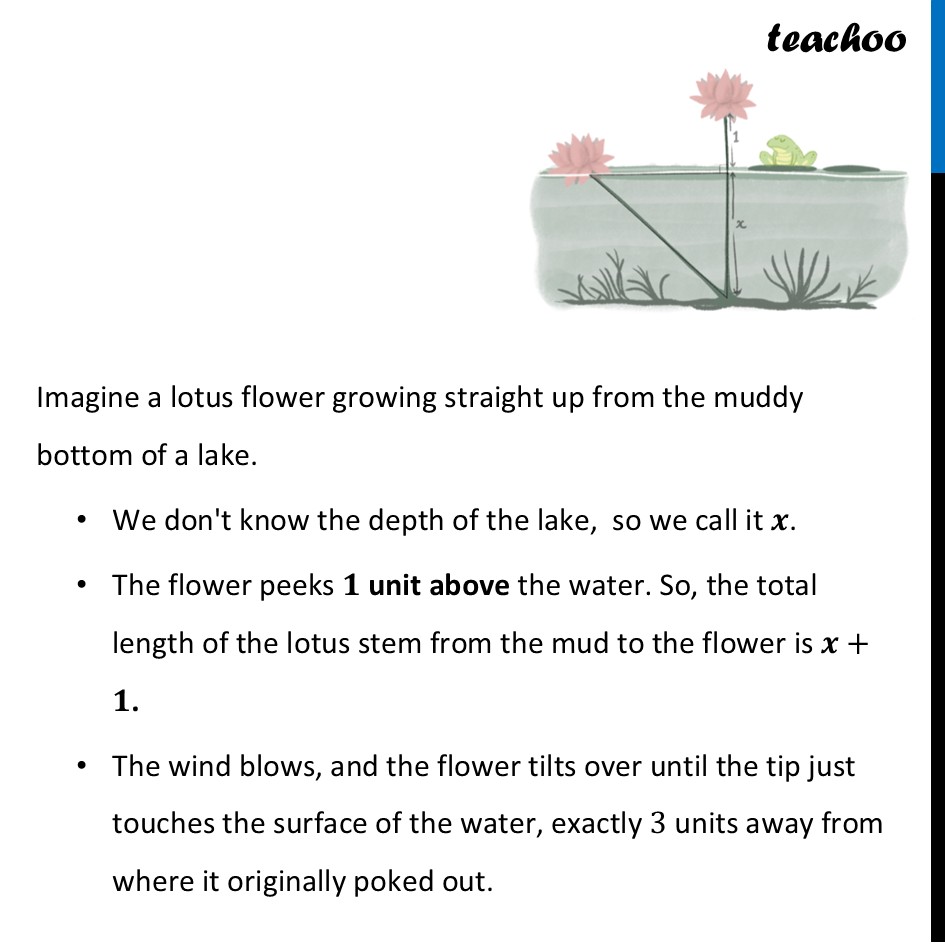
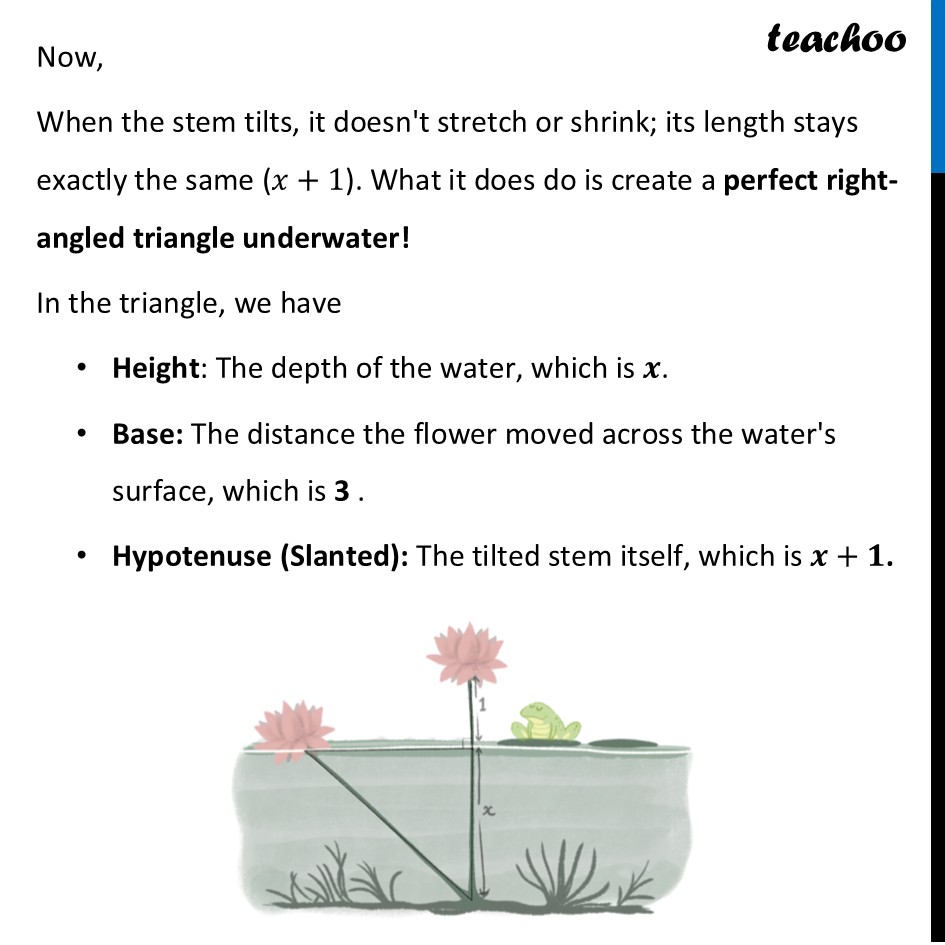
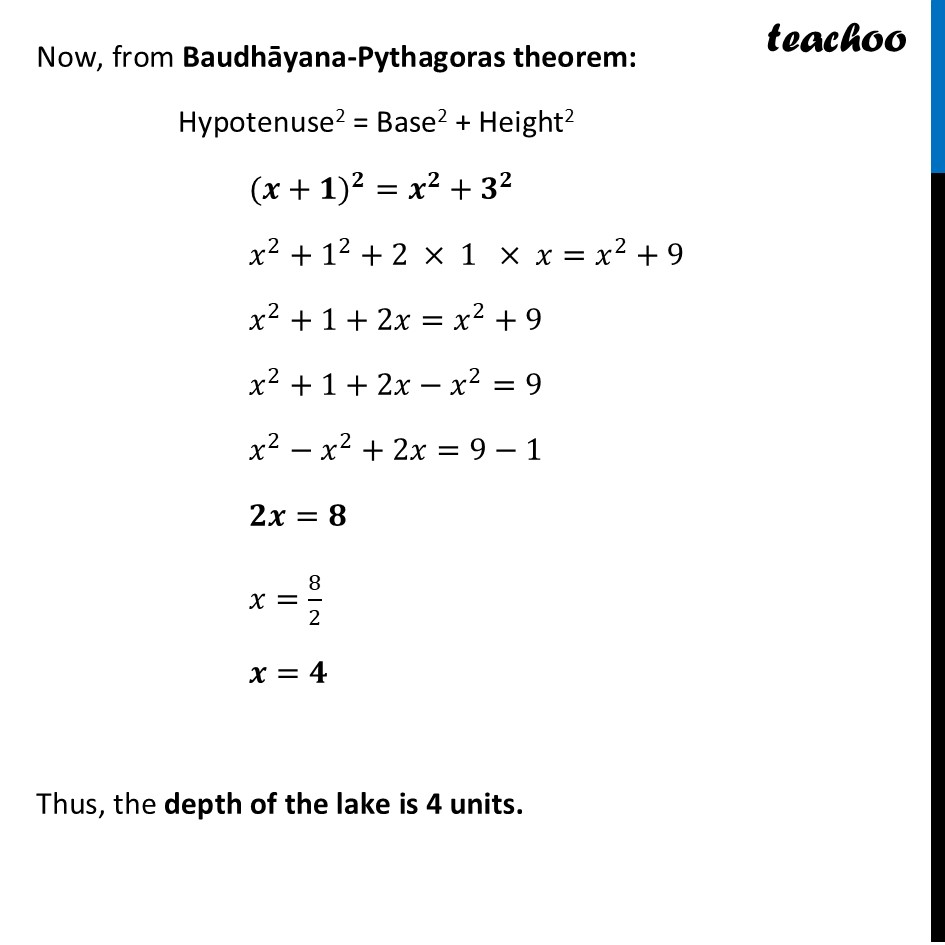
A Problem from Bhāskarāchārya’s LīlāvatīThis is a problem from Bhāskarāchārya’s (Bhāskara II) Līlāvatī. “In a lake surrounded by chakra and krauñcha birds, there is a lotus flower peeping out of the water, with the tip of its stem 1 unit above the water. On being swayed by a gentle breeze, the tip touches the water 3 units away from its original position. Quickly tell the depth of the lake.” Imagine a lotus flower growing straight up from the muddy bottom of a lake. We don't know the depth of the lake, so we call it 𝒙. The flower peeks 𝟏 unit above the water. So, the total length of the lotus stem from the mud to the flower is 𝒙+𝟏. The wind blows, and the flower tilts over until the tip just touches the surface of the water, exactly 3 units away from where it originally poked out. Now, When the stem tilts, it doesn't stretch or shrink; its length stays exactly the same (𝑥+1). What it does do is create a perfect right-angled triangle underwater! In the triangle, we have Height: The depth of the water, which is 𝒙. Base: The distance the flower moved across the water's surface, which is 3 . Hypotenuse (Slanted): The tilted stem itself, which is 𝒙+𝟏. Now, from Baudhāyana-Pythagoras theorem: Hypotenuse2 = Base2 + Height2 (𝒙+𝟏)^𝟐=𝒙^𝟐+𝟑^𝟐 𝑥^2+1^2+2 × 1 × 𝑥=𝑥^2+3^2 𝑥^2+1+2𝑥1^2+2 × 1 × 𝑥=𝑥^2+3^2 Now, from Baudhāyana-Pythagoras theorem: Hypotenuse2 = Base2 + Height2 (𝒙+𝟏)^𝟐=𝒙^𝟐+𝟑^𝟐 𝑥^2+1^2+2 × 1 × 𝑥=𝑥^2+9 𝑥^2+1+2𝑥=𝑥^2+9 𝑥^2+1+2𝑥−𝑥^2=9 𝑥^2−𝑥^2+2𝑥=9−1 𝟐𝒙=𝟖 𝑥=8/2 𝒙=𝟒 Thus, the depth of the lake is 4 units.
