 You are here

A Long-Standing Open Problem
A Long-Standing Open Problem
Last updated at February 23, 2026 by Teachoo
Transcript
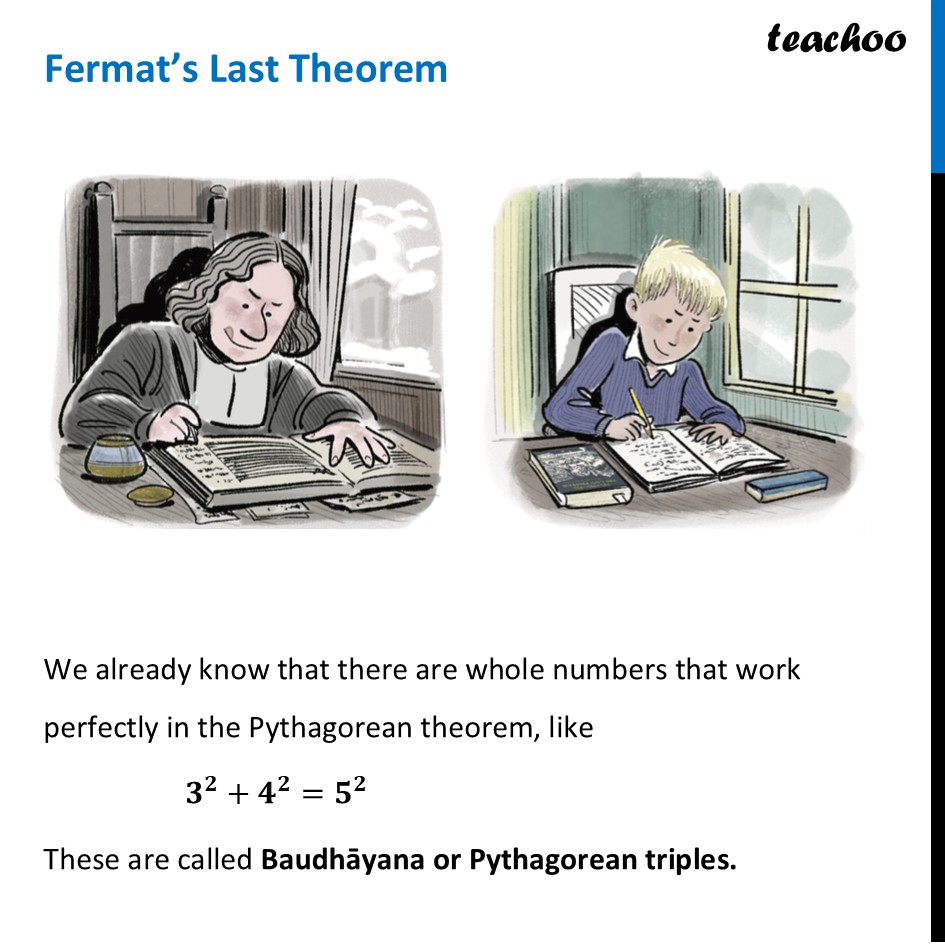
Fermat’s Last TheoremWe already know that there are whole numbers that work perfectly in the Pythagorean theorem, like 𝟑^𝟐+𝟒^𝟐=𝟓^𝟐 These are called Baudhāyana or Pythagorean triples. Fermat's Question Fermat wondered, "What if we change the little '2' (the square) to a ' 3 ' (a cube), or a ' 4 ', or any bigger whole number?" He was asking if there are any whole numbers for 𝑥,𝑦, and 𝑧 that make this equation true: 𝒙^𝒏+𝒚^𝒏=𝒛^𝒏 where 𝑛 is any whole number greater than 2 The Ultimate Tease Fermat realized the answer was no. You cannot find any positive whole numbers that make that equation work if the power is 3 or higher. But the funny part? He wrote in the margin of his math book that he had a "truly marvellous proof" for this, but the margin was too small to write it down! The Resolution Fermat died without ever writing the proof down. For over 300 years, the smartest mathematicians in the world tried to prove it and failed. It wasn't until 1994 that a mathematician named Andrew Wiles finally proved it, fulfilling a dream he had since he was a 10-year-old boy.
