
 You are here
Question 2 - Figure it out - Page 50 - Chapter 2 Class 8 - The Baudhayana-Pythagoras Theorem (Ganita Part 2)
Last updated at February 23, 2026 by Teachoo
Figure it out - Page 50
Figure it out - Page 50
Last updated at February 23, 2026 by Teachoo
Transcript
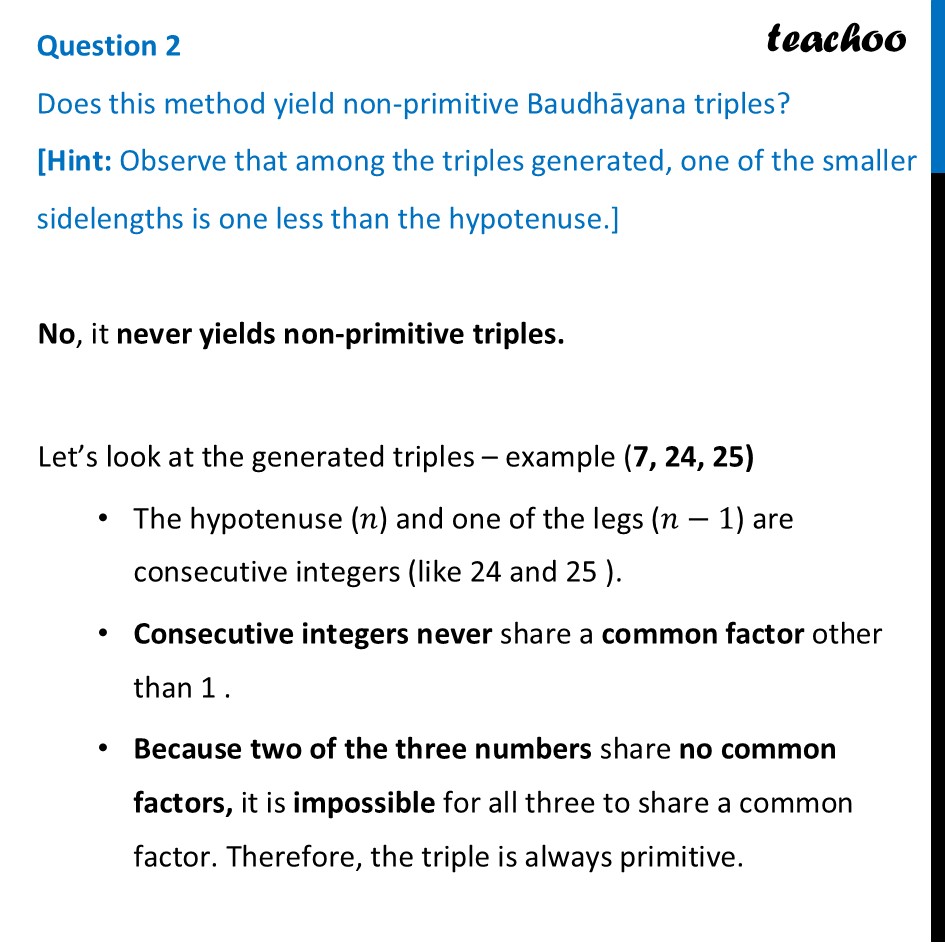
Question 2 Does this method yield non-primitive Baudhāyana triples? [Hint: Observe that among the triples generated, one of the smaller sidelengths is one less than the hypotenuse.]No, it never yields non-primitive triples. Let’s look at the generated triples – example (7, 24, 25) The hypotenuse (𝑛) and one of the legs (𝑛−1) are consecutive integers (like 24 and 25 ). Consecutive integers never share a common factor other than 1 . Because two of the three numbers share no common factors, it is impossible for all three to share a common factor. Therefore, the triple is always primitive.
