
 You are here
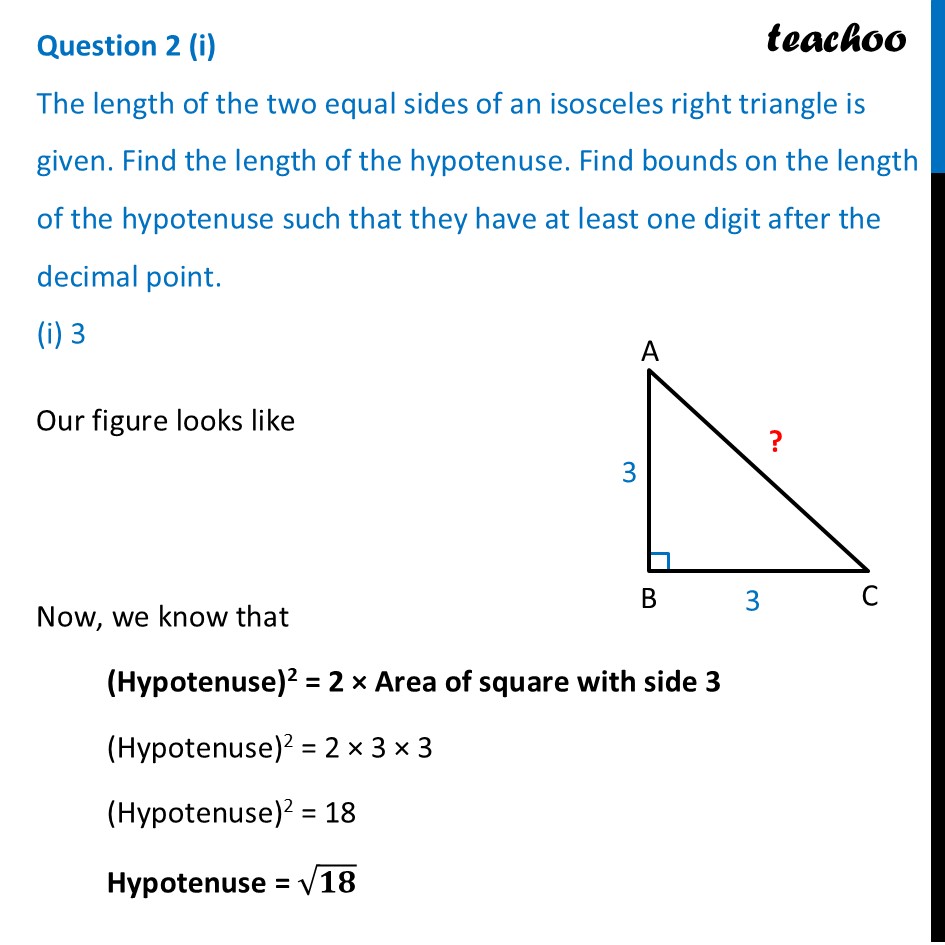
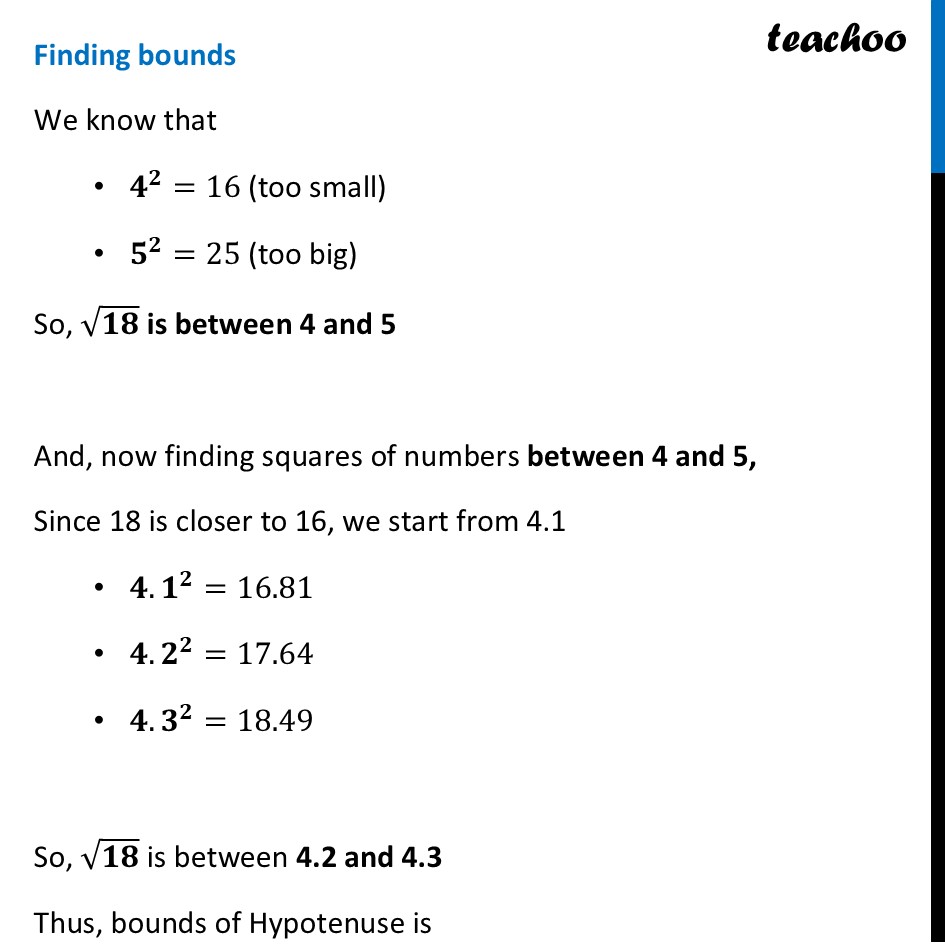
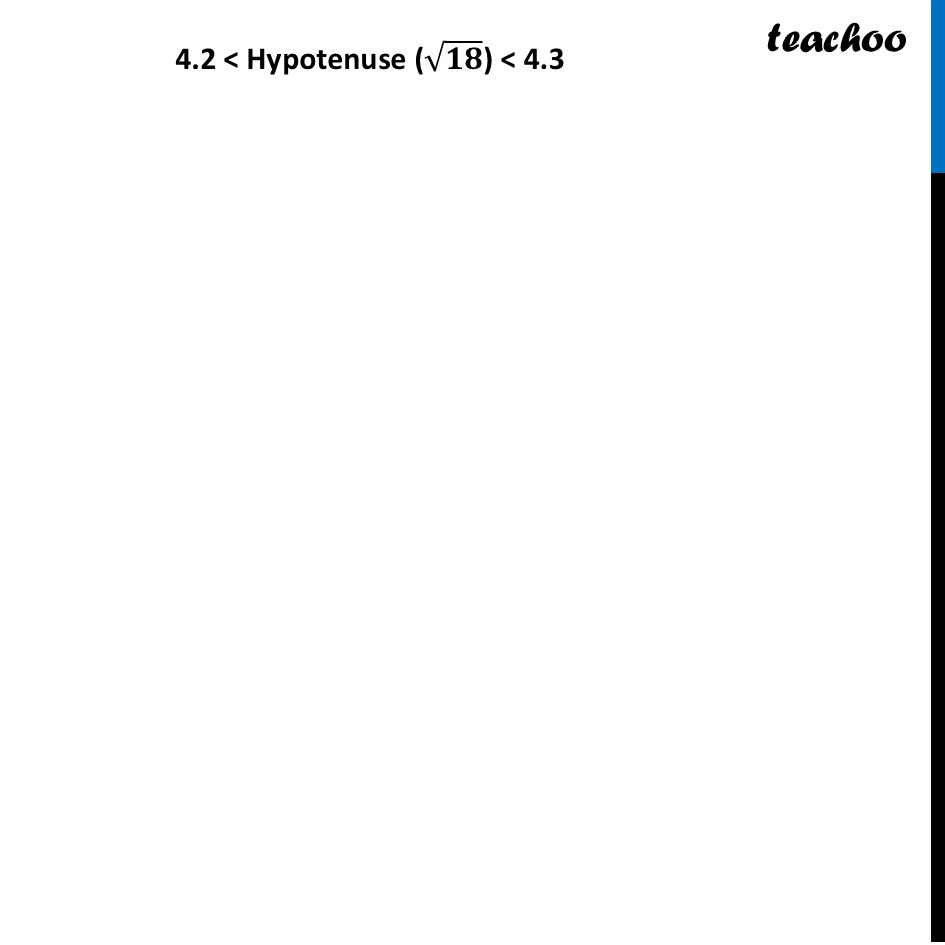
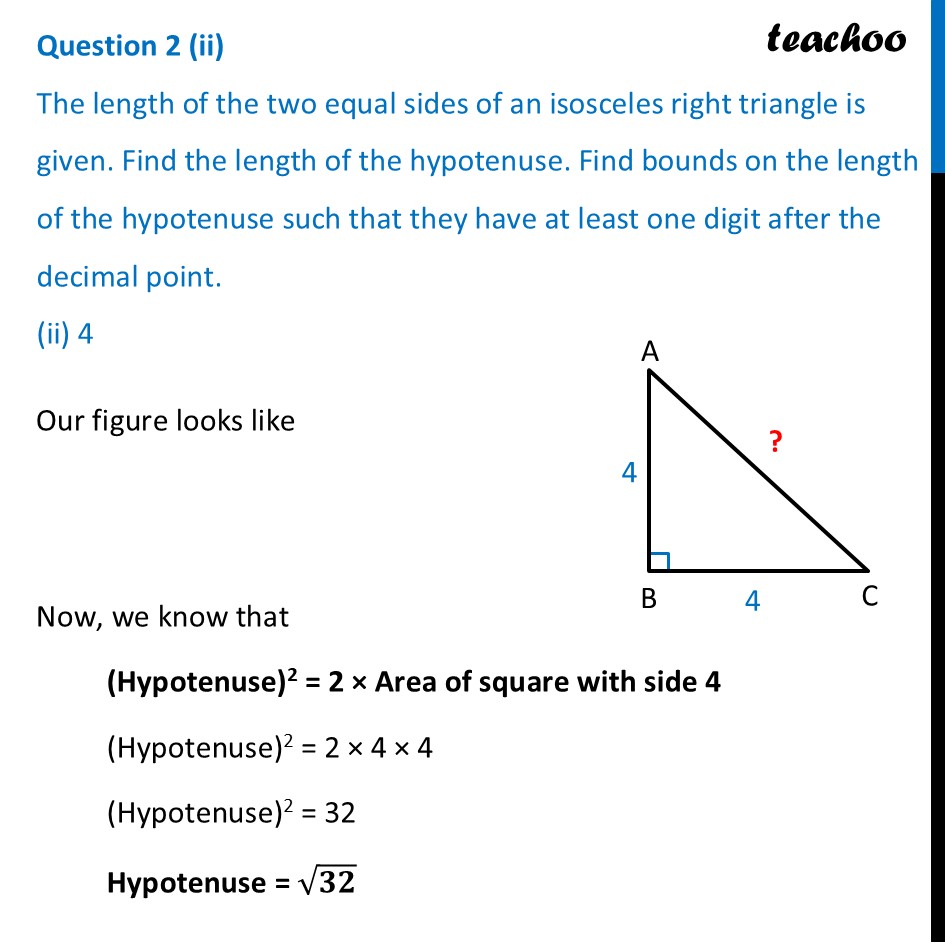
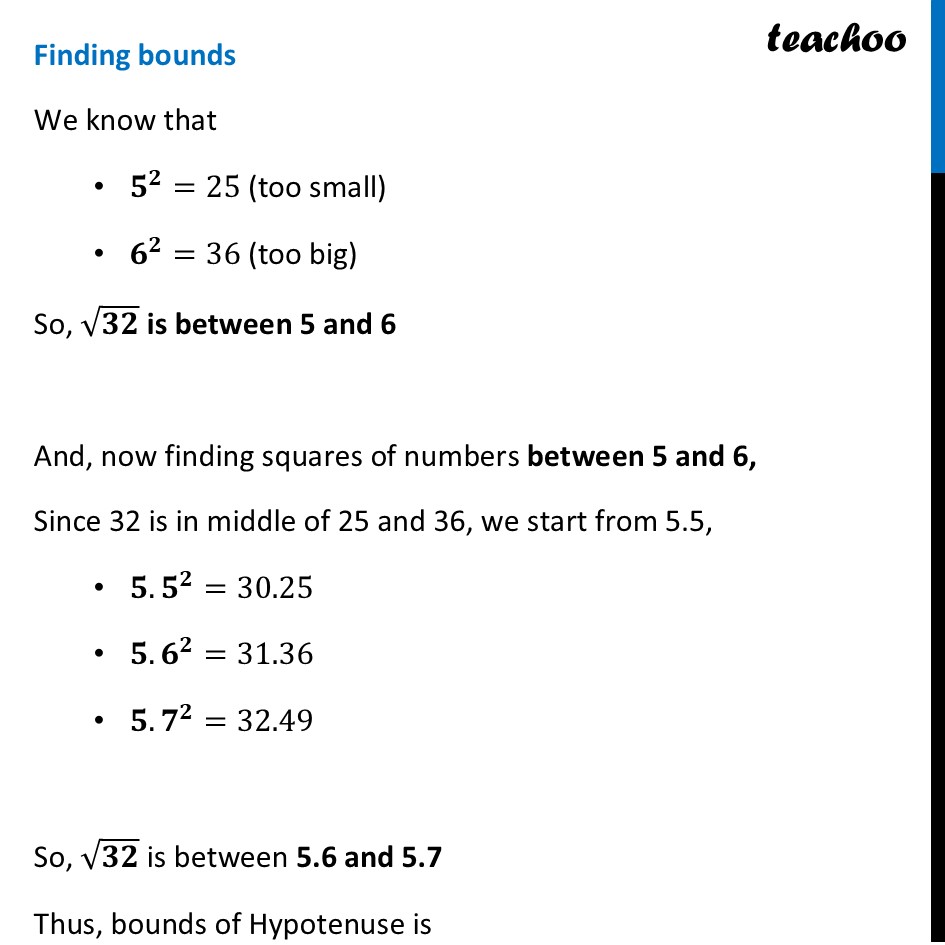
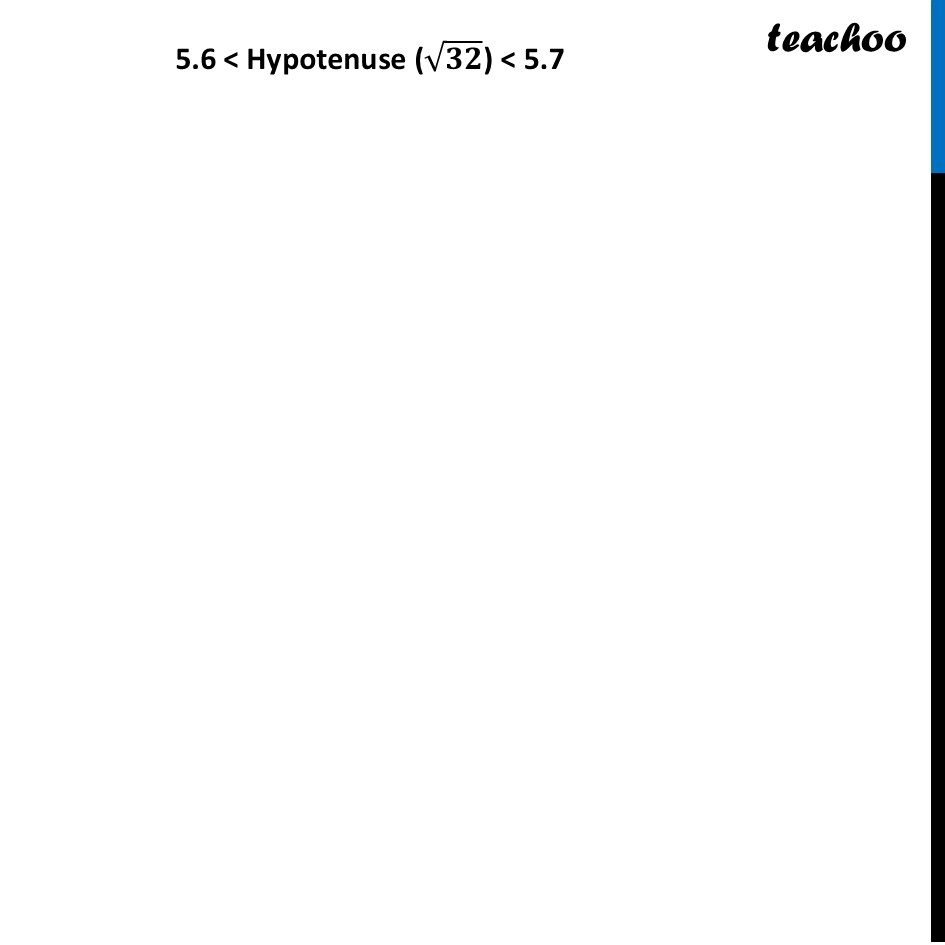
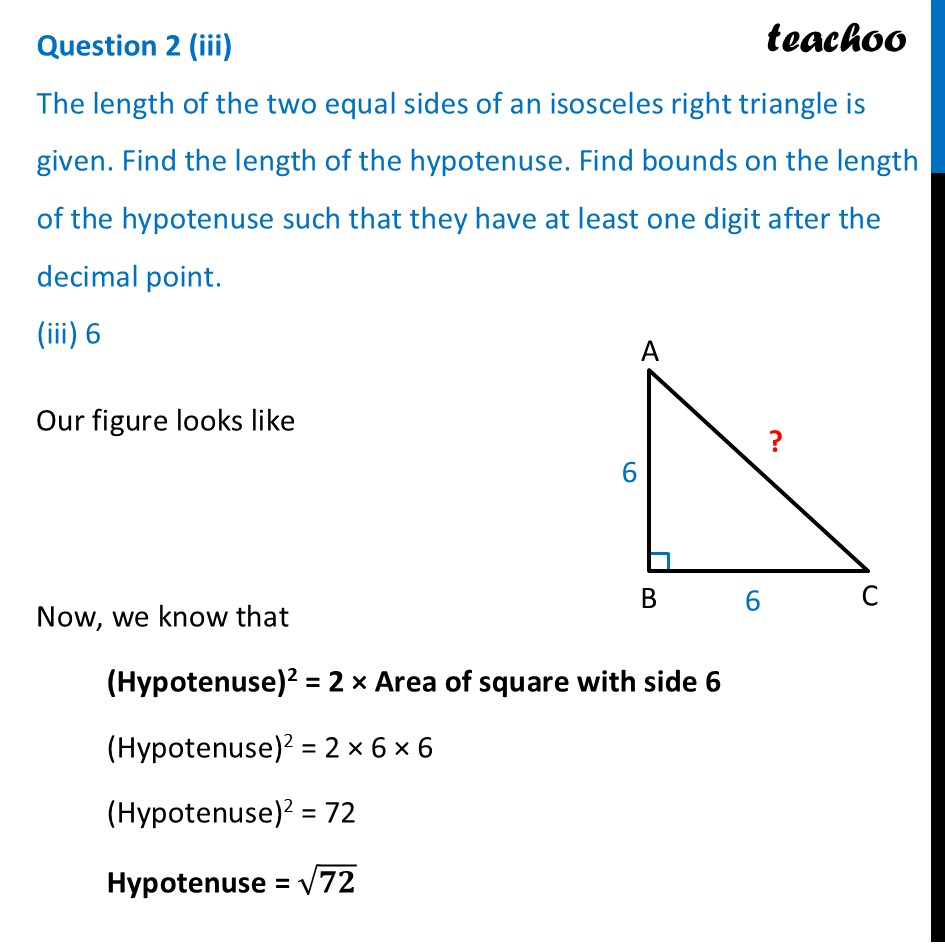
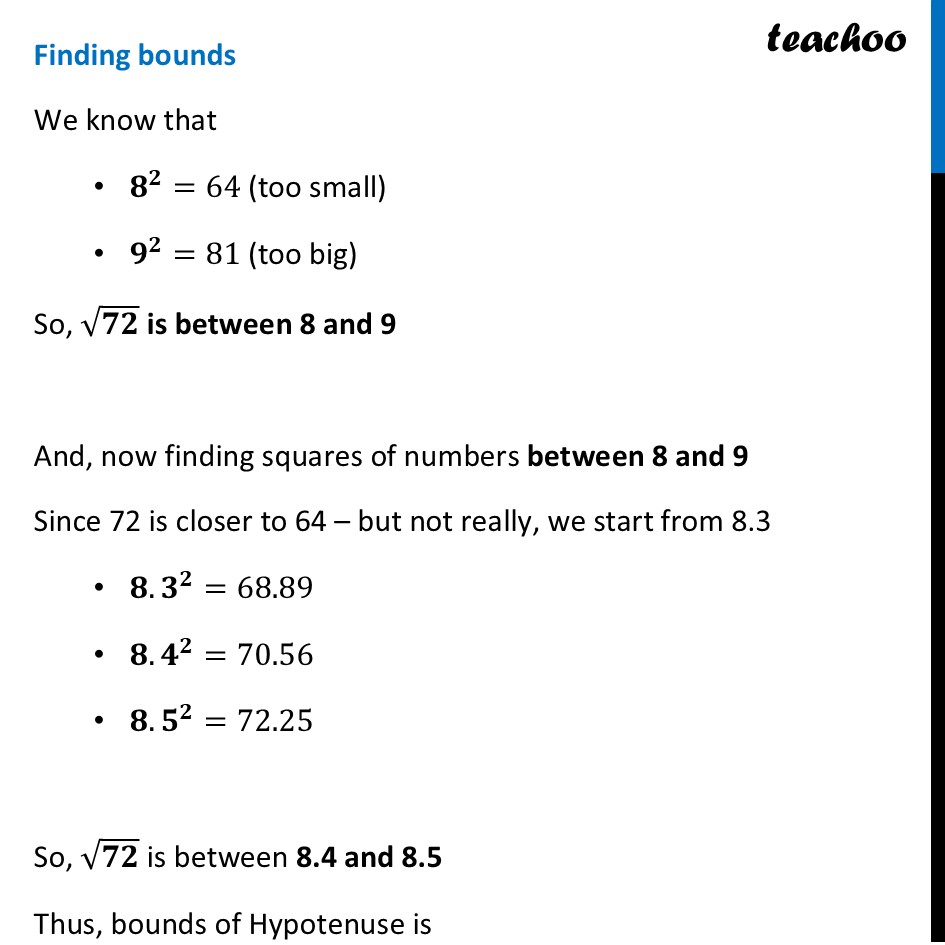
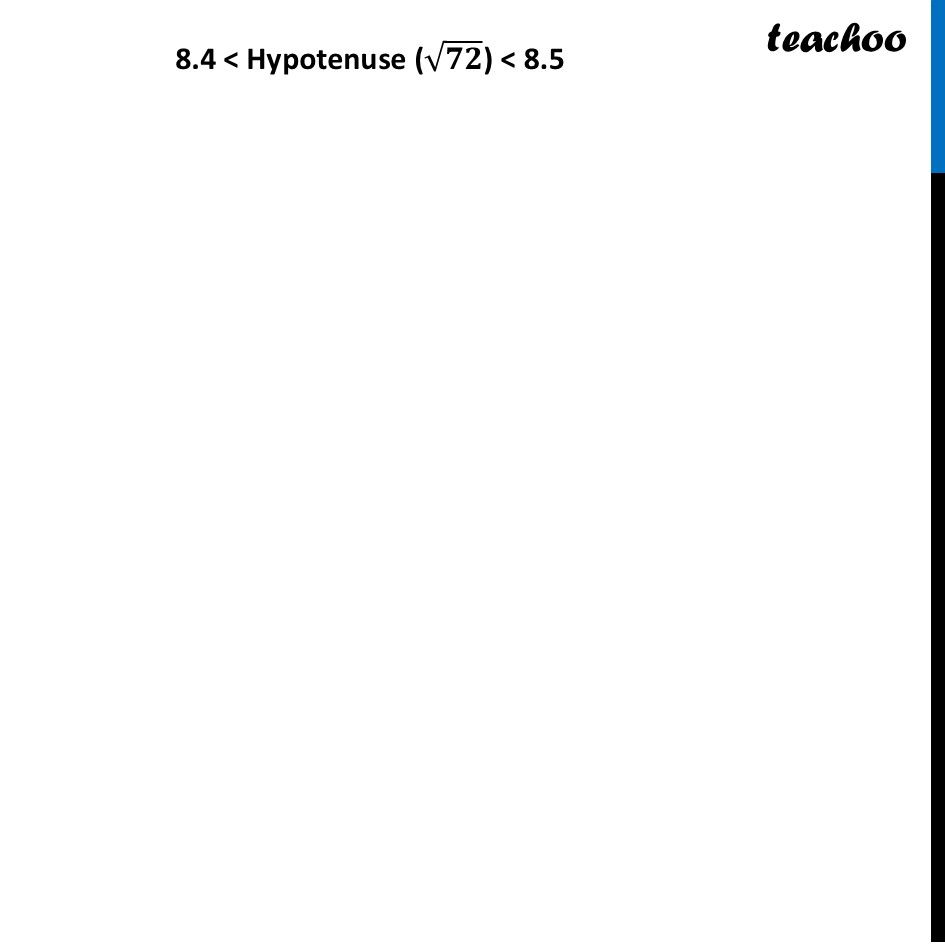
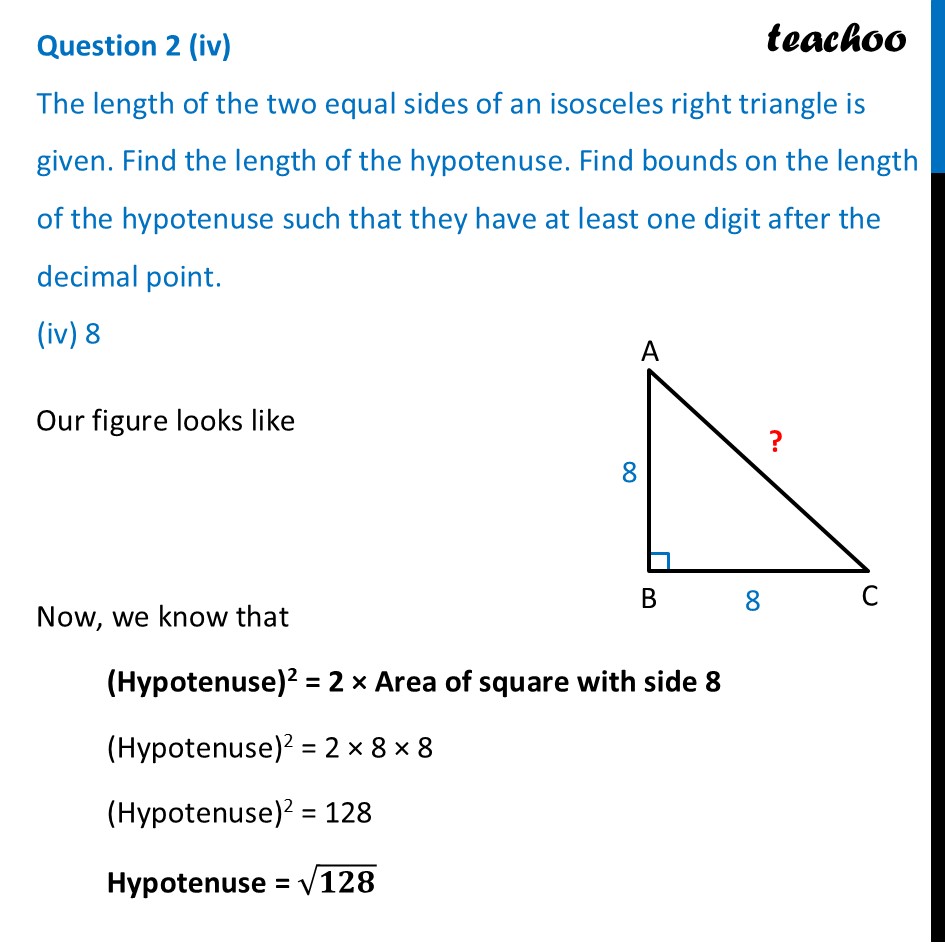
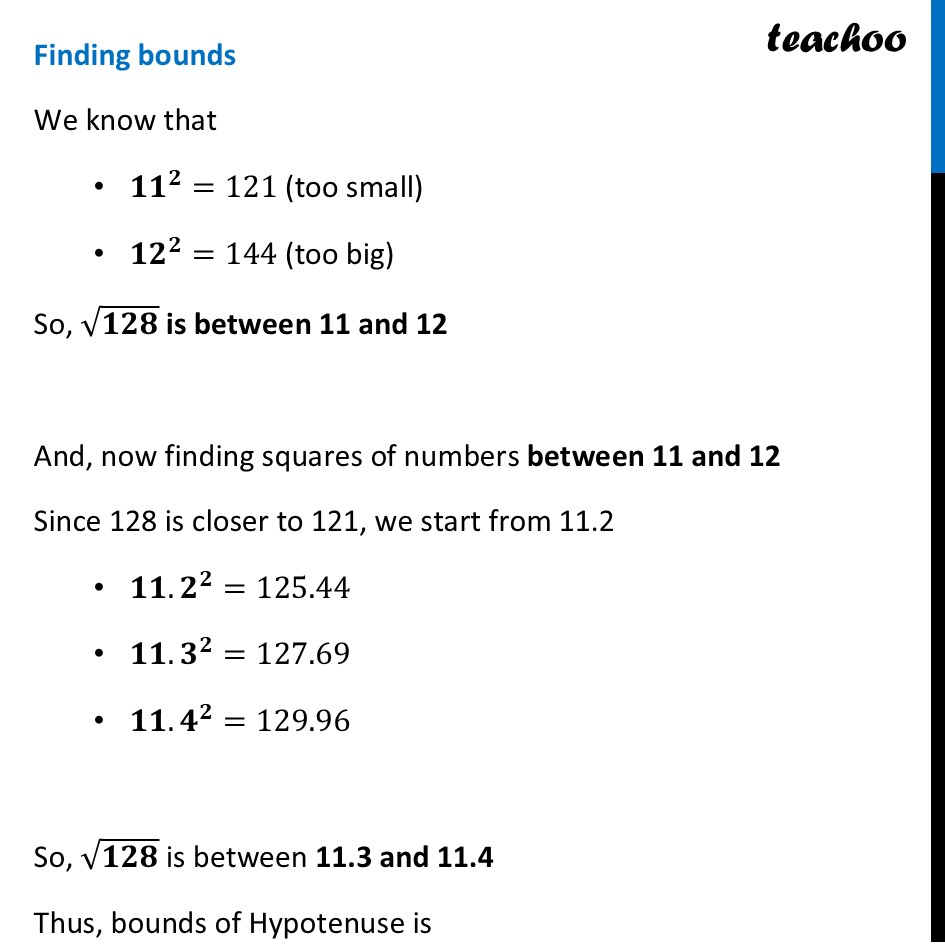
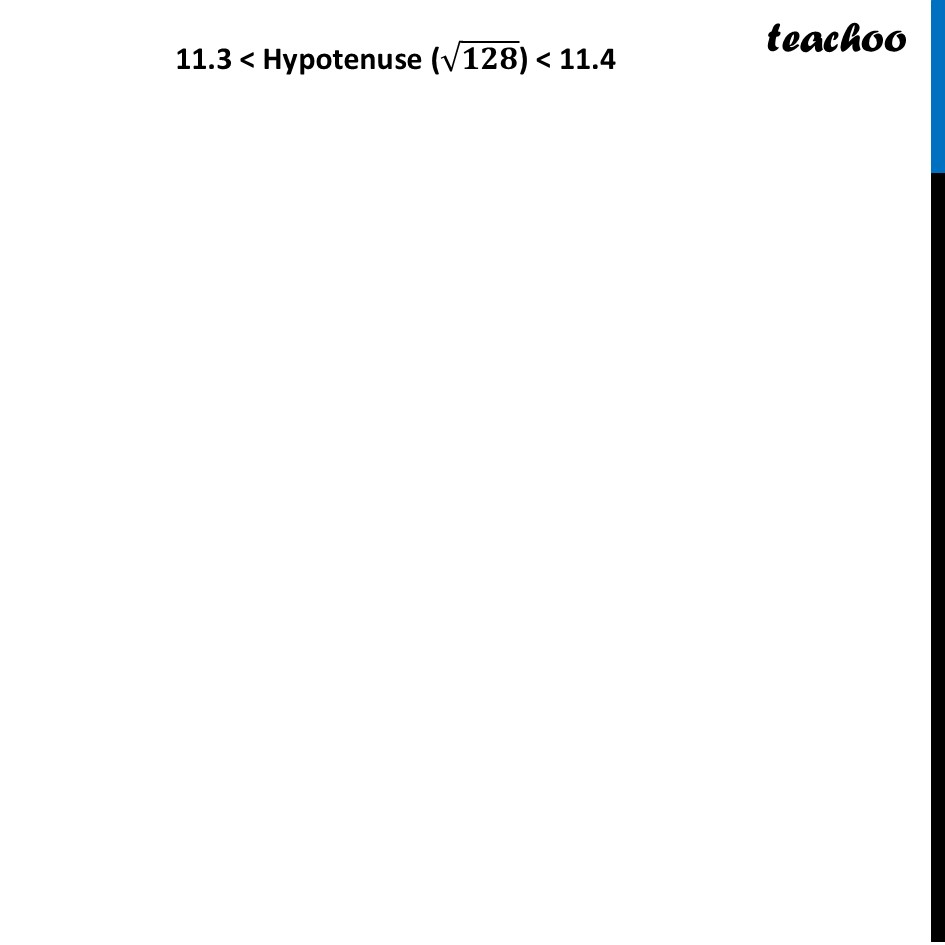
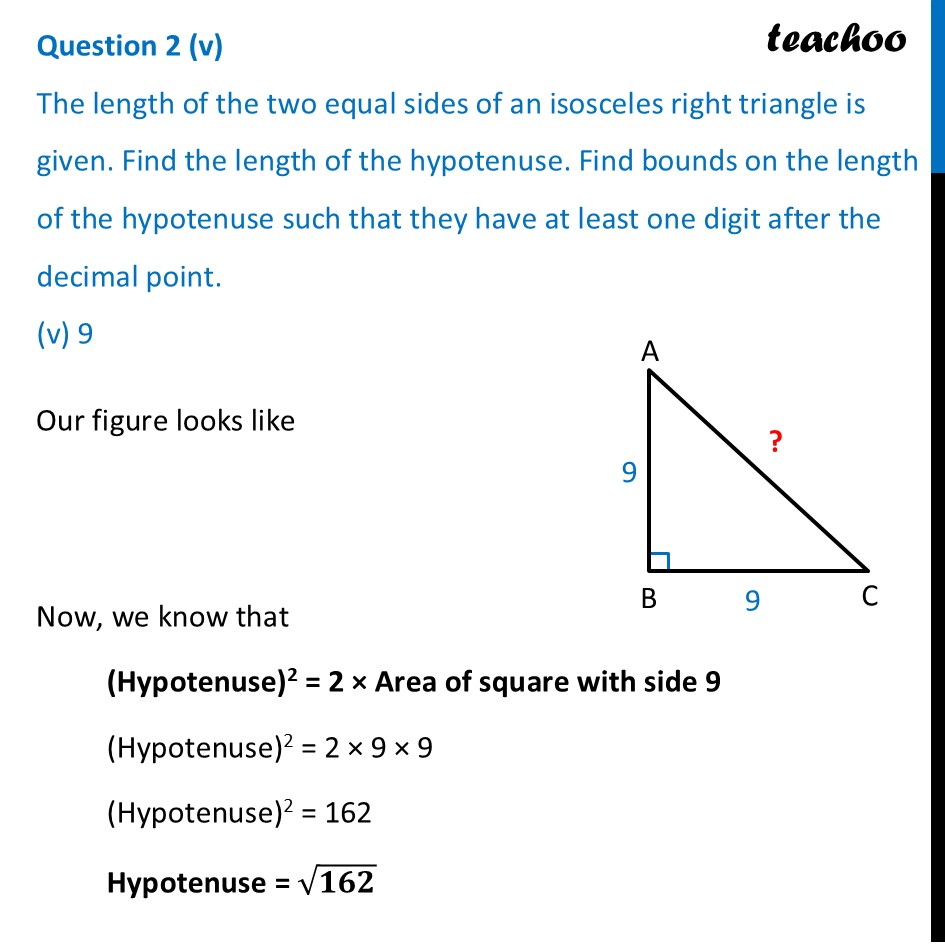
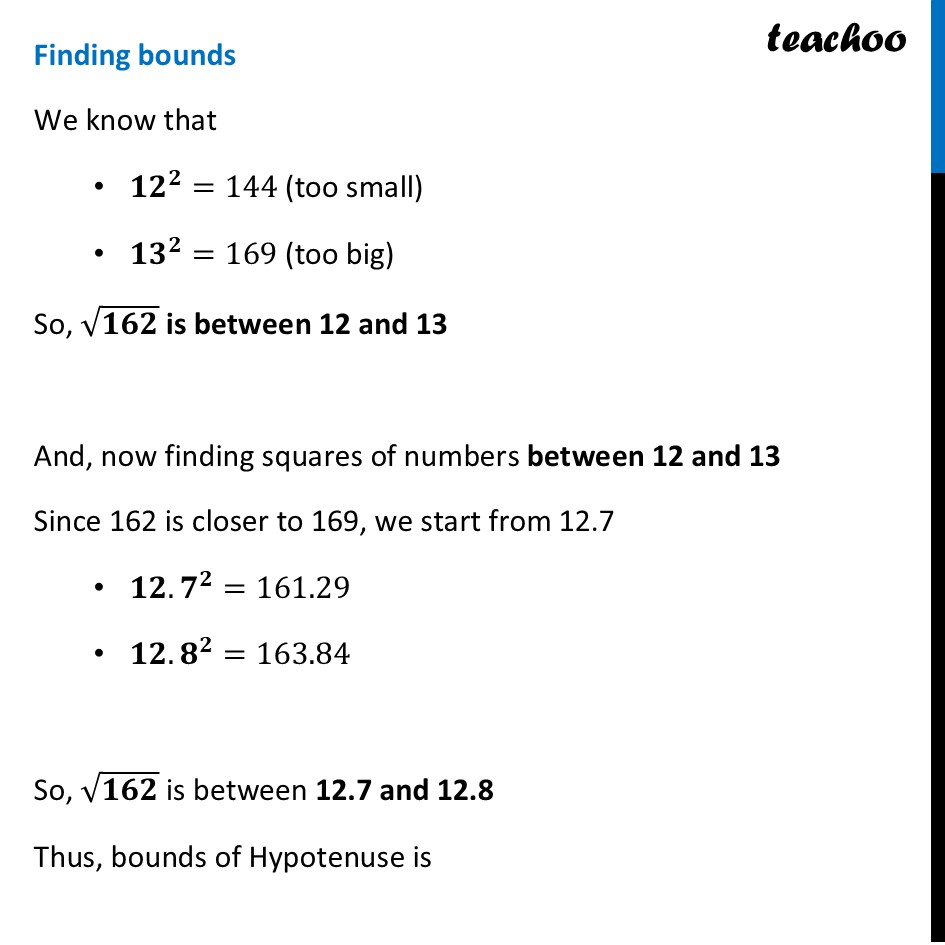
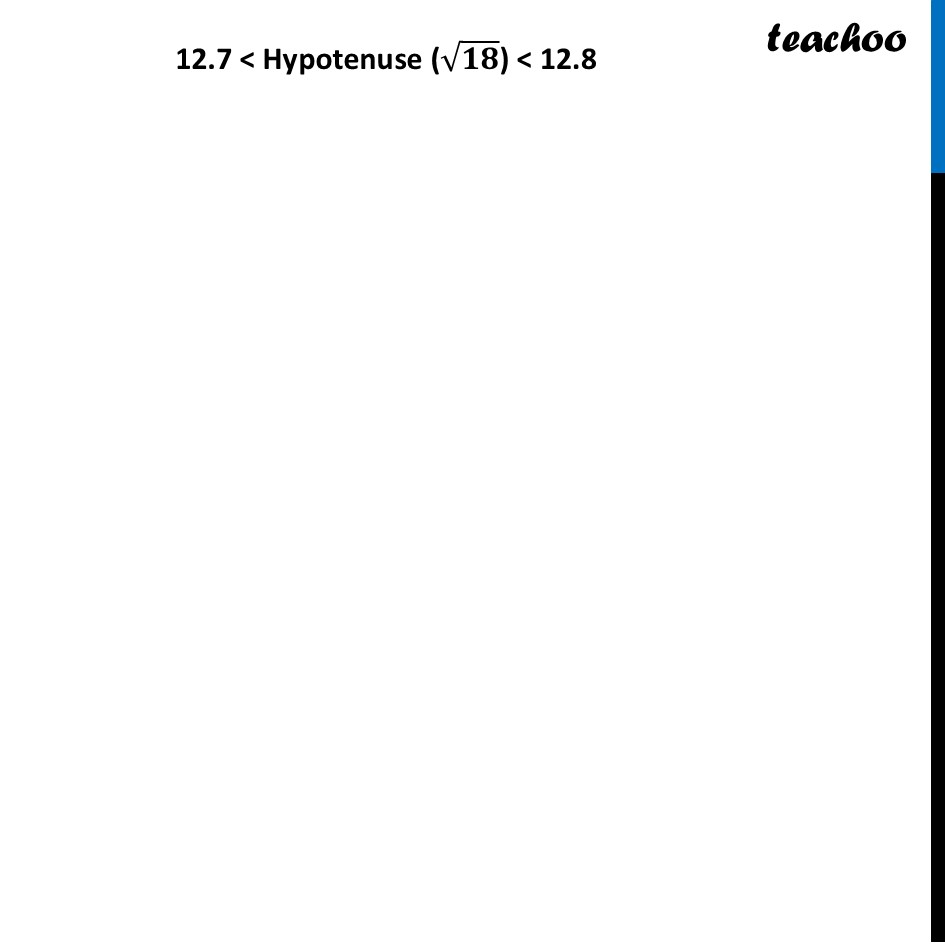
Figure it out - Page 39, 40
Figure it out - Page 39, 40
Last updated at February 20, 2026 by Teachoo
Transcript
Question 2 (i) The length of the two equal sides of an isosceles right triangle is given. Find the length of the hypotenuse. Find bounds on the length of the hypotenuse such that they have at least one digit after the decimal point. (i) 3 Our figure looks like Now, we know that (Hypotenuse)2 = 2 × Area of square with side 3 (Hypotenuse)2 = 2 × 3 × 3 (Hypotenuse)2 = 18 Hypotenuse = √𝟏𝟖 Finding bounds We know that 𝟒^𝟐=16 (too small) 𝟓^𝟐=25 (too big) So, √𝟏𝟖 is between 4 and 5 And, now finding squares of numbers between 4 and 5, Since 18 is closer to 16, we start from 4.1 〖𝟒.𝟏〗^𝟐=16.81 〖𝟒.𝟐〗^𝟐=17.64 〖𝟒.𝟑〗^𝟐=18.49 So, √𝟏𝟖 is between 4.2 and 4.3 Thus, bounds of Hypotenuse is 4.2 < Hypotenuse (√𝟏𝟖) < 4.3 Question 2 (ii) The length of the two equal sides of an isosceles right triangle is given. Find the length of the hypotenuse. Find bounds on the length of the hypotenuse such that they have at least one digit after the decimal point. (ii) 4 Our figure looks like Now, we know that (Hypotenuse)2 = 2 × Area of square with side 4 (Hypotenuse)2 = 2 × 4 × 4 (Hypotenuse)2 = 32 Hypotenuse = √𝟑𝟐 Finding bounds We know that 𝟓^𝟐=25 (too small) 𝟔^𝟐=36 (too big) So, √𝟑𝟐 is between 5 and 6 And, now finding squares of numbers between 5 and 6, Since 32 is in middle of 25 and 36, we start from 5.5, 〖𝟓.𝟓〗^𝟐=30.25 〖𝟓.𝟔〗^𝟐=31.36 〖𝟓.𝟕〗^𝟐=32.49 So, √𝟑𝟐 is between 5.6 and 5.7 Thus, bounds of Hypotenuse is Question 2 (iii) The length of the two equal sides of an isosceles right triangle is given. Find the length of the hypotenuse. Find bounds on the length of the hypotenuse such that they have at least one digit after the decimal point. (iii) 6Our figure looks like Now, we know that (Hypotenuse)2 = 2 × Area of square with side 6 (Hypotenuse)2 = 2 × 6 × 6 (Hypotenuse)2 = 72 Hypotenuse = √𝟕𝟐 Finding bounds We know that 𝟖^𝟐=64 (too small) 𝟗^𝟐=81 (too big) So, √𝟕𝟐 is between 8 and 9 And, now finding squares of numbers between 8 and 9 Since 72 is closer to 64 – but not really, we start from 8.3 〖𝟖.𝟑〗^𝟐=68.89 〖𝟖.𝟒〗^𝟐=70.56 〖𝟖.𝟓〗^𝟐=72.25 So, √𝟕𝟐 is between 8.4 and 8.5 Thus, bounds of Hypotenuse is 8.4 < Hypotenuse (√𝟕𝟐) < 8.5 Question 2 (iv) The length of the two equal sides of an isosceles right triangle is given. Find the length of the hypotenuse. Find bounds on the length of the hypotenuse such that they have at least one digit after the decimal point. (iv) 8Our figure looks like Now, we know that (Hypotenuse)2 = 2 × Area of square with side 8 (Hypotenuse)2 = 2 × 8 × 8 (Hypotenuse)2 = 128 Hypotenuse = √𝟏𝟐𝟖 Finding bounds We know that 〖𝟏𝟏〗^𝟐=121 (too small) 〖𝟏𝟐〗^𝟐=144 (too big) So, √𝟏𝟐𝟖 is between 11 and 12 And, now finding squares of numbers between 11 and 12 Since 128 is closer to 121, we start from 11.2 〖𝟏𝟏.𝟐〗^𝟐=125.44 〖𝟏𝟏.𝟑〗^𝟐=127.69 〖𝟏𝟏.𝟒〗^𝟐=129.96 So, √𝟏𝟐𝟖 is between 11.3 and 11.4 Thus, bounds of Hypotenuse is 11.3 < Hypotenuse (√𝟏𝟐𝟖) < 11.4 Question 2 (v) The length of the two equal sides of an isosceles right triangle is given. Find the length of the hypotenuse. Find bounds on the length of the hypotenuse such that they have at least one digit after the decimal point. (v) 9Our figure looks like Now, we know that (Hypotenuse)2 = 2 × Area of square with side 9 (Hypotenuse)2 = 2 × 9 × 9 (Hypotenuse)2 = 162 Hypotenuse = √𝟏𝟔𝟐 Finding bounds We know that 〖𝟏𝟐〗^𝟐=144 (too small) 〖𝟏𝟑〗^𝟐=169 (too big) So, √𝟏𝟔𝟐 is between 12 and 13 And, now finding squares of numbers between 12 and 13 Since 162 is closer to 169, we start from 12.7 〖𝟏𝟐.𝟕〗^𝟐=161.29 〖𝟏𝟐.𝟖〗^𝟐=163.84 So, √𝟏𝟔𝟐 is between 12.7 and 12.8 Thus, bounds of Hypotenuse is 12.7 < Hypotenuse (√𝟏𝟖) < 12.8
