
 You are here
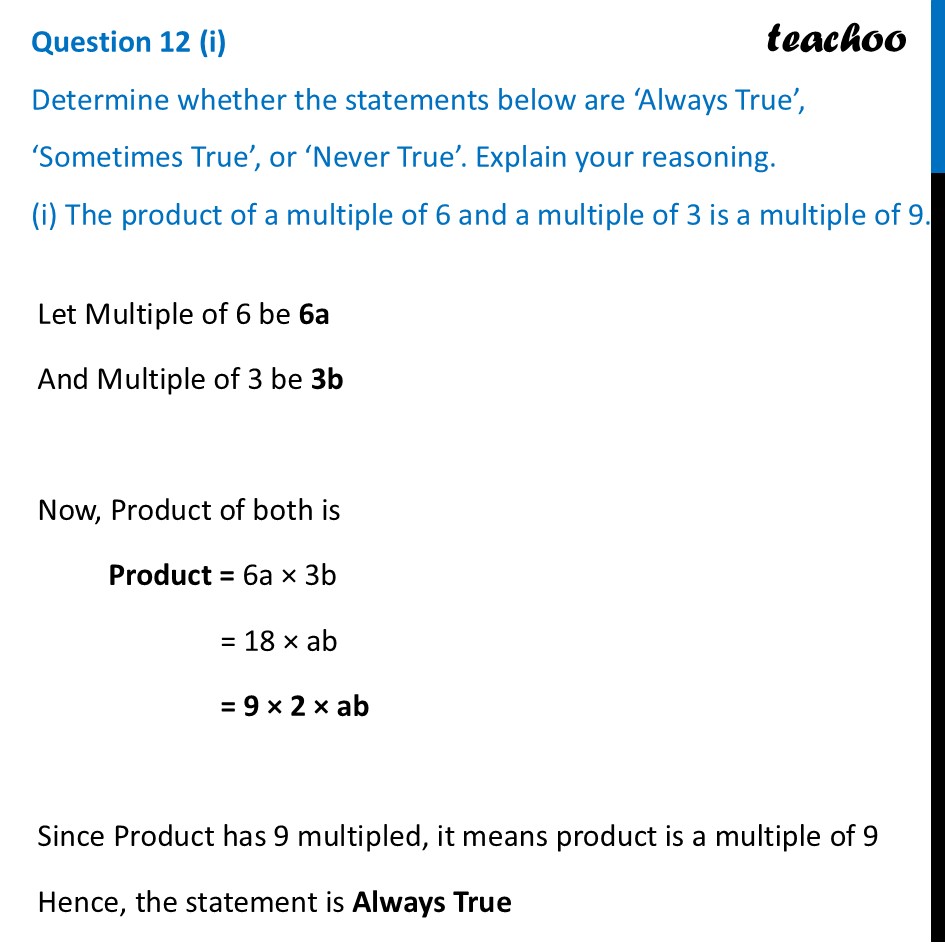
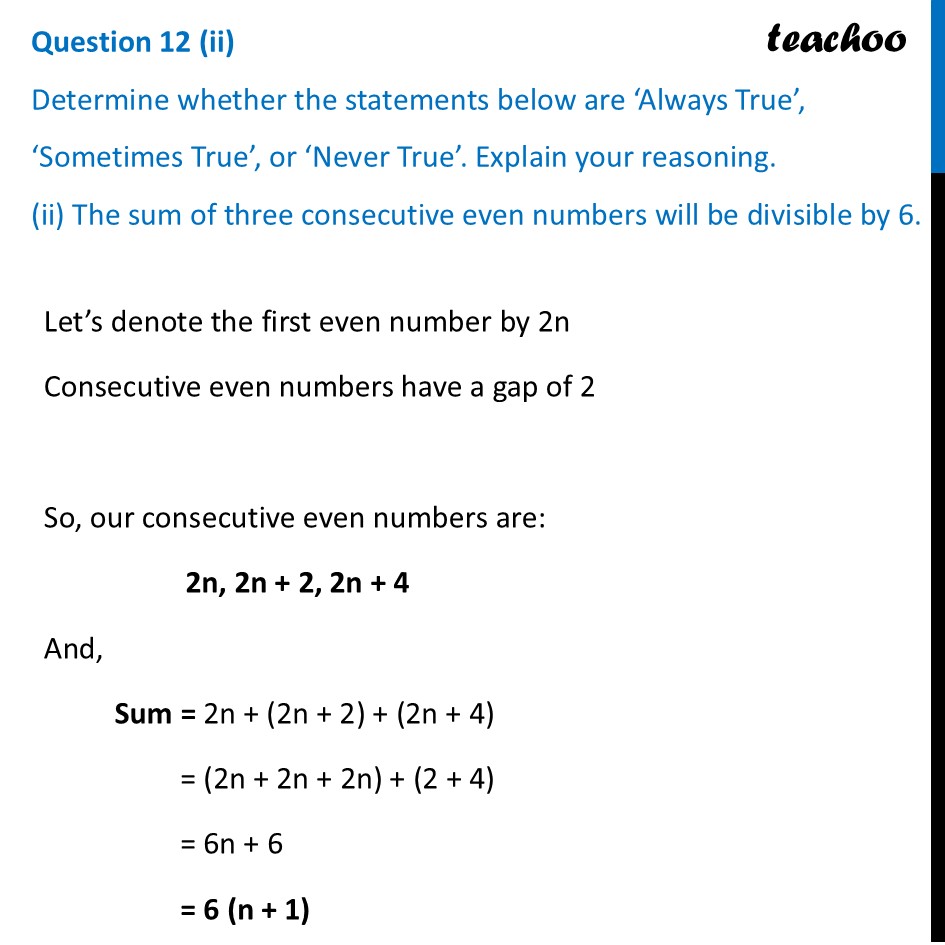
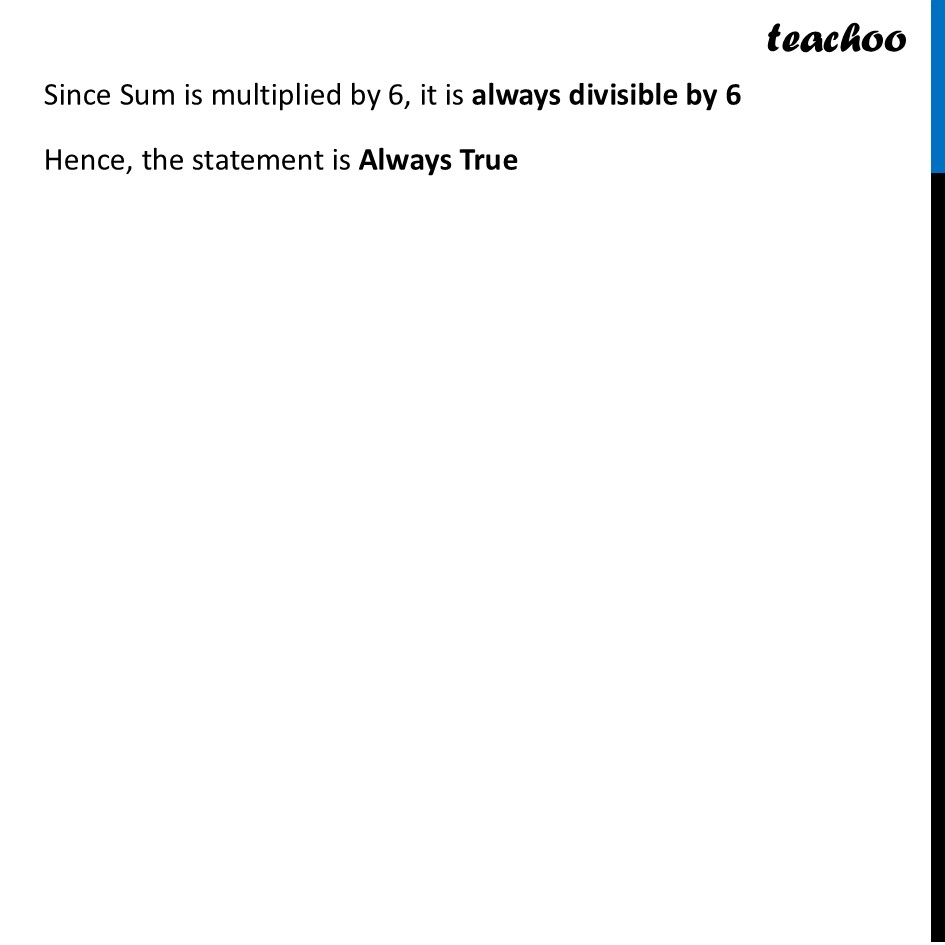
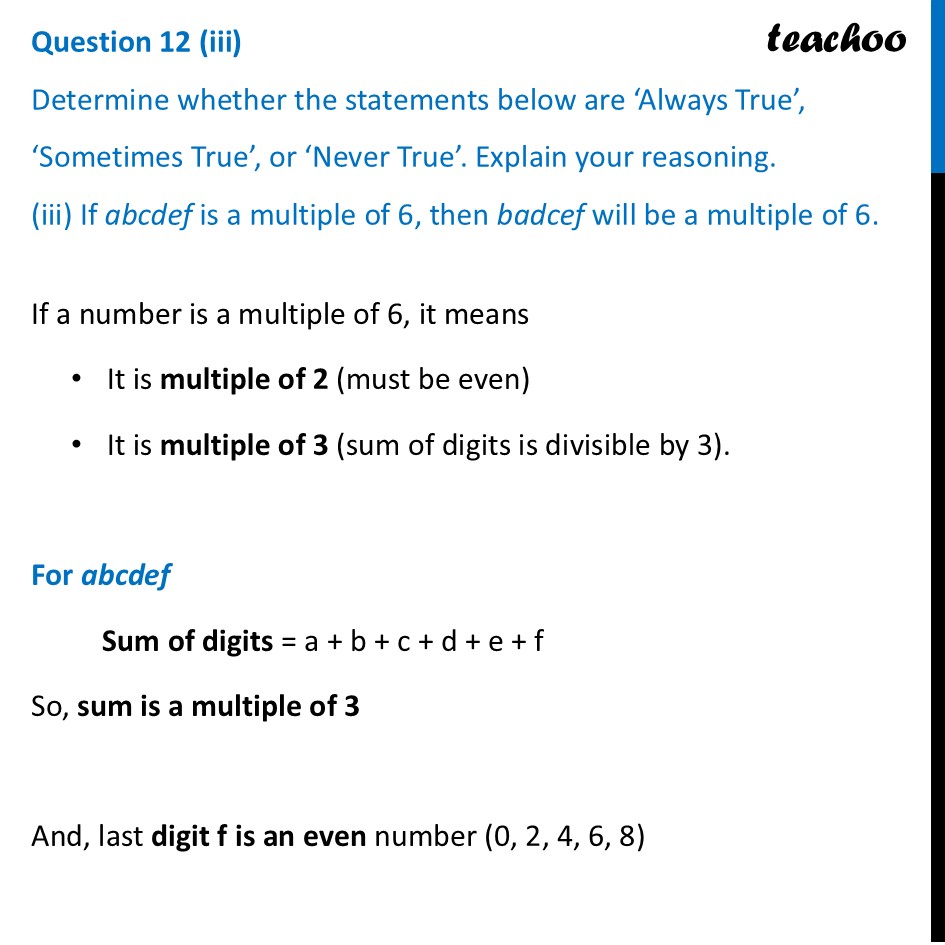
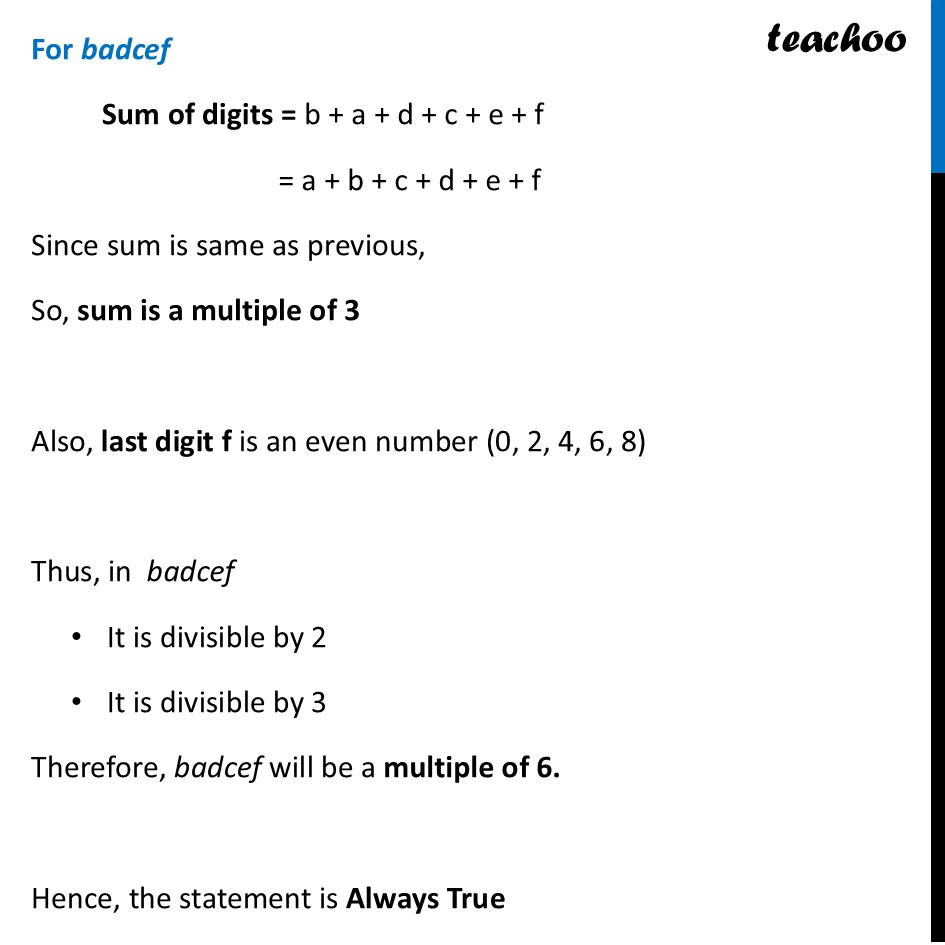

Figure it out - Page 132, 133, 134
Figure it out - Page 132, 133, 134
Last updated at January 8, 2026 by Teachoo
Transcript
Question 12 (i) Determine whether the statements below are ‘Always True’, ‘Sometimes True’, or ‘Never True’. Explain your reasoning. (i) The product of a multiple of 6 and a multiple of 3 is a multiple of 9.Let Multiple of 6 be 6a And Multiple of 3 be 3b Now, Product of both is Product = 6a × 3b = 18 × ab = 9 × 2 × ab Since Product has 9 multipled, it means product is a multiple of 9 Hence, the statement is Always True Question 12 (ii) Determine whether the statements below are ‘Always True’, ‘Sometimes True’, or ‘Never True’. Explain your reasoning. (ii) The sum of three consecutive even numbers will be divisible by 6.Let’s denote the first even number by 2n Consecutive even numbers have a gap of 2 So, our consecutive even numbers are: 2n, 2n + 2, 2n + 4 And, Sum = 2n + (2n + 2) + (2n + 4) = (2n + 2n + 2n) + (2 + 4) = 6n + 6 = 6 (n + 1) Since Sum is multiplied by 6, it is always divisible by 6 Hence, the statement is Always True Question 12 (iii) Determine whether the statements below are ‘Always True’, ‘Sometimes True’, or ‘Never True’. Explain your reasoning. (iii) If abcdef is a multiple of 6, then badcef will be a multiple of 6.If a number is a multiple of 6, it means It is multiple of 2 (must be even) It is multiple of 3 (sum of digits is divisible by 3). For abcdef Sum of digits = a + b + c + d + e + f So, sum is a multiple of 3 And, last digit f is an even number (0, 2, 4, 6, 8) For badcef Sum of digits = b + a + d + c + e + f = a + b + c + d + e + f Since sum is same as previous, So, sum is a multiple of 3 Also, last digit f is an even number (0, 2, 4, 6, 8) Thus, in badcef It is divisible by 2 It is divisible by 3 Therefore, badcef will be a multiple of 6. Hence, the statement is Always True Question 12 (iv) Determine whether the statements below are ‘Always True’, ‘Sometimes True’, or ‘Never True’. Explain your reasoning. (iv) 8 (7b – 3) – 4 (11b + 1) is a multiple of 12.Simplifying 8 (7b – 3) – 4 (11b + 1) = 56b – 24 – 44b – 4 = (56b – 44b) – (24 + 4) = 12b – 28 Now, in 12b – 28 We cannot take 12 common So, it is not a multiple of 12 Hence, the statement is Never True
