 You are here

![[Number Play] Sum of Consecutive Numbers - Class 8 Ganita Prakash - Sum of Consecutive Numbers](https://cdn.teachoo.com/415402a2-db96-4e94-899b-6a84fb8b723b/slide3.jpg)

Sum of Consecutive Numbers
Last updated at January 7, 2026 by Teachoo
Transcript
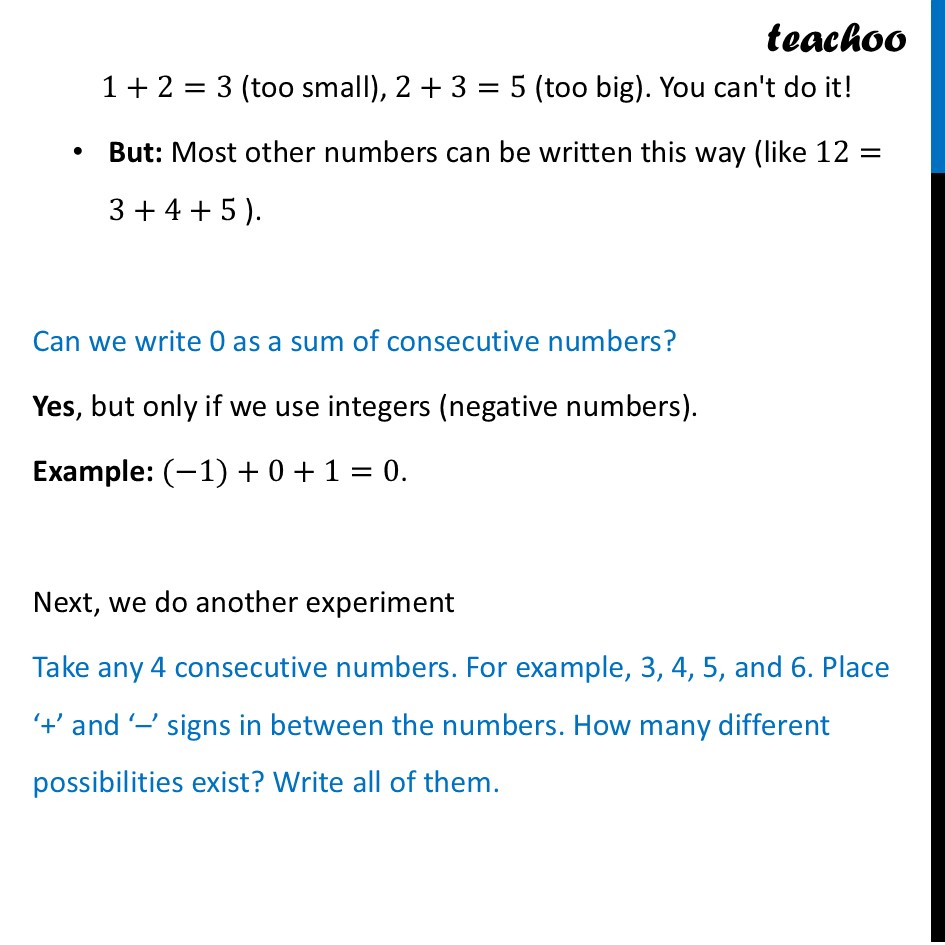
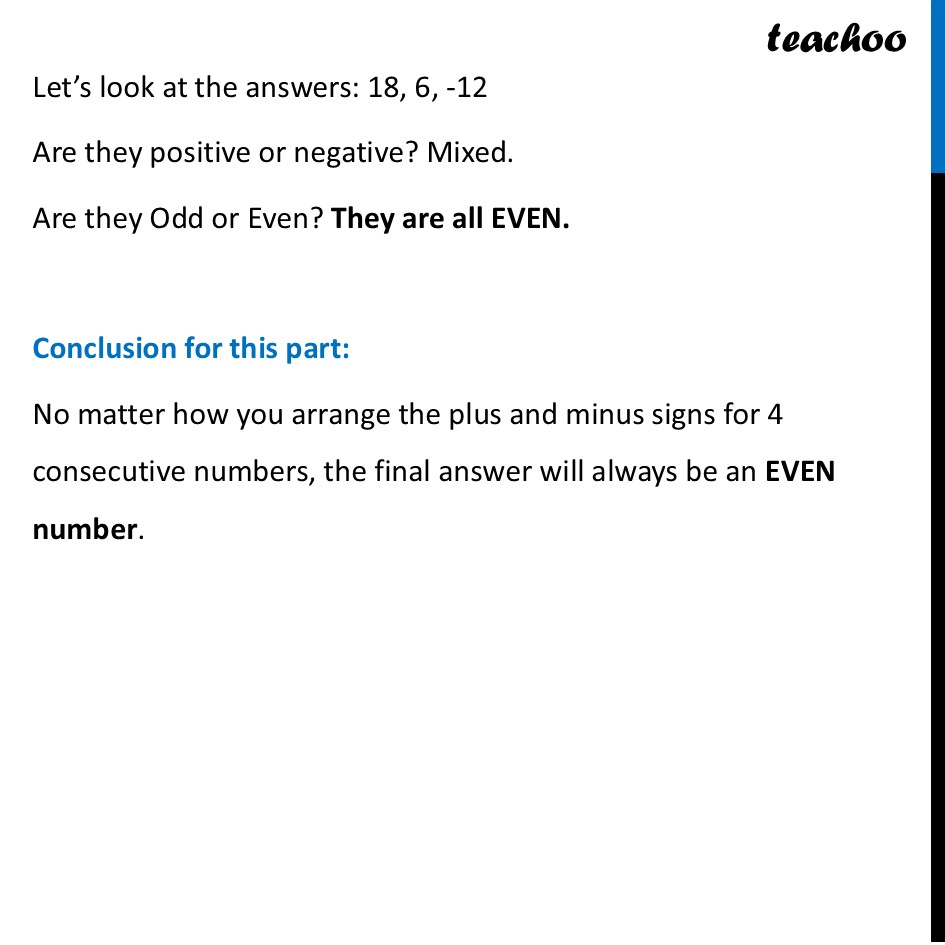
Sum of Consecutive NumbersAnshu is exploring sums of consecutive numbers. He has written the following – Now, he is wondering Can I write every natural number as a sum of consecutive numbers? No, not every number. The "powers of 2" (like 2, 4, 8, 16, 32...) cannot be written as the sum of consecutive natural numbers. Try it: Can you write 4 as a sum of consecutive numbers? 1+2=3 (too small), 2+3=5 (too big). You can't do it! But: Most other numbers can be written this way (like 12=3+4+5 ). Can we write 0 as a sum of consecutive numbers? Yes, but only if we use integers (negative numbers). Example: (−1)+0+1=0. Next, we do another experiment Take any 4 consecutive numbers. For example, 3, 4, 5, and 6. Place ‘+’ and ‘–’ signs in between the numbers. How many different possibilities exist? Write all of them. All the possibilities would look like Let’s look at the answers: 18, 6, -12 Are they positive or negative? Mixed. Are they Odd or Even? They are all EVEN. Conclusion for this part: No matter how you arrange the plus and minus signs for 4 consecutive numbers, the final answer will always be an EVEN number.
