 You are here




Pairs to Make Fours
Last updated at January 7, 2026 by Teachoo
Transcript
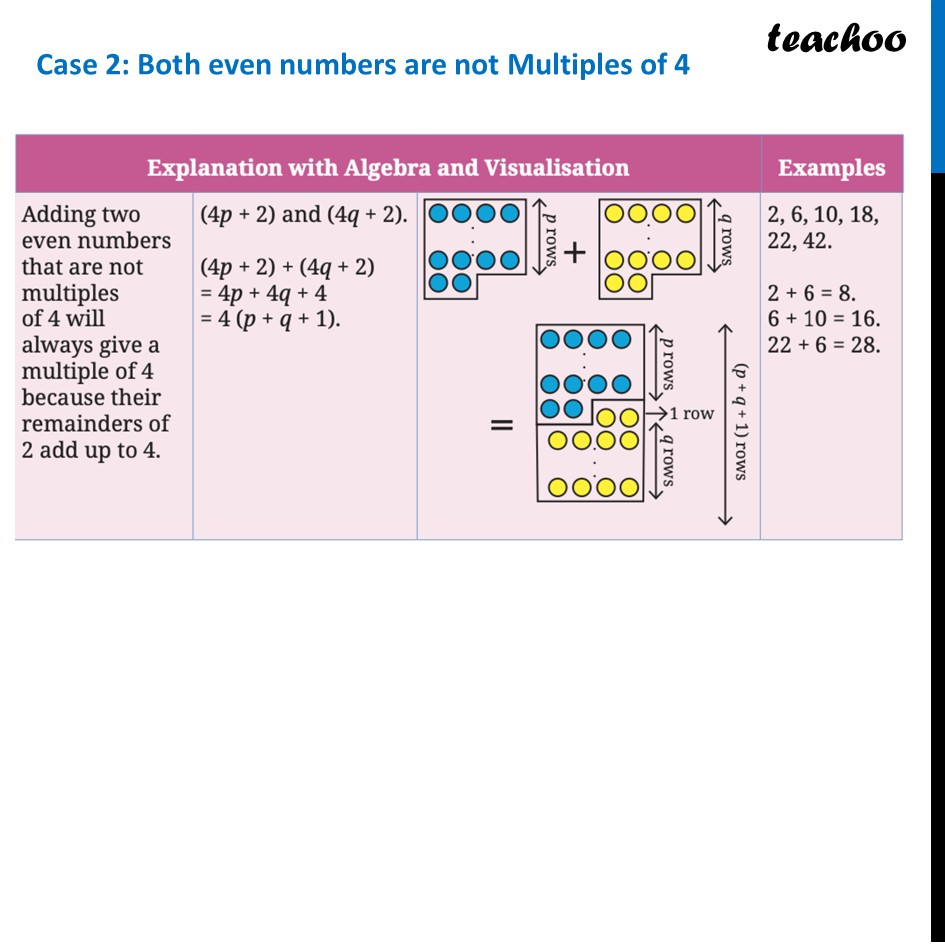
Pairs to Make FoursWe have to answer the question: When you add two even numbers, is the sum divisible by 4? There are two types of even numbers: Type A: Multiples of 4 (e.g., 4, 8, 12). They have 0 remainder when divided by 4. Type B: Even numbers that are NOT multiples of 4 (e.g., 2, 6, 10). They have a remainder of 2 when divided by 4. So, we have 3 cases Case 1: Adding two even numbers which are multiples of four (both Type A) Case 2: Adding two even numbers which are not multiples of four (both Type B) Case 3: Adding two even numbers, one is Multiple of 4 and another is not a multiple of 4 (Type A + Type B) Explanation with Algebra and Visualisation Examples Adding two (even) numbers that are multiples of 4 will always give a multiple of 4 . Explanation with Algebra and Visualisation Examples Adding two (even) numbers that are multiples of 4 will always give a multiple of 4 . Case 2: Both even numbers are not Multiples of 4 Explanation with Algebra and Visualisation Examples Adding two even numbers that are not multiples of 4 will always give a multiple of 4 because their remainders of 8 add up to 4 . Case 3: One even number which is not Multiple of 4 and another number which is a multiple of 4 When we add a multiple of 4 (4p) to an even number that is not a multiple of 4 (4q + 2), the result is never divisible by 4. The first part (4p) is divisible, but the second part (4q+2) leaves a remainder of 2. Therefore, the total sum will always have a remainder of 2. Examples: 4 + 6 = 10 (4 is a multiple; 6 is not. 10 is not divisible by 4). 8 + 10 = 18 (8 is a multiple; 10 is not. 18 is not divisible by 4). 12 + 2 = 14 (12 is a multiple; 2 is not. 14 is not divisible by 4).
