You are here
Do triangles always exist?
Last updated at November 7, 2025 by Teachoo
Transcript
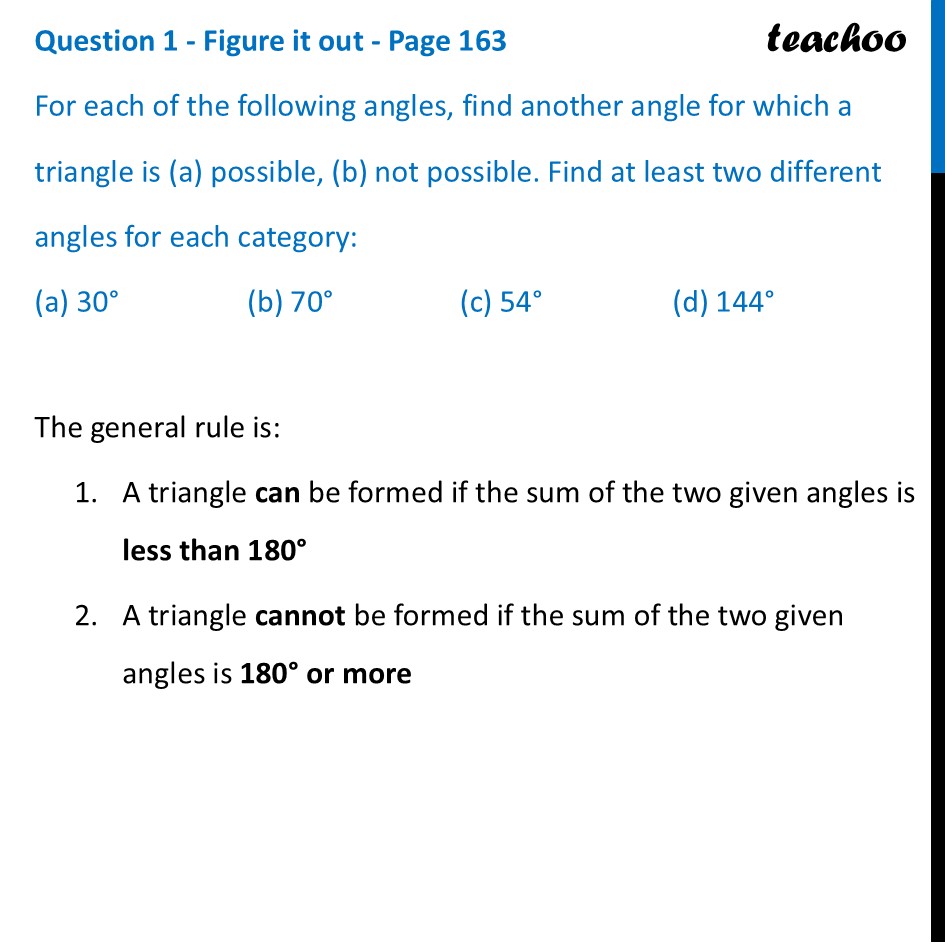
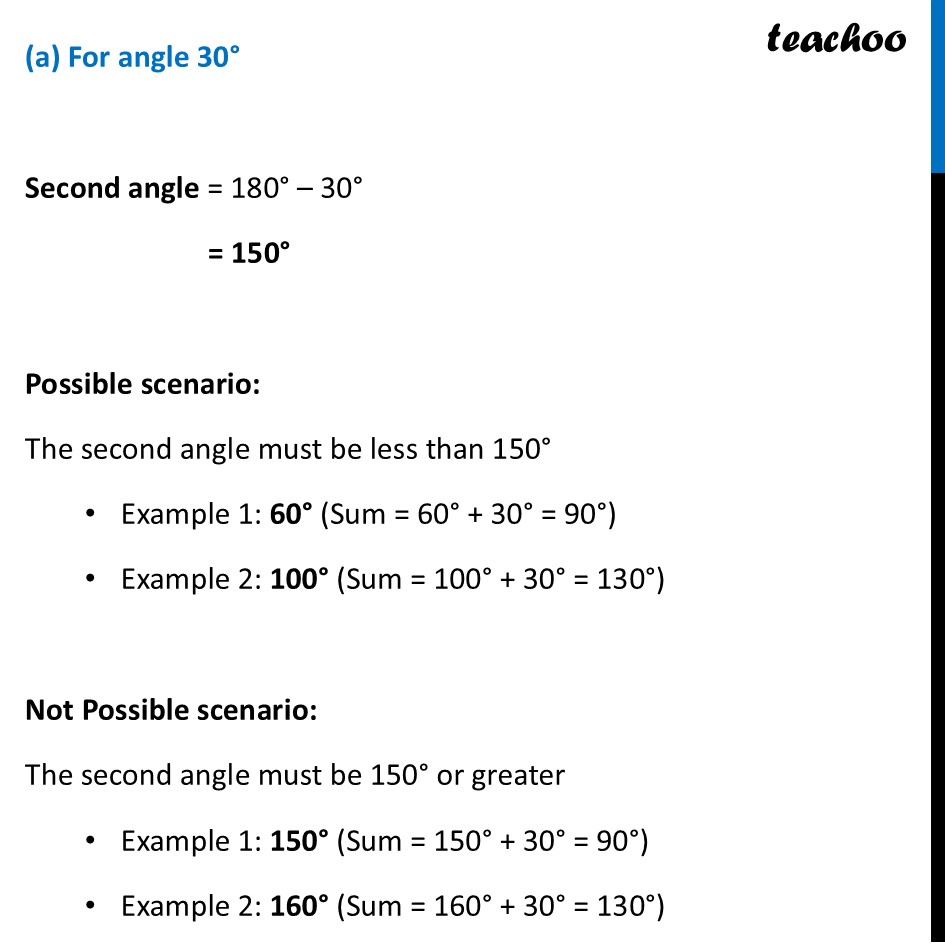
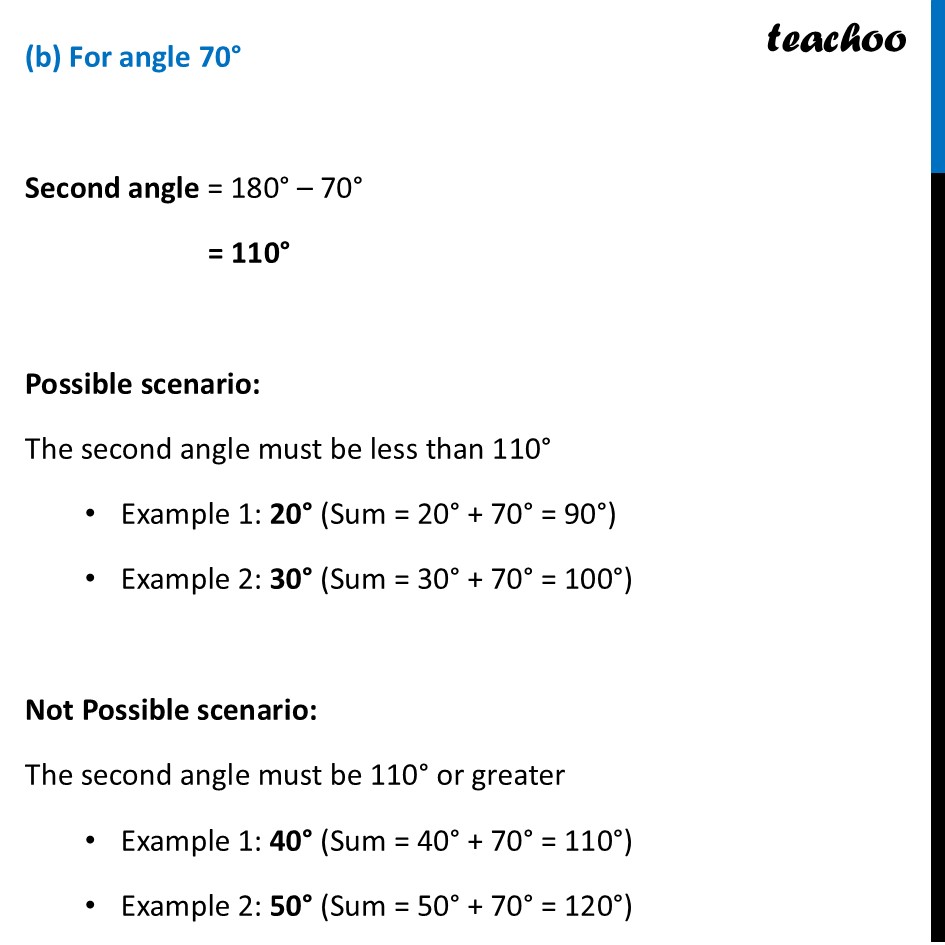
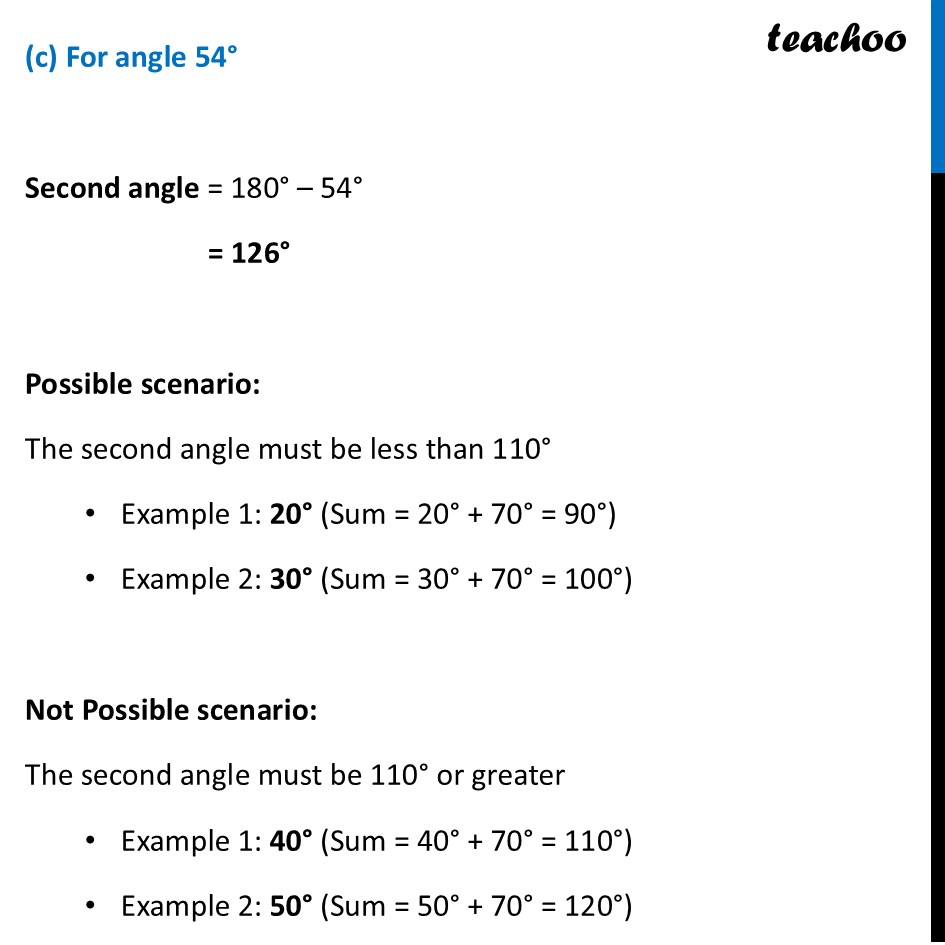
Question 1 - Figure it out - Page 163 For each of the following angles, find another angle for which a triangle is (a) possible, (b) not possible. Find at least two different angles for each category: (a) 30° (b) 70° (c) 54° (d) 144° The general rule is: A triangle can be formed if the sum of the two given angles is less than 180° A triangle cannot be formed if the sum of the two given angles is 180° or more (a) For angle 30° Second angle = 180° – 30° = 150° Possible scenario: The second angle must be less than 150° Example 1: 60° (Sum = 60° + 30° = 90°) Example 2: 100° (Sum = 100° + 30° = 130°) Not Possible scenario: The second angle must be 150° or greater Example 1: 150° (Sum = 150° + 30° = 90°) Example 2: 160° (Sum = 160° + 30° = 130°) (b) For angle 70° Second angle = 180° – 70° = 110° Possible scenario: The second angle must be less than 110° Example 1: 20° (Sum = 20° + 70° = 90°) Example 2: 30° (Sum = 30° + 70° = 100°) Not Possible scenario: The second angle must be 110° or greater Example 1: 40° (Sum = 40° + 70° = 110°) Example 2: 50° (Sum = 50° + 70° = 120°) (c) For angle 54° Second angle = 180° – 54° = 126° Possible scenario: The second angle must be less than 110° Example 1: 20° (Sum = 20° + 70° = 90°) Example 2: 30° (Sum = 30° + 70° = 100°) Not Possible scenario: The second angle must be 110° or greater Example 1: 40° (Sum = 40° + 70° = 110°) Example 2: 50° (Sum = 50° + 70° = 120°)